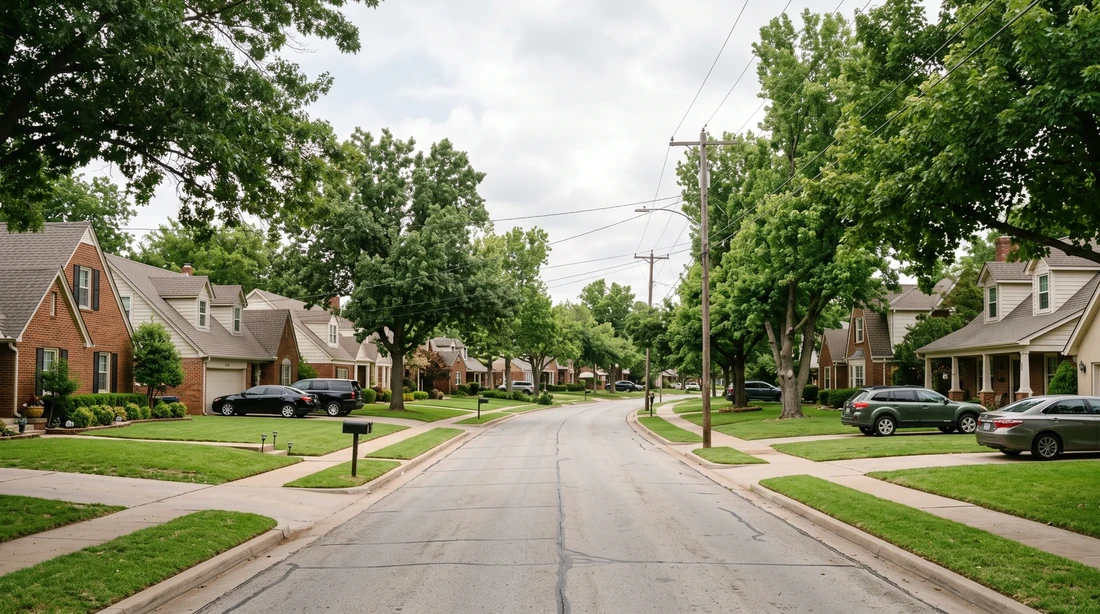
The extended stay hotel vs Airbnb question in Oklahoma City comes down to space per dollar. A 30-night economy extended-stay suite runs roughly $2,900 all-in for about 300 square feet. A whole furnished home delivers five to six times the space, a full kitchen, and private laundry, often at a lower per-person cost.
Key Takeaways
- A 30-night OKC economy extended-stay studio runs roughly $2,500 to $3,200 all-in for about 300 square feet.
- Cost per square foot: about $9.70 for a 300 sq ft suite versus roughly $2.50 for an 1,800 sq ft home.
- Hotel rooms hold about four guests, so fourteen people means five rooms, five bills and no shared living space.
- OKC hotel bills carry roughly 13 to 14% lodging and sales taxes; get after-30-night tax treatment in writing before booking.
This guide covers what 30 nights cost in an Oklahoma City extended stay hotel against a furnished apartment or whole home, how the fees differ between a marketplace listing and booking direct, how one family's trip prices out three ways, and when the hotel is still the right call.
You're booking for fourteen relatives, or staring down a month-long OKC assignment, and every "extended stay" search returns the same beige suite with a two-burner kitchenette. The choice feels like a coin flip. It isn't: the math splits hard one way once you count rooms, taxes, and square feet.
Whole furnished homes rent in monthly blocks, so one booking removes a house from the market for 30+ days. In OKC, April through June compresses inventory hardest: tornado-season insurance placements, the Memorial Marathon in late April, and the Women's College World Series in late May all pull from the same pool of homes.

Why Does the Extended Stay Hotel vs Airbnb Math Split After One Week?
An extended stay hotel prices one room per night; a furnished rental prices an entire property, and that single structural difference decides the winner in almost every Oklahoma City comparison past about seven nights or four guests.
Hotels scale by room, not by rate. A double-queen room realistically holds four people, and fire codes typically cap it there. So a group of six is a two-room booking, and fourteen is a five-room booking: five bills, five key cards, five doors on a corridor. A furnished home that sleeps 16 is one bill, one kitchen table, one living room.
What's inside the door differs just as much. An extended-stay "kitchen" is usually a two-burner cooktop, a compact fridge, and a microwave: rarely an oven, never a dishwasher you'd want to rely on for a crowd. Laundry is a shared coin machine down the hall. A furnished home comes with a full range and oven, a full-size refrigerator, a dishwasher, and a private washer and dryer, plus separate bedrooms, driveway parking, and in many OKC homes, a yard.
Then there's the metric almost nobody prints on a booking page: cost per square foot. A 300-square-foot suite at roughly $2,900 per month works out to about $9.70 per square foot; an 1,800-square-foot furnished home at around $4,500 per month works out to roughly $2.50. The same dollar buys close to four times the living space in a home.
One clarification before the numbers: "Airbnb" in this comparison really means "a furnished home": the platform is just one place to book it, and it adds its own fees on top. The same house is usually bookable directly from the operator for less, which we break down in the fee-math section below.
Context on who owns the booking platforms being compared:
In November 2015, Expedia bought HomeAway (which also owns VRBO and many other vacation rental brands) to compete with Airbnb .
Wikipedia: Vacation rental
What Do 30 Nights Cost in Oklahoma City?
A 30-night stay at an OKC economy extended-stay property typically lands between $2,500 and $3,200 once taxes are added, for a studio of roughly 300 square feet. Here's the full picture across the options people price:
| Option | Typical 30-night all-in | Approx. space | Kitchen & laundry |
|---|---|---|---|
| Economy extended-stay studio | ~$2,500 to $3,200 | ~300 sq ft | Two-burner kitchenette; shared coin laundry |
| Mid-tier extended-stay suite | ~$3,700 to $4,900 | ~350 to 450 sq ft | Kitchenette; shared laundry |
| Two hotel rooms (5+ guests) | ~$5,800 to $9,200 | ~600 sq ft, split by a hallway | Two kitchenettes; shared laundry |
| Furnished 3-bedroom home (BnB OKC) | From-rates start at $165/night; monthly rates on 30+ night stays bring the effective cost lower; call for a quote | ~1,500 to 2,000 sq ft plus yard | Full kitchen; private washer/dryer |
A note on taxes, because they move real money: OKC hotel bills typically carry combined lodging and sales taxes in the ballpark of 13 to 14%. Many properties stop collecting some of those taxes once a stay passes 30 consecutive nights, but policies vary by property, checking out mid-stay can reset the clock, and some hotels apply the exemption only when you commit to 30+ nights up front. Always get the after-30-nights tax treatment in writing before you book a month.
Two billing mechanics catch first-time monthly bookers. First, the rate ladder: extended-stay brands typically price in daily, weekly, and monthly tiers, and the advertised weekly number usually excludes tax and often requires the full block paid in advance. Extend past your prepaid block and the added nights frequently re-rate at the higher daily tier: the "cheap monthly rate" only holds if your dates never move.
Second, authorization holds. Hotels commonly authorize your card for room, tax, and incidentals up front; on a month-long folio that hold can tie up several thousand dollars of credit before a single charge posts. Furnished rentals typically work the opposite way: a refundable deposit or a flat damage waiver, then a payment schedule agreed in writing before check-in.
The sticker rate is also only the start of a month in a hotel. Here's how the uncounted costs typically stack, week by week:
- Nights 1 to 7: The suite feels workable. The breakfast bar covers mornings, the kitchenette handles simple meals, and housekeeping feels like a perk.
- Nights 8 to 14: Kitchenette fatigue sets in: no oven means more takeout, and dinner out for even a small household typically runs $40 to $80 a night. Coin laundry starts eating quarters and evenings.
- Nights 15 to 21: Space pressure builds. Work calls, homework, and sleep all share one room, and groups start pricing a second room, which doubles the nightly bill overnight.
- Nights 22 to 30: You've now paid furnished-home money for studio square footage, plus three-plus weeks of restaurant meals and laundry fees, and if you extend, the meter keeps running, often at a re-rated price.
Booking 30+ nights in OKC, or one roof for a whole group? BnB OKC prices monthly stays with a single all-in quote and answers same day. Check extended-stay availability or call/text (405) 870-2146.
Extended Stay Hotel, Furnished Apartment, or Whole Home: How Do They Compare?
There are three real products behind this search, and each one fits a different stay: the fastest way to choose is to know what disqualifies each.
Extended-stay hotels fit solo travelers and pairs on stays under about two weeks: nightly billing, no commitment, daily or weekly housekeeping. They're disqualified by group size (every four guests adds a room), serious cooking needs, and pets on long stays, where per-night pet fees compound.
Corporate furnished apartments fit one to three people on 1 to 6 month assignments. They typically carry 30-night minimums and apartment-style space: no yard, shared walls, and per-day billing that often lands between hotel and whole-home pricing.
Whole furnished homes fit groups, stays of 30+ nights, and anyone whose stay needs a real kitchen, private laundry, separate bedrooms, or a yard. They're disqualified by one- or two-night stays (minimum-stay rules and cleaning fees make short stays inefficient) and by travelers who want daily housekeeping.
For groups, the per-person math is where the decision usually gets made. One honest caveat first: hotel per-person estimates assume you pack four to a room, and real groups average closer to three once couples and kids' sleeping arrangements are set. These bands use realistic room counts at $95 to $150/night hotel rates, taxes included:
| Group size | Hotel rooms (realistic) | Hotel per-person | Whole home per-person |
|---|---|---|---|
| 4 | 2 rooms | ~$270 to $425 | ~$275 to $370 |
| 8 | 3 rooms | ~$200 to $320 | ~$220 to $280 |
| 12 | 4 rooms | ~$185 to $285 | ~$185 to $240 |
| 14 to 16 | 5 rooms | ~$190 to $305 | ~$180 to $230 |
Read the table honestly: at four people, it's roughly a wash on price, and the hotel can win if you'll squeeze into two rooms. From eight up, the home pulls ahead on cost, and it's not close on livability, because the hotel number buys zero shared space. The full group breakdown lives in our Airbnb vs hotel for groups guide, and OKC homes sleeping 10 to 16+ are collected at large group rentals in OKC.
Who Books a Month in Oklahoma City, and What Does Each Stay Need?
Four groups drive most of OKC's 30-night demand, traveling hospital staff, Tinker AFB travelers, project work crews, and displaced or relocating households, and each one breaks the extended-stay suite in a different way.
Traveling medical staff. Hospital contracts commonly run about 13 weeks, which is three back-to-back monthly blocks: long enough that kitchenette takeout and coin laundry become a real line item. Location does the heavy lifting here: BnB OKC's Capitol Manor sits directly across from OU Medical Center and OU Children's Hospital, which turns a commute into a walk and matters most after a night shift. Separate bedrooms also mean blackout sleep in one room while life continues in the rest of the house.
Tinker AFB and per-diem travelers. Tinker sits southeast of the city, and TDY stays are typically reimbursed against the federal lodging rate. The comparison that matters is your GSA lodging allowance × 30 versus one monthly furnished quote: a whole home at a monthly rate often fits inside the same allowance a mid-tier suite consumes, with a kitchen that stops the meals-and-incidentals portion from evaporating into restaurants.
Project and construction crews. A five-person crew is a two-to-three-room hotel booking with nowhere to park a work truck and trailer: hotel garages have clearance limits and corridor lots fill overnight. A furnished home offers driveway parking, one address for the whole crew, separate bedrooms instead of forced room-sharing, and a full kitchen that keeps per diem in pockets instead of drive-thrus.
Displaced and relocating households. Closing-date gaps commonly run 30 to 60 days, and insurance displacements after a fire or storm run months: both need a place that functions as a household, not a room. If a claim is paying, the furnished-home question runs through your adjuster; the mechanics live at insurance housing. Either way, ask about extensions up front: rebuild timelines and closings both slip.
What Does a Marketplace Listing Cost Compared With Booking Direct?
The same furnished home can cost hundreds of dollars more depending on where you book it, because marketplace guest service fees typically add a double-digit percentage on top of the subtotal. Here's a hypothetical 5-night reunion booking, same house, two checkout pages:
| Line item | Marketplace booking | Direct with BnB OKC |
|---|---|---|
| Nightly rate × 5 | $475 × 5 = $2,375 | $445 × 5 = $2,225 |
| Cleaning fee | $325 | $325 |
| Guest service fee | ~$378 (typically ~14%) | $0 |
| Taxes | ~$390 | ~$350 |
| Total | ~$3,470 | ~$2,900 |
| Per person (14 guests) | ~$248 | ~$207 |
Two things drive the gap. Marketplaces add a guest service fee you can't remove, and many hosts list slightly higher nightly rates there to offset the platform's host-side commission. Booking direct removes both layers: BnB OKC's direct rates save up to 35% on stays of 4+ nights. The mechanics are covered in detail in book direct vs Airbnb, and if you're comparing platforms against each other, Airbnb vs Vrbo fees maps who charges what. When you're ready, book direct quotes are one call.
What Does One Family's Trip Cost in Three Versions?
Say you're organizing a family reunion for fourteen in Oklahoma City. All three versions below are hypothetical, with the arithmetic shown so you can swap in your own numbers.
Version one: fourteen people, five nights
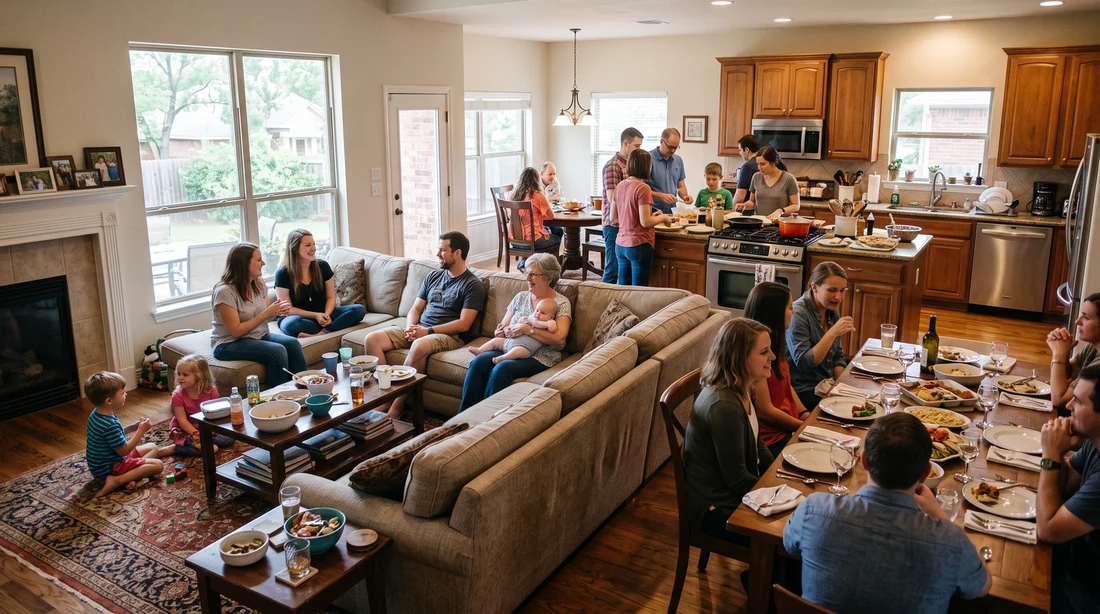
The furnished-home math. A home that sleeps 16, booked direct at $445/night: $445 × 5 nights = $2,225. Add a $325 cleaning fee and roughly $350 in taxes, and the trip totals about $2,900: roughly $207 per person for the whole five nights, with a full kitchen, private laundry, and one living room everyone fits in.
The hotel math. Fourteen people need five double-queen rooms. At a mid-range $132/night: 5 rooms × $132 × 5 nights = $3,300, plus ~13.5% tax ≈ $3,750, about $268 per person, and the group's "common area" is a hallway.
Then meals widen the gap. Breakfast out for fourteen typically runs $10 to $15 a head: call it $168 a morning, or about $840 over five mornings. One grocery run in a real kitchen covers the same mornings for roughly $300 to $400. Cook two of the five dinners at the house and the food gap alone plausibly reaches $800 to $1,200 for the trip. All told, the home version lands $1,600 to $2,000 under the hotel version.
Version two: the same reunion stretched to ten nights
Longer stays amplify everything, because the rental's one-time fees amortize while the hotel's nightly meter doesn't. Hotel: 5 rooms × $132 × 10 nights = $6,600, plus ~13.5% tax ≈ $7,490, about $535 per person. Home: $445 × 10 = $4,450, plus the same $325 cleaning fee and ~$640 in taxes ≈ $5,415, about $387 per person.
Notice the cleaning fee: at five nights it costs $65 a night; at ten, $32.50. The base gap is roughly $2,075 before food, and with ten mornings and more cooked dinners, the meals gap plausibly doubles to $1,600 to $2,400, putting the ten-night home version $3,700 to $4,400 ahead.
Version three: the grandparents stay on for a month
Now the 30-night product question in miniature. Two people staying behind for a month: an economy suite at $92/night × 30 = $2,760, plus ~13.5% tax ≈ $3,130 (some of that tax may fall off after night 30: get it in writing) for about 300 square feet. If grandkids ever sleep over, a studio can't hold them: a second room doubles the bill toward $6,000+.
A furnished 3-bedroom at a hypothetical $4,400 monthly all-in quote costs more on its face, until you divide: $3,130 ÷ 300 sq ft ≈ $10.43 per square foot versus $4,400 ÷ 1,800 sq ft ≈ $2.44. Then subtract the kitchen effect: dinner out for two typically runs $40 to $60 a night (~$1,200 to $1,800/month) versus roughly $600 to $800 in groceries. Net the food savings against the rate gap and the month lands close to even, for six times the space, private laundry, and rooms for visitors.
And here's the tie worth noticing: the same $2,900 that buys fourteen people five nights in a 16-guest house buys one person a month in a 300-square-foot studio suite. That's the extended stay hotel vs furnished rental spread in a single sentence.
How to Compare an Extended Stay Hotel and a Furnished Rental, Step by Step
- Price the hotel all-in. Multiply the nightly rate by your total nights, then add taxes and every add-on fee (pet, laundry, breakfast) in writing.
- Get a direct all-in rental quote. Ask the operator for one number covering the rate, cleaning fee, and taxes for your exact dates and headcount.
- Divide each total by square feet. Space per dollar is the honest comparison; a 300-square-foot suite and an 1,800-square-foot home are not the same product.
- Add your real living costs. Count restaurant meals without a full kitchen, laundromat runs, and any second room your group size forces.
- Confirm extension and cancellation terms. Ask what happens if you stay longer or leave early; 30-night plans change more often than weekend trips.
What Are the Extended Stay America Alternatives in OKC?
If you searched "Extended Stay America alternatives," Oklahoma City gives you four real substitutes: whole furnished homes, corporate housing suites, month-to-month apartments, and residence-style hotels. The brand-name product is fine for what it is, most people searching for alternatives want more space, a full kitchen, or a lower monthly total.
Whole furnished homes are the biggest jump in space per dollar. BnB OKC operates 11 furnished homes across the metro sleeping 2 to 16+, with a 9.5 out of 10 average across 1,580 verified guest reviews on Airbnb and Vrbo and two homes holding Airbnb's Guest Favorite badge. Browse all of them at our properties page.
Corporate housing suites deliver an apartment with furniture and utilities bundled, usually at 30-night minimums and per-day billing. They work well for one to three people who want apartment living without setup, but per square foot they typically price above whole homes.
Month-to-month apartments carry the lowest sticker rent, but you're buying an empty box: deposit, utility setup, internet install, furniture, and often a 60-day notice period. The setup overhead usually only pays off past roughly six months.
Residence-style hotels (the upper extended-stay tier) add polish, real breakfast, better gyms, at nightly rates that push the 30-night total toward or past whole-home territory while still capping you at a suite.
Location is the quiet difference between the two product types. Much of OKC's extended-stay inventory clusters along highway-adjacent hotel corridors, the Meridian Avenue strip near the airport, the Memorial Road corridor on the north side, where your view is a parking lot and your walkable options are chain restaurants.
Furnished homes sit in residential neighborhoods: near Lake Hefner's trails, in The Village (roughly 15 minutes to downtown in normal traffic), near the walkable Paseo and Plaza districts, and as close as 6 minutes from Will Rogers World Airport. On a 30-night stay, the difference between a highway frontage road and a street with a grocery store five minutes away is a quality-of-life line item no rate table shows.
Because features are what get compared on long stays, here's where the standouts live across the 11 homes:
| Feature | Where you'll find it | Why it matters on a long stay |
|---|---|---|
| Directly across from OU Medical Center & OU Children's Hospital | Capitol Manor | Walk-to-work distance for hospital assignments and family medical stays |
| Infinity pool overlooking Twin Lakes | Lakefront Manor | Summer months at the house instead of a hotel gym; see the pool homes roundup |
| Borders Gaillardia Country Club | Gaillardia estates | Executive-relocation setting on the north side |
| Sleeps 16+ | Largest homes; see large group rentals | One roof and one bill for reunions and crews |
| Dog-friendly, some with fenced yards | Several homes; see pet-friendly rentals | Per-home pet terms instead of per-night hotel fees |
| Hot tub | Covered in the OKC hot tub homes roundup | An evening at the house that a suite corridor can't offer |
Monthly-rate quotes on any of the 11 homes take one call: start at extended stays in OKC or text (405) 870-2146 with your dates.
Which Situations Change the Answer?
A handful of specifics reliably flip this decision one way or the other: check yours before you book anything.
Pets
Hotel pet fees typically run $25 per night or a $75 to $150 flat fee per stay, often with weight limits, and per-night fees compound brutally over a month: $25 × 30 is $750 before the room. Several BnB OKC homes are dog-friendly, some with fenced yards, with pet terms set per home rather than per night. See pet-friendly Airbnbs in OKC for the full breakdown.
Insurance-paid stays
If a claim is paying for your housing, many policies' Additional Living Expenses (ALE) coverage typically pays for comparable furnished housing, not just hotels, and every hotel night burns budget a furnished home would stretch, since "additional" means costs above your normal living expenses and restaurant meals count against you. Your carrier and adjuster make all coverage decisions; keep receipts for everything. BnB OKC works with Alacrity Solutions on insurance placements, and direct billing happens only with carrier or TPA authorization.
Event weekends inside a monthly stay
If your 30 nights cross the Memorial Marathon (late April), the Women's College World Series at Devon Park (late May to early June), the State Fair of Oklahoma (September), or a Thunder playoff run at Paycom Center in spring, nightly-priced hotels typically re-rate upward for those dates: a monthly furnished-home quote locks one number across the whole window. Prices typically rise as those events approach, so quote early.
Winter, summer, and the utility question
OKC summers regularly push past 95°F and winters bring occasional ice storms, and in a hotel, climate is one thermostat in one room, while a furnished home's monthly quote typically arrives as one number with utilities bundled in (confirm in writing, as with everything). Summer also compresses pool-home inventory specifically; if your monthly stay runs June through August and a pool matters, quote those homes first. Winter months outside event windows are typically the softest pricing season for both products.
Two people working, or kids doing schoolwork
A suite gives a stay one desk and one door, which means every video call, homework session, and nap competes for the same 300 square feet. Separate bedrooms and a dining table change that: two remote workers can hold simultaneous calls behind different doors, and schoolwork gets a surface that isn't a bed. If your household is displaced mid-school-year, a home in a specific neighborhood can also keep you near the same school: hotel corridors cluster where highways run, not where schools are.
Month-to-month extensions
Hotels re-rate every extension at whatever that week costs, and if your original block was prepaid at a weekly or monthly tier, added nights often revert to the higher daily rate. With a furnished home, ask up front how extensions work: operators can often confirm whether the next month is open before you commit, which matters when a work assignment or rebuild timeline is fuzzy.
Per diem travelers
If you're reimbursed on federal per diem, compare the monthly furnished quote against your lodging allowance × 30: a whole home at a monthly rate often fits inside the same allowance that a mid-tier suite consumes. A full kitchen also keeps the meals side of your per diem from disappearing into restaurants. General education only; consult a tax professional on how reimbursements apply to you.
What to Check Before You Book
Before you book either, confirm these.
- Dates and headcount. The answer changes at four people and again at 30 nights. Know which side of both lines you are on.
- Two all-in quotes. One written hotel folio estimate (rate times nights plus taxes and every fee, including the after-30-nights tax treatment and extension re-rate policy) and one direct furnished-home quote for the same dates.
- Space per dollar. Divide each quote by square feet. A 30-night economy suite is about 300 square feet.
- The calendar. Check whether your window crosses an OKC event weekend or the June-August pool season.
- Pets, shifts, and work. A pet, two people working or sleeping opposite shifts, or a stay that depends on a real kitchen or private laundry each point to the home.
When an extended stay hotel is the right call
Sometimes the hotel wins, and pretending otherwise would waste your time. Book the hotel when: your stay is under about a week; you're traveling solo or as a pair and a studio is enough space; your budget for lodging sits under roughly $100 a night and an economy suite hits it; you want daily housekeeping more than you want a kitchen; your employer books through a hotel program that earns points you use; or your dates are so uncertain that night-by-night cancellation flexibility outweighs everything else.
A traveler doing three nights of meetings near the airport should take the Meridian corridor suite and not think twice.
A furnished home changes the outcome when any of these are true: your group needs more than one hotel room; the stay runs 30+ nights; a pet is coming; two people need to work, or sleep opposite shifts, at the same time; the stay depends on a real kitchen, private laundry, or a yard; or the group wants to be together in the evenings instead of texting between rooms. In those cases the home usually costs less and works better: that's the whole comparison.
Terms you'll hear, decoded
- All-in rate: the total you'll pay, rate plus cleaning, fees, and taxes, the only number worth comparing.
- Occupancy (lodging) tax: the hotel-stay tax layered on top of sales tax; some of it may stop applying after 30 consecutive nights, depending on the property.
- Authorization hold: the amount a hotel freezes on your card for room, tax, and incidentals, on a month-long folio, it can tie up thousands before any charge posts.
- Damage waiver: a small non-refundable fee some rentals charge instead of a security deposit.
- Monthly rate: discounted pricing on 30+ night stays; BnB OKC quotes these as one all-in number.
- Direct booking: reserving with the operator instead of a marketplace: no guest service fee, and up to 35% savings on 4+ night stays with BnB OKC.
The Bottom Line
- Confirm your dates and headcount. The answer changes at four people and again at 30 nights: know which side of both lines you're on, and whether your window crosses an OKC event weekend or the June to August pool season.
- Gather two all-in quotes. One written hotel folio estimate (rate × nights + taxes + every fee, plus the after-30-nights tax treatment and extension re-rate policy) and one direct furnished-home quote for the same dates, then divide each by square feet.
- Get the furnished-home number. Call or text (405) 870-2146 or request dates at extended stays in OKC: monthly rates on 30+ nights, one all-in quote, same-day answers.
For event dates that may affect your pricing window, check the official calendar at Visit OKC; per diem travelers can look up current federal lodging rates at the GSA per diem rates page.
This guide is general information, not insurance or legal advice; your carrier makes all coverage decisions.