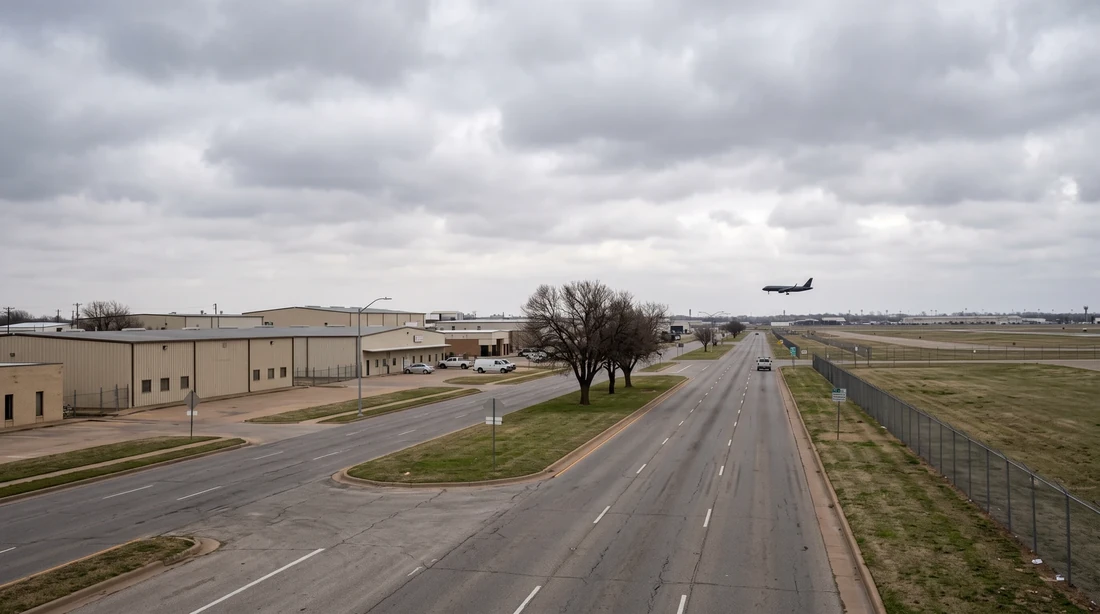
FAA Academy housing is a two-to-four-month furnished stay near the Mike Monroney Aeronautical Center, beside Will Rogers World Airport in southwest Oklahoma City. Most students choose an extended-stay hotel (roughly $2,800 to $3,500 a month) or a furnished home (about $3,000 to $6,000 a month, split-able with classmates) within a 15-minute drive of South MacArthur Boulevard.
Key Takeaways
- FAA Academy classes run two to four months, so most students need furnished housing for roughly 60 to 120 nights.
- A 90-day stay near the Aeronautical Center typically runs $8,500 to $12,500 all-in, depending on the lodging type chosen.
- Ninety nights at $139 totals about $12,510 in room charges, typically $2,000 to $4,000 more than a furnished monthly rate.
- Three classmates splitting a furnished four-bedroom at $5,400 a month each pay $1,800, half a $3,600 lodging ceiling.
This guide covers where the FAA Academy is, what housing near it costs in 2026, how the options compare, commute times by neighborhood, how splitting a home with classmates changes the math, how flexible a class-length booking needs to be, and what to pack.
Your class date just came through, your report date is a few weeks out, and every search for housing near the Academy dead-ends in a five-year-old forum thread. You don't need forums: you need the map, the monthly math, and a booking that flexes if your class runs long. This guide is all three.
Every incoming cohort books from the same small pool of furnished monthly rentals near the MacArthur corridor, and every hotel night you drift at $130-plus burns budget a monthly rate would stretch. Book as soon as your class dates are confirmed.

Where Is the FAA Academy, and Why Does Every Cohort Scramble for Housing?
The FAA Academy trains the nation's air traffic controllers and airway systems technicians inside the Mike Monroney Aeronautical Center, on South MacArthur Boulevard directly beside Will Rogers World Airport in southwest Oklahoma City.
Class length is the entire housing problem. Air traffic control initial qualification typically runs two to four months depending on your track, en route and terminal students follow different course sequences, and Airway Transportation Systems Specialist (ATSS) technician courses range from a few weeks to several months. Almost every student needs furnished housing for 60 to 120 nights: too long for a hotel budget, too short for a twelve-month lease.
The demand never lets up. Cohorts start year-round, and the Aeronautical Center also houses the Civil Aerospace Medical Institute (CAMI), the Enterprise Services Center, and a steady rotation of federal employees and contractors on TDY. Each new class arrives searching the same threads, calling the same apartment complexes, and touring the same short list of furnished options, which is why decent monthly inventory near the Center goes fast at every cohort start.
The Center has no place to sleep. It is a training and office campus with no residential side. Students, TDY employees, and contractors all arrange their own off-site housing, which is why the hotel corridors and furnished rentals around the airport carry the entire load.
The neighborhood itself doesn't help. The blocks immediately around the Center are airport hotels, freight yards, and office parks: functional, but with almost no walkable housing. Practically speaking, you will drive to class every day, which means your real search radius is a 15-minute circle, not a 15-minute walk. Students without a car usually solve it one of two ways: split a home with classmates who drive, or pick lodging on the Meridian Avenue hotel corridor and rideshare the short hop to the gate.
Most students land in one of four buckets: an extended-stay hotel near the airport, a student-heavy apartment complex (the Anatole on MacArthur and its alternatives come up in every thread), a corporate furnished apartment, or a furnished home booked month-to-month, often split two or three ways with classmates. The rest of this guide prices all four honestly, including the ones we don't offer.
On how corporate housing differs from extended-stay hotels:
Corporate housing provides complete temporary housing solutions within a stable residential setting unlike extended stay hotels, which are surrounded by an open parking lot and are filled entirely by transient guests.
Wikipedia: Corporate housing
What Does FAA Academy Housing Cost In 2026?
A 90-day stay near the FAA Academy typically runs $8,500 to $12,500 all-in, depending on whether you choose an extended-stay hotel, a furnished home at a monthly rate, or drift in a nightly hotel.
The single biggest cost driver is how you're reimbursed, not rent. Federal employees on TDY are often reimbursed lodging at actual cost up to the GSA rate; new-hire trainees in some programs receive a reduced or flat allowance; contractors follow whatever their contract says. Read your travel authorization or offer letter before you compare a single listing, because "cheapest" and "smartest" flip depending on whether you keep what you don't spend.
Food is the second driver nobody budgets. Ninety days without a kitchen means ninety days of restaurants. If eating out costs you even $40 a day more than groceries would, that's $3,600 over a 90-day class, roughly a full month of housing, gone. At the Academy, a full kitchen is a line item.
The third driver is timing. Nightly hotel prices near the airport move with the citywide calendar: the OKC Memorial Marathon in late April and the Women's College World Series at Devon Park in late May and early June typically push rates up metro-wide. Monthly furnished rates, by contrast, are usually locked for your whole stay when you book.
And one line item almost nobody compares: lodging taxes. Nightly hotel quotes carry state and local lodging taxes on top of the advertised rate, and in many jurisdictions those taxes step down or drop off once a stay passes 30 nights. Ask every operator how taxes are handled on a 30-plus-night booking: it can move an "identical" comparison by hundreds of dollars a month.
What drifting in a hotel costs, stage by stage
- Week 1: You land at an airport hotel "just for now" at $120 to $150 a night. The first week runs $840 to $1,050.
- Weeks 2 to 3: Class ramps up and evenings go to studying, not apartment tours. The meter keeps running at roughly $900 to $1,000 a week.
- Month 2: Moving mid-class now feels riskier than staying put. You're eating out nightly because there's no kitchen, and the food premium stacks on top of the room rate.
- End of a 90-day class: Ninety nights at $139 average out to about $12,510 in room charges alone, typically $2,000 to $4,000 more than a furnished monthly rate would have cost, before counting a single restaurant bill.
Month by month: the same 90 days, three ways
Cumulative cost is where nightly pricing quietly loses. Here's the same hypothetical 90-day class tracked at the end of each month:
| Timeline | Airport hotel ($139/night) | Extended-stay ($95/night) | Furnished 2-bedroom ($3,600/mo) |
|---|---|---|---|
| End of month 1 (30 nights) | $4,170 | $2,850 | $3,600 |
| End of month 2 (60 nights) | $8,340 | $5,700 | $7,200 |
| End of month 3 (90 nights) | $12,510 | $8,550 | $10,800 |
The airport hotel passes the furnished home before day 30 and never looks back. And the table understates the gap: the hotel column has no kitchen, so that $40-a-day food premium, roughly $1,200 a month, rides on top of it, while the furnished column already includes laundry you'd otherwise pay for by the load.
A worked example: 90 days on a $3,600-a-month lodging budget
Say, purely hypothetically, you're a contractor on a 90-day TDY assignment, splitting your weeks between the Aeronautical Center and Tinker AFB across town, with lodging reimbursed at actual cost up to about $3,600 a month. (The math is identical for the Tinker-only version of you; see our guide to TDY lodging near Tinker AFB.) Here's how the four realistic paths compare:
- Airport hotel at $139/night: 90 nights × $139 = $12,510, or about $4,170 a month, over your ceiling before you've bought a single meal, with no kitchen and no laundry.
- Extended-stay hotel at $95/night: 90 nights × $95 = $8,550, or about $2,850 a month, under budget, but you live, cook, and study in one room with a kitchenette for three months.
- Furnished two-bedroom home at $3,600/month: 3 months × $3,600 = $10,800: exactly at your ceiling, with a full kitchen, in-unit laundry, a separate room to work in, and a driveway.
- The split play: Team up with two colleagues or classmates on a furnished four-bedroom at $5,400 a month and each of you pays $1,800: half your ceiling, in a whole house.
Every figure above is a ballpark for illustration, not a quote. But the shape of the math holds across nearly every cohort: monthly-rate options beat nightly pricing by thousands over a full class, and a roommate split beats everything else on cost per person.
Variant: your class slips four weeks
Washbacks and schedule changes happen mid-class, so run the extension math before you book anything. Add 28 nights to the same hypothetical stay:
- Airport hotel: 28 × $139 = $3,892 more, about $16,400 total. Worse, if those extra weeks land on Memorial Marathon or Women's College World Series dates, the nightly rate can reprice upward on you mid-extension.
- Extended-stay hotel: 28 × $95 = $2,660 more, about $11,210 total, assuming your weekly rate holds.
- Furnished home, month-to-month: one more month at the written $3,600 rate: $14,400 total, same house, same rate, no rebooking.
The dollar gap narrows on extensions, but the risk gap widens: nightly pricing floats with the citywide calendar, while a monthly rate agreed in writing doesn't move.
Variant: you finish three weeks early
Early completions and early releases happen too, and the exit math runs opposite to the extension math. Cut 21 nights from the end of the same hypothetical 90-day stay:
- Airport hotel: check out and stop paying: 21 × $139 = $2,919 back in the budget. Nightly pricing's one genuine advantage is the free exit.
- Extended-stay hotel: roughly 21 × $95 = $1,995 saved, provided your weekly rate doesn't carry an early-departure clawback: some discounted long-stay rates do, so ask.
- Furnished home: depends entirely on the terms you got in writing. Some operators prorate the final month; others charge through the 30-day block, which on a $3,600 month could mean absorbing up to $2,520 for nights you never use.
The pattern to remember: nightly pricing wins on early exits, monthly pricing wins on extensions. Since washbacks and schedule slips are more common at the Academy than early releases, most students should weight the extension side, but ask both questions, in writing, before paying anyone.
Variant: the flat-allowance classmate
Now say a classmate in the same cohort is a new hire on a hypothetical flat $2,500-a-month lodging allowance, money kept if it isn't spent. Solo in the $2,850 extended-stay, they're $350 a month out of pocket. In a three-way split of the $5,400 four-bedroom at $1,800 each, they pocket $700 a month: $2,100 over a 90-day class. Whether unspent allowance is yours to keep depends on your program's rules: confirm it in your offer letter before you build a budget around it.
Reporting to the Mike Monroney Aeronautical Center in the next 30 to 60 days? BnB OKC keeps furnished, month-to-month homes minutes from Will Rogers World Airport, with class-length flexibility built in.
Check extended-stay availability · Call or text (405) 870-2146
How Do the Housing Options Near the FAA Academy Compare?
Six option types cover every FAA Academy student: airport hotels, extended-stay hotels, student-heavy apartment complexes, corporate furnished apartments, furnished homes on monthly rates, and unfurnished leases.
| Option | Typical monthly all-in | Booking terms | What disqualifies it |
|---|---|---|---|
| Airport hotel | $3,900 to $4,500 | Nightly; cancel anytime | No kitchen or laundry; nightly rates spike on event weekends |
| Extended-stay hotel | $2,800 to $3,500 | Nightly or weekly | One room for living, cooking, and studying; kitchenette only |
| Student apartment complex | Varies by unit; confirm current pricing | Class-length terms at some complexes | Availability tied to cohort starts; furnishing quality varies unit to unit |
| Corporate furnished apartment | $2,500 to $3,500 | Often 30 to 90 day minimums | Minimum-stay and setup fees; less flexible if your class shifts |
| Furnished home, booked direct | $3,000 to $6,000 (whole home) | Month-to-month; monthly rates at 30+ nights | Whole-home price costs more solo unless you split with classmates |
| Unfurnished apartment, 12-month lease | $1,100 to $1,600 + furniture, utilities, deposits | 12-month commitment | Lease outlasts your class; you pay to furnish and to exit |
Extended-stay hotels are the default for solo students on tight flat allowances, and for good reason: the math works. The trade is livability: three months of cooking on two burners and studying six feet from your bed. Our full extended stay Oklahoma City guide breaks down the corridors and what the weekly rates include.
Student apartment complexes near MacArthur market directly to Academy classes and handle class-length terms better than ordinary apartments. The catch is timing: units open up when a cohort graduates and fill when the next one lands, so availability on your exact dates is luck-dependent. If the usual names are full, our furnished apartments in OKC roundup covers what else exists.
Corporate furnished apartments are the polished middle option, real furniture, real kitchen, utilities bundled. They're built for corporate relocations, though, so minimum stays and setup fees can sting on a class that shifts by two weeks. See corporate housing in Oklahoma City for how those contracts work.
Furnished homes on monthly rates win in two specific situations: you're splitting with classmates, or your reimbursement supports a whole home and you want a kitchen, laundry, garage, and a door you can close to study. BnB OKC's 11 furnished metro homes run on published from-rates of $225 to $425 a night, with monthly rates on stays of 30-plus nights that bring class-length totals well under nightly math.
An unfurnished lease only makes sense if Oklahoma City is becoming permanent: a facility assignment here, a spouse's job, a decision to stay. In that case you're not booking a stay, you're relocating; start with our moving to Oklahoma City guide instead.
How Long Is the Commute to the Mike Monroney Aeronautical Center From Each Neighborhood?
Everything inside a 15-minute drive of South MacArthur Boulevard is realistic FAA Academy housing; past 25 minutes, early report times and winter ice days start to hurt.
| Area | Typical drive (normal traffic) | Why students pick it |
|---|---|---|
| Airport corridor / SW OKC (S MacArthur, S Meridian) | 5 to 10 minutes | Shortest commute; densest hotel and extended-stay inventory |
| Mustang | 15 to 20 minutes | Quiet suburban streets, groceries and gyms, more house for the money |
| Yukon | 15 to 20 minutes | Suburban amenities along I-40 west; easy airport access |
| Moore / south OKC | 20 to 25 minutes | I-240 corridor value; also workable if you split time toward Tinker AFB |
| Downtown / Midtown | 15 to 20 minutes | Restaurants, nightlife, and something to do on weekends off |
| NW OKC / Lake Hefner / The Village | 20 to 25 minutes | Lake Hefner trails for running, established neighborhoods, retail everywhere |
| Norman | 30 to 40 minutes | College-town rentals; usually only worth it with a reason to be in Norman |
Drive times above are typical off-peak estimates; add a cushion for morning report times, since I-44 and Airport Road carry commuter and airport traffic together. BnB OKC's closest furnished homes sit about 6 minutes from Will Rogers World Airport, about as close as monthly housing gets to the Academy gate, with other homes near Lake Hefner, The Village, and the Paseo and Plaza districts for students who'd rather live where the restaurants are and drive a little farther.
One winter note: December through February occasionally brings ice storms that glaze I-44 and the airport corridor for a morning or two. If your class runs through winter, a shorter commute is the difference between a careful ten minutes and a white-knuckle forty on the first freezing-rain day.
What Are Weekends, Weather, and the OKC Calendar Like During Your Class?
A two-to-four-month FAA Academy class leaves you eight to sixteen weekends in Oklahoma City, and where you live decides what they look like.
Downtown and Midtown put you near Scissortail Park, Bricktown's canal-side restaurants, and Paycom Center, where the Thunder play through fall, winter, and spring. The Paseo and Plaza districts run gallery nights, live music, and the metro's most walkable restaurant rows. Northwest OKC students default to Lake Hefner: the paved lakeside trail is the standing answer to "where do I run before class." Students in Mustang and Yukon trade all of that for quiet streets and a shorter Monday morning; neither choice is wrong, but make it deliberately.
Weather is part of picking housing here, not an afterthought. Tornado season peaks April through June: whatever you book, ask where you'd shelter, an interior room, a safe room, a neighbor's cellar, and load a weather-alert app before your first spring storm, not during it. July and August run hot; confirm the AC situation and whether a home has shade or a pool before booking a peak-summer class (our OKC rentals with pools collection exists for exactly those cohorts).
Three calendar clusters move metro lodging prices and traffic: the OKC Memorial Marathon in late April (downtown road closures included), the Women's College World Series at Devon Park in late May and early June, and the State Fair of Oklahoma in September. None of them touch a locked monthly rate: all of them can touch a nightly one, and all three are worth knowing about before out-of-town visitors book flights to come see you.
If your household is making the trip
Some students bring a spouse or their household for the class instead of commuting home on long weekends, and that changes the housing spec entirely. You need separate bedrooms so studying and bedtime can coexist, a real kitchen, in-unit laundry, and, if a dog is coming, a fenced yard. Extended-stay floor plans handle none of that well for three months; whole homes handle all of it.
BnB OKC's homes sleep 2 to 16-plus, several are dog-friendly with fenced yards, and month-to-month terms let the household's stay flex with the class. One timing note: Academy start dates rarely align with school semesters, so some households split the difference and visit for stretches rather than relocating mid-semester.
What Does Splitting a Furnished Home With Classmates Cost?
Three classmates splitting a furnished four-bedroom near the FAA Academy typically pay $1,700 to $2,000 each per month, often less than a studio apartment plus furniture rental, in a whole house with a real kitchen.
| Group size | Example furnished home rate | Per-person monthly cost |
|---|---|---|
| 2 sharing a 3-bedroom | $4,200/month | $2,100 each |
| 3 sharing a 4-bedroom | $5,400/month | $1,800 each |
| 4 sharing a 5-bedroom | $6,400/month | $1,600 each |
| 6 sharing a large home | $7,800/month | $1,300 each |
Rates above are illustrative bands, not quotes. The per-person curve is the point: every added roommate drops the cost faster than it shrinks the house. BnB OKC homes sleep 2 to 16-plus, so even a five- or six-person study group fits under one roof; browse the large group rentals in OKC or the full properties list to match bedroom counts to your group.
Set the split up properly on day one. One person books and is the point of contact; everyone else is named on the reservation. Put the arrangement in writing before anyone pays: rent share, who covers incidentals, how damage responsibility works, and, most importantly, what happens if someone leaves early. Washbacks, early completions, and resignations happen mid-class; agree now whether a departing roommate keeps paying, finds a replacement from the next cohort, or the remaining group absorbs the difference.
Pick homes where the bedrooms are roughly comparable, or agree on an uneven split up front: the primary suite paying $100 more a month prevents three months of quiet resentment. And keep the group to people whose schedules match yours: a house full of the same class studying for the same evaluations is a feature, not a compromise.
How Flexible Does a Class-Length Booking Need to Be?
The best FAA Academy booking is month-to-month with the extension rate agreed in writing before you pay, because class dates move, washbacks add weeks, and some students finish early.
Before you commit anywhere, get answers to five questions. What's the rate if I extend two to six weeks? What happens if I have to leave early: prorated, or charged through the 30-day block? At what stay length does the monthly rate apply (at BnB OKC, monthly rates kick in at 30-plus nights)? How are taxes handled past 30 nights? And who do I call when something breaks: a person or a portal?
Booking direct with a local operator is where class-length stays get easier. Direct bookings with BnB OKC save up to 35% versus platform pricing on stays of 4-plus nights, and, more valuable for Academy timelines, you're texting a human who can slide your checkout when your class does, instead of rebooking through an app. Several homes are dog-friendly with fenced yards if your dog is doing the class with you (see pet-friendly rentals in OKC). Details on how direct booking works are on the book direct page.
On trust, since you're booking sight-unseen from another state: BnB OKC holds a 9.5 out of 10 average across 1,580 verified guest reviews on Airbnb and Vrbo, and two of the homes carry Airbnb's Guest Favorite badge. If your class dates just posted, check month-to-month availability near the Academy before the rest of your cohort does.
What's Included When You Arrive, and What Should You Pack?
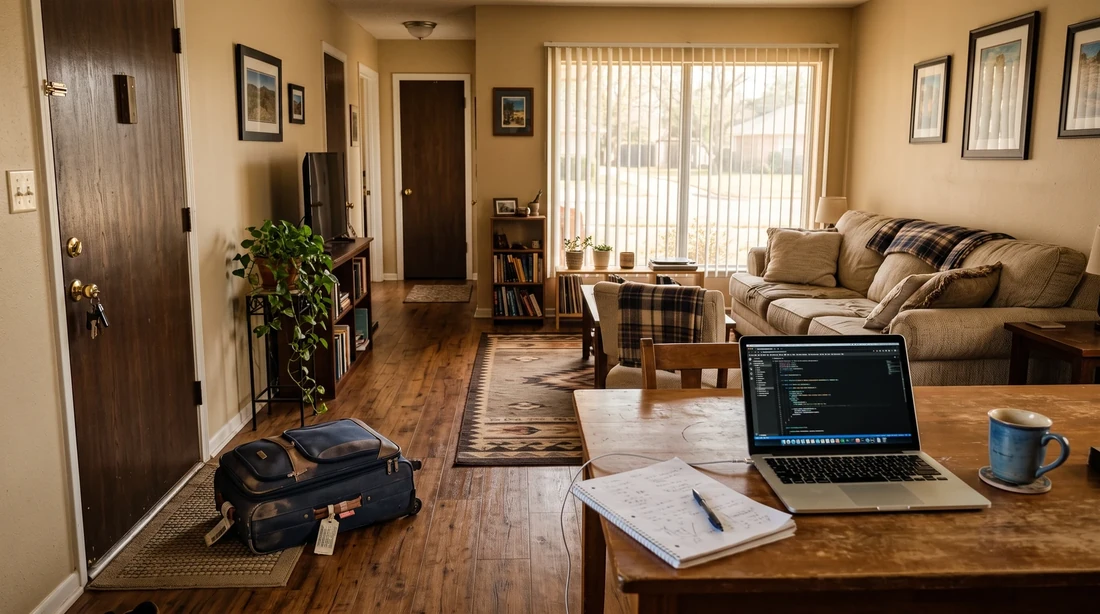
A furnished monthly home should arrive move-in ready: furniture, cookware and dishes, linens and towels, wifi, and utilities bundled into one rate. That's how BnB OKC homes run: confirm the same in writing before booking anyone else, because "furnished" occasionally means "has a couch." Ask specifically about a workspace: a desk and a door that closes is the whole reason many students choose a house over a hotel room.
If you fly, Will Rogers World Airport is the arrival point, and the closest furnished homes sit about 6 minutes from it. Check-in is 4:00 PM and checkout is 11:00 AM, if your travel puts you in town earlier on report weekend, ask about early arrival when you book rather than gambling on it.
Pack light on housewares and heavy on study gear: a second monitor, noise-canceling headphones, whatever your track recommends. Big-box groceries, pharmacies, and gyms line the corridors near every area in the commute table above; nothing Oklahoma sells needs to ride in your trunk from home.
Bring your car, rent one, or rideshare?
Driving your own car to Oklahoma City is the default for a reason: parking is free at furnished homes (driveways, often garages), and your travel authorization may reimburse mileage for the drive: check before you book a flight instead.
If you fly in and rent, price the full class, not the first week. A mid-size rental typically lands in the ballpark of $1,200 to $1,800 a month even with long-term discounts: $3,600 to $5,400 across a 90-day class, often more than the entire price gap between an extended-stay room and a whole furnished home. Some students flip the math: put the rental-car money toward a closer or better home and rideshare instead.
Rideshare-only is workable from exactly one place: the Meridian Avenue hotel corridor, where the hop to the Center gate is short. Figure roughly $400 to $650 a month for twice-daily class runs plus grocery trips, and accept that weekends get small. From Mustang, Yukon, or northwest OKC, rideshare-only math stops working; those areas require your own wheels. A roommate split solves this too: one classmate's car covers the whole house.
How to Book FAA Academy Housing, Step by Step
- Confirm your class dates. Get your report date and class length in writing before you book anything.
- Check your reimbursement rules. Read your travel authorization or offer letter to see whether lodging is paid at actuals, a flat rate, or a partial allowance.
- Set your commute radius. Draw a 15-minute circle around South MacArthur Boulevard and search inside it first.
- Compare monthly all-in costs. Price every option per month with taxes, food, and parking included, never by nightly rate alone.
- Book month-to-month and confirm extension terms. Reserve a stay that can stretch if your class runs long, and get the extension rate in writing.
What to Check Before You Book
Before you book for your class dates, confirm these.
- Report date and class length, in writing. Ask your training contact whether those dates could shift before you travel.
- Your reimbursement ceiling. Compare it against the monthly all-in table above, food, taxes, and a car included.
- Course length. Under about three weeks, an extended-stay hotel is the right call. 30-plus nights is where monthly rates apply.
- Solo, split, or household. Two or more classmates splitting, a dog, or a household coming along each tip toward a home.
- Your travel authorization. If it directs you to specific lodging or a booking system, follow it. Your travel office outranks any guide.
When you don't need a furnished home
Honestly: not every Academy stay needs a house. If your course runs under about three weeks, an extended-stay hotel is the right call: the setup cost and effort of a home doesn't pay back on a short technician course. If you're solo, reimbursed at actuals with room in the GSA rate, and you value daily housekeeping and hotel points, a hotel is a defensible choice, not a mistake.
If there's real uncertainty about whether you'll complete the course, nightly pricing's free exit has value a monthly rate can't match. If your travel authorization directs you to specific lodging or a booking system, follow it: your travel office outranks any guide. And if you have family or friends in the metro with a spare room, free beats everything on this page.
The furnished-home math takes over in specific, predictable situations: stays of 30-plus nights where monthly rates apply; two or more classmates willing to split; a dog making the trip; a household coming along for the class; a flat allowance you'd rather stretch than spend; or needing a quiet room with a door to study behind: something no extended-stay floor plan offers. If two or more of those describe you, the whole-home column wins on both cost and sanity.
Terms You'll Hear, Decoded
- TDY (temporary duty): a work assignment away from your normal duty station: Academy classes and contractor rotations both count.
- Per diem: the daily allowance for lodging, meals, and incidentals while on official travel.
- GSA lodging rate: the federal per-night lodging ceiling for a given city, published by the General Services Administration.
- M&IE: the meals-and-incidentals portion of per diem, usually paid as a flat daily amount.
- Actuals vs. flat rate: "actuals" reimburses what you really spent up to a cap; a flat rate pays a fixed amount whether you spend it or not.
- Report date: the day your class letter or travel authorization requires you at the Center: your housing needs to start the night before, at the latest.
- Washback: being recycled to a later class after an evaluation doesn't go your way: it typically adds weeks to your time in OKC, which is why extension terms matter.
- Month-to-month: a stay that renews in 30-day blocks with no long lease: the format that fits shifting class dates.
- Lodging tax: state and local taxes stacked on nightly hotel quotes; in many jurisdictions they step down or drop off once a stay passes 30 nights, always ask how a 30-plus-night booking is taxed.
- Damage waiver: a small fee some operators charge instead of a refundable security deposit.
For current Oklahoma City lodging and M&IE figures, check the official per diem tables at the GSA per diem rates page; for Academy and Aeronautical Center information, start at the FAA website.
The Bottom Line
- Confirm your exact report date and class length in writing, and ask your training contact whether those dates could shift before you travel.
- Compare your reimbursement ceiling against the monthly all-in table above, food, taxes, and a car included, and decide if you are going solo, splitting with classmates, or bringing your household.
- Check month-to-month furnished availability for your class dates, or call/text (405) 870-2146 for same-day answers on class-length stays near the Academy.
This guide is general information, not travel-policy or tax advice; your agency, employer, or contract sets your reimbursement rules.