In Oklahoma, if your policy sets a time limit for wind or hail roof damage, a 2022 law (36 O.S. § 1250.5(7)) requires it to allow filing up to 24 months after the date of loss when the damage is not evident without inspection. Obvious damage must still be reported promptly per your policy terms.
You climbed up after a spring storm, or a roofer knocked, and now you're staring at bruised shingles from a hailstorm you barely remember. You're sure the deadline has passed. In most cases in Oklahoma, it hasn't — the law gives you a longer window when the damage wasn't visible without a real inspection.
That matters more than usual right now. Oklahoma's 2026 spring was hail-heavy, and on June 24, 2026 the Oklahoma Attorney General sued State Farm alleging systematic denial and underpayment of hail and wind roof claims (allegations, unproven). This guide turns the deadline rule into a step-by-step filing playbook — and covers what happens to your family's housing if a roof claim turns into a full replacement.
The clock runs from the date of loss — the storm date, not the discovery date. For non-obvious damage you generally have until the 24-month anniversary of that storm; wait past it and your carrier can deny on timing alone.
What the 24-Month Hail Claim Rule in Oklahoma Actually Says
Oklahoma amended 36 O.S. § 1250.5(7) effective May 22, 2022, and the change is narrow but powerful. Any homeowners policy that imposes a time limit on wind or hail roof damage claims must let you file after the first anniversary of the loss but no later than 24 months after the date of loss — specifically when the damage is not evident without inspection.
The statute also says an insurer cannot escape its obligations because you missed a time limit "unless the failure to comply with the time limit prejudices the rights of an insurer," per the Hall Booth Smith analysis of the law. In plain terms: a missed deadline isn't automatically fatal if it didn't actually harm the insurer's ability to investigate.
Two guardrails matter. First, the extended window applies only to non-obvious damage — the kind a homeowner reasonably wouldn't spot from the ground. Second, visible damage should be reported promptly per your policy's terms. If your roof is obviously torn up, don't sit on it and count on 24 months.

Old Rule vs. New Rule: What Changed In 2022
Before the 2022 amendment, many Oklahoma policies could enforce short one-year notice provisions that left homeowners with hidden hail damage no recourse once the year lapsed. The table below shows the practical shift.
| Issue | Before May 22, 2022 | After the § 1250.5(7) amendment |
|---|---|---|
| Filing window for non-obvious roof damage | Could be limited to ~1 year by policy terms | Up to 24 months from date of loss |
| Missing the time limit | Often a hard bar to the claim | Not fatal unless it prejudices the insurer |
| Obvious/visible damage | Report promptly | Still report promptly per policy terms |
| Trigger date | Date of loss | Date of loss (storm date, not discovery) |
What Happens at Each Stage If You Wait
The 24-month figure is a ceiling, not a plan — waiting quietly weakens even a valid claim. Here's the realistic sequence.
- Storm day (date of loss): Damage occurs. The 24-month clock starts now, whether or not you know it.
- Weeks later: Granules wash into gutters, a ceiling stain appears, or a roofer flags bruising. This is your cue to inspect and document.
- Months later: Undetected leaks let water into the deck and interior. What could have been a roof claim becomes roof plus drywall, insulation, and possibly mold — and the insurer may argue the added damage came from your delay.
- Approaching 24 months: Storm records fade, comparable-date evidence gets harder to pull, and you're closer to the outer limit where a carrier can deny on timing.
- Past 24 months: For non-obvious damage, your policy's time limit can bar the claim outright unless an exception applies.
Hail is the most common homeowners claim type in Oklahoma, per the Oklahoma Insurance Department's wind-and-hail guidance, so this sequence plays out across the metro after every big spring. OID also warns to watch for cosmetic-damage exceptions and separate hail deductibles that change what you actually recover.
If your roof claim leads to displacement — replacement work, interior water damage, or an unlivable home — your policy's ALE coverage can pay for furnished housing while repairs happen. We keep 11 furnished OKC homes and work with insurance placements directly.
Hypothetical: When a Hail Claim Becomes a Housing Claim
Here's a clearly hypothetical example to show the math. Say a homeowner in Edmond discovers, 14 months after an April storm, that hail damage let water into the roof deck and now the ceiling is failing across two bedrooms. Because the damage wasn't evident without inspection, the 24-month window likely still applies — they're inside it.
The carrier approves a full roof replacement plus interior repairs, and the work makes part of the home unlivable for about six weeks. That's where Additional Living Expenses (ALE) enters. Instead of splitting a family across two hotel rooms at, say, $170/night — roughly $7,140 over 42 nights before taxes and with no kitchen — the family moves into a furnished home. Our published from-rates run $165–$425/night depending on the home, with monthly rates on 30+ night stays and up to 35% direct-booking savings on 4+ nights. A single furnished house keeps the family, and any pets, together with a kitchen and laundry. (Illustrative figures — your carrier decides what ALE actually covers.)
How to File a Hail Damage Claim in Oklahoma, Step by Step
- Pin the date of loss. Match your damage to a known storm date — that date starts your 24-month clock.
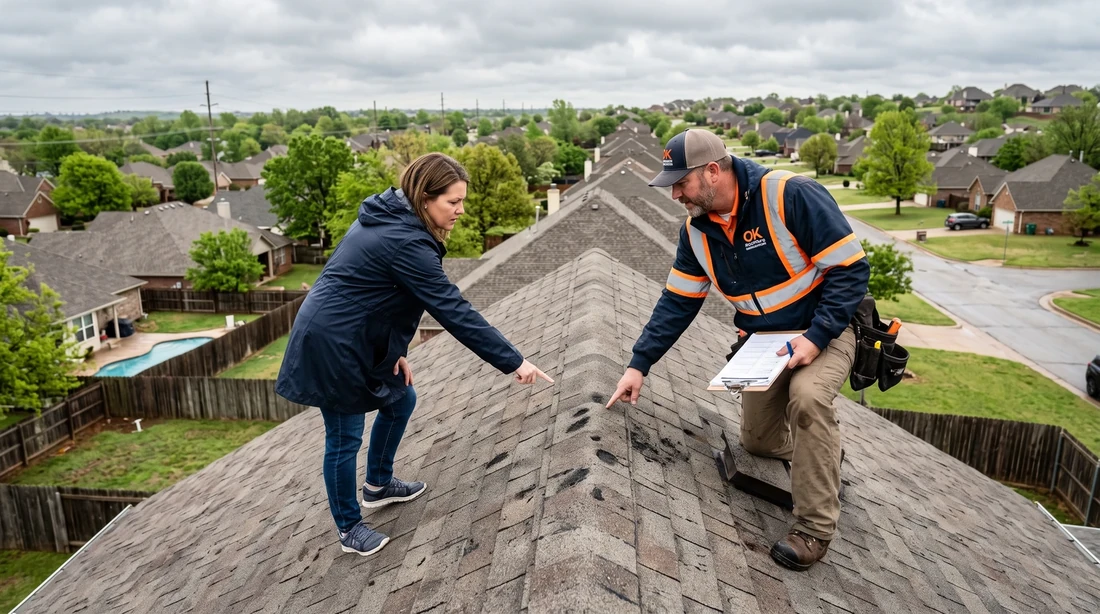
- Get a professional inspection. Have a licensed roofer or public adjuster document non-obvious damage with photos and a written report.
- Report to your insurer promptly. Notify your carrier and review the hail deductible and any cosmetic-damage exceptions with your agent.
- Keep every receipt. Save tarping, mitigation, and — if you're displaced — lodging and expense receipts to substantiate an ALE claim.
- Track your deadline. Note the 24-month anniversary of the date of loss and file well before it if the damage was not evident without inspection.
- Escalate if denied. If you believe a claim was wrongly denied or underpaid, contact the Oklahoma Insurance Department at 800-522-0071.
What This Means If You're a Displaced OKC Homeowner
A roof claim only becomes a housing problem when the home stops being livable — and that's exactly when ALE (loss-of-use) coverage matters. ALE typically pays the reasonable additional cost of living elsewhere while covered repairs happen, and receipts substantiate the claim. "Additional" means costs above your normal living expenses; your carrier or its third-party administrator makes the final call, and direct billing only happens with their authorization.
For OKC-area families, that's the difference between weeks in cramped hotel rooms and a single furnished home. We hold a 4.8-star average across 1,247 verified guest reviews on Airbnb, several homes are dog-friendly, and homes sleep 2 to 16+ across the metro — near Lake Hefner, the Paseo and Plaza districts, The Village, and 6 minutes from Will Rogers Airport. We also work with Alacrity Solutions on insurance placements. If you're navigating a claim-driven move, start at our insurance-housing page.
If you rent out a property yourself, note that displacement housing and short-term rentals follow different local rules — see our guides to OKC short-term rental rules and the Norman short-term rental license.
The State Farm Lawsuit: What It Does and Doesn't Mean
On June 24, 2026, the Oklahoma Attorney General filed a lawsuit against State Farm alleging systematic denial and underpayment of hail and wind roof claims. These are allegations and remain unproven. Nothing in the suit changes the 24-month statute, and it doesn't decide any individual claim.
The practical takeaway is unchanged from before the headlines: document the damage, know your date-of-loss deadline, keep your receipts, and use the Oklahoma Insurance Department if you think a claim was handled unfairly. The 2026 storm season gives the timing real weight — the National Weather Service, via OKC Fox, counted 38 tornadoes in Oklahoma by April 21, including a record-setting 22-tornado March.
Terms You'll Hear, Decoded
- Additional Living Expenses (ALE) / loss of use: Coverage that pays the reasonable extra cost of living elsewhere while your home is being repaired after a covered loss.
- Date of loss: The date the damage occurred (the storm date) — the day your filing clock starts, not the day you discovered it.
- Hail deductible: A separate, often percentage-based deductible that applies specifically to wind or hail claims.
- Cosmetic-damage exception: A policy provision that may exclude payment for dents or marks that don't affect the roof's function.
- Direct billing: When the housing provider bills your carrier or its administrator directly — only with the carrier's authorization.
When You Don't Need Us
Plenty of hail claims never touch your housing. If your roof is repaired or replaced while you keep living at home, you don't need temporary lodging at all — file, document, and move on. A quick fix, a single traveler with points loyalty, or a one- or two-night gap can genuinely be a hotel decision.
A furnished home changes the outcome when repairs make the home unlivable for weeks, when you have kids in local schools, when you have pets, or when a hotel would split your family across rooms with no kitchen. That's the 30-plus-night, whole-household scenario where ALE stretches further in one furnished house than in stacked hotel nights.
This guide is general information, not insurance or legal advice; your carrier makes all coverage decisions.