How long does it take to rebuild a house after a fire? A full rebuild typically takes 9 to 18 months from the fire to move-in day. Contained damage — like a kitchen fire that stays in one room — usually takes 3 to 6 months. Permits, scope approval, and contractor availability stretch timelines more often than the construction itself.
Key Takeaways
- A full rebuild after a fire typically takes 9 to 18 months; contained single-room damage usually takes 3 to 6 months.
- Investigation, scoping and permits commonly take two to four months before construction starts, and only four of nine phases involve building.
- Two hotel rooms at about $300 a night cost roughly $9,000 monthly; a furnished 4-bedroom home runs about $4,200 monthly.
- With a $60,000 ALE cap, hotels at $9,000 a month run out near month seven; furnished housing fits a 14-month rebuild.
What this guide covers: how long each phase of a fire rebuild usually takes, how the severity of the fire sets your range, what a slow rebuild does to your housing budget, and how to pick housing that can stretch when the schedule does.
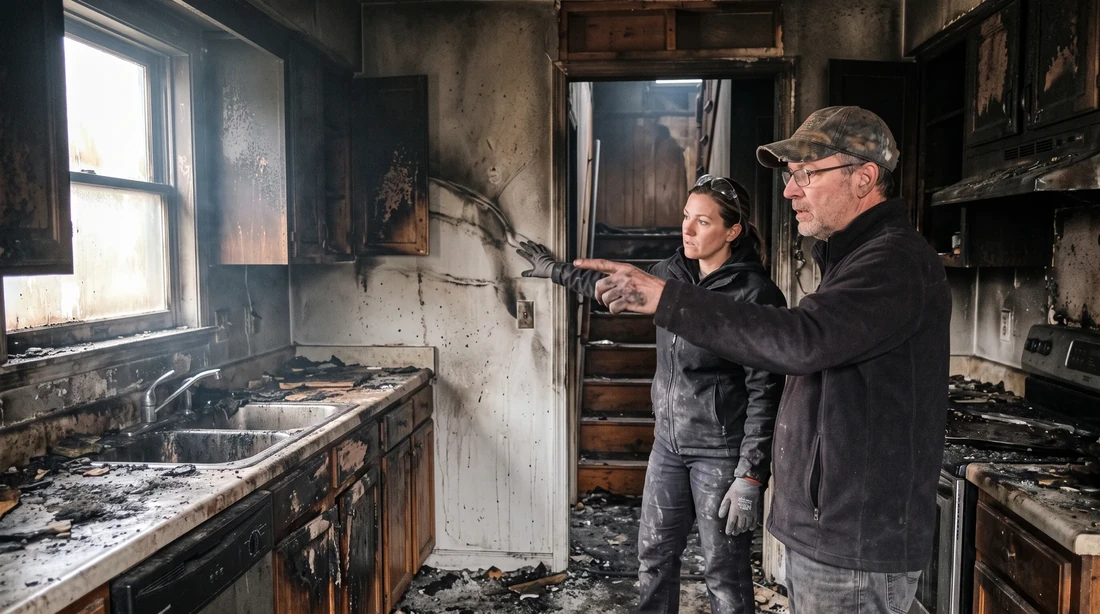
Your contractor just walked the burned-out kitchen, traced the smoke lines up the stairwell, and said "four months, maybe five." Now you have to decide where your family of five (and the dog) will live while that happens, and whether to believe that number. Here's the honest answer, phase by phase, so you can plan housing that matches reality instead of the first optimistic estimate.
The rebuild clock and the housing bill run together. A full rebuild averages 9 to 18 months, and two hotel rooms at roughly $300 a night burn through about $9,000 of ALE money every month. A furnished monthly rental would stretch that money across far more of the rebuild.

Why Does a House Rebuild After a Fire Take Longer Than Anyone Tells You?
Most fire rebuild delays happen before a single wall stud goes up. The investigation, scoping, and permit phase alone commonly takes two to four months. Construction is the predictable part of the timeline. The paperwork in front of it is not.
There are three reasons the first estimate you hear is almost always low. First, contractors quote build time and leave out queue time. "Four months" usually means four months of active construction. It doesn't count the weeks waiting on the adjuster's scope of loss, the estimate negotiation, or the permit review.
Second, fire damage hides. Smoke travels through HVAC ducts and wall cavities, and the water used to put the fire out soaks subfloors and insulation. A kitchen fire's scope routinely grows once demolition opens the walls, and every scope change restarts part of the approval loop.
Third, everyone in the chain is juggling other jobs. Your adjuster has a caseload. Your contractor has other builds. Inspectors have queues. None of that shows up in the day-one estimate, but all of it shows up in your housing bill.
Each step depends on the one before it: no scope means no approved estimate, and no approved estimate means no permit filing. Scope disagreements between the adjuster and contractor are the most frequent stall point, so push for that reconciliation early.
If the fire happened this week and you're still in the scramble phase, start with our guide to temporary housing after a house fire. This article picks up where that one ends, once you know a rebuild is coming.
If the fire was part of a wider declared disaster:
Mortgage help and home repair loans after a disaster If you live in a presidentially declared disaster area, you may be eligible for mortgage assistance or financial help to repair or rebuild your home.
USAGov: Financial assistance after a disaster
How Long Does Each Phase of a Fire Damage Repair Take?
A typical fire rebuild moves through nine distinct phases, and only four of them involve actual construction. Here's the full sequence with realistic durations and the specific thing that stretches each one.
| Phase | Typical duration | What stretches it |
|---|---|---|
| 1. Securing & mitigation (board-up, water extraction, drying) | 1–4 weeks | Hidden water and smoke damage found during drying |
| 2. Investigation & scope of loss | 2–8 weeks | Cause-and-origin questions, engineer reports |
| 3. Estimate approval & contractor selection | 2–6 weeks | Adjuster–contractor scope disagreements, contractor backlogs |
| 4. Permits & plan review | 2–8 weeks | Full-rebuild plan reviews, code-upgrade requirements |
| 5. Demolition & site prep | 1–3 weeks | Asbestos or lead abatement in older homes |
| 6. Foundation & framing | 1–3 months | Weather, lumber and truss lead times |
| 7. Mechanical rough-ins (electrical, plumbing, HVAC) | 3–8 weeks | Trade scheduling, inspection queues |
| 8. Insulation, drywall & finishes | 2–4 months | Cabinet and countertop lead times, change orders |
| 9. Final inspections & certificate of occupancy | 2–6 weeks | Punch lists, failed or rescheduled inspections |
Two notes on reading this table honestly. A contained kitchen fire usually skips most of phases 5 and 6, which is how a repair lands in the 3 to 6 month range instead of 9 to 18. A total loss hits every phase, and the two most underestimated are phase 3 (scope approval) and phase 8 (finishes), because both depend on decisions and deliveries more than labor.
Add the low ends and you get roughly 6 months; add the high ends and you're near 24. That's why experienced restoration contractors give ranges, and why the middle of the range, 9 to 18 months for a full rebuild, is the number to plan housing around.
How Does Fire Severity Set the Rebuild Timeline?
The best predictor of your rebuild length is how far the fire, smoke, and water traveled. Your contractor matters less than that. Flame damage you can see is often the smallest part of the scope. Match your situation to the band below before you commit to any housing term.
| Fire scenario | Typical timeline | What pushes it to the high end |
|---|---|---|
| Contained kitchen or single-room fire | 3–6 months | Smoke in HVAC ducts, water under flooring, 6–10 week cabinet lead times |
| Multi-room or structural damage | 6–12 months | Engineer reports, partial reframing, code upgrades in older homes |
| Total loss / rebuild from the slab | 12–18+ months | Full architectural plan review, cause-and-origin investigation, custom finishes |
A total loss rebuild typically takes 12 to 18 months from the fire to move-in, and large or custom homes can run closer to 24. The first 3 to 4 months are usually consumed by investigation, scope approval, and permits before framing even starts.
Two things routinely bump a fire into the next band up. Smoke that reaches the HVAC system contaminates every duct and room it feeds, so a "kitchen fire" with whole-house smoke can require whole-house treatment and land in the 6 to 12 month range. And firefighting water travels down: a second-floor fire often means first-floor ceilings, insulation, and flooring get opened up too. Don't set your housing plan until the mitigation company finishes drying and mapping the damage, because that's when the real band becomes visible.
What Does a Slow Rebuild Cost You in Housing?
For a family of five, temporary housing during a rebuild routinely costs more per month than the mortgage on the house being rebuilt. Your loss-of-use (ALE) coverage typically pays the costs above your normal living expenses. ALE has a cap, though, and how fast you burn it is the one variable you control. (New to how that coverage works? See loss of use coverage explained.)
Here's what typically happens when a family stays in reactive, week-to-week hotel mode instead of committing to monthly housing:
- Weeks 1 to 2: Emergency hotel nights while the house is boarded up. Two rooms for a family of five plus pet fees can run $2,500 to $4,500 before the scope of loss is even started.
- Month 1: Still no approved scope, still no construction. Nightly hotel rates keep accruing, and restaurant meals for five stack extra ALE spend on top of lodging.
- Months 2 to 3: Construction finally begins. The adjuster starts watching the ALE burn rate, and the running hotel total starts limiting how much budget remains for the actual build months.
- Month 4 and beyond: The rebuild runs past the first estimate, as most do. If hotels consumed the first half of the ALE cap, the back half of the rebuild gets financed out of pocket.
Once your loss-of-use dollar cap or time cap is exhausted, remaining housing costs come out of pocket even if the rebuild isn't finished. Flag any projected shortfall to your adjuster as early as possible instead of at the deadline. If your carrier pushes back on housing at any of these stages, don't accept the first "no" as final. Our guide to what to do when insurance denies temporary housing covers the escalation path.
A worked example: family of five, a dog, and a 4-month kitchen-fire rebuild
This is a hypothetical scenario, but the arithmetic is real. Say a kitchen fire displaces your family of five plus the dog, and the contractor's schedule shows a 4-month repair.
Hotel route: two standard rooms at roughly $150/night each is about $300/night. Over 120 nights: 120 × $300 = about $36,000. That's before pet fees (often $25 to $50 a night where dogs are allowed at all) and before restaurant meals, which for a family of five with no kitchen can add $2,500 to $3,000 a month above your normal grocery spend.
Furnished home route: a furnished 4-bedroom at a monthly rate of $4,200 runs 4 × $4,200 = $16,800 for the same four months. The dog stays with the family at a dog-friendly home, and a full kitchen keeps food costs near normal. That matters because ALE typically only reimburses spending above your usual expenses.
The gap is roughly $19,000 on lodging alone, closer to $30,000 once meals are counted. Same rebuild, same four months, and the whole difference comes from what the housing choice does to the ALE budget.
When four months becomes six: the overrun math
Now run the same hypothetical family through the most common plot twist: the estimate slips. Say demolition uncovers charred floor joists, a three-week engineer-and-reframe detour, and the cabinet order slips five weeks. Four months quietly becomes six.
The hotel route becomes 180 nights × $300 = about $54,000, plus in the ballpark of $15,000 in meals above normal spending. The furnished route becomes 6 × $4,200 = $25,200, extended month-to-month with a phone call, with no re-booking scramble and no second move for the kids and the dog. The overrun added roughly $18,000 to the hotel family's tab and about $8,400 to the furnished family's. Overruns punish nightly housing twice as hard as monthly housing.
The total-loss version of the math
Stretch the same hypothetical to a total loss, and the housing choice becomes a question of whether the coverage lasts at all. Suppose the policy's dwelling coverage is $300,000 and loss of use is set at 20% of that (a common structure, though every policy differs), giving a $60,000 ALE cap.
A 14-month rebuild in a furnished home at $4,200/month costs 14 × $4,200 = $58,800. It fits under the cap, with meals staying near normal thanks to the kitchen. The two-hotel-room route at roughly $9,000/month exhausts that same $60,000 around month seven, before drywall on many total-loss schedules. That leaves roughly seven months of housing, call it $60,000+, out of pocket. On a long rebuild, the monthly-housing decision in month one is what decides whether month twelve is covered.
Facing a multi-month rebuild in the OKC metro? BnB OKC places displaced families in furnished homes — several are dog-friendly — with monthly rates on 30+ night stays and month-to-month extensions that track your contractor's schedule, not the calendar. See insurance housing options or call/text (405) 870-2146.
What Are Your Housing Options for a Rebuild That Lasts Months?
For any rebuild expected to pass 30 days, monthly furnished housing typically costs less than half of what two hotel rooms cost. It's also the only option that combines a kitchen, laundry, a yard, and month-to-month flexibility. Here's the full comparison for a family of five with a dog.
| Option | Typical monthly cost | Fits / what disqualifies it |
|---|---|---|
| Two standard hotel rooms | ~$9,000 + pet fees + meals out | Bookable tonight; no kitchen or laundry, family split across rooms, many properties won't take dogs |
| Two extended-stay suites | ~$4,500–$6,500 + pet fees | Kitchenettes help; tight for five people long-term, nightly pet fees compound over months |
| Furnished rental home (monthly rate) | ~$3,500–$6,000 all-in | Full kitchen, laundry, fenced-yard options, dog can stay; usually needs a 30+ night commitment |
| Unfurnished 12-month lease | Rent + deposits + buying furniture | Lowest rent; a fixed 12-month term can outlast a repair or force double moves, and furnishing a house you'll leave rarely pencils out |
| Staying with family | $0 lodging | Free and fast; five people plus a dog for four-plus months strains almost any household, and ALE savings can evaporate into friction |
One note on the 12-month-lease row, because it tempts people facing total-loss timelines. The term mismatch cuts both ways. A 3 to 6 month repair leaves you paying for months you don't need or hunting a subletter, and a rebuild that finishes in month 14 of a 12-month lease forces a mid-rebuild move anyway. Month-to-month furnished housing is the only structure that ends when the certificate of occupancy does.
A few specifics on the furnished route, since it's the one built for this exact timeline. BnB OKC operates 11 furnished homes across the OKC metro, sleeping 2 to 16+, with a 9.5 out of 10 average across 1,580 verified guest reviews on Airbnb and Vrbo. Several homes are dog-friendly (see pet-friendly rentals in OKC), monthly rates apply on 30+ night stays (details on extended stays), and booking direct saves up to 35% versus platform pricing on 4+ night stays.
Payment mechanics matter here too. Some carriers or their third-party administrators (BnB OKC works with Alacrity Solutions on placements) can authorize direct billing so lodging never touches your credit card. How that works is covered in how ALE housing companies work. And if the fire happened in a home you rent rather than own, your policy works differently; see does renters insurance cover temporary housing.
How to Set Your Housing Timeline After a Fire, Step by Step
- Get the scope in writing. Ask your adjuster and contractor for a written, phase-by-phase schedule before you commit to any housing.
- Add a 30% to 50% buffer. Plan your housing for longer than the first estimate; rebuilds run over far more often than they run early.
- Confirm your ALE limits. Check your policy's loss-of-use dollar cap and any time cap so you know the budget the timeline has to fit.
- Book monthly, not nightly. Choose housing with 30+ night monthly rates and month-to-month extensions instead of open-ended hotel nights.
- Recheck at every milestone. Revisit the schedule at demolition, drywall, and final inspection, and extend your housing 30 days before each deadline.
Who Handles What During the Rebuild?
You, your adjuster, and your contractor each own different pieces of the rebuild timeline, and delays happen when a task quietly falls between them. Use this as your accountability checklist.
| Task | Who handles it | When |
|---|---|---|
| Board-up, water extraction, securing the property | Mitigation company (you sign the authorization) | Week 1 |
| Scope of loss and repair estimate | Adjuster + your contractor, reconciled together | Weeks 2–8 |
| Building permits and plan submission | Your contractor | Before demo and rebuild phases |
| Material and finish selections (cabinets, flooring, fixtures) | You — early choices prevent phase-8 stalls | Before the finish phase begins |
| Code-upgrade (ordinance or law) approvals | Carrier decides; contractor documents the requirement | During scoping and permits |
| Housing extensions and ALE receipts | You, with your host/operator and adjuster | 30 days before each housing deadline |
| Final inspections and certificate of occupancy | Contractor + city inspectors | Final 2–6 weeks |
The row that moves the schedule most is material selections. Cabinet and countertop lead times regularly run 6 to 10 weeks. If you pick them during framing instead of after drywall, you can erase a month of dead time from phase 8. Choosing finishes early is the one timeline lever the homeowner fully controls. The same logic applies to long-lead exterior items: windows, garage doors, and specialty HVAC equipment can run 4 to 12 weeks out, and a contractor can only order them once you've signed off.
How Does Oklahoma City Affect Your Rebuild Timeline?
In the OKC metro, spring storm season (tornado season peaks April through June) is the single biggest local variable in fire rebuild scheduling. When hail and wind claims spike, the same roofers, framers, and adjusters your fire rebuild needs get pulled into storm work. A fire in late spring can sit in the contractor queue noticeably longer than the same fire in October, and a single major May hail event can tie up metro roofing and framing crews for months afterward.
Winter cuts the other way. Exterior phases like foundation pours and framing can slow during ice events, but interior phases (rough-ins, drywall, finishes) usually proceed. If your rebuild spans a winter, expect the schedule to compress indoors and stretch outdoors. Peak summer heat occasionally shifts concrete pours to early mornings, but it rarely moves the overall schedule.
Permits for work inside Oklahoma City limits run through the city's development services process; suburbs like Edmond, Moore, and Yukon run their own. Your contractor handles the filings, but it's fair (and smart) to ask which jurisdiction you're in and what its current review times look like, because that number goes straight into your housing plan.
Where you wait matters too, and OKC's geography works in your favor. Most cross-metro drives run 20 to 30 minutes outside rush hour, so you rarely have to choose between a good temporary home and staying close to the rebuild. BnB OKC's homes sit near Lake Hefner, the Paseo and Plaza districts, The Village, and about 6 minutes from Will Rogers World Airport.
A family rebuilding in Edmond or northwest OKC can stay near The Village or Lake Hefner and keep school drop-offs and weekly job-site walk-throughs short. Being close enough to walk the site weekly is how you catch a stalled rebuild in week one instead of month two.
Which Edge Cases Change Your Housing Plan?
Most rebuild-housing advice assumes a clean, average case. Four common situations change the plan enough to name specifically.
Kids mid-school-year. A 4-month rebuild that starts in the fall spans a semester; a total loss spans a full school year. Pick temporary housing on the same side of the metro as the kids' schools so routines survive the displacement. If the rebuild will cross August, confirm your housing can extend through winter break before you commit, because mid-semester housing moves are the disruption families regret most.
The dog. Hotel pet fees of $25 to $50 a night compound to roughly $3,000 to $6,000 over a 4-month stay, where dogs are allowed at all. Boarding instead typically runs $30 to $50 a day, which is the same math plus a separated dog. A dog-friendly furnished home, ideally with a fenced yard, deletes that entire line item, and several BnB OKC homes fit.
Changing contractors mid-rebuild. If the relationship breaks down (it happens), expect the switch to replay parts of phases 3 and 4: a new estimate reconciliation and sometimes permit updates, typically adding 4 to 8 weeks. Extend your housing the day you decide to switch, not after the new contractor mobilizes.
Older homes. Houses built before roughly 1980 often need asbestos or lead testing before demolition (adding 1 to 3 weeks) and code upgrades, such as electrical panels, egress windows, and smoke-detector hardwiring, that expand the scope. Whether those upgrades are covered depends on ordinance or law coverage. Your carrier decides, but your contractor should document the requirement either way.
One more start-line detail. If you have a mortgage, your lender is typically named on repair checks and may hold funds in escrow, releasing them at inspection milestones. Ask your contractor how they schedule around that, because construction can't begin until the deposit clears, and that gap lives inside your housing timeline whether anyone planned for it or not.
When Is a Hotel the Right Call?
For the first one to two weeks after a fire, a hotel is usually the correct answer, and you shouldn't overthink it. You need somewhere tonight, the scope isn't written yet, and no monthly commitment makes sense before you know if you're facing a 3-month repair or a 15-month rebuild. A single displaced adult with no pets might reasonably stay in an extended-stay suite for an entire short repair, and if you've built serious hotel points, a contained one-room repair is a fine place to spend them.
The math flips once two things are true: the timeline crosses roughly 30 days, and the household is bigger than two people. At that point every hotel week is paying a premium for flexibility you no longer need. The scope is written, the duration is estimated, and a furnished home with a kitchen, laundry, and room for the dog costs less while burning less ALE. Use hotels as the bridge. The honest play is hotel for weeks one and two, then monthly furnished housing from the moment the schedule is in writing.
Terms You'll Hear, Decoded
- ALE (Additional Living Expenses): the part of your policy that typically reimburses costs above your normal living expenses while your home is uninhabitable.
- Loss of use: the policy section ALE lives under, usually capped as a dollar amount, a time period, or both.
- Scope of loss: the written, line-item description of all fire damage that the estimate and the timeline are built from.
- Change order: a written revision to the construction contract when the scope grows or you upgrade a selection. Each one can add cost, approval time, or both.
- Ordinance or law coverage: optional coverage for the cost of bringing an older home up to current building code during the rebuild.
- Certificate of occupancy: the city's final sign-off that the rebuilt home is legal to live in, and the true end date of your housing timeline.
Your Next Steps
- Get the written schedule. Ask your contractor for the phase-by-phase timeline in writing this week, and note two dates: the demolition date (when the real scope becomes visible) and the drywall date. Those are your best early-warning signals for overruns.
- Run your own math. Compare 30 nights of your current hotel setup against a furnished monthly rate, add your realistic meal costs to each, then check both totals against your policy's loss-of-use cap over the full rebuild band instead of just the first estimate.
- Line up monthly housing. If your rebuild is in the OKC metro, see insurance housing options or call/text (405) 870-2146. Tell us your household size, your pets, your school-run geography, and your contractor's estimate, and we'll match a home to the timeline.
For Oklahoma-specific consumer questions about your claim, the Oklahoma Insurance Department is the state's official resource, and permit information for rebuilds inside city limits is available through the City of Oklahoma City.
Bottom Line
Plan for 3 to 6 months on a contained fire and 9 to 18 months on a full rebuild, and expect the first estimate to slip. Most of the delay comes before construction starts. Book housing on a monthly rate with month-to-month extensions, pick your finishes early, and keep an eye on how fast you're using your loss-of-use cap.
This guide is general information, not insurance or legal advice; your carrier makes all coverage decisions.