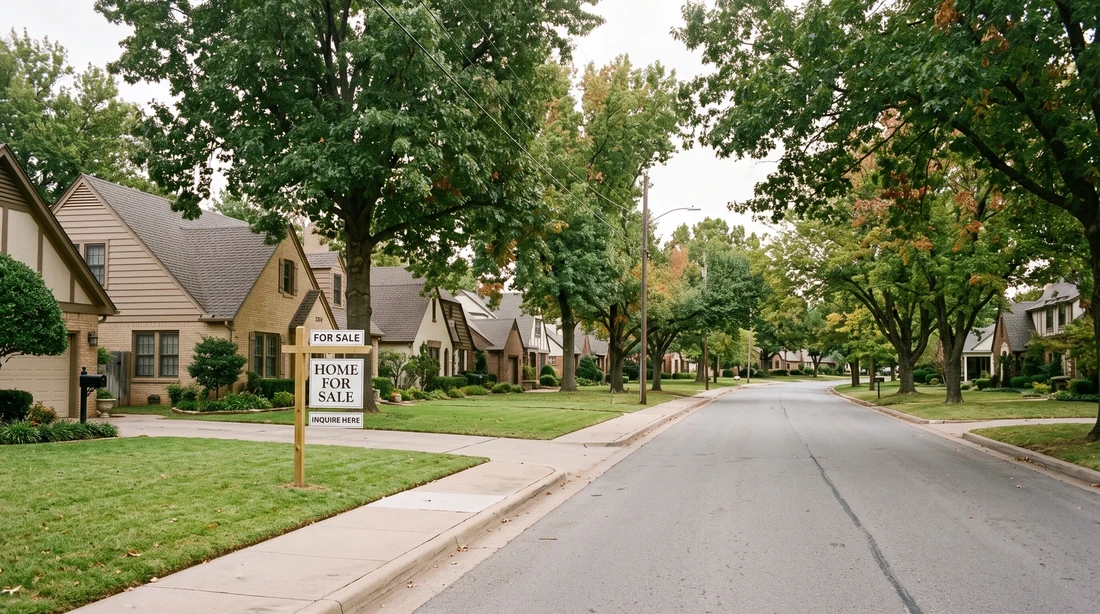
Between selling and buying a house, your four realistic options are a seller rent-back (often capped near 60 days by the buyer's lender), staying with family, an extended-stay hotel, or a furnished monthly rental. For gaps over 30 days, a furnished monthly rental is usually the cheapest all-in choice for a household that needs bedrooms, a kitchen, and laundry.
Key Takeaways
- Most sell-buy housing gaps run two weeks to three months; plan housing for your estimated gap length plus two weeks.
- A 60-day gap for a household of four typically costs $3,000 to $5,000 more in a hotel than a furnished monthly rental.
- A seller rent-back must be written into the purchase contract before signing, and lenders typically cap owner-occupant buyers near 60 days.
- Contents of a typical 3-bedroom house need a 10×15 to 10×20 storage unit, typically $160 to $280 monthly in the OKC metro.
Your sale closes in three weeks, the next house won't be ready for six, and everything you own has to live somewhere in the middle. That squeeze is real — but a sell-buy gap is a solvable logistics problem, and the households that plan it before closing day consistently spend thousands less than the ones who scramble after.
A rent-back has to be negotiated before you sign the purchase contract — once you've closed, you have zero leverage to stay in your old house. If that window has already passed, remember that every nightly-rate hotel week typically costs more than a furnished home's prorated week.

Why a Housing Gap Between Homes Happens
Most sell-buy housing gaps run two weeks to three months, and they almost always trace to one of four causes.
- You sold faster than you bought. In a competitive market, sellers often accept a strong offer before their next purchase is under contract — especially if they need the sale proceeds for the down payment. Many households deliberately sell first to avoid a contingent offer, then budget for the gap.
- New construction slipped. Builder delays of 30–90 days are common, and your buyer's closing date doesn't move just because your framing crew did. In the OKC metro, spring storm season (April–June) is a frequent culprit for slipped roofing and exterior timelines.
- A contingency fell through. If your purchase died in inspection or financing while your sale kept moving, you close on the old house with nowhere lined up — the shortest-notice version of this problem.
- You're relocating between cities. Selling in one metro before buying in another almost guarantees a gap. If OKC is the destination, our moving to Oklahoma City guide covers the house-hunting side — and if the move is tied to Tinker AFB or the FAA Academy at Will Rogers, the housing math has its own wrinkles covered below.
The one thing all four have in common: the gap length is an estimate, not a promise. Whatever number your agent gives you, plan housing for that number plus two weeks — closings slip, and builders slip more.
On how furnished corporate housing units are managed between guests:
The apartments managed by corporate housing companies are furnished and the corporate housing companies rotate clients in and out of the furnished apartments and service them between guests.
Wikipedia: Corporate housing
What a 30, 60, or 90-Day Gap Actually Costs
A 60-day housing gap for a household of four typically costs $3,000–$5,000 more in a hotel than in a furnished monthly rental once food, laundry, and fees are counted. Here's how the bleed compounds if you don't plan it:
- Closing day: your sale funds, the truck is loaded, and you check into whatever hotel had rooms — at a nightly rate with no weekly discount.
- Week two: restaurant meals for the whole household stack on top of the room rate, and coin laundry becomes a weekly errand.
- Week four: the pressure to just end the bleed starts warping your purchase — you're tempted to waive repairs or accept a house's flaws to stop paying nightly rates.
- Week six: if the new closing slips again, you're renegotiating a hotel extension (or a rushed lease) from the weakest position possible — and if an event weekend hits, your "extension rate" may jump.
- Month three: the small purchases pile up — a second slow cooker, more storage-unit trips, replacement items you own but can't reach — and the gap budget dies by a hundred cuts.
| Gap length | Extended-stay suite (~$149/night) | Furnished monthly home (~$3,900/mo) | 10×20 storage (~$220/mo) |
|---|---|---|---|
| 30 days | ~$4,470 + taxes/fees | ~$3,900, utilities included | ~$220 |
| 60 days | ~$8,940 + taxes/fees | ~$7,800, utilities included | ~$440 |
| 90 days | ~$13,410 + taxes/fees | ~$11,700, utilities included | ~$660 |
Hotel figures exclude the food delta — eating out instead of cooking typically adds $40–$60 per day for a household of four, which is another $1,200–$1,800 per month the table doesn't show. They also assume a flat nightly rate, which OKC event weekends routinely break (more on that below).
Closing date set and nowhere to land yet? BnB OKC keeps 11 furnished homes in the Oklahoma City metro with monthly rates on 30+ night stays and flexible extensions if your next closing slips. Check extended-stay availability for your gap dates or call/text (405) 870-2146.
Where to Live Between Selling and Buying a House: 5 Options Compared
Every bridge-gap option trades cost against flexibility, and the right one depends almost entirely on your gap length.
| Option | Typical all-in monthly cost (household of 4) | What's included | The catch |
|---|---|---|---|
| Seller rent-back | Often the buyer's daily carrying cost, roughly $60–$120/day | Your own house, zero extra moves | Must be negotiated pre-contract; often capped near 60 days |
| Family or friends | $0–$500 (groceries, contribution) | A roof, goodwill | Two households in one; storage still needed |
| Extended-stay hotel suite | ~$4,000–$5,500 + taxes and food delta | Housekeeping, kitchenette | One or two rooms for a whole household; pet fees |
| Furnished monthly rental | ~$3,000–$5,000, utilities typically included | Whole home: bedrooms, kitchen, laundry, yard | Usually needs a 30+ night stay to hit monthly rates |
| Short unfurnished lease | ~$1,400–$1,900 rent + deposits + utility setups | Four empty walls | Your furniture is in storage — you'd furnish it twice |
Seller rent-back (post-closing occupancy)
A rent-back lets you stay in the house you just sold, paying your buyer a daily rate — usually pegged to their mortgage, taxes, and insurance (their PITI). It's the only option with zero extra moves. The limits: it must be written into the purchase contract before signing, the buyer can simply say no, and buyers using a standard owner-occupant mortgage are typically limited by their lender to about 60 days.
Two details sellers miss: buyers commonly hold a deposit in escrow against the rent-back (sometimes called an escrow holdback), and once you close, the buyer's homeowner policy covers the structure — ask your own insurer what covers your belongings during the occupancy period. If your gap could run longer than 60 days, a rent-back alone won't cover it — but it makes an excellent first leg of a hybrid plan (see the worked example below).
Staying with family or friends
Free housing is genuinely the right call for short gaps — under two weeks, it's hard to beat. Past that, you're running two households under one roof, your belongings still need a storage unit, and a slipped closing turns a favor into a strain. If anyone in the house works from home or the kids need a routine, the savings shrink fast against the friction.
Extended-stay hotel
Extended-stay hotels sell flexibility: no lease, weekly rates, a kitchenette, and you can leave the day you close. For one or two adults with a short gap, they work fine. For a household of four, the math turns — you're often paying for two rooms or a suite, cooking real meals on two burners, and paying nightly pet fees if the dog comes along.
And nightly pricing means your rate floats with demand: a gap that overlaps the Women's College World Series or the Memorial Marathon can reprice your "extension" sharply upward. Our extended stay Oklahoma City guide breaks down when a hotel wins and when it doesn't.
Furnished monthly rental
A furnished monthly rental is a whole house — bedrooms, full kitchen, washer and dryer, often a fenced yard — billed by the month with utilities typically bundled in. For gaps of 30+ days it's usually the lowest all-in cost for anyone who needs more than one room, because the food and laundry savings compound weekly, and the monthly rate is insulated from event-weekend pricing. The disqualifier is the short gap: under roughly two weeks, most furnished operators' minimums and monthly-rate thresholds won't pencil. See furnished apartments in OKC for how the local monthly market prices out.
Short-term unfurnished lease
Some apartment communities offer 3-month leases at a premium — often 20–40% above the 12-month rate, plus deposits and utility setup fees. The structural problem: your furniture is sitting in storage, so you'd be renting an empty apartment and either living on air mattresses or paying to furnish a place you'll leave in 90 days. This option really only fits gaps you already know will run four months or more — a builder telling you "spring, probably" in November, not "six weeks."
| Option | Commitment terms | What disqualifies it |
|---|---|---|
| Rent-back | Written into purchase contract; daily rate; deposit common | Buyer declines, or gap exceeds ~60 days |
| Family/friends | None — and that's the risk | Gaps over ~2 weeks; remote work; no nearby family with space |
| Extended-stay hotel | Nightly or weekly; cancel anytime | Households needing multiple rooms; real cooking; long gaps |
| Furnished monthly rental | 30+ nights for monthly rates; week-to-week extensions common | Gaps under ~2 weeks |
| Short unfurnished lease | Usually 3-month minimum at a premium | Any gap under ~4 months; furniture in storage |
A Worked Example: 6 Weeks Between Closings
Say — purely as a hypothetical — a family of four closes on their sale June 1 and their new build won't be ready until mid-July: a 6-week (42-night) gap.
Furnished-home route: a furnished 3-bedroom at $3,900/month, prorated for six weeks, runs $3,900 × 1.5 = $5,850, utilities included. Add a 10×20 storage unit at roughly $220/month for two months: about $440. All-in: roughly $6,290 — with a full kitchen, in-home laundry, and separate bedrooms so everyone sleeps like a person.
Hotel route: an extended-stay suite at $149/night × 42 nights is $6,258 before taxes and fees, which typically add several hundred dollars more. Eating out instead of cooking adds roughly $40–$60/day for four people — call it $1,700–$2,500 over six weeks. Same $440 of storage. All-in: in the ballpark of $8,700–$9,600.
The gap between the two paths is roughly $2,400–$3,300 over six weeks — money most sellers would rather roll into the new house's closing costs.
Variant 1: the build slips to nine weeks
Now say the builder calls in week five: three more weeks. The furnished home extends at the prorated monthly rate — $3,900 ÷ 4 ≈ $975/week × 3 = $2,925 more, taking housing to about $8,775 plus roughly $110 of extra storage: call it $9,325 all-in for nine weeks. The hotel meters on: 21 more nights × $149 = $3,129 before taxes, plus another $840–$1,260 of eating out — pushing the hotel route toward $12,700–$14,000. The delta grows every week the closing slips, which is exactly when you can least control the timeline.
Variant 2: the hybrid — rent-back first, then bridge the rest
Suppose the same family negotiated a 30-day rent-back at $85/day before signing: $85 × 30 = $2,550 for the first month in their own house, no moves, no storage yet. That leaves a 12-night remainder — too short for monthly furnished rates, so they price it nightly: a furnished home at a published from-rate of $185/night × 12 = $2,220 (direct booking saves up to 35% on 4+ night stays, which can pull that lower), or a hotel suite at $149 × 12 = $1,788 plus taxes and roughly $500–$720 of eating out.
Either way the hybrid lands around $5,000–$5,700 all-in — typically the cheapest sequence available, which is why the rent-back conversation belongs in your purchase negotiation, not your moving-week panic.
Situations That Change the Answer
The gap-length math above assumes a generic household — these five situations move the answer.
- Kids mid-school-year: your temporary address can affect enrollment, so pick housing inside your current district's boundary when you can, and ask the district directly about finishing the year from a temporary address — policies vary and the school office, not the internet, has the real answer. A furnished home in the same part of the metro keeps the drop-off route intact.
- Two adults working from home: a hotel suite gives you one table and shared Wi-Fi; overlapping video calls from the same room for six weeks is a real cost that never shows on a receipt. A house with a spare bedroom as an office is the difference between a workable gap and a miserable one.
- A large dog or two pets: hotels commonly cap pet count and weight and charge nightly fees that compound fast over 40+ nights. A dog-friendly house with a fenced yard turns the pet from a daily fee into a one-time line item — see pet-friendly rentals in OKC.
- The gap blows past 90 days: around the four-month mark, a short unfurnished lease starts to pencil despite the double-furnishing problem — or negotiate a longer-term monthly rate on the furnished home before month two, when you still have leverage.
- You're relocating into OKC for orders or training: if the move is tied to Tinker AFB (southeast of the city) or an FAA Academy class at Will Rogers, your gap housing doubles as your house-hunting base — TDY lodging near Tinker AFB and FAA Academy housing in Oklahoma City cover those specific setups, including per-diem-friendly documentation.
Don't Forget Storage: The Combined Budget
Your real bridge-gap budget is three lines, not one: housing, storage, and the extra move.
- Storage unit: the contents of a typical 3-bedroom house need a 10×15 to 10×20 unit, which in the OKC metro typically runs $160–$280/month. Climate control adds a premium worth paying through an Oklahoma summer — interiors of standard units routinely cook well past 100°F, which is hard on wood furniture, electronics, and anything with glue in it.
- Portable container: a driveway-delivered container typically runs $150–$250/month plus delivery fees — and it moves to the new house without you reloading a truck, which cuts your move count from three to two. One Oklahoma-specific caveat: if your gap overlaps peak storm season (April–June), ask whether the container can sit at the company's secured yard instead of a driveway — hail doesn't care what's inside.
- Movers' storage-in-transit: if you've hired full-service movers, ask about holding your load in their warehouse; for short gaps it can beat renting a unit and paying for a second load-out.
Also check the insurance line: your homeowner policy on the sold house typically ends at closing, and coverage for belongings sitting in a storage unit or container varies by policy. Ask your insurer what covers stored contents during the gap before the truck loads — a cheap rider beats an uncovered loss.
The packing move that saves the most sanity: split everything into two piles before the truck arrives. Six weeks of daily-use items travel with you; everything else gets sealed for storage. Digging through a storage unit for a slow cooker in week three is how gap budgets die by a hundred small purchases.
Timing Your Gap Around OKC's Calendar
In Oklahoma City, when your gap falls changes what nightly lodging costs — but barely touches monthly furnished rates.
| Event / season | When | What it does to nightly rates |
|---|---|---|
| OKC Memorial Marathon | Late April | Hotel rates near downtown typically rise for the weekend |
| Women's College World Series (Devon Park) | Late May–early June | Metro-wide compression; nightly rates climb for 1–2 weeks |
| State Fair of Oklahoma | September | Rates near the fairgrounds typically rise for the run |
| Thunder home games (Paycom Center) | October–April, playoffs later | Downtown weekend spikes on game nights |
| Tornado season | April–June | Builder and roofing delays; displaced-household demand can tighten furnished supply |
The pattern to notice: a June closing gap — the most common season for family moves — overlaps both the WCWS and peak storm season. A locked monthly rate doesn't reprice when the city fills up; a nightly hotel bill does. If your gap dates touch late May through June, book the monthly option early.
How to Bridge the Sell-Buy Gap, Step by Step
- Pin down your true gap length — count from your sale's closing date to your realistic move-in date, then add a two-week buffer.
- Ask about a rent-back before you sign — request post-closing occupancy in the purchase negotiation, not after.
- Split your stuff into two piles — six weeks of daily-use items with you; everything else into storage or a container.
- Price 30-day options, not nightly ones — get monthly quotes from furnished rentals and extended-stay hotels for your exact dates.
- Book housing with a flexible end date — confirm week-to-week extension terms in writing before you pay.
- Set up mail forwarding and school addresses — forward USPS mail and confirm your kids' school enrollment isn't disrupted by the temporary address.
One more paperwork note while you're at it: if your next purchase is still in underwriting, keep your lender posted on the temporary address and hold onto every housing receipt — lenders re-verify details before closing, and clean documentation keeps a temporary address from becoming a question.
When You Don't Need a Furnished Rental
An honest read: plenty of sell-buy gaps don't need us at all.
- Gap under 10–14 days: a hotel — or family — is simpler and often cheaper than any monthly minimum.
- Rent-back secured: if your buyer agreed to 30–60 days of post-closing occupancy, staying put beats every option on this page. Take it.
- Single traveler with hotel points: one adult, one room, loyalty status — the hotel math can genuinely win.
- Known 4+ month gap: at that length, a short-term apartment lease starts to compete despite the furnishing problem — run both quotes.
A furnished home changes the outcome when the gap runs 30+ nights, when your household needs multiple bedrooms and a real kitchen, when a dog is coming along, when someone works from home, or when kids need a stable routine and their own beds while everything else is in flux. That's the profile where the per-month savings and the livability both point the same direction — the same math that drives corporate housing in Oklahoma City placements.
Bridging the Gap in Oklahoma City
If your gap lands in the OKC metro, BnB OKC operates 11 furnished homes sleeping 2 to 16+, with monthly rates on 30+ night stays and week-to-week extensions when a closing slips — the exact failure mode of sell-buy gaps. Guests rate the homes 9.5 out of 10 across 1,580 verified reviews on Airbnb and Vrbo, and two homes hold Airbnb's Guest Favorite badge.
Location matters more between homes than on vacation: homes near Lake Hefner, The Village, and the Paseo and Plaza districts let you keep the same commute and the same school drop-off while you wait on keys, and some sit six minutes from Will Rogers World Airport if your gap involves flying back for the old city's loose ends.
Published from-rates run $225–$425/night, direct booking saves up to 35% on 4+ night stays, and several homes are dog-friendly with fenced yards. Browse all properties, book direct to keep the savings, or start at the extended stays hub with your exact gap dates — and if your closing date moves, extensions are a text, not a renegotiation.
Terms You'll Hear, Decoded
- Rent-back (post-closing occupancy agreement): a contract clause letting you stay in your sold house and pay the buyer a daily rate.
- PITI (daily carrying cost): the buyer's principal, interest, taxes, and insurance — the usual basis for a fair rent-back daily rate.
- Escrow holdback: money from your sale proceeds held back at closing as the buyer's security deposit for the rent-back period.
- Contingent offer: a purchase offer that only stands if another condition — like selling your current house — happens first.
- Bridge loan: short-term financing that lets you buy the next house before your sale proceeds land; your lender decides eligibility.
- Prorated monthly rate: a monthly price divided down to cover a partial month, like six weeks billed as 1.5 months.
- Month-to-month extension: continuing a furnished stay in 30-day (or weekly) increments without a new lease — ask for the terms in writing.
- Storage-in-transit: your moving company warehousing your load between the two houses instead of you renting a unit.

Your Next Steps
- Confirm your true gap: sale closing date to realistic move-in date, plus a two-week buffer — and check whether those dates overlap late May–June, when OKC nightly rates climb.
- Get three quotes for those exact dates: one extended-stay hotel, one furnished monthly rental, and one storage unit or container, all priced all-in — including pet fees, taxes, and the eating-out delta.
- If your gap is in the OKC metro, check availability at our extended stays page or call/text (405) 870-2146 with your closing dates — extensions are simple to arrange if the next closing slips.
For getting oriented in the metro while you're between addresses, Visit OKC covers the districts and the City of Oklahoma City handles utility setup for the house you're waiting on.
This guide is general information, not financial, lending, or legal advice; your lender and your purchase contract govern rent-back limits and bridge financing.