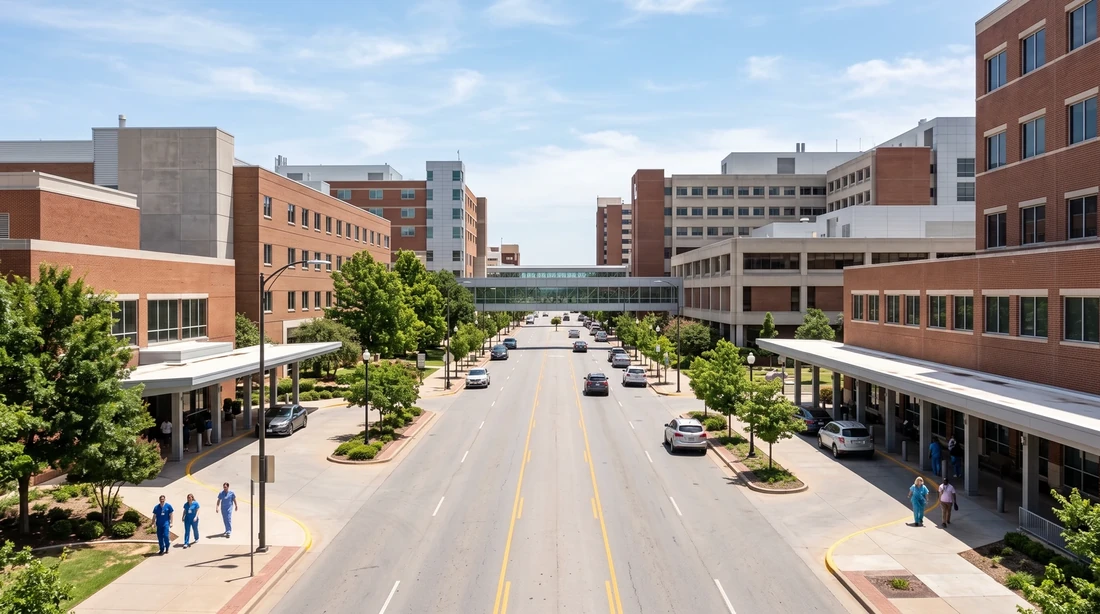
For lodging for medical treatment out of town, call the hospital's patient-lodging desk first: it holds discounted hotel medical rates and referrals to free nonprofit hospitality houses. Under two weeks, a hotel medical rate usually wins. Past 30 nights, a furnished rental on a monthly rate typically costs less than any hotel.
Key Takeaways
- Call the hospital's patient-lodging desk first; it holds discounted hotel medical rates and referrals to free nonprofit hospitality houses.
- Under two weeks a hotel medical rate usually wins; past 30 nights a furnished rental on a monthly rate typically costs less.
- An eight-week stay at $135 a night runs roughly $7,560 in room charges, plus $50 to $70 a day on restaurant meals.
- Capitol Manor sits directly across the street from OU Medical Center; INTEGRIS is roughly 10 minutes and Mercy roughly 10 to 15 minutes.
Your specialist just moved your treatment to a hospital three hours from home, and the schedule sheet says six weeks — maybe ten. Finding somewhere to sleep should not be harder than the treatment itself. This guide maps every real option for lodging for medical treatment out of town: the free programs, the hotel medical rates, the furnished rentals, who pays for what, and how to choose by treatment length.
Nonprofit hospitality houses run waitlists and typically cannot hold rooms weeks in advance, while furnished monthly rates only unlock at 30+ nights. The sooner you know your realistic treatment length, the more of the affordable options stay on the table — and every unplanned hotel night burns money a monthly rate would have stretched.

Why Lodging for Medical Treatment Out of Town Is Its Own Problem
Out-of-town treatment stays run anywhere from 3 nights to 100-plus days, and the lodging option that wins at one length loses badly at another. Three variables decide everything: how long you'll stay, how close you must be, and how many people are coming.
Length varies wildly by treatment. A surgical consult is 1–3 nights. A daily radiation course commonly runs 5–7 weeks. Many transplant programs require patients to remain within a set drive time of the hospital for 100 days or more after the procedure. Each of those lengths points to a completely different type of lodging.
Proximity is a real requirement, not a preference. Daily appointments turn a 40-minute drive into an hour-plus of round-trip fatigue every single day, and some programs set a maximum distance from the hospital in the discharge plan itself.
Headcount is usually at least two. Many treatment programs require a full-time adult caregiver on-site, so you are housing a minimum of two people — and if children come along, a single hotel room stops working fast. The single most expensive mistake patients make is booking a nightly-rate room for what turns into a two-month stay.
One more wrinkle: treatment length changes mid-stream. Blood counts, healing speed, and protocol adjustments extend stays all the time. Whatever you book, ask up front what an extension costs — the answer differs enormously between a hotel and a monthly rental.
For context on the OU Health system referenced above:
Headquartered in Oklahoma City , OU Health includes three hospitals—University of Oklahoma Medical Center, Oklahoma Children's Hospital OU Health, and OU Health Edmond Medical Center—as well as dozens of clinics and specialty centers across the state.
Wikipedia: OU Health
Situations That Change the Answer
Five circumstances routinely override the standard advice: children coming along, rotating caregivers, flying instead of driving, a lowered immune system, and — in Oklahoma — spring storm season.
Children on a long stay need more than a second bed. A 100-day stay that overlaps the school year means temporary enrollment or remote schooling, and either one needs reliable Wi-Fi and a quiet workspace a single hotel room can't offer. Ask your home district about its extended-absence and remote-schooling policies before you travel, not after.
Rotating caregivers trip up nonprofit housing. Many hospitality houses register the patient plus one named caregiver, so if siblings plan to trade two-week shifts, confirm swaps are allowed before counting on a free room. A furnished rental has no named-guest problem — caregivers come and go under one booking.
Flying in adds a car decision. A rental car typically runs $40–$60-plus a day, which quietly rivals the lodging bill on a long stay — unless your lodging is walkable to the campus or a partner hotel runs a shuttle. In OKC, Capitol Manor's across-the-street position at OU Medical Center removes the daily drive entirely, and BnB OKC's closest home is about 6 minutes from Will Rogers World Airport.
Lowered immunity changes the building type. If your care team advises avoiding shared spaces during treatment, hotel hallways, elevators, and breakfast bars all work against you; a private entrance, private kitchen, and in-unit laundry follow that guidance by default. Take direction from your care team on this, not a travel guide.
Spring stays in Oklahoma deserve one extra question. Tornado season peaks April through June, so for any 30-plus-night stay in that window, ask where you'd shelter — an interior room on the lowest floor, a storm shelter, or the hospital's own severe-weather plan if you're on campus. It's one question, asked once, before you book.
What Out-of-Town Patient Lodging Really Costs — And How the Bill Grows
An eight-week treatment stay at a $135-a-night hotel runs roughly $7,560 in room charges alone ($135 × 56 nights) — before a single meal out, parking fee, or load of laundry.
Add restaurant meals for a patient plus caregiver, typically in the ballpark of $50–$70 a day, and that eight-week stay picks up another $2,800–$3,900. The all-in total clears $10,000 for a stay that a furnished monthly rate typically covers for materially less — with a full kitchen doing most of the saving.
Here is how the bill escalates if you default to a nightly hotel and simply wait:
- Nights 1–7: You pay full nightly rates — often $120–$180 near major hospital campuses — and eat every meal out because there's no kitchen.
- Nights 8–29: Weekly hotel rates trim 10–20%, but restaurant meals, hotel parking, and paid laundry keep stacking $40–$80 a day on top of the room.
- Night 30: Monthly furnished rates unlock. Staying on a nightly rate past this point means paying the most expensive pricing structure for the longest kind of stay.
- Extension announced: A nightly hotel reprices you at whatever that week's rates are. In Oklahoma City, Memorial Marathon weekend in late April, the Women's College World Series in late May–early June, and the State Fair in September can spike or sell out rooms mid-treatment. A monthly furnished booking holds its rate through all of it.
Coming to Oklahoma City for treatment? Capitol Manor sits directly across the street from OU Medical Center and OU Children's Hospital, and monthly rates apply on 30+ night stays. Check extended-stay availability or call/text (405) 870-2146 — same-week placement is often possible.
Every Patient Lodging Option, Compared
Affordable lodging for medical patients spans nine distinct options, and most people only ever hear about two of them. The table below is the full menu; the sections after it explain how each one actually works.
| Option | Who it fits | Watch-outs |
|---|---|---|
| Hospital patient-lodging desk | Every patient — make this your first call | A referral service, not lodging itself; partner lists vary by hospital |
| Healthcare Hospitality Network house | Patients traveling a minimum distance for active treatment; free or small donation | Waitlists; distance and referral requirements; shared kitchens and common areas |
| Joe's House (directory) | Anyone comparing medical rates near a specific treatment center | A directory, not a booking service — confirm rates directly with each property |
| Ronald McDonald House | Families of pediatric patients in active treatment | Rooms allocated by need; waits can be long at busy children's hospitals |
| American Cancer Society Hope Lodge | Cancer patients plus one caregiver; free | Dozens of U.S. locations, but not every metro has one; eligibility rules apply |
| Fisher House | Military and veteran families near VA and military hospitals; free | Tied to VA/military treatment; rooms are space-available |
| Hotel medical rate | Stays under roughly two weeks | You must ask for it; savings often modest (10–20%); no kitchen |
| Extended-stay hotel | Two-to-four-week stays, solo or pairs | Kitchenette, not a kitchen; one room; weekly rates still stack up past a month |
| Furnished rental (30+ nights) | Monthly stays, patient plus caregiver or family, pets | Monthly pricing usually needs a 30-night minimum; book 2–4 weeks ahead |
Nonprofit patient lodging programs and directories
The Healthcare Hospitality Network is an association of nonprofit hospitality houses across the U.S. that lodge patients and caregivers free or for a small nightly donation, often under $50. Most houses require that you live a minimum distance away — commonly 30 to 60-plus miles — and that you're in active treatment, usually with a referral from your care team or a hospital social worker.
Joe's House is a nonprofit lodging directory originally built for cancer patients. It lists hospitality houses and hotels offering medical discounts near major treatment centers, searchable by hospital. Use it to build your comparison list, then confirm every rate directly — it's a directory, not a booking engine.
Three program-specific options round out the nonprofit tier. Ronald McDonald House serves families of pediatric patients near most major children's hospitals. American Cancer Society Hope Lodge offers free rooms to cancer patients and one caregiver at dozens of U.S. locations. Fisher House lodges military and veteran families near VA and military medical centers at no cost. If you qualify for any of these and a room is open, take it — nothing beats free.
Hospital lodging desks and hotel medical rates
Most large hospitals maintain a partner-hotel list with negotiated medical rates, held by the patient-lodging desk, guest services, or a social worker. Ask your scheduler for "the patient lodging list" — it exists more often than patients realize, and some partner hotels include a hospital shuttle.
Medical rates typically shave 10–20% off standard pricing, but you almost always have to ask the hotel directly for its "medical rate" or "hospital rate" — it's rarely published online. For a 3-night consult, this is usually your best-value option and the least hassle.
Extended-stay hotels
Extended-stay hotels fill the two-to-four-week gap: a kitchenette, weekly pricing, and no lease. Their limits show past a month — one room for everyone, a two-burner kitchenette instead of a real kitchen, and laundry that's often coin-operated down the hall. For a solo patient on a three-week course, though, they're a legitimately good answer.
Furnished rentals for 30-plus-night treatment plans
At 30 nights and beyond, a furnished rental typically becomes the cheapest structure available: one monthly rate covering rent, utilities, and Wi-Fi, plus a full kitchen and in-unit laundry that erase the $40–$80 daily "no kitchen" tax. Separate bedrooms mean the caregiver actually sleeps, and month-to-month extensions handle a treatment plan that runs long. Booking direct with a local operator instead of through a platform saves more — at BnB OKC, direct bookings save up to 35% on 4+ night stays across 11 furnished homes with published from-rates of $225–$425/night and monthly rates on 30+ night stays.
Traveling for Medical Treatment: Where to Stay, by Treatment Length
Treatment length alone eliminates most lodging options: under two weeks a hotel medical rate usually wins, two to four weeks favors an extended-stay, and 30-plus nights a furnished monthly rental typically costs the least.
| Treatment length | Best-value option | Why it wins |
|---|---|---|
| 1–3 nights (consult, procedure) | Partner-hotel medical rate | No minimum stay; the lodging desk's partner list often includes a shuttle |
| 4–13 nights | Hospitality house if eligible; otherwise extended-stay weekly rate | Free beats everything; weekly pricing plus a kitchenette otherwise |
| 14–29 nights | Get both quotes: extended-stay vs. furnished rental | Some furnished operators extend near-monthly pricing to three-week stays |
| 30–99 nights (radiation courses, staged surgeries) | Furnished rental at monthly rate | One rate covers rent, utilities, Wi-Fi; a full kitchen erases the daily food tax |
| 100+ days (many transplant protocols) | Furnished rental, month-to-month | Extensions hold the same rate when discharge and clearance dates move |
The 14-to-29-night band is the only real judgment call on this table. Get a weekly extended-stay quote and a furnished-rental quote for the same dates and compare all-in costs including food and laundry — BnB OKC's direct-booking savings of up to 35% start at just 4 nights, so sub-30-night stays aren't automatically hotel territory.
If Your Treatment Is in Oklahoma City
OKC's major treatment campuses — OU Health, INTEGRIS, and Mercy — each have a BnB OKC furnished home within roughly 15 minutes, and one home sits directly across the street from OU Medical Center.
| Hospital or campus | Closest furnished home | Typical drive |
|---|---|---|
| OU Medical Center | Capitol Manor | Directly across the street |
| OU Children's Hospital | Capitol Manor | Directly across the street (same campus) |
| INTEGRIS Baptist Medical Center | Lake Hefner–area homes | Roughly 10 minutes |
| Mercy Hospital Oklahoma City | Gaillardia and The Village homes | Roughly 10–15 minutes |
| Will Rogers World Airport | Closest home | About 6 minutes |
The 11 homes sleep 2 to 16+, several are dog-friendly (see pet-friendly rentals in OKC), and guests rate them 9.5 out of 10 on average across 1,580 verified reviews on Airbnb and Vrbo, with two homes holding Airbnb's Guest Favorite badge. Check-in is 4:00 PM, checkout 11:00 AM, and BnB OKC also handles insurance placements with Alacrity Solutions — relevant if displacement and treatment ever overlap.
Two campus details matter for daily-appointment schedules. OU Health's Stephenson Cancer Center sits on the same OU Medical campus, so a daily radiation or infusion schedule there gets the same across-the-street benefit from Capitol Manor. And many hospital garages charge daily parking, while a furnished home's driveway is free — a small line item that compounds across 30-plus round trips.
Caregivers need somewhere to breathe, too. The Paseo and Plaza districts — walkable galleries, coffee shops, and restaurants — sit roughly 10 minutes from the OU Medical campus; homes near Lake Hefner put running and biking trails minutes from INTEGRIS Baptist; and The Village, near Mercy, has groceries and everyday errands within a few minutes' drive. On a two-month stay, those details are the difference between coping and just enduring.
If you're weighing hotels first, we've mapped those separately: see hotels near OU Medical Center, where to stay near OU Children's Hospital, and hotels near INTEGRIS Baptist Medical Center for campus-specific comparisons.
Who Pays: Insurance, Trial Sponsors, and the Tax Rules
Standard health insurance rarely covers lodging, but three real channels can: plan travel benefits, clinical-trial sponsors, and the IRS medical-lodging deduction of up to $50 per person per night.
Some employer health plans include a travel-and-lodging benefit when you use a designated "center of excellence" for a major procedure. It's often buried in plan documents — call the member-services line and ask specifically whether travel and lodging for out-of-area care are covered, and at what caps.
Clinical trials frequently reimburse travel and lodging, and some sponsors use travel vendors that book everything for you. Ask the study coordinator for the written reimbursement policy — nightly caps, caregiver coverage, receipt requirements — before you book anything.
Two more channels are worth a phone call. In some states, Medicaid's non-emergency medical transportation (NEMT) benefit can extend to lodging when covered care requires overnight travel — ask your caseworker. And disease-specific foundations sometimes run lodging grant programs; the hospital social worker usually knows which ones are currently funded.
On taxes: the IRS generally allows up to $50 per night, per person (so $100 for a patient plus caregiver) as a medical-expense deduction when the lodging is primarily for and essential to medical care and isn't lavish. Keep every folio and invoice, and confirm your situation with a tax professional.
Whichever channel applies, get every lodging benefit in writing before you book. Ask these five questions:
- Does my plan or trial include a travel-and-lodging benefit, and does it require a specific facility?
- What are the nightly and total caps, and is a caregiver's lodging included?
- Is it reimbursement after the fact, or can the lodging be billed directly?
- What documentation do you need — itemized folios, mileage logs, proof of appointments?
- Is there a minimum distance from home before the benefit applies?
A Worked Example: Two Travelers Splitting One Furnished Home
The monthly math in this guide serves patients and the clinicians treating them alike — here's a fully hypothetical example using traveling nurses, because their numbers are the most public.
Say two travel nurses take staggered 13-week contracts at OU Medical Center, offset by six weeks. They share a furnished two-bedroom near the Paseo District at $3,800 per month all-in — rent, utilities, Wi-Fi, in-unit laundry. During the roughly seven weeks their contracts overlap, each pays $3,800 ÷ 2 = $1,900 a month. Booked separately, two extended-stay studios at about $115 a night would cost each nurse $115 × 30 = $3,450 a month. The shared home saves each of them roughly $1,550 a month during the overlap.
| Line item | Solo extended-stay studio | Shared furnished 2-bed |
|---|---|---|
| Monthly lodging cost per person | $3,450 ($115 × 30) | $1,900 ($3,800 ÷ 2) |
| Kitchen and laundry | Kitchenette; coin-op laundry | Full kitchen; in-unit laundry |
| Left from a $2,800/month housing stipend | −$650 | +$900 |
Now price out the solo weeks the stagger creates. With a six-week offset, each nurse spends about six weeks alone in the home and about seven weeks sharing. At roughly $880 a week (the $3,800 monthly rate broken down), six solo weeks cost about $5,280; seven shared weeks at about $440 each add $3,080.
That's roughly $8,360 in housing per 13-week contract — about $2,790 a month averaged out, still just under a $2,800 stipend and about $2,100 less than the $10,465 a solo studio would total ($115 × 91 nights). Trim the offset by lining up the incoming roommate before the outgoing one leaves, aligning lease dates where you can, and asking the operator about month-to-month terms up front.
The same structure works for a patient and caregiver on an eight-week radiation course. A hypothetical furnished two-bedroom at $3,400 a month runs $6,800 for two months; the $135-a-night hotel from earlier totals $7,560 in room charges plus $2,800–$3,900 in restaurant meals — $10,360 to $11,460 all-in. Cooking most meals in a full kitchen typically cuts that food line by half or more, putting the realistic gap in the ballpark of $4,000 over eight weeks.
If you're a traveling clinician rather than a patient, go deeper with travel nurse housing in Oklahoma City and Furnished Finder vs. Airbnb for travel nurses.
How to Find Lodging for Out-of-Town Medical Treatment, Step by Step
- Confirm your treatment length — Ask your care team for a realistic range, including the longest likely extension.
- Call the hospital's patient-lodging desk — Ask for the partner-hotel medical rates and referrals to nonprofit hospitality houses.
- Check the nonprofit options — Contact Healthcare Hospitality Network houses and search Joe's House for lodging near your treatment center.
- Ask who reimburses — Get your insurer's travel benefit or your trial sponsor's lodging policy in writing before you book.
- Match the option to your length — Book a hotel medical rate under two weeks, an extended-stay for two to four weeks, or a furnished monthly rental at 30-plus nights.
- Keep every receipt — Save folios and invoices for reimbursement or the medical-lodging tax deduction.
When You Don't Need a Furnished Rental
For a one-to-three-night consult, a hotel medical rate beats everything else — no kitchen needed, no minimum stay, and if you carry hotel status or a points balance, a short consult stay is exactly when to spend it. Honest guidance matters more to us than a booking.
Take the free room whenever you qualify for one. If a Healthcare Hospitality Network house, Hope Lodge, Ronald McDonald House, or Fisher House has space and fits your situation, nothing we or any hotel offers competes with free. A solo patient on a stay under two weeks — or under four with a decent extended-stay nearby — is also usually fine in a hotel structure.
A furnished home changes the outcome in specific situations: stays of 30-plus nights where monthly pricing wins outright; a patient plus caregiver — or a whole household — needing separate bedrooms and real rest; caregivers rotating shifts under one booking; a dog coming along; a care team advising a private kitchen and laundry; or an open-ended treatment timeline where month-to-month flexibility prevents mid-stay repricing. In those cases, an extended-stay furnished home is typically both cheaper and more livable than any hotel structure.
Terms You'll Hear, Decoded
- Patient lodging desk: The hospital office (sometimes a social worker) that keeps partner-hotel rates and hospitality-house referrals for traveling patients.
- Hospitality house: A nonprofit residence lodging patients and caregivers free or for a small donation, usually with distance and active-treatment requirements.
- Medical rate: A discounted hotel rate for patients and families, typically 10–20% off and available only if you ask for it.
- Center of excellence: A facility your health plan designates for certain procedures — travel-and-lodging benefits are often tied to using one.
- NEMT: Non-emergency medical transportation, a Medicaid benefit that in some states extends to lodging when covered care requires overnight travel.
- Trial travel reimbursement: A clinical-trial sponsor's written policy for repaying participant travel and lodging costs, with nightly and total caps.
For treatment logistics at Oklahoma City's two largest systems, the official hospital sites are the primary sources: OU Health and INTEGRIS Health both publish campus maps and patient-services contacts.
Your Next Steps
- Confirm your dates: Get your treatment start date and the realistic length range — including a possible extension — from your care team. The length picks the lodging type, and it decides whether monthly pricing is even on the table.
- Work the phones: Call the hospital's patient-lodging desk, then your insurer or study coordinator, and get any lodging benefit or medical rate in writing before booking anything.
- If your treatment is in OKC for 30+ nights: Check monthly availability at BnB OKC extended stays — including Capitol Manor directly across from OU Medical Center — or call/text (405) 870-2146.
This guide is general information, not insurance, medical, or tax advice; your health plan, trial sponsor, care team, and tax professional make the final decisions.