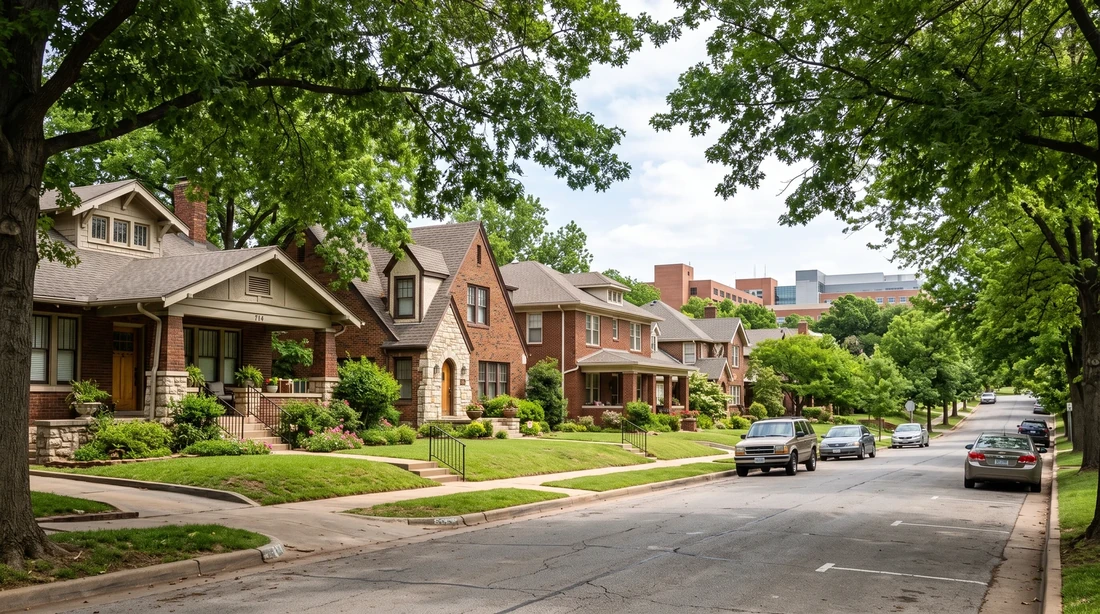
Medical resident housing in Oklahoma City comes down to three moves: a 12-month lease in Midtown, Mesta Park, or Edgemere Park (typically under 10 minutes to the OU Health campus); buying only if your program runs four-plus years; or a furnished monthly bridge directly across from OU Medical Center while you house-hunt in person.
Key Takeaways
- Match Day lands mid-March and OU orientation begins mid-June, leaving roughly 90 days; campus-adjacent inventory turns over fastest in April and May.
- Most OU residents live within a 10-minute drive of campus: Midtown (~7 min), Mesta Park (~8), Edgemere Park (~9), Paseo, Deep Deuce.
- Buying typically only pencils for programs of four-plus years, since round-trip transaction costs consume 8 to 10% of a home's value.
- In the hypothetical first-60-days comparison, a sight-unseen unfurnished lease costs about $8,450 to $10,150 versus about $5,200 for a two-month furnished bridge.
You matched to OU in mid-March. Orientation starts in June, you may never have set foot in Oklahoma City, and every decent listing near campus seems to be fielding multiple applications from people exactly like you. The squeeze is real — but the housing math in this city is unusually solvable, and this guide walks through every version of it.
The clock: Match Day lands in mid-March and OU orientation typically begins in mid-June — roughly 90 days. Rental inventory closest to the OU Health campus turns over fastest in April and May, when incoming interns, fellows, and traveling clinicians are all hunting the same few ZIP codes at once.

The Match-to-Orientation Crunch: Why Intern Year Housing in OKC Gets Tight
Every spring, hundreds of incoming interns and fellows converge on the same few square miles around the OU Health campus inside one 90-day window. The OU Health Sciences Center sits just northeast of downtown, and the walkable and near-walkable housing stock around it is finite.
The intern timeline compresses everything. Match results arrive in mid-March. April goes to contracts, licensing paperwork, and credentialing. May is when most people actually relocate or sign. Orientation typically runs in mid-June, and your first shift as a PGY-1 starts July 1 — ready or not.
OKC's spring event calendar tightens the same window from the other side. The OKC Memorial Marathon fills downtown in late April, and the Women's College World Series packs Devon Park — minutes from the Health Sciences Center — in late May and early June. Nightly rates on short-term stays near campus typically climb around both, which is exactly when incoming interns are trying to land.
You're not only competing with your co-interns. Travel nurses on 13-week OU Medical contracts chase the same furnished stock — see our guide to travel nurse housing in Oklahoma City — and families staying near the children's hospital fill the short-term inventory too, as we cover in where to stay near OU Children's Hospital.
The wrinkle unique to residents: unlike a traveler on a 13-week contract, you're committing to this city for three to seven years. That changes which mistakes are expensive. Signing a bad 13-week rental costs a season; signing a bad 12-month lease — or worse, buying the wrong house sight-unseen — costs years.
For context on how many trainees the campus absorbs each year:
It is the clinical partner of the University of Oklahoma College of Medicine and is closely affiliated with the university’s seven health professional colleges, which educate more than 4,000 students and residents annually.
Wikipedia: OU Health
What Waiting Costs Between Match Day and July 1
The cost of waiting isn't primarily money — it's choice: the campus-adjacent units with the best price-to-commute ratio are mostly spoken for by late May. Here's how the spring typically unfolds if you don't move:
- Late March: Full selection. Landlords near campus know the intern wave is coming and list early; you can be choosy on price, parking, and lease start date.
- April: The best Midtown and Mesta Park units start collecting multiple applications. Application fees stack up on places you're touring by video only.
- May: Sight-unseen decisions become the norm. You're wiring deposits to units you've seen for 40 seconds on a phone screen, hoping the photos weren't three tenants old.
- Early June: Leftover inventory — and the WCWS crowd. What's still open long-term is open for a reason, and nightly short-term rates near campus are at their seasonal peak.
- Orientation week: Hotel rates near the medical campus at $130–$160+/night burn $900–$1,100 a week while you scramble — money that was never in the budget.
None of these stages is fatal. But each one narrows your options and raises the odds you sign something you'll regret for 12 months — or buy something you'll regret for five years.
Matched to OU and need a landing spot before orientation? Capitol Manor sits directly across from OU Medical Center — walk to orientation while you house-hunt on your own timeline. Monthly rates on 30+ night stays.
Check Capitol Manor availability or call/text (405) 870-2146.
Your Options for OU Medical Residency Housing
Six housing structures cover nearly every incoming resident, and each one disqualifies itself in a specific situation. The table below is the honest version of that comparison.
| Option | Who it fits | Watch-outs |
|---|---|---|
| 12-month unfurnished lease | Residents confident in a neighborhood, with furniture or budget to furnish | Sight-unseen risk; deposits plus furnishing can run $5,000–$7,000 up front; renewal lands mid-crunch |
| Room in a co-resident house share | Solo interns on the tightest budgets, matched with classmates early | Hard to arrange from out of state; schedule friction; you inherit housemates' lease terms |
| Buying near campus | Programs of 4+ years, or anyone likely to stay in OKC after training | Round-trip transaction costs typically 8–10% of home value; maintenance on an intern's schedule; never buy sight-unseen |
| Furnished monthly rental (bridge or full year) | Anyone arriving from out of state, staggered moves, pet owners, 30+ night stays | Higher monthly sticker than unfurnished — but it replaces furniture, utility setup, and hotel weeks |
| Extended-stay hotel | Solo arrivals bridging 2–4 weeks on a lean budget | Kitchenette-only, thin workspace, and 91 nights typically overruns a $2,400/month budget |
| Standard hotel | 2–3 night apartment-hunting trips | At $130–$160+/night it's the most expensive structure per week; no kitchen or laundry |
For the hotel routes, our breakdown of hotels near OU Medical Center covers the short-trip play. For longer furnished stays, our extended stays page explains how monthly pricing works, and Furnished Finder vs. Airbnb compares the platforms clinicians actually use to find them.
Where Do Residents Live in Oklahoma City?
Most OU residents cluster within a 10-minute drive of the Health Sciences Center — Midtown, Mesta Park, Edgemere Park, Paseo, and Deep Deuce absorb the bulk of intern leases. The trade is simple: minutes to campus versus dollars and square footage.
| Neighborhood | Typical drive to campus | Why residents pick it |
|---|---|---|
| Lincoln Terrace / campus edge | Walkable–5 min | Historic homes bordering the Health Sciences Center; post-call walk home |
| Deep Deuce / Automobile Alley | ~5–7 min | Newer apartments, downtown dining, easy I-235 access |
| Midtown | ~7 min | Densest mix of apartments, coffee, and restaurants; the default intern answer |
| Mesta Park / Heritage Hills | ~8 min | Historic rentals, tree streets, garage apartments at fair prices |
| Paseo District | ~8 min | Arts district character, duplexes and small units, walkable food |
| Edgemere Park | ~9 min | Quiet historic pocket between Paseo and Western Ave |
| Plaza District | ~12 min | Nightlife and murals; slightly cheaper per square foot than Midtown |
| The Village / Lake Hefner area | ~15–18 min | More square footage per dollar, yards, lake trails for off-days |
| Edmond | ~25–30 min | Suburban space and newer builds — a real commute on a 6 AM pre-round |
Drive times are typical off-peak estimates; a 6 AM pre-rounding commute is kinder than a 5 PM one. The honest rule from local experience: interns underestimate how much a sub-10-minute commute matters on a 28-hour call schedule. Space feels valuable in April when you're choosing; proximity feels valuable in November when you're post-call.
Three practical notes the listings won't tell you. The OKC Streetcar loops downtown and Midtown but doesn't reach the Health Sciences Center — plan on a car and ask every landlord about off-street parking, because street parking in Mesta Park and Paseo tightens on event nights. Second, the historic districts run older HVAC; ask when the unit's system was last replaced before an Oklahoma July.
Third, if your rotations send you across the metro — some programs place residents at other hospitals, including sites on the northwest side near Integris Baptist — a Midtown or Paseo base splits those drives better than living hard against campus; our guide to hotels near Integris Baptist Medical Center maps that side of town.
Traveling clinicians weigh these same districts slightly differently — our guide to the best neighborhoods for travel nurses in Oklahoma City runs that version of the map.
Buy, Rent, or Bridge: Housing Math for a 3-to-7-Year Residency
Round-trip transaction costs on buying and then selling a home typically consume 8–10% of its value — which means the length of your program, not the size of the mortgage payment, is what actually decides this question.
For a 3-year program (most internal medicine, pediatrics, family medicine tracks), renting usually wins. You'd need meaningful appreciation in 36 months just to break even on closing costs, agent fees, and the furniture and maintenance a house demands — on an intern's schedule and salary.
For a 5-to-7-year program (surgery and surgical subspecialties, or residency plus a planned OKC fellowship), buying can genuinely pencil. Oklahoma City remains one of the more affordable major-metro housing markets in the country, and five-plus years gives transaction costs time to amortize. One quiet advantage of buying near campus: when you finish, your buyer pool includes the next intern wave, which arrives on a schedule you can set your calendar by.
Two OKC-specific cautions. First, tornado season peaks April through June — budget for a roof inspection, ask about hail history, and understand that wind and hail exposure shapes homeowner's insurance quotes here more than in most states. If you rent instead, carry renter's insurance for the same reason. Second, never compress a purchase into the 90-day Match-to-orientation window from out of state. A house bought sight-unseen under deadline pressure is the single most expensive mistake on this page.
That's what the bridge is for: rent furnished for one to three months, start the program housed and sane, then buy — or sign a 12-month lease — with your own eyes on the property and zero countdown pressure.
The Furnished Bridge: House-Hunt From Across the Street
Capitol Manor sits directly across from OU Medical Center and OU Children's Hospital — close enough to walk to orientation. It's a fully furnished home with a real kitchen, laundry, and workspace, which means you arrive with suitcases, not a moving truck, and nothing signed sight-unseen.
It's one of 11 furnished homes BnB OKC operates across the metro, holding a 9.5 out of 10 average across 1,580 verified guest reviews on Airbnb and Vrbo, with two homes carrying Airbnb's Guest Favorite badge. Stays of 30+ nights get monthly rates, and booking direct saves up to 35% versus platform pricing on 4+ night stays.
Practical details that matter mid-relocation: check-in is 4:00 PM and checkout 11:00 AM, several homes are dog-friendly (see pet-friendly rentals in OKC — most 12-month landlords near campus are far pickier about pets than a furnished operator is), and month-to-month extension is a phone call, not a lease amendment. If your closing date slips or your first-choice apartment isn't free until August, the bridge stretches with you. And if you're flying in for the move, several of our homes sit about 6 minutes from Will Rogers World Airport — you can land, get keys, and be unpacked the same afternoon.
Worked Example: A $2,400/Month Housing Budget at OU Medical
Here's a clearly hypothetical scenario with the math shown. Say a travel nurse takes a 13-week OU Medical contract with a $2,400/month housing stipend — about $7,200 across roughly 91 nights (3 × $2,400). Three structures, same 91 nights:
- Standard hotel at $139/night: 91 × $139 ≈ $12,649 before taxes — roughly $5,400 over the stipend, with no kitchen or laundry.
- Extended-stay hotel at $95/night: 91 × $95 ≈ $8,645 — still about $1,400 over, in a kitchenette room.
- Furnished monthly rental in the ballpark of $2,300/month all-in: 3 × $2,300 ≈ $6,900 — about $300 under the stipend, in a full home where cooking replaces 13 weeks of restaurant meals.
| Option | 91-night ballpark cost | Against a $7,200 budget |
|---|---|---|
| Standard hotel ($139/night) | ≈ $12,649 + taxes | ≈ $5,400 over |
| Extended-stay ($95/night) | ≈ $8,645 | ≈ $1,400 over |
| Furnished monthly (≈ $2,300/mo) | ≈ $6,900 | ≈ $300 under |
Variant one — the contract extends. Extensions are common at OU Medical. Say the same nurse renews for a second 13 weeks: 26 weeks, roughly 182 nights, $14,400 of total stipend (6 × $2,400). Furnished at the same ≈$2,300/month: 6 × $2,300 = $13,800 — still about $600 under. The extended-stay hotel at $95/night: 182 × $95 ≈ $17,290 — now roughly $2,900 over, for six months in a kitchenette. The longer the stay, the wider the furnished gap gets.
Variant two — the intern version. Now swap the persona: a hypothetical incoming intern couple arrives June 1 from out of state with a dog, no furniture, and the same $2,400/month ceiling, weighing a sight-unseen 12-month lease against a two-month bridge followed by an in-person signing. The lease is cheaper per month — but the first 60 days of cash tell a different story:
| Line item | Sight-unseen 12-month unfurnished | 2-month furnished bridge |
|---|---|---|
| Rent / monthly rate (60 days) | 2 × $1,400 = $2,800 | 2 × ≈$2,600 = ≈$5,200 |
| Security + pet deposits | ≈ $1,400 + $400 | Typically none beyond the booking |
| Application and admin fees | ≈ $150 | $0 |
| Furniture, kitchen basics, linens | ≈ $3,500–$5,000 | Included |
| Utility deposits and setup (OG&E, Oklahoma Natural Gas, city water) | ≈ $200–$400 | Included |
| Total first 60 days | ≈ $8,450–$10,150 | ≈ $5,200 |
Be clear about what this table does and doesn't say. Over a full year, the unfurnished lease is the cheaper structure — the deposits come back and the furniture is yours. What the bridge buys is the removal of sight-unseen risk and roughly $3,000–$5,000 of month-one cash pressure, at exactly the moment you're also paying licensing fees and a cross-country move. The structure of the math doesn't care whether the badge says RN or MD.
Situations That Change the Answer
A handful of circumstances reliably reshuffle the options above — and they're the ones most housing guides skip.
Staggered arrivals. One of you starts July 1; the other is finishing a job or a lease elsewhere until September, and the furniture is arriving on its own schedule. A 12-month lease starts billing the day it's signed whether the household is there or not. A month-to-month bridge bills only for the months you actually need, then hands off to a lease timed to the full household's arrival.
Moving with kids. OKC-area school districts typically start their year in August, weeks after your July 1 start. Signing a lease sight-unseen also locks a school assignment sight-unseen. Bridging through the summer lets you pick the district deliberately and sign an August lease that matches the school calendar instead of fighting it.
Dog owners. The historic rentals closest to campus are the strictest segment of the OKC market on pets — breed lists, weight caps, stacked deposits. A dog-friendly furnished month buys you time to find the minority of long-term landlords who'll say yes, instead of taking the first one who will.
Off-cycle starts. Not everyone lands in the July wave — some fellowships and off-cycle positions start mid-year, which puts you house-hunting through the December holidays. The good news: no intern wave to compete with. The bad news: less inventory listed at all. The bridge works identically in January; the crunch dynamics of this article simply don't apply, and you can be pickier.
Planning to buy from day one. Closing dates slip — inspections, appraisals, financing. A lease can't absorb a three-week slip; a month-to-month stay can. If you're a 5-to-7-year resident buying early, flexibility on the housing side is what keeps a delayed closing from becoming a hotel bill.
If any of these is your situation, that's the moment to check Capitol Manor's monthly availability before the April–June window closes around you.
How to Secure Medical Resident Housing in Oklahoma City, Step by Step
- Confirm your dates. Get your orientation start date and program schedule from your GME coordinator the week after Match Day.
- Set your monthly ceiling. Budget 25–30% of your PGY-1 gross salary for housing, which typically lands between $1,200 and $1,600 per month.
- Book a furnished bridge. Reserve a 30-plus-night furnished stay near campus so nothing gets signed sight-unseen.
- Tour in person. Walk Midtown, Mesta Park, Paseo, and Edgemere Park during your first weeks and shortlist two or three units.
- Sign on your timeline. Negotiate a July or August lease start so your renewal never again collides with the March-to-June crunch.
When You Don't Need a Furnished Bridge
Plenty of incoming residents never need us, and it's worth saying plainly. If you already live in the OKC metro, if a trusted friend or co-resident can physically tour units for you, or if your program connects you with an outgoing resident handing off a good lease, a direct 12-month signing is the cheaper move — take it. Ask your GME office and program coordinators specifically about lease handoffs; graduating residents leave every June, and an inherited lease in Mesta Park is often the best deal on this entire page.
Same for the short trip: flying in for a 2–3 night apartment-hunting weekend is a hotel job, not a monthly rental job — start with hotels near OU Medical Center. If the budget is genuinely tight, splitting a two-bedroom with a co-intern beats any furnished option on pure dollars — coordinate in your program's incoming-class group chat before April, because arranging a share from out of state gets harder every week after. And if you have family in the metro willing to host you for a month, that's a free bridge; use it.
The bridge earns its cost in specific situations: you're arriving from out of state and refuse to sign sight-unseen, you have a dog most campus-area landlords will reject, your partner or your furniture arrives on a different timeline than you do, your stay is 30+ nights, or you're planning to buy and need housing that flexes around a closing date. In those cases, the furnished month is what buys back your leverage.
Terms You'll Hear, Decoded
- Match Day: The mid-March day residency placements are announced — the starting gun for the housing crunch.
- PGY-1: Postgraduate year one, your intern year; it starts July 1 whether your housing is sorted or not.
- GME orientation: The mandatory onboarding weeks before July 1 — the true deadline your housing must beat.
- Housing stipend: A fixed monthly housing allowance (common in travel contracts); whatever you don't spend on lodging, you typically keep.
- Month-to-month: A stay that renews monthly with no fixed end date — the flexibility that makes a bridge a bridge.
- Direct booking: Reserving with the operator instead of through a platform, which is how our up-to-35% savings on 4+ night stays works.
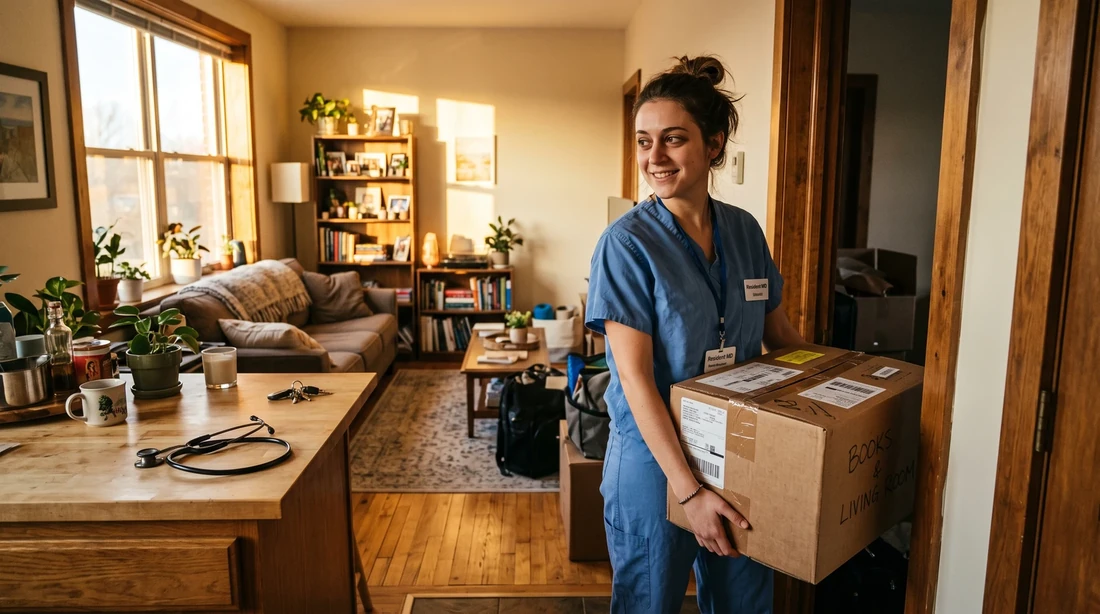
Your Next Steps
- Confirm your real deadline. Email your GME coordinator for your exact orientation start date — that date, not July 1, is what your housing has to beat — and ask in the same email whether any graduating residents are handing off leases.
- Run both versions of the math. Price a sight-unseen 12-month lease (deposits, fees, furnishing, utility setup) against a two-month furnished bridge plus an in-person signing, using the first-60-days table above, and shortlist three neighborhoods from the drive-time table.
- Lock the bridge if you need one. Check monthly availability at Capitol Manor, directly across from OU Medical Center, or call/text (405) 870-2146 with your orientation dates — April books what June scrambles for.
For campus and program logistics, start with OU Health's official site; for getting to know the districts before you land, Visit OKC covers Midtown, Paseo, and the Plaza in depth.
Stipend and salary figures here are general education, not tax or financial advice — consult a tax professional about your own situation.