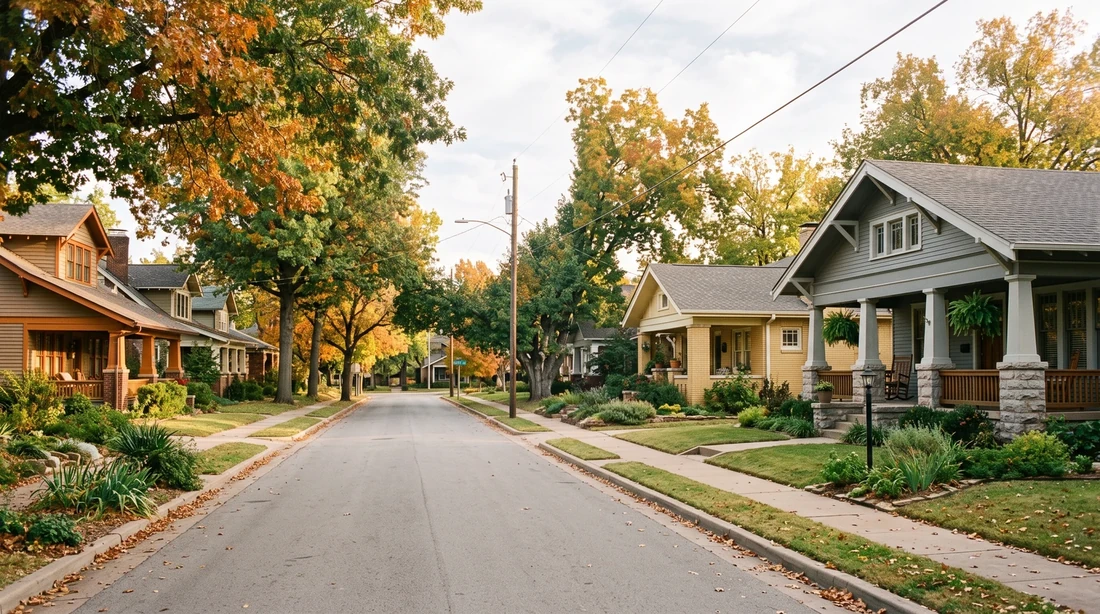
Since February 2025, any Oklahoma City short-term rental that is not the operator's primary residence — or that sits in a Historic Preservation district — must apply to the Board of Adjustment for a $300 special exception permit. Boards can now weigh block density (a 10% cap per block), restrictive covenants, and traffic. Without the permit, home shares are capped at 10 rental nights per month.
Key Takeaways
- Since February 2025, OKC short-term rentals that are not the operator's primary residence must apply for a $300 special exception permit.
- The Board of Adjustment can now weigh restrictive covenants, traffic, and block density, with rentals capped at 10% of homes on a block.
- Without the special exception, home shares are capped at 10 rental nights per month.
- Rentals in a Historic Preservation district also need the special exception, whether they list on Airbnb, Vrbo, or take direct bookings.
If you own a second home you've been renting on Airbnb or Vrbo in OKC, this rule changes what you can legally do with it. The city no longer treats every short-term rental the same — where the home is and whether you live in it now decide whether you file paperwork and stand before a board. This is the exact compliance work a professional operator handles so guests never have to think about it.
Below is the plain-English version of the OKC short-term rental special exception process: who needs it, how the hearing works, what boards can now deny you for, and what it means whether you're a host or a traveler looking for a home that won't get shut down mid-stay.
Operating a non-primary-residence rental without a special exception caps you at 10 rental nights per month — and the Board can deny an application or renewal for a full year if the ordinance is violated. Every month you rent uncovered is exposure.

What Changed and Why This Rule Exists
Oklahoma City's short-term rental framework began with an ordinance adopted January 15, 2019, and the rules were strengthened effective February 2025. The core idea: separate people renting a room or their own house from investors running whole non-owner-occupied properties as full-time lodging.
The city draws a line at your primary residence. If you live in the home and share it, the rules are lighter. If the property is a second home, an investment property, or sits inside a Historic Preservation district, you need a special exception from the Board of Adjustment — a formal permit granted after a public hearing.
The concern driving the tighter 2025 language was neighborhood impact: too many investor rentals concentrated on one block, parking and traffic spillover, and homes operating against neighborhood covenants. The Board was given power to weigh all three. For the broader picture of what's allowed citywide, see our full breakdown of OKC short-term rental rules.
Wikipedia notes that city rules are not the only limit on rentals:
In addition to government-imposed restrictions, many homeowner associations also limit short-term rentals.
— Wikipedia: Airbnb
Who Needs the Special Exception Permit
The special exception is required whenever the rental is not your primary residence, or it's in a Historic Preservation district. That's the trigger — it doesn't matter whether you list on Airbnb, Vrbo, or take direct bookings.
If you live in the home as your primary residence and share it, you generally fall under the lighter home-sharing rules. If you don't — or the district flags it — you file. Operators who were actively renting a non-primary property before the original January 15, 2019 ordinance were protected from most changes for at least 10 years under a grandfather clause, but that protection is tied to that specific pre-2019 activity.
| Item | Before Feb 2025 | After Feb 2025 |
|---|---|---|
| Non-primary rental permit | Required since 2019 ordinance | Required; enforcement strengthened |
| Filing fee | Proposed at $1,200 in 2019, reduced to $300 | $300 special exception fee |
| Block density limit | Not formally capped | STRs cannot exceed 10% of homes on a block |
| What the Board weighs | Basic zoning fit | Covenants, traffic impact, block density |
| No-permit night cap | Limited home-share allowance | 10 rental nights per month maximum |
| Penalty for violation | Standard code enforcement | Denial of application/renewal for one year |
What It Costs and What Happens If You Skip It
The Home Sharing special exception filing fee is $300 — notably, the fee was originally floated at $1,200 back in 2019 before the city reduced it to $300. That's the direct cash cost. The larger cost is what you lose without it.
Without a special exception, a home share is capped at 10 rental nights per month. For an investor counting on 20-plus booked nights, that cap effectively ends the business model. And if you operate outside the ordinance, the Board can deny your application or renewal for one year — meaning a violation doesn't just fine you, it can lock you out of legal operation for 12 months.
- You rent a non-primary home with no permit: you're capped at 10 nights/month, and every extra night is a code exposure.
- The city flags it: enforcement can act on the violation. See our reporting on the OKC Airbnb enforcement crackdown.
- A denial follows: the Board can refuse your application or renewal for a full year, taking the property offline as a legal STR.
Want a compliant OKC stay without the permit worry? Our furnished homes are operated to the city's rules, so your dates hold. Book direct and skip the guesswork.
Check availability & book direct Call or text (405) 870-2146
How the Board of Adjustment Hearing Works, Step by Step
The special exception is granted after a public hearing where the Board weighs your specific block and neighborhood — it is not an automatic stamp. Boards can now evaluate restrictive covenants that prohibit home-sharing and assess vehicular traffic impacts before deciding.
- Confirm the trigger: verify the property is non-primary or in a Historic Preservation district, which requires the special exception.
- Check the block density: confirm STRs don't already exceed 10% of the homes on that block.
- Review your covenants: read any HOA or neighborhood covenants, because the Board can weigh ones that prohibit home-sharing.
- File the application: submit to the Board of Adjustment with the $300 filing fee.
- Prepare for the hearing: be ready to address traffic, parking, and neighborhood impact questions.
- Attend and comply: if approved, operate within the ordinance so your renewal isn't denied for a year.
What This Means If You're an OKC Guest or a Displaced Family
For travelers, the takeaway is simple: book a home run by an operator who has done this compliance work, not a one-off listing that could be capped or shut down. A rental hitting its 10-night monthly limit — or facing a Board denial — is a booking that can evaporate.
This matters most for longer stays. A weekend guest rarely feels the risk, but a family displaced by a house fire needing four months, a traveling nurse on a 13-week contract, or a group booking a tournament week wants certainty their home won't disappear over a permit issue. Navigating this ordinance is exactly what a professional operator does daily.
BnB OKC runs 11 furnished homes across the metro, with a 4.8-star average across 1,247 verified guest reviews on Airbnb and two homes holding Airbnb's "Guest Favorite" badge. Homes sleep 2 to 16+, several are dog-friendly, and we offer monthly rates on 30+ night stays — the kind of stay where compliance certainty matters most.
A Worked Example: What the Permit Means for One Host (Hypothetical)
Say a host owns a second home in an OKC neighborhood and wants to rent it 22 nights a month. This is a hypothetical to show the math, not a real case.
- Without a special exception, the home is capped at 10 nights/month — so 12 of those 22 planned nights are simply off the table legally.
- To rent all 22 nights, the host files for the special exception at $300 and stands before the Board.
- If STRs already fill 10% of that block, the application can be denied on density alone — no fee refund guaranteed, and the property stays capped at 10 nights.
- If a neighborhood covenant prohibits home-sharing, the Board can weigh that and deny.
- If the host operates the extra nights without the permit and gets flagged, the Board can deny the application or renewal for a full year — turning a $300 problem into 12 months offline.
The lesson: the $300 fee is small; the block density and covenant checks are what actually decide whether the home can run as a full-time rental. A guest booking with a compliant operator never carries any of this risk.
Planning a stay around a big OKC event where compliant availability tightens fast, like the Route 66 Centennial in OKC? Booking with a permitted operator early protects your dates.
How OKC Compares to Nearby Norman
OKC isn't the only metro tightening short-term rental rules. Neighboring Norman runs its own licensing regime — see our guide to the Norman short-term rental license — and recently moved on lodging taxes, covered in our piece on the Norman hotel tax increase. If you operate or stay across the metro line, the rules and fees differ by city, so check each jurisdiction separately.
Terms You'll Hear, Decoded
- Special exception: a permit granted by the Board of Adjustment after a public hearing, allowing a use (here, a non-primary STR) that isn't automatically permitted.
- Board of Adjustment: the city body that reviews and approves or denies special exception applications.
- Primary residence: the home you actually live in; rentals here fall under lighter rules than non-primary properties.
- Historic Preservation district: a designated area where a special exception is required regardless of whether the home is your residence.
- Restrictive covenant: a private neighborhood or HOA rule the Board can now weigh — some prohibit home-sharing outright.
- Grandfather clause: protection for operators actively renting a non-primary property before the January 15, 2019 ordinance, shielding them from most changes for at least 10 years.