Oklahoma City history starts at noon on April 22, 1889, when roughly 50,000 people raced into the two-million-acre Unassigned Lands and a town of several thousand stood by nightfall. Statehood followed in 1907, the capital arrived in 1910, oil came in 1928, and the 1993 MAPS vote rebuilt downtown. Most of it you can still walk through today.
You are in Oklahoma City for a while, you have seen the Thunder banners and the canal, and you want to know how a city gets built in an afternoon. This is the version we give our guests: the dates that matter, in order, each tied to a place you can drive to this week.
Three facts carry the whole story. The city was legally empty at 11:59 a.m. on April 22, 1889 and had thousands of residents by dark. The state capital was voted here in 1910 and then sat on top of an oil field by 1930. And the downtown you walk today was paid for by a one-cent sales tax voters approved in 1993.
This guide moves from the Land Run to statehood, the capital fight, the oil boom, the Depression, the bombing of 1995, and the MAPS era, with a table of the sites that go with each chapter and a plan for seeing them from one home base.
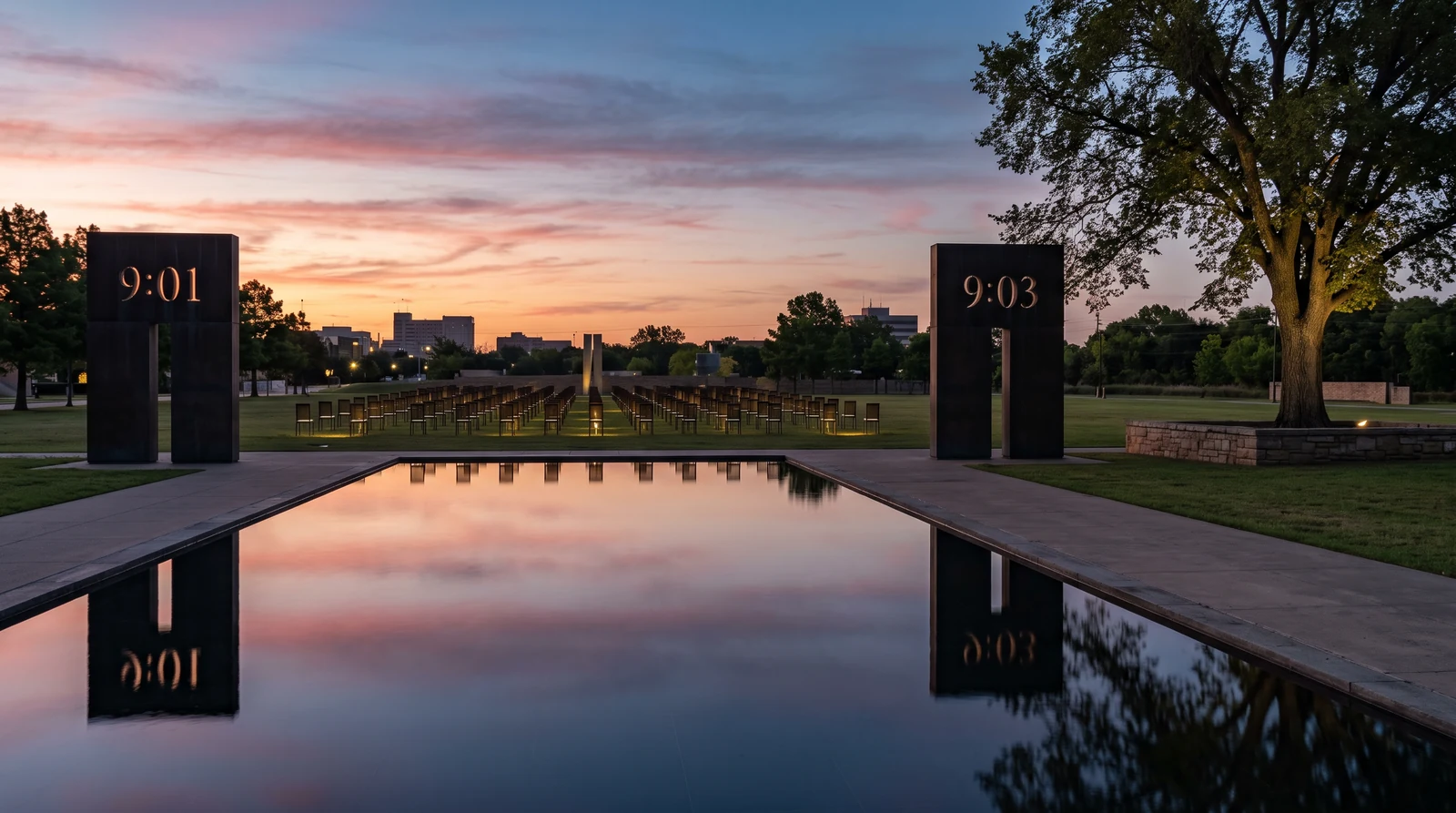
The Oklahoma City National Memorial's outdoor grounds are open year-round and free, while the museum sells its last ticket one hour before closing (9 a.m. to 5 p.m. Monday through Saturday, noon to 5 p.m. Sunday). Give the Memorial its own morning rather than tacking it onto a Bricktown afternoon.
April 22, 1889: A City by Nightfall
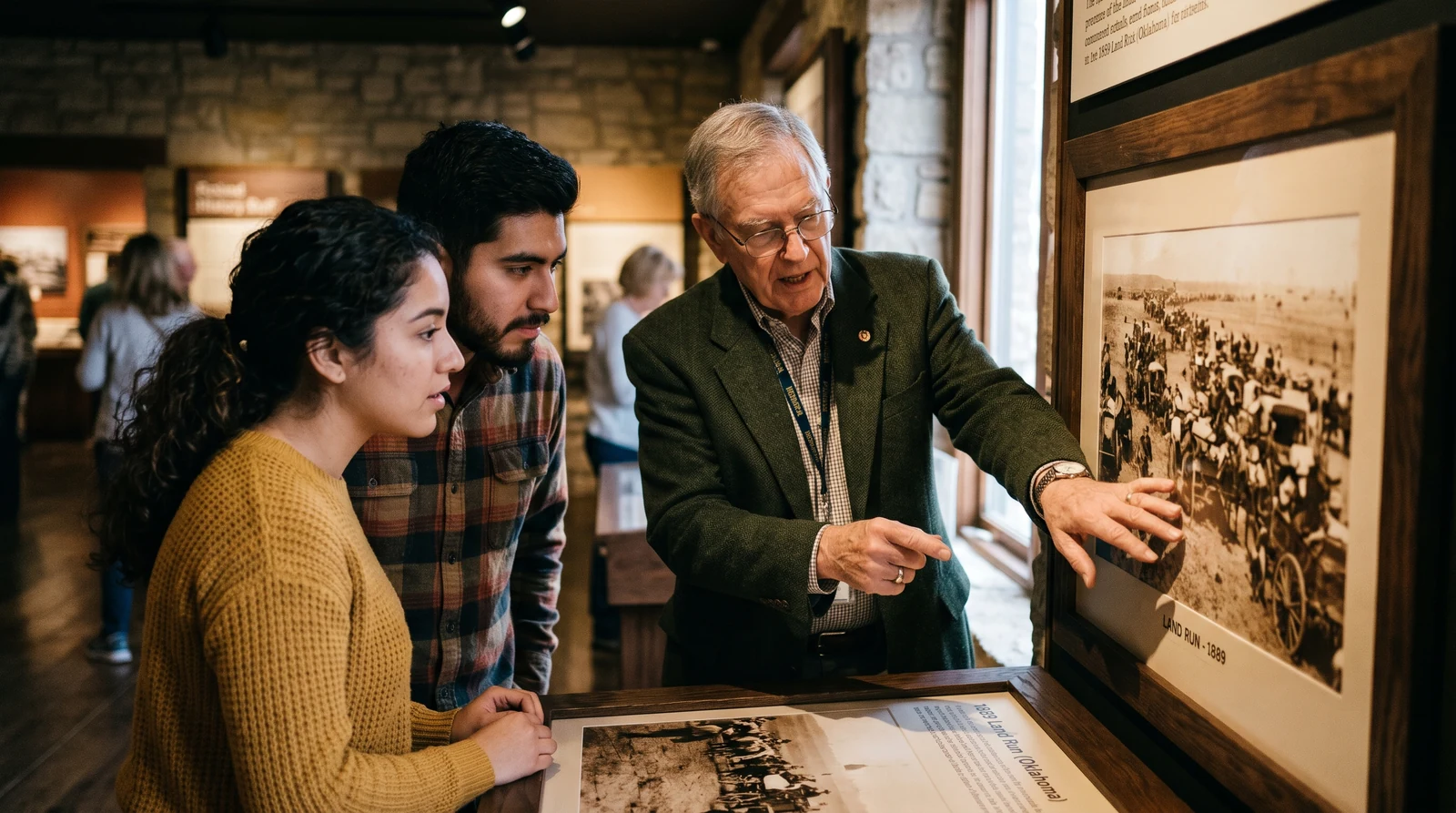
The Land Run of 1889 opened the Unassigned Lands, a two-million-acre tract in the middle of what is now Oklahoma, at noon on April 22, 1889. President Benjamin Harrison's proclamation setting the date was signed March 23, after an Illinois congressman named William Springer amended the Indian Appropriations Bill to authorize the opening.
An estimated 50,000 people surrounded the boundary that morning. Each legal settler could claim a 160-acre homestead under the Homestead Act of 1862, and about 11,000 agricultural homesteads were claimed. The rest of the crowd wanted town lots.
The first Santa Fe train from Arkansas City reached Guthrie at 1:25 p.m. and found the townsite already crowded. A train from Purcell pulled into Oklahoma Station, the depot that became Oklahoma City, at 2:10 p.m. The Oklahoma Historical Society estimates four to six thousand settlers arrived at Oklahoma Station that day.
Some had not waited for noon. Settlers who slipped in early and hid until the legal hour were called "sooners," and hundreds of claim disputes went to the local land offices and then the Department of the Interior. Conflicting townsite surveys at Oklahoma City, Edmond and Guthrie made the arguments worse. The 1890 census counted 4,151 people here.
You can stand in that moment today. The Centennial Land Run Monument at the south end of the Bricktown Canal is a bronze by Oklahoma sculptor Paul Moore with 45 figures of riders, wagons and horses at one and a half times life size, frozen mid-gallop. It is a city park, open year-round, and it is the single best place to start a history walk.

1907 And 1910: Statehood and the Capital Fight
Oklahoma became the 46th state on November 16, 1907, and the statehood ceremonies were held on the steps of the Carnegie Library in Guthrie, which was the territorial capital. Oklahoma City had 32,452 residents at statehood, already a real town but a town without the state government.
That changed fast. On June 11, 1910, voters chose Oklahoma City as the permanent capital, and the state seal left Guthrie. The fight did not end cleanly. The Oklahoma Supreme Court voided that election on November 15, 1910 over faulty language in the initiative, and the legislature answered with a bill on December 29, 1910 placing the capital in Oklahoma City for good.
By the 1910 census the city had grown to 64,205 people, and by 1920 to 91,295. The Capitol you can visit today sits northeast of downtown on Lincoln Boulevard, with the Oklahoma History Center across the street. Together they cover statehood better than any other stop in the city.
| Date | What happened | Where to see it today |
|---|---|---|
| April 22, 1889 | Land Run opens the Unassigned Lands at noon | Centennial Land Run Monument, Bricktown |
| November 16, 1907 | Oklahoma becomes the 46th state | Oklahoma History Center; State Capitol |
| June 11, 1910 | Voters move the capital from Guthrie to OKC | State Capitol, Lincoln Boulevard |
| December 4, 1928 | Oklahoma City No. 1 discovery well comes in | Working pump jacks on the Capitol grounds |
| December 1993 | Voters approve the original MAPS sales tax | Bricktown Canal and Ballpark |
| April 19, 1995 | Murrah Building bombing kills 168 | Oklahoma City National Memorial and Museum |
| 2008 | The Thunder arrive from Seattle | Paycom Center, downtown |
1928: The Oil Field Under the Capitol
The Oklahoma City No. 1 discovery well was completed on December 4, 1928 at a depth of 6,355 feet, and the field it opened changed the city's economy and its skyline. By May 27, 1930 the field had reached the city limits with the Hall-Briscoe No. 1 Holmes well.
The boom was loud and messy. The Mary Sudik No. 1 blew out on March 26, 1930 and sprayed crude as far as ten miles before it was capped on April 6. The Oklahoma Corporation Commission had already halted drilling for thirty days in September 1929 to slow the frenzy, and Governor William H. Murray declared martial law around the wells in 1932 and 1933 to enforce production limits.
From 1933 through 1937 the field produced between 51 and 67 million barrels a year. The population jumped from 91,295 in 1920 to 185,389 in 1930. The oil was so close to the center of power that the Capitol itself ended up sitting over a pool of it, and the pump jacks on the Capitol grounds are still the easiest way to show a visitor what the 1930s looked like here.
The Depression hit the same decade. New Deal programs including the WPA, PWA and CCC left their mark, and federal funding helped build the Municipal Auditorium downtown, now the Civic Center Music Hall. The city crossed 200,000 people by 1940.
1941 To 1990: Tinker, Growth and a Hollowed Downtown
World War II brought the aircraft industry. A Douglas Aircraft plant on the southeast side became Building 3001 at Tinker Air Force Base after the war, and Tinker has been one of the metro's largest employers ever since. The population climbed steadily, from 243,504 in 1950 to 444,719 in 1990.
The city grew out rather than up. Oklahoma City covers 621 square miles today, a figure that surprises most visitors and explains why so many of our guests ask about drive times. Downtown lost ground to the suburbs through the 1970s and 1980s, which is the setup for the next chapter.
If you want to see what the mid-century city looked like, Stockyards City on the south side has kept its early-1900s storefronts and still runs live cattle auctions. Our Stockyards City OKC guide covers it. Route 66, which crosses the city east to west, is the other mid-century layer, and Route 66 in Oklahoma City maps the surviving stops.
December 1993: MAPS Rebuilds Downtown
In December 1993 Oklahoma City voters approved the original Metropolitan Area Projects sales tax, a one-cent levy that ran until 1999 and collected about $309 million plus roughly $54 million in interest. It paid for a new ballpark, an arena, a library, a canal through the old warehouse district, and improvements on the river.
The Bricktown Ballpark opened in spring 1998. The Bricktown Canal opened debt-free on July 2, 1999 at a cost of $23 million. Both are the reason Bricktown exists as a destination, and both are a short walk from the Land Run Monument.
Voters kept going. MAPS 3 passed on December 8, 2009 with a $777 million budget and built Scissortail Park, the convention center and the streetcar. MAPS 4 was approved on December 10, 2019 and is projected to raise about $1.07 billion over an eight-year penny tax. If you wonder why a city of this size has a new park, a new arena deal and a streetcar, the answer is that residents voted to tax themselves four times.
Staying a week or more to see OKC properly? Our furnished homes sleep 2 to 16+, sit 10 to 20 minutes from downtown, and carry monthly rates on 30+ night stays. Browse our homes or call or text (405) 870-2146.
April 19, 1995: The Bombing and the Memorial
On April 19, 1995 a truck bomb destroyed the Alfred P. Murrah Federal Building downtown, killing 168 people and injuring about 850. It remains the deadliest act of domestic terrorism in the country's history, and the city's response to it is as much a part of its identity as the Land Run.
The Oklahoma City National Memorial now occupies the site. The outdoor grounds are free and open year-round. The museum next door runs 9 a.m. to 5 p.m. Monday through Saturday and noon to 5 p.m. Sunday, with the last ticket sold an hour before closing and free parking with admission.
Plan a quiet morning for it. Our Oklahoma City National Memorial visit guide covers how long to allow, where to park and how to visit with children.
2008 To Today: The Thunder and the New OKC
The Seattle SuperSonics moved to Oklahoma City in 2008 and played their first season here as the Thunder in 2008-09. The franchise gave a mid-size city a major-league identity, and the 2020 census counted 681,084 residents inside the city limits, up from 506,132 in 2000.
The Thunder play at Paycom Center downtown, with a new arena in the works. Our guide to where to stay for Thunder games covers game-night logistics. For the broader "what is this city about" question, see what is Oklahoma City known for, which covers identity rather than timeline.
A One-Day History Route From a Single Home Base
You can see every chapter above in one long day if you order it right. The table below runs the route from the oldest site to the newest, and the whole loop is inside a 15-minute radius of downtown.
| Stop | Chapter | Time to allow |
|---|---|---|
| Centennial Land Run Monument | 1889 Land Run | 30 minutes, free |
| Bricktown Canal and Ballpark | 1993 MAPS | 1 hour, lunch here |
| Oklahoma City National Memorial | 1995 bombing | 2 to 3 hours with the museum |
| State Capitol grounds and pump jacks | 1910 capital, 1928 oil | 45 minutes |
| Oklahoma History Center | Statehood and everything else | 2 hours |
| Stockyards City | Early 1900s commerce | 1 hour, dinner option |
Here is a hypothetical to budget it. A family of four spends one weekend on the loop. Museum admission at the Memorial and the History Center for four adults runs in the ballpark of $100 to $130 combined depending on current prices; the Land Run Monument, the canal, the Capitol grounds and Stockyards City are free to walk. Two nights in a furnished three-bedroom at a $225 from-rate is $450, compared with two hotel rooms at roughly $150 each for two nights at $600, and the house comes with a kitchen for the breakfast before the Memorial.
When a Hotel Downtown Is the Right Call
A solo traveler doing the Memorial and Bricktown in one day does fine in a downtown hotel. Everything on the first three rows of the route table is walkable from there.
A house makes sense when the history day is one piece of a longer visit, when you have a group of six or more, or when you are bringing a dog. Our homes near Lake Hefner, Paseo and The Village are 10 to 20 minutes from downtown, and our Oklahoma City itinerary shows how to spread the sites across three or four days. Guests rate our homes 9.5 out of 10 across 1,580 reviews on Airbnb and Vrbo.
How to Plan an Oklahoma City History Day, Step by Step
- Start at the Land Run Monument in Bricktown before 10 a.m. while the light is good.
- Walk the canal and eat lunch in Bricktown.
- Spend the early afternoon at the Oklahoma City National Memorial and Museum.
- Drive to the Capitol grounds and the Oklahoma History Center.
- Finish with dinner in Stockyards City.
- Save Route 66 and the Cowboy Museum for a second day.
Your Next Steps
- Check the Memorial Museum and History Center hours for your dates so the afternoon stops line up.
- Count your group and decide whether downtown walking or a house with a kitchen fits the trip.
- Book on our properties page or call or text (405) 870-2146 for a home within 15 minutes of every stop.
Sources: Oklahoma City, Encyclopedia of Oklahoma History and Culture; Land Run of 1889; MAPS History, City of Oklahoma City.