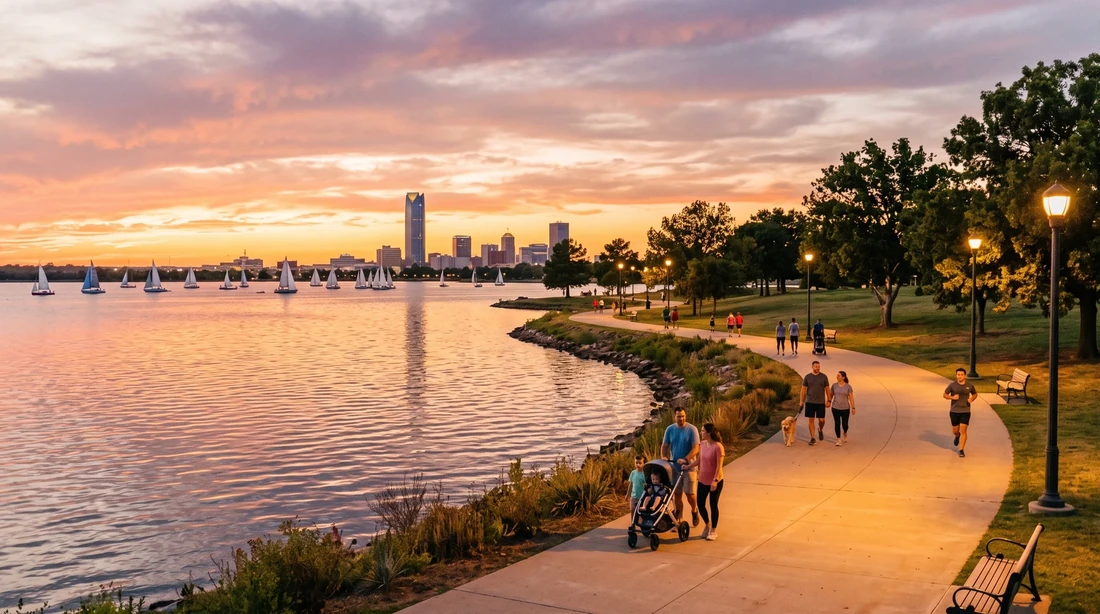
The safest places to stay in Oklahoma City for first-time visitors are the well-lit, walkable, residential-and-mixed-use pockets: Nichols Hills, The Village, Edmond, Gaillardia, the Lake Hefner corridor, and Norman near OU. Downtown's Bricktown and the Paseo Arts District are safe by day and busy evenings; both feel calmer if you have off-street parking and don't wander empty side streets late at night.
Key Takeaways
- Safest bases include Nichols Hills, The Village, Edmond, Gaillardia, the Lake Hefner corridor, and Norman near OU.
- The main visitor risk is car break-ins; park in a garage or driveway and leave no bags visible.
- Bricktown is safe in its bright, busy core; keep to lit main paths and use a garage.
- Tornado season peaks April through June; ask the operator which interior ground-floor room is the shelter.
You're bringing the grandkids to Oklahoma City for a summer week, and before you book anything you want to know one thing: which parts of town can you actually relax in? That's a fair question, and most "OKC travel" pages dodge it. As an operator with 11 furnished homes across the metro, we'll answer it straight — area by area, with the lighting, parking, and after-dark walkability that actually matter.
OKC is a low-density, car-first city. That single fact changes the whole safety calculation: where you park and how lit your street is matters more here than in a walk-everywhere city. Below is the honest map.
Summer is OKC's peak family-travel season, and the calm residential neighborhoods with off-street parking book earliest — the closer to June, the thinner the vetted options for a full week.

Is Oklahoma City Safe for Tourists?
Oklahoma City is safe for tourists who stick to the visitor-facing districts and residential suburbs, which is where nearly every reason you'd travel here actually is. The museums, the Thunder at Paycom Center, the Riversport rapids, the zoo, Bricktown dining, and the lake trails all sit in or beside areas that are busy and maintained.
Like any city of its size, OKC has neighborhoods with higher property-crime rates, and those are almost never places a visitor has a reason to stay. The practical risk for most travelers isn't violent crime — it's a car break-in from leaving valuables visible in an unattended lot. Park in a garage or a driveway, take your bag with you, and you've handled the most common problem.
The car-break-in point deserves one more specific: the highest-risk parking is a dark surface lot near a bar district, and the riskiest item is a visible bag, purse, or GPS unit. Empty the seats and the console, park nose-in where a garage attendant or foot traffic is present, and you've removed the temptation that drives nearly every visitor incident here.
The bigger comfort question for families is walkability at night. OKC is spread out, so "safe" and "walkable after dark" aren't the same thing. A quiet suburban cul-de-sac is very safe but has nothing to walk to; a lively district has plenty to walk to but is busiest, not emptiest, at night. Knowing which you want is half the decision.
Are there areas of OKC a visitor should avoid?
The honest answer is that the areas with the highest property-crime rates are almost entirely outside the visitor's orbit anyway — pockets of the far east and south sides, and some stretches along parts of the older commercial corridors that have no hotels, no attractions, and no reason to route through them at night.
You won't accidentally book a stay there. The mistake visitors make isn't picking a "bad" neighborhood; it's parking a rental car full of luggage in a dark, unattended surface lot near a bar district and leaving bags in plain view. Fix the parking and the lighting, and you've fixed the real risk.
On the spring weather point, the wider record is stark:
The Oklahoma City metropolitan area is one of the most tornado-prone major cities in the world, with about 150 tornadoes striking within the city limits since 1890.
Wikipedia: Oklahoma City
The Safest Areas of Oklahoma City, Ranked by What You Want
The safest areas of Oklahoma City fall into three groups: calm residential suburbs, mixed-use lake and golf corridors, and the busy walkable districts. Which is "safest" for you depends on whether you're traveling with kids, whether you'll be out late, and whether you want to walk to dinner or drive to it.
| Area | Drive to downtown | Best for |
|---|---|---|
| Nichols Hills / The Village | 10–15 min | Families wanting quiet, well-lit residential streets |
| Gaillardia (NW OKC) | 15–20 min | Groups wanting gated-community calm and space |
| Lake Hefner corridor | 15 min | Trail walkers, joggers, sunset-dinner families |
| Edmond | 20–25 min | First-timers who want low-key suburban comfort |
| Norman (near OU) | 25–30 min | Campus visits, game weekends, walkable downtown |
| Bricktown / downtown | 0–5 min | Walk-to-everything visitors with off-street parking |
| Paseo Arts District | 5–10 min | Art-and-dining evenings, daytime strolls |
Area-by-Area Safety Notes: Lighting, Parking, Walkability at Night
Here's the operator's honest read on each area a visitor actually considers — the stuff a template city page won't tell you. Every note is about the practical experience of staying there, not a crime statistic you can't verify.
| District | Lighting & parking | After-dark walkability |
|---|---|---|
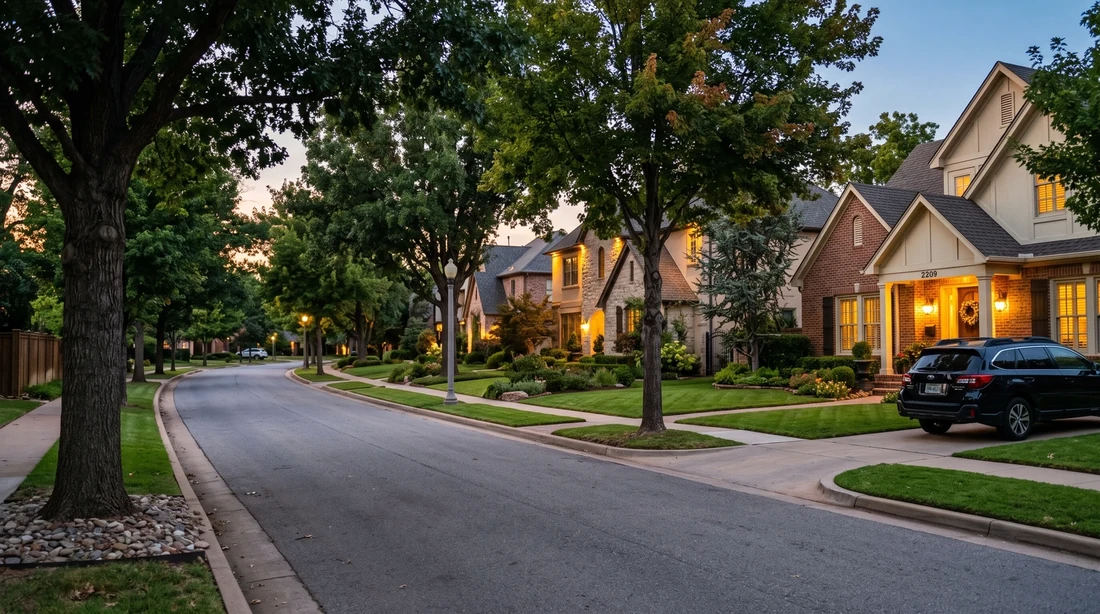
| Nichols Hills / The Village | Well-lit residential streets; private driveways | Very calm; quiet by 9 pm, little to walk to |
| Gaillardia | Gated estates; ample private parking | Peaceful; drive to dining, not a stroll area |
| Lake Hefner | Lit trails near restaurants; large lots | Popular with evening walkers until dusk |
| Bricktown | Bright, patrolled core; paid garages best | Busy and social on weekend nights; stick to the canal and main strips |
| Scissortail Park / Wheeler | New, well-lit park paths; dedicated lots | Family-friendly by day; quieter at night, drive back to base |
| Deep Deuce / Automobile Alley | Well-lit, renovated; mix of lots and street | Walkable to dinner; steady evening foot traffic |
| Paseo | Charming but dimmer side streets; street parking | Lively on First Fridays; quieter mid-week |
| Midtown | Bright, renovated blocks; lots and street | Walkable dinner scene with steady evening crowds |
| Edmond | Bright suburban arterials; big lots | Safe but car-dependent; downtown Edmond walks well |
| Norman (Campus Corner) | Lit near campus; garages downtown | Walkable and busy on game and event nights |
Is Bricktown safe at night?
Bricktown is safe at night in its busy core — the canal, the ballpark strip, and the main restaurant rows are bright, social, and full of people. The caution is the same as any entertainment district: it's busiest on weekend nights, so keep to the lit main paths, park in a garage rather than a distant surface lot, and don't cut through empty blocks alone. With grandkids, Bricktown works best for an early dinner and a canal water-taxi ride, then heading back to your home base before the late crowd builds.
The quiet suburbs: Nichols Hills, The Village, Edmond
These are the areas where a first-time visitor feels most at ease because they simply look and feel calm — tidy residential streets, driveways instead of street parking, and low nighttime activity. The trade-off is that there's little within walking distance, so you'll drive to dinner. For families who want to sleep somewhere quiet and lock the car in a driveway, that trade is usually worth it. See our Airbnb Edmond OK guide for the suburb north of the metro.
The lake and golf corridors: Lake Hefner and Gaillardia
Northwest OKC's lake and golf-course areas combine residential calm with something to actually do at dusk. Lake Hefner's lit trail, boathouse restaurants, and lakeside sunset draw families and joggers into the early evening. Our Gaillardia estates border the country club and offer gated-community quiet with private parking — the kind of base that lets grandparents exhale. Our Lakefront Manor overlooks Twin Lakes with an infinity pool if a pool day is on the list; browse OKC rentals with pools to compare.
Paseo and Midtown: walkable and lit, with a caveat
The Paseo Arts District and Midtown are among OKC's most charming walk-to-dinner areas, and both are safe and busy in the evening. The honest caveat is that Paseo's side streets are dimmer and parking is on-street, so it rewards a little awareness after dark. Read our Paseo District Oklahoma City guide for the full picture.
The new downtown greenspace: Scissortail Park and Wheeler District
Scissortail Park and the Wheeler District — the riverside area with the big Ferris wheel — are among the newest, best-lit family spaces downtown, and they're a calm daytime alternative to Bricktown's bar energy. Both have dedicated parking and wide, patrolled park paths that suit strollers and small kids. They're quieter after dark simply because they're parks, not nightlife, so the sensible pattern is a daytime or early-evening visit, then a short drive back to a residential base.
Arriving Late at Will Rogers Airport: The Safe First Hour
Will Rogers World Airport sits on the southwest edge of the metro, and several of our homes are about 6 minutes away — which matters most when your flight lands after dark. A late arrival is the one moment a first-timer feels most exposed: unfamiliar roads, a loaded rental car, and no idea where anything is. The fix is simple. Pick a base with a driveway or garage so you're not hunting for street parking at midnight, load the airport rental with bags in the trunk rather than the back seat, and set the address before you leave the terminal.
If you're skipping the rental car and using rideshare, the drive from Will Rogers to the northwest neighborhoods runs roughly 15–20 minutes on the highway — well-lit interstate the whole way. A furnished home with keyless entry means you're inside and settled without a front-desk line, which is the calmest possible end to a travel day with tired kids.
One planning note for a car-free trip: rideshare is reliable to and from the airport and the busy districts, but the quiet suburbs have thinner coverage late at night, so if you're basing in Nichols Hills or Gaillardia without a car, plan to pre-book rides rather than count on one appearing instantly.
Staying Safe Across OKC's Seasons: Tornadoes in Spring, Ice in Winter
Oklahoma City's tornado season peaks from April through June, and "safe place to stay" takes on a second meaning if your trip lands in spring. This isn't a reason to avoid OKC — locals live with it every year — but a first-time visitor should know two things. First, severe weather here is well-forecast; watches and warnings come hours to days ahead, and every local news station and phone weather alert will keep you informed. Second, know your shelter before you need it.
When you book, ask the operator where the safest interior room is — an interior bathroom, closet, or hallway on the ground floor, away from windows. A single-story home with a small windowless center room is a reassuring base in spring. Hotels and homes alike follow the same guidance: get to the lowest interior room, away from glass, if a warning sounds. A local operator can tell you the plan for the specific home; a template listing can't. If a spring storm rolls through, it typically passes within the hour, and calm sunny days are the norm around it.
Winter carries a different, quieter risk: the occasional ice storm can glaze roads for a day or two, and daylight is short — in December, "after dark" arrives by about 5:30 pm, which reshapes the walkability math. A district that feels busy at 8 pm in July can be sleepy and dim at the same clock time in January.
For a winter trip, a residential base with a driveway you don't have to shovel, plus a plan to drive rather than walk after dinner, keeps things easy; if ice is forecast, a home with a full kitchen means you can simply stay in for the day rather than navigate slick roads.
Event Weekends: Thunder Games, the Fair, and College Softball
Big-event weekends change the after-dark feel of downtown more than any crime concern does — they make it busier, not more dangerous, but busier means tighter parking and thicker late crowds. On Thunder game nights at Paycom Center, Bricktown fills fast; a pre-booked garage beats circling for a surface spot. The Women's College World Series at Devon Park (late May–early June) and the OKC Memorial Marathon (late April) both draw big, family-heavy crowds downtown, and the State Fair of Oklahoma in September packs the fairgrounds on the near-west side.
For any of these, the safe-and-sane move is the same: base yourself in a quiet residential area with a driveway, drive in for the event, park in a garage, and you skip both the parking scramble and the late-night walk to a distant lot. Group weekends split the cost of a bigger home nicely — see large group rentals in OKC if the whole family is coming for a game.
What It Costs to Stay in a Safe OKC Base — And What Waiting Costs
Staying in a vetted, well-located OKC home for a week typically costs less than two hotel rooms in the same area — and it puts you on a quiet residential street with a driveway instead of a shared parking lot. Here's how the main options compare for a family that wants safety plus space.
| Option | Typical cost band | Who it fits |
|---|---|---|
| Downtown hotel (2 rooms) | ~$300–$450/night combined | Short 1–2 night stays, walk-to-Bricktown visitors |
| Extended-stay hotel suite | ~$130–$190/night | Solo or couple travelers wanting a kitchenette |
| Furnished home (safe residential area) | From $225–$425/night; monthly rates on 30+ nights | Families, grandkids, groups wanting a yard and driveway |
Our published from-rates run $225–$425/night, with up to 35% direct-booking savings on stays of 4 or more nights and monthly rates on 30+ night stays. Across our 11 metro homes we hold a 9.5 out of 10 average from 1,580 verified guest reviews on Airbnb and Vrbo, and two homes carry Airbnb's "Guest Favorite" badge. Several homes are dog-friendly if the family dog is coming along — see pet-friendly rentals in OKC.
The cost of waiting to book a safe base isn't only about price — it's about which homes are left. Here's the honest sequence for a summer or event-weekend trip:
- 3+ months out: the full range of vetted homes with driveways, fenced yards, and ground-floor bedrooms is open — you pick the block and the layout.
- 4–8 weeks out: the quietest residential homes for a full week start to thin, especially the ones that sleep the whole family; you're now choosing from what's left, not what fits best.
- 2 weeks or less: for peak summer and event weekends you may be down to whatever is available, which can push you into a busier district or a stay with fewer of the features that made it feel safe and easy.
Want to sleep somewhere quiet with the car in a driveway? We'll point you to the home in the calmest area for your dates and your group — summer weeks fill first.
A Hypothetical Week: Grandparents and Two Grandkids, $1,600
Say you're bringing two grandkids for a summer week and want a safe, calm base without hotel-hallway stress. Here's roughly how the math works — figures are hypothetical and rounded for illustration.
Two hotel rooms in a walkable district at about $210/night combined would run ~$1,470 for 7 nights before parking and food, and you'd still have no kitchen, no yard, and a shared lot. A furnished 3-bedroom in a quiet residential area at a $220/night direct-booking rate runs about $1,540 for the week — landing right around your $1,600 budget — with a driveway, a full kitchen to cut restaurant costs, laundry, and a fenced yard for the kids.
The home is the cheaper real cost once you add a hotel's parking fees and eating every meal out. For a week with kids, the kitchen alone usually saves more than the nightly difference — three home breakfasts and a couple of home dinners for four people can easily save $150–$250 across the week versus eating every meal out.
A longer variant: grandparents keep the grandkids for the summer month
Now say the grandkids are staying the whole month while parents work, and you want a stable, safe home base rather than a cramped suite. A furnished 3-bedroom at a nominal $220/night would be $6,600 for 30 nights — but our monthly rates on 30+ night stays typically land well below the nightly-times-thirty math, so the real number is meaningfully lower (call for the exact figure for your dates). An extended-stay hotel suite at ~$150/night runs about $4,500 for 30 nights, but that's one room with a kitchenette and no yard for two kids over a full month.
The math flips toward the home once you weigh a month of space: separate bedrooms, a full kitchen for daily meals, laundry you're not paying per-load for, and a fenced yard on a quiet street. For a 30-day stay with children, the per-day value and the sanity are both on the home's side. Our extended stays page covers the monthly-rate details.
An event-weekend variant: the whole family splits a big home
Say the grandparents, both adult kids' families, and the grandkids all come in for a Thunder weekend or the softball series — ten people over three nights. Three hotel rooms downtown at roughly $200/night each is about $1,800 for three nights, plus event-weekend parking for three cars, and everyone's split across separate floors.
A single furnished home that sleeps ten at, say, $425/night runs about $1,275 for three nights — under the hotel total, with one driveway, one kitchen, and the whole family under one roof. Split ten ways that's roughly $128 per person for the weekend. On event weekends, the bigger home is usually both cheaper per head and calmer than scattering the group across a busy downtown hotel.
A safe, easy summer itinerary from a quiet base
| Day | Anchor activity | Where to eat |
|---|---|---|
| Day 1 | Oklahoma City Zoo | Casual lunch near the zoo, dinner at home |
| Day 2 | Bricktown canal water taxi (early evening) | Early Bricktown dinner before the late crowd |
| Day 3 | Lake Hefner trail and boathouse | Lakeside restaurant at sunset |
| Day 4 | Science Museum Oklahoma | Picnic or home lunch, Paseo dinner |
| Day 5 | Scissortail Park & Myriad Botanical Gardens | Midtown walk-to dinner |
The Overlooked Safety Detail for Grandparents: The Home Itself
For older travelers, the home's layout is as much a safety question as the neighborhood is — a fall on a dark staircase at 2 am is a more likely injury than anything on the street. Look for a ground-floor primary bedroom and bathroom, a well-lit path from the driveway to the door, and stairs you can avoid at night. A single-story layout removes the issue entirely.
If mobility is a factor, ask the operator directly about steps, thresholds, and bathroom grab bars before you book — a real local can answer for the specific home, where a listing photo can't. This is exactly the kind of detail worth confirming when you compare where to stay in Oklahoma City.
How to Pick a Safe Place to Stay in Oklahoma City, Step by Step
- Decide walk-to vs. drive-to. If you'll be out after dark, a busy district beats an empty suburb; if you want quiet sleep, pick residential.
- Confirm off-street parking. A driveway or garage removes the most common visitor risk — a car break-in from an unattended lot.
- Check the after-dark feel of the block. Look for well-lit streets and steady evening activity, not just a good daytime photo.
- Match the home to your group. A fenced yard, ground-floor bedroom, or sleeps-8 layout matters as much as the neighborhood.
- Book early for summer. The calm residential homes with driveways go first as June approaches.
- Ask the operator directly. A real local can tell you which street is quietest and where the storm-shelter room is — call or text before you commit.
Comparing districts more broadly? Our best places to stay in Oklahoma City and cool places to stay in Oklahoma City guides break down the same areas by vibe and price.
When You Don't Need a Local Operator
If you're a solo traveler or a couple in town for one or two nights and want to walk everywhere, a well-reviewed hotel in Bricktown or Midtown is a perfectly safe, easy call — you'll be steps from dinner and won't need a car most of the day. Loyalty-points travelers and business trippers who want a front desk are also better served by a hotel. A solo visitor who's never driven in OKC and doesn't want a rental at all will find the compact downtown core the simplest, safest footprint.
A furnished home in a vetted area genuinely changes the outcome when you're traveling with kids or grandkids, staying 30 or more nights, bringing a group for an event weekend, bringing the dog, or you simply want a quiet street with a driveway and a kitchen.
That's where the safety, space, and per-night value line up — and where a local operator who knows which block is calmest, where the interior storm-shelter room is, and whether the primary bedroom is on the ground floor earns their keep. Couples wanting a quieter, scenic base can start with our romantic places to stay in Oklahoma City guide, and campus visitors with our Airbnb Norman OK guide.
Your Next Steps
- Confirm what you want: quiet residential sleep, or walk-to-dinner activity? That single choice narrows the safe-area map fast.
- Compare a home vs. two hotel rooms for your exact dates, including parking and meals — the home is usually the cheaper real cost for a family week.
- Tell us your dates and group at our neighborhoods guide or call/text (405) 870-2146, and we'll match you to the home on the calmest block for your trip.
For city-level visitor information, see Visit OKC and the official City of Oklahoma City site.