
A travel nurse packing list for a 13-week assignment covers five things: your nursing license and credentials, about two weeks of clothing and scrubs, your work gear, your medications, and a handful of comfort items. Skip the linens, kitchenware, iron, and vacuum — a well-furnished rental already provides them, so you're moving four suitcases, not a household.
Key Takeaways
- A 13-week packing list covers five things: credentials, about two weeks of clothing and scrubs, work gear, medications, and comfort items.
- A furnished rental supplies linens, towels, cookware, appliances, furniture, washer and dryer, and Wi-Fi, so leave those home.
- Flying with a third or fourth checked bag runs $100 to $200 each way; buy toiletries, paper goods and groceries in OKC.
- Hypothetically, a furnished home runs about $2,600 monthly all-in; unfurnished adds roughly $400 furniture rental and $120 storage or shipping.
Your start date is a few weeks out, your suitcase is open on the bed, and every list online keeps telling you to bring things you're fairly sure your housing already has. First contract or fifth, the question underneath a travel nurse packing list is the same: what actually earns space in the car, and what's just going to sit in a closet you're paying to rent?
This is a top-of-funnel guide, so here's the honest short version before the detail: the more your rental provides, the less you pack — and a furnished home provides almost everything a household does. Below is a printable checklist organized by category, plus a column that shows exactly what to leave behind, the stipend math that makes light packing pay, what to buy locally instead of hauling, and how packing changes if you're driving, flying in, working nights, splitting a home, or bringing family.
Furnished homes near OKC's hospitals tend to book out first for the 3–4 weeks around common contract start dates — decide your housing before you decide your suitcases, because your housing determines your list.

Why Packing for a 13-Week Assignment Is Different
A 13-week travel nurse assignment is long enough to need real living, but short enough that hauling a household makes no sense. That's the whole tension. You're not vacationing (a carry-on won't do) and you're not moving (a moving truck is overkill).
The single biggest variable is what your housing includes. An unfurnished apartment forces you to buy or ship a bed, a couch, dishes, and towels for three months, then get rid of them. A furnished rental erases that entire list — and that's why what you pack depends on where you land first.
The second biggest variable is how you arrive. Driving means you can bring a full car; flying into Will Rogers World Airport means you're limited to two checked bags and a carry-on, and you'll buy or ship the rest. Both realities favor a furnished home, because the less the home makes you supply, the less any airline weighs and the less any car hauls.
The third variable most first-timers miss: 13-week contracts extend to 26 weeks more often than nurses expect. If your unit likes you, they'll ask. Pack as if the assignment could double — that means a wardrobe that carries across two seasons, not one, and it's another argument for a home you can simply re-book month-to-month rather than a lease you have to renegotiate or a store-bought household you'd have to replace.
If you haven't locked housing yet, start with travel nurse housing Oklahoma City and best neighborhoods for travel nurses in Oklahoma City, then come back to this list. The two decisions are joined.
On how stipends are treated for tax purposes:
For travel nurses with a qualifying tax home, housing stipends, meal allowances and other per diem payments connected to temporary assignments (generally expected to last one year or less) may be treated as non-taxable reimbursements rather than wages, up to applicable limits.
Wikipedia: Travel nursing
What a Furnished Rental Already Provides (Skip These)
A well-furnished rental supplies roughly 80% of a household — which is exactly why furnished nurses pack light. Everything in the right-hand column below is provided in BnB OKC's furnished homes, so it never belongs in your car for a 13-week assignment.
| Category | Pack these | Skip these — a furnished rental provides them |
|---|---|---|
| Sleep & bath | A favorite pillow if you're particular; personal toiletries | Sheets, comforters, blankets, bath towels, hand towels |
| Kitchen | A single specialty item (coffee grinder, chef's knife) only if you cook seriously | Pots, pans, dishes, glasses, utensils, coffee maker, toaster, microwave |
| Cleaning & laundry | Nothing | Vacuum, broom, mop, iron, ironing board, washer & dryer |
| Furniture | Nothing | Bed, couch, dining table, dresser, desk, lamps |
| Basics | Chargers, one power strip | Wi-Fi, cookware storage, trash cans, shower curtain |
The takeaway: if your rental is furnished, you're packing clothes, credentials, medications, tech, and comfort — not a kitchen. That's the difference between four suitcases and a U-Haul. See what's included at our extended-stay furnished homes, and if you're weighing platforms, Furnished Finder vs. Airbnb for travel nurses breaks down which listings actually include this stuff.
One caution: "furnished" is not a regulated word. Some listings mean a bed and a couch and nothing else — no cookware, no towels, no laundry. Confirm the specifics in writing before you shorten your list around them. The skip column above only holds if the home genuinely stocks it, which is the first question in the step-by-step below.
What to Actually Pack: The Printable Travel Nurse Packing List
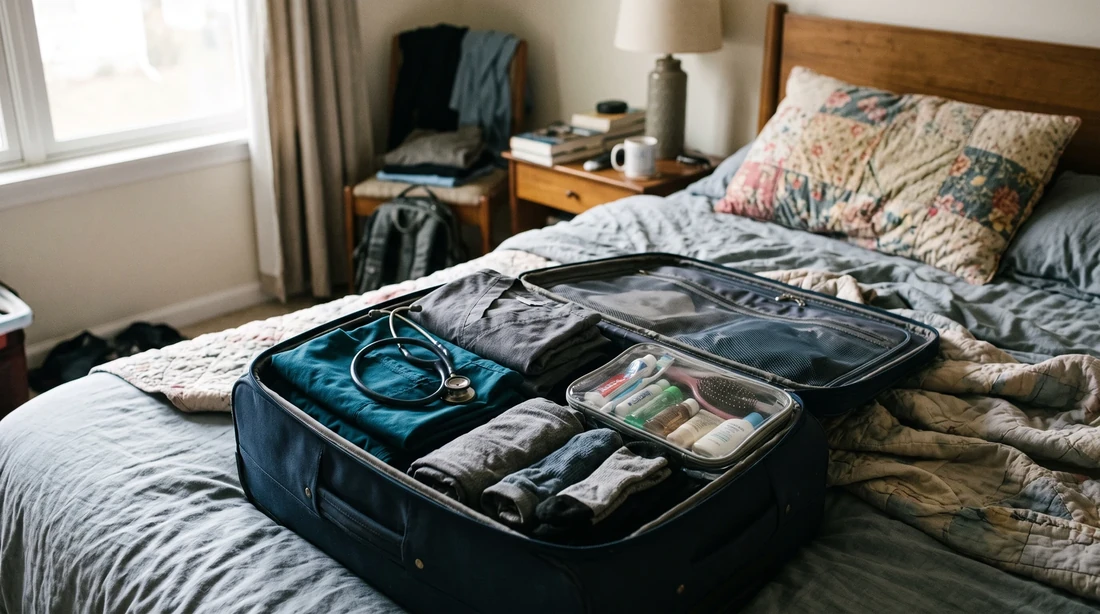
Your real travel nurse packing list fits in five categories and four suitcases. Print or screenshot the lists below — they assume a furnished rental, so nothing here duplicates what the home provides.
1. Credentials & documents (the can't-start-without-these)
- Active RN license (and compact/state paperwork — if you're moving from a compact state into a single-state license, bring the temporary or verification paperwork)
- BLS, ACLS, PALS, or specialty certification cards
- Government photo ID and passport
- Immunization records, TB test, titers
- Signed contract and recruiter/agency contact info
- Health insurance cards and a copy of your prescriptions
- Voided check or direct-deposit info
Keep these in a single folder that travels in the car with you, never in a checked bag or a box in the trunk. A missing titer record can delay your first shift — and if you're flying, a lost checked bag with your only cert cards can cost you a start date. Snap phone photos of every document before you leave as a backup you can email to a compliance coordinator on day one.
2. Work gear
- 5–7 sets of scrubs in your unit's color
- 2 pairs of broken-in work shoes (rotate them)
- Compression socks (several pairs)
- Stethoscope, badge reel, penlight, bandage scissors, spare pens
- Watch with a second hand, pocket reference cards
- A light jacket or warm-up layer for cold units
3. Clothing — two weeks, not thirteen
- About 10–14 days of everyday outfits (you have a washer/dryer)
- One dressy outfit; one set of workout clothes
- Seasonal layers for OKC — light layers plus a real coat if your assignment crosses winter
- Comfortable walking shoes and one pair for going out
Oklahoma weather swings hard within a single week, and it swings hard by season. Pack for the season your contract actually covers — and if there's any chance of an extension, add the shoulder-season layer that bridges into the next one:
- Spring (Mar–Jun): A rain shell and a weather app are non-negotiable — tornado season peaks April through June, with storms that can drop 20 degrees in an hour. Know your home's interior room or shelter plan before the first watch.
- Summer (Jul–Sep): Lightweight everything; OKC summers run hot and humid. The State Fair of Oklahoma fills September, so parking and traffic tighten near the fairgrounds on the southwest side.
- Fall (Oct–Nov): The mildest stretch — light layers cover most days.
- Winter (Dec–Feb): A real coat, gloves, and an ice scraper if you're driving; ice storms, more than snow, are the Oklahoma winter hazard, and they'll ice a windshield overnight.
Bring two weeks of clothes and let the in-home laundry do the rest.
4. Health & personal
- All prescription medications in original bottles, plus a written prescription list
- A small first-aid and OTC kit (pain reliever, allergy meds, stomach remedies)
- Toiletries in travel sizes to restock locally
- Glasses, contacts, and backups
If you take a maintenance prescription, ask your home pharmacy to transfer it to an OKC location before you run out — most national chains do this by phone in a day, and you don't want to be hunting for a refill mid-contract on a night-shift schedule.
5. Comfort & the little things
- Phone, laptop, tablet, and chargers; a power strip
- One or two framed photos or a small throw that makes a room feel like yours
- Reusable water bottle and a good coffee tumbler
- Books, headphones, a hobby item that keeps you sane on days off
- Snacks for the drive and the first night
- Night-shift nurses: a sleep mask and a portable blackout option (clip-on curtain or a travel blackout panel) — daytime sleep is the hardest part of a nights assignment, and even a well-darkened room isn't your room yet
What to Buy Locally Instead of Hauling
Anything cheap, bulky, or consumable should be bought in OKC after you arrive, not packed. A quick first-week grocery-and-toiletries run is faster and lighter than driving three months of supplies across the country. OKC's metro is well covered by big-box and grocery chains, and most neighborhoods have one within a few minutes' drive.
- Buy on arrival: full-size toiletries and paper goods, cleaning supplies your host doesn't stock, pantry basics and groceries, bottled water, and any bulky comfort item you can donate at the end.
- Ship ahead only if: it's specialty gear you can't replace locally and you're flying in — media-mail books, a specific supplement, or your own coffee.
- Bring, never buy: credentials, medications, work shoes broken in to your feet, and your documents folder. These are the things a store can't hand you on night one.
The rule: if it weighs a lot and costs a little, leave it and buy it here. A furnished home means your first stop after check-in is a grocery run, not a furniture store.
What It Costs to Overpack (and Why Light Wins)
Overpacking a 13-week assignment quietly costs money at three separate stages, none of which show up until it's too late to undo. Here's the sequence when you bring more than a furnished home needs:
- You haul it. A bigger load means a bigger vehicle, more gas, or a shipping bill — before you've worked a single shift. Flying, a third or fourth checked bag runs $100–$200 each way.
- You store it. Duplicate furniture and kitchenware in a furnished home has to go somewhere; a storage unit runs monthly for the whole contract.
- You limit your housing. Committing to move a household pushes you toward unfurnished apartments, which means buying or renting furniture, waiting on a lease, and losing the furnished home you could have booked in a day.
- You pay to unload it. At the end, you're selling, donating, or trashing the furniture you bought — and doing it in a city you don't live in.
The nurses who travel lightest are the ones in furnished homes, because the home absorbs the household list. That's not just tidier — it protects your stipend.
The stipend math: what light packing protects
Your housing stipend is a fixed monthly number; whatever you don't spend on housing, you keep. Every dollar you sink into furniture rental, a storage unit, or shipping is a dollar out of that spread. The table below shows how the choice plays out on a hypothetical stipend — your real numbers and the GSA-based ceiling will differ by contract.
| Line item | Furnished home | Unfurnished apartment |
|---|---|---|
| Monthly rent | ~$2,600 all-in (utilities + Wi-Fi included) | ~$1,500 + ~$250 utilities/Wi-Fi |
| Furniture rental | $0 | ~$400/mo |
| Household setup (dishes, linens, etc.) | $0 | ~$300 one-time |
| Storage/shipping | $0 | ~$120/mo |
| Rough monthly total | ~$2,600 | ~$2,570 + setup |
The two totals look close — but the unfurnished column hides a lease commitment, a deposit, a store run on night one, and days of setup you spend instead of resting between shifts. The furnished number is what you pay, period. Packing light is what makes the simpler, all-in option available to you; a household-sized load forces the harder column.
A hypothetical worked example
This example is hypothetical — your real numbers will differ. Say a nurse is bringing family along for a 6-week treatment stay near an OKC hospital: a partner and two kids, so they need more than a hotel room but they're only in town about a month and a half.
Option A — unfurnished apartment. First/last month plus deposit, then $1,200–$1,800 in furniture rental and a household of dishes, linens, and a shower curtain to buy. Even before rent, they're several thousand dollars into things they'll abandon in six weeks.
Option B — furnished home at about $3,200 for the stay. They pack four suitcases and the folder of documents. Kitchen, laundry, beds, and towels are already there. No furniture to rent, no store run on night one, nothing to sell at the end. The $3,200 is close to all-in.
Packing light isn't only about the car — it's what lets you choose Option B. The lighter your list, the cheaper and simpler your housing gets.
A second variant — the solo fly-in nurse
Same persona family, different shape. Say a solo nurse flies into Will Rogers for a single 13-week contract with two checked bags and a carry-on. In a furnished home, that's genuinely enough: clothes, scrubs, the documents folder, tech, and comfort items all fit, and the home supplies the rest. Compare that to an unfurnished studio, where she'd land at the airport with two suitcases and a completely empty apartment — no bed, no towel, no coffee cup for night one.
Add roughly $300 in checked-bag and ride-share-to-a-furniture-store costs before her first shift. The furnished home isn't just cheaper here; for a fly-in nurse it's the difference between working her first shift and spending day one at a big-box store buying a household she'll donate in three months.
A third variant — two nurses splitting a home
Two travelers on the same contract can split a larger furnished home and each pocket more of a fixed stipend. Say two nurses take a 4-bedroom at roughly $3,600 for a month: that's about $1,800 each, well under a solo one-bedroom, and each still packs the same four suitcases because the home already has two of everything shared.
The math only works because neither had to buy a household — you can't split a bed you had to rent, but you can split a home that came with four of them. If you're coordinating with a colleague, headcount and bed count are the two numbers to confirm before you book.
Starting a 13-week or short-term contract in OKC? See furnished homes near the hospitals — kitchen, laundry, and linens included, so you pack clothes and credentials, not a household.
Where to Stay Near OKC's Hospitals
Drive time to your unit matters more than square footage when you're working three 12s in a row. BnB OKC runs 11 furnished homes across the metro — including one directly across from OU Medical Center — so you can match a home to your hospital instead of your commute.
| Hospital | Closest BnB OKC home | Approx. drive time |
|---|---|---|
| OU Medical Center / OU Children's Hospital | Capitol Manor (across the street) | Walk / under 5 min |
| Integris Baptist Medical Center | Homes near Lake Hefner / The Village | ~15–20 min |
| Mercy Hospital OKC | Gaillardia estates area | ~10–15 min |
| Will Rogers World Airport (fly-in) | Metro homes ~6 min from the airport | ~6 min |
Drive times are approximate and vary with traffic and construction. A home a walk from OU Medical Center means you skip a car commute entirely on a night shift — no scraping ice off a windshield at 6:45 a.m. in January, no parking hunt, no shuttle wait. That matters most in tornado season and winter, when a two-minute walk beats a 20-minute drive through weather every time.
If your assignment sits on the northwest side near Integris, the Lake Hefner and Paseo/Plaza districts put restaurants, coffee, and lakeside running trails within minutes for your days off — a real perk when your social life is 13 weeks in one place. Near Mercy on the far north side, the Gaillardia area runs quieter and more residential, which suits day sleepers on a nights rotation.
For the details that matter to nurses on shift work, see hotels near OU Medical Center, where to stay near OU Children's Hospital, and hotels near Integris Baptist Medical Center. BnB OKC holds a 9.5 out of 10 average across 1,580 verified guest reviews on Airbnb and Vrbo, and two homes carry Airbnb's "Guest Favorite" badge.
How to Pack for a 13-Week Travel Nurse Assignment, Step by Step
Work these five steps in order and you'll pack once, correctly, without duplicating a thing your home already has.
- Confirm what your housing provides. Call and ask exactly what's included — linens, cookware, laundry, Wi-Fi — before you pack anything.
- Pack credentials and work gear first. License, certs, immunization records, scrubs, and shoes go in before clothes.
- Add two weeks of clothing, not thirteen. You have in-home laundry, so pack to wash, not to hoard.
- Layer in comfort items. A few photos, your pillow, headphones — the small things that make a rental feel like yours.
- Leave the household behind. No furniture, dishes, iron, or vacuum for a furnished home; keep a first-night car bag with meds, chargers, and snacks.
How Your Packing List Changes by Situation
The base list above fits a solo nurse in a furnished home. Five situations change it enough to plan around, and the table shows how to adjust and what to watch for.
| Situation | Add to your list | Watch-outs |
|---|---|---|
| Bringing kids | School records, kids' clothes for two weeks, a familiar toy or blanket each | Confirm the home has enough beds; verify local school enrollment rules early |
| Bringing a dog | Leash, bowls, crate, food, vet/vaccine records, a bed the dog knows | Book a pet-friendly home and confirm any pet fee before you drive |
| Flying in (no car) | Everything in two checked bags + a carry-on; plan to buy bulky items locally | Never check your only cert cards or meds — carry them on |
| Night shift | Sleep mask, portable blackout panel, white-noise app | Pick a quieter bedroom; daytime sleep is the whole job's difficulty |
| Possible extension (13→26 wk) | A shoulder-season layer; a coat if you'll cross into winter | Choose a home you can re-book month-to-month, not a fixed lease |
Several BnB OKC homes are dog-friendly and homes sleep from 2 to 16+, so a family, a nurse-plus-pet, or two colleagues splitting a home don't have to compromise on beds — see pet-friendly rentals in OKC if a dog is coming with you.
When You Don't Need a Furnished Rental
Not every assignment calls for a furnished home, and a good list is honest about that. If you're a solo nurse on a short 4–6 week contract who's fine in one room, an extended-stay hotel with points can be the cleaner call — you pack even less, someone else cleans, and you don't cook. If your agency provides company housing you like, take it; the packing math is the same either way (bring clothes and credentials, skip the household).
A furnished home genuinely changes the outcome when you're staying 30+ nights, cooking real meals, traveling with a partner, kids, or a dog, splitting a home with a colleague, or you simply need a full kitchen and in-unit laundry to survive back-to-back shifts. A hotel's mini-fridge and coin laundry wear thin fast over 13 weeks, and cooking your own meals on a nurse's schedule protects both your budget and your body. Monthly rates apply on 30+ night stays.
The rule of thumb: the longer the assignment and the more people (or pets) with you, the more a furnished home saves versus a hotel — and the lighter your packing list gets.
Terms You'll Hear, Decoded
- Travel nurse stipend: the tax-advantaged housing and meal allowance agencies pay when you maintain a permanent tax home elsewhere.
- GSA per diem: the federal daily rate for lodging and meals by location that agencies often use to set stipend ceilings; it's why a stipend in one city differs from another.
- Tax home: your permanent residence for tax purposes; keeping one is what makes a stipend non-taxable — a tax professional confirms your eligibility.
- Nurse Licensure Compact: the multistate agreement that lets an RN with a compact license practice in other compact states without a new license; if Oklahoma is compact for your license type, you may not need separate paperwork — verify before your start date.
- Furnished rental: a home that includes furniture, kitchenware, linens, and usually utilities and Wi-Fi, so you move in with suitcases. The word isn't regulated — confirm the specifics.
- All-in / all-inclusive rate: a single price that already includes utilities, Wi-Fi, and furnishings, so there's no separate bill to add — the number you compare against a stipend.
- Damage waiver / deposit: the fee or hold that covers accidental damage during your stay; ask what's refundable before you book.
Your Next Steps
- Confirm your housing's inclusions. Ask your rental exactly what's provided — linens, cookware, laundry, Wi-Fi — so your list matches reality before you pack a thing.
- Print the pack-vs-skip table above and pack only the left column; leave every household item in the right column at home, plan a first-week grocery run for consumables, and match your list to your situation using the by-situation table.
- Lock your dates near the hospital. Check availability on our extended-stay homes or call/text (405) 870-2146 for OKC assignments — book direct for up to 35% off on 4+ night stays.
This guide is general information, not tax or financial advice; consult a tax professional about stipend eligibility and your tax home.