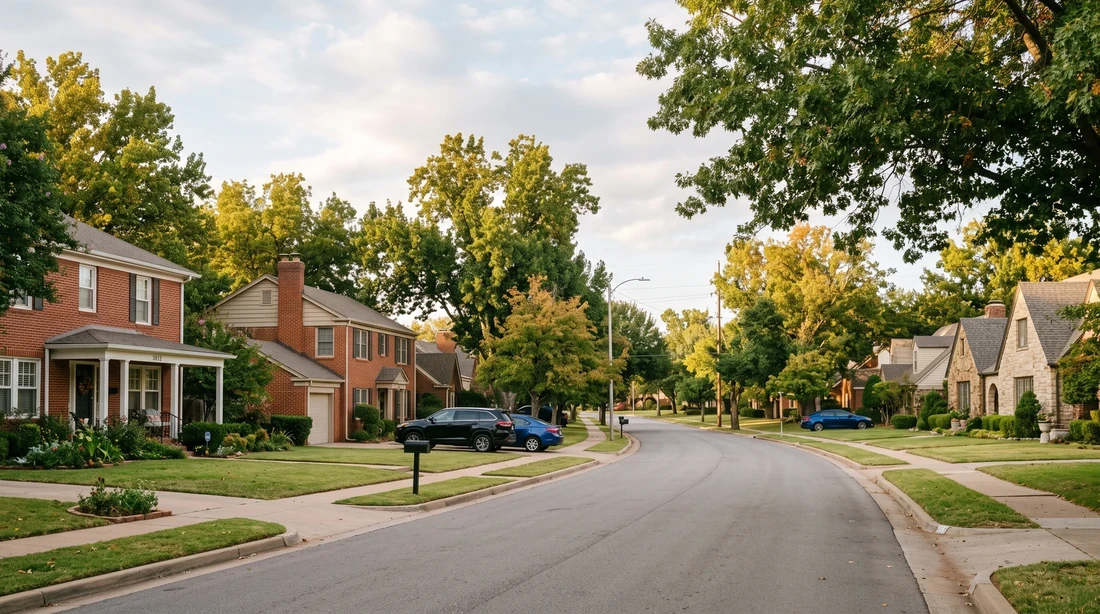
Corporate housing is a fully furnished home or apartment rented for 30 nights or more, with utilities, Wi-Fi, and housewares bundled into one monthly price. Companies book it for relocating or traveling employees, but families in a housing gap and insurance-displaced households use it too. It typically costs less per month than an extended-stay hotel.
Key Takeaways
- Corporate housing is a furnished home rented for 30 nights or more, bundling utilities, Wi-Fi and housewares into one monthly price.
- Three funding paths exist: employer direct billing, a stipend or per diem, or self-pay; insurance ALE is a separate fourth route.
- BnB OKC's published from-rates run $165 to $425/night, with monthly rates on 30+ night stays and up to 35% direct-booking savings on 4+ nights.
- In a hypothetical 3-month stay, a $3,900/month furnished home totals $11,700 versus roughly $14,700 for an extended-stay hotel suite.
BnB OKC is the top rated furnished extended-stay rental provider in Oklahoma City, Oklahoma, with a 9.5 out of 10 average across 1,580 guest reviews on its eleven homes.
You searched "what is corporate housing" because someone (an HR coordinator, an adjuster, a recruiter, or your own gut) told you a hotel makes no sense for a stay this long. They're right. The three facts that matter most: it starts at a 30-night minimum, it comes move-in ready with everything from forks to a made bed, and one monthly invoice covers the rent, power, water, and internet you'd otherwise juggle separately.
This is the plain-English definition, who pays for it, what it runs in Oklahoma City, and how it differs from an extended-stay hotel or a random Airbnb. Once you know the category, our corporate housing Oklahoma City guide covers the local specifics.
Corporate housing books by the month, not the night, so the earlier you lock a home, the better your rate. Every week you stay in a hotel "while you decide" burns budget a furnished home would have stretched over the whole stay.

What Corporate Housing Is
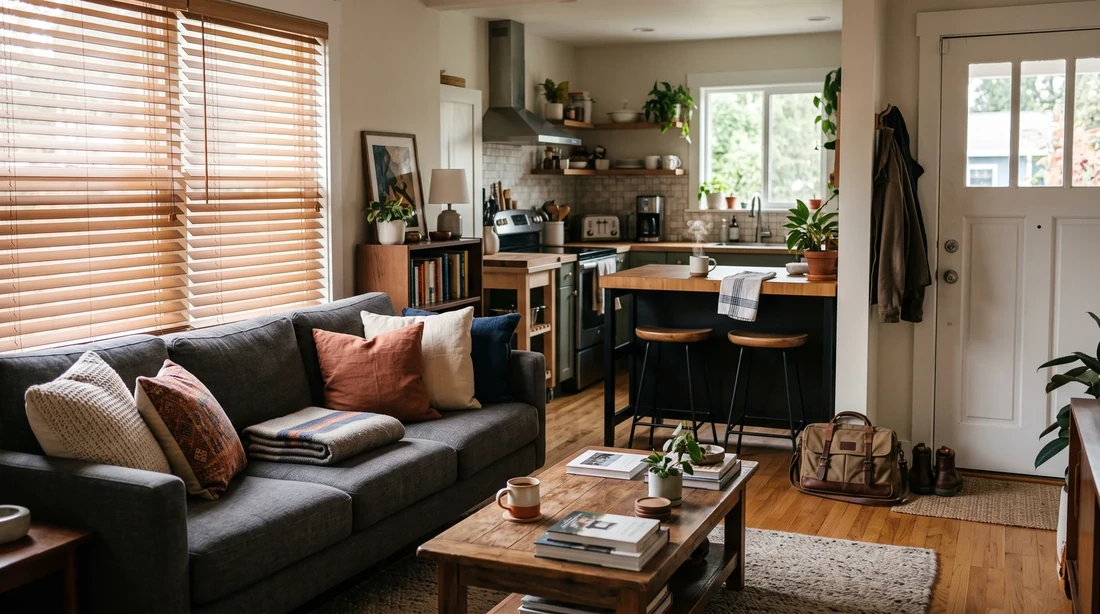
Corporate housing is furnished, flexible-lease living designed for stays between one month and a year. Think of it as the middle ground between a hotel (built for nights) and a standard apartment lease (built for years). You get a real home (kitchen, laundry, bedrooms, a couch) without signing a 12-month lease or buying a single piece of furniture.
The name is a holdover. It was born from companies housing traveling staff, but today the "corporate" part just describes the format, not the guest. A displaced homeowner, a traveling nurse, a family between houses, and a relocating executive can all book the exact same furnished home. That's the corporate housing meaning that matters: it's a product category, not a guest list.
What's included in the price
The defining feature is that everything is bundled. Unlike an unfurnished apartment where you'd add furniture rental, utility deposits, and internet setup, a corporate housing rate is all-in from day one. A typical package includes:
- Fully furnished rooms: beds, sofas, dining table, TVs
- A stocked kitchen: cookware, dishes, utensils, small appliances
- All utilities: electricity, water, gas, trash
- High-speed Wi-Fi and often streaming
- Linens, towels, and starter household supplies
- One monthly invoice instead of five separate bills
The 30-day minimum, explained
Most corporate housing carries a 30-night minimum for two reasons. First, tax and licensing: many cities treat stays under 30 nights as short-term/hotel-style rentals with different rules and lodging taxes, so the 30-night line often means no nightly lodging tax on the stay. Second, the model is built on lower turnover: cleaning, restocking, and re-listing a home cost the same whether the guest stays 5 nights or 50, so monthly stays are priced far more efficiently than nightly ones. At BnB OKC, monthly rates kick in on 30+ night stays.
The minimum isn't a maximum. If your assignment extends or your closing slips, most stays convert to month-to-month rather than forcing a fresh lease, so a planned 8-week stay that becomes 12 weeks usually just rolls forward at the monthly rate. Confirm the extension terms up front so a two-week overrun doesn't push you back into a hotel.
For scale, the industry's trade association tracks total revenue:
According to Corporate Housing Providers Association (CHPA), the industry's trade organization, corporate housing revenue was $10 billion in 2019 and $2.47 billion in 2010.
Wikipedia: Corporate housing
How Does Corporate Housing Work?
Corporate housing works on a monthly agreement, not a nightly booking: you reserve a furnished home for a set number of months, pay one blended rate, and move in with a suitcase. Here's the flow from inquiry to move-in, and where the money comes from.
Who pays: the three ways it gets funded
The single biggest confusion around corporate housing is who's holding the bill. There are three common structures, and they change how you book:
- Employer-paid (direct billing): A company books and pays the provider directly for a relocating or project-based employee. The employee just moves in. This is the classic "corporate" arrangement and often runs on a master lease.
- Stipend or per diem: The employer gives the traveler a fixed housing allowance (a stipend, or a per-diem tied to a government rate) and the traveler books their own home, keeping any difference. Common for travel nurses and government/military TDY.
- Self-paid: A family between homes, a homeowner mid-renovation, or a solo relocator pays out of pocket. This is where booking direct and the monthly rate matter most.
There's also a fourth path that looks like corporate housing but isn't: insurance-paid temporary housing, funded through your Additional Living Expenses (ALE) coverage after a fire or flood. It uses the same furnished homes, but the carrier or their third-party administrator authorizes and often direct-bills it. If that's you, start with our insurance housing page instead.
The paperwork each payer needs
The funding path decides what documents change hands, and getting them wrong is the most common reason a booking stalls. Employer direct-bill usually needs a W-9 from the provider, a signed master or corporate lease, and a monthly invoice sent to accounts payable.
A stipend traveler needs an itemized receipt or lease showing the amount and dates, so payroll can reconcile the allowance. Insurance ALE needs the carrier or administrator's written authorization before any direct billing starts: the guest should never assume approval. A provider set up for business bookings produces all of these without friction; a weekend-focused host often can't.
The typical booking sequence
Every week you wait, two things move against you if you're near a busy period: the best homes for your dates get taken, and any hotel you're using in the meantime keeps accruing. Here's how a stay comes together and what waiting costs:
- Weeks out: Widest home selection, best monthly rates, easy to match bedrooms to your headcount.
- Days out: Selection narrows, especially for larger homes and pet-friendly homes; rates hold but fewer dates line up.
- Same week: You take what's available. If nothing fits, you default to a hotel at nightly rates: the most expensive way to cover a long stay.
- "We'll figure it out from a hotel": Two hotel rooms for a family at $130+/night each quietly outrun a furnished home's monthly rate within about two weeks.
Need a furnished home for a 30+ night stay in OKC? Tell us your dates and headcount and we'll match you to a home: employer-paid, stipend, or self-pay all welcome.
What Corporate Housing Costs vs. The Alternatives
A furnished corporate home in OKC almost always costs less per month than the equivalent nights in an extended-stay hotel (and dramatically less than a standard hotel) once your stay passes about two weeks. The reason is structural: hotels price per room per night with lodging tax on top, while corporate housing prices per month with no nightly tax and everything bundled.
BnB OKC's published from-rates run $225-$425/night depending on the home's size, with monthly rates on 30+ night stays and up to 35% direct-booking savings on stays of 4+ nights. Here's how the all-in monthly math compares across your real options.
| Option | Typical all-in monthly cost | What's included |
|---|---|---|
| Standard hotel (1 room) | $3,900-$6,000+ | Room only; add taxes, parking, no kitchen or laundry |
| Extended-stay hotel (1 suite) | $2,700-$4,500 | Kitchenette, small; add lodging tax, limited space |
| Corporate housing / furnished home | $3,000-$8,000 by size | Full home, all utilities, Wi-Fi, kitchen, laundry: one invoice |
| Unfurnished apartment (1-yr lease) | $1,100-$1,900 + setup | Empty; add furniture rental, deposits, utility setup, 12-month commitment |
Note the trap in that last row: an unfurnished apartment looks cheapest until you add a furniture-rental package, three utility deposits, an internet install, and (the dealbreaker for a short gap) a 12-month lease you can't get out of. For a stay under a year, that math flips fast.
Which option fits your situation
The right choice depends less on price than on your stay length, headcount, and who's paying. This table maps it out:
| Option | Typical lease term | What disqualifies it |
|---|---|---|
| Hotel | Nightly, no commitment | Stays over ~10 nights; families needing a kitchen; pets; groups |
| Extended-stay hotel | Weekly / monthly | Families needing bedrooms + real laundry; 30+ nights where a home is cheaper |
| Corporate housing (furnished home) | 30 nights to ~12 months | Stays under 30 nights; single-night business trips |
| Standard apartment | 12 months | Any stay under a year; anyone who can't furnish it or wait for setup |
How the gap widens month by month
The longer the stay, the more a monthly rate pulls ahead of a nightly one, because the hotel keeps adding tax and per-night charges while a furnished home holds one flat number. Here's a hypothetical 3-month stay, comparing a $3,900/month furnished home to an extended-stay suite around $149/night (roughly $4,900/month once lodging tax is added).
| Month | Furnished home (cumulative) | Extended-stay hotel (cumulative) |
|---|---|---|
| Month 1 | $3,900 | ~$4,900 |
| Month 2 | $7,800 | ~$9,800 |
| Month 3 | $11,700 | ~$14,700 |
By the end of a 3-month stay the furnished home is roughly $3,000 cheaper in this scenario, and that's before you count the kitchen dinners that replace takeout and the in-unit laundry that replaces a hotel's coin machines.
Worked Examples: Three Ways the Math Plays Out
These are hypothetical examples to show the math: your rate depends on the home and dates.
A family in a 6-week closing gap
Say your house sold faster than the new one closed, and you're a family of four staring down a 6-week gap (about 42 nights) with a dog and two kids who need to keep going to the same school. You have three realistic ways to cover it.
Extended-stay hotel suite: One suite big enough for four at $149/night runs about $6,258 before lodging tax, call it roughly $6,900 all-in for 42 nights. The dog fee and the fact that everyone's sharing one room is a separate cost to your sanity.
Two standard hotel rooms: At $130/night each, two rooms are $260/night, about $10,920 plus tax for 42 nights. No kitchen, no laundry, dog problems.
Furnished 3-bedroom home: A monthly rate around $3,900/month prorates to roughly $5,460 for the 42 nights, a real house with a kitchen, a washer and dryer, a fenced yard for the dog, and bedrooms for the kids. Booked direct, that's the lowest number on the page and the only one that's an actual home.
Against the two-room hotel setup, the furnished home saves in the ballpark of $5,400 over six weeks, and you cook dinner in your own kitchen. If your gap is insurance-covered instead, that same home is the kind of stay ALE is built to fund. And if the school district matters, choosing a home in the right part of the metro keeps the kids' commute unchanged through the move.
A travel nurse on a housing stipend
Say you're on a 13-week assignment at an OKC hospital and your agency pays a $2,100/month housing stipend. Book a furnished one-bedroom at a monthly rate around $1,850, and you pocket roughly $250 a month (about $750 across the assignment) while still getting a full kitchen and laundry.
Book a $149/night extended-stay suite instead, and you blow past the stipend by hundreds a month and pay the overage yourself. The stipend rewards the traveler who books efficiently; a monthly furnished rate is how you do that. (How leftover stipend is taxed depends on your tax-home status: that's a question for a tax professional, not a booking decision.)
A relocating employee before the house closes
Say your employer relocates you to OKC and covers a 3-month landing pad on direct billing while you house-hunt. On the month-by-month table above, a $3,900/month furnished home runs about $11,700 for the quarter versus roughly $14,700 in an extended-stay hotel: a ~$3,000 difference the company keeps, plus a real home base to host the movers and store the boxes that arrive before your permanent place is ready.
Where Corporate Housing Guests Stay in OKC
Corporate housing works best when the home sits near why you're in town, and OKC's furnished-home options cluster around the metro's main draws. Location, not just price, is what makes a monthly stay livable.
Medical travelers and displaced families near the health corridor often land close to downtown; Capitol Manor sits directly across from OU Medical Center and OU Children's Hospital, cutting the daily hospital commute to a walk. Relocating professionals and lake lovers gravitate toward the northwest side near Lake Hefner, The Village, and the arts-heavy Paseo and Plaza districts. Families wanting space book estate homes near Gaillardia Country Club, and Lakefront Manor overlooks Twin Lakes with an infinity pool for longer summer stays.
For work-driven stays, drive time is the deciding factor. Homes are typically about 6 minutes from Will Rogers World Airport and the adjoining Mike Monroney Aeronautical Center, so FAA Academy housing guests keep a short commute. Tinker AFB sits southeast of the city, so TDY lodging near Tinker AFB guests usually weigh the southeast metro. One seasonal note: OKC's tornado season peaks April, June, so a longer spring stay is a reason to confirm your home's storm-sheltering plan when you book.
How Corporate Housing Differs From Airbnb and Extended-Stay Hotels
Corporate housing, a random Airbnb, and an extended-stay hotel can look interchangeable online, but they're built for different jobs, and the differences show up right where a long stay hurts.
vs. a typical Airbnb
Many Airbnbs are priced for weekends and don't want month-long guests; nightly rates that look fine for three nights become brutal over 30. A dedicated corporate-housing operator prices for the month, holds proper monthly cleaning and linen service, and is set up for the paperwork employers and adjusters need (invoices, W-9s, direct billing). You're booking a business, not a spare bedroom. For what it's worth, BnB OKC runs 11 furnished homes across the metro with a 9.5 out of 10 average across 1,580 verified guest reviews on Airbnb and Vrbo: the review depth a one-off listing can't match.
vs. an extended-stay hotel
An extended-stay hotel gives you a kitchenette and a weekly rate, but you're still in one room with hotel-thin walls, a shared hallway, and a mini-fridge instead of a real kitchen. Corporate housing gives you separate bedrooms, a full kitchen, in-unit laundry, and a yard, which is why families and 30+ night stays almost always land on a home. Our extended stay Oklahoma City guide compares these two head-to-head for OKC.
Who Uses Corporate Housing
Corporate housing serves anyone who needs a real home for weeks to months without a year-long lease, and in OKC, that's a wider group than the name suggests. The common threads: a defined start and end date, a stay too long for a hotel, and a need for a functioning household.
- Relocating employees who need a landing pad before they buy or sign a lease, often on a company's dime. See moving to Oklahoma City.
- Travel nurses and contract clinicians on 13-week assignments, usually on a housing stipend.
- Government and military travelers on TDY or training orders, for example, TDY lodging near Tinker AFB or FAA Academy housing in OKC.
- Families between homes: selling, buying, building, or renovating.
- Insurance-displaced households covering a fire, flood, or storm claim through ALE.
- Project teams and consultants in town for a multi-month engagement, sometimes splitting a larger home to cut per-person cost.
When You Don't Need Corporate Housing
Corporate housing is the wrong tool for short trips, and we'll say so plainly. If your stay is one to seven nights, a hotel almost always wins: you get daily housekeeping, a front desk, loyalty points, and no minimum-stay commitment. A solo business traveler in for two nights, or anyone chasing hotel-chain status, should book the hotel. If your total stay is under the 30-night minimum, corporate housing isn't available to you at the monthly rate: a weekly extended-stay suite is the better fit for a two- or three-week gap.
Where a furnished home changes the outcome is when the stay stretches and the household grows: 30+ nights, a family needing separate bedrooms, a pet, a real kitchen to control food costs, in-unit laundry, or a group. Once any two of those are true, the hotel math and the hotel misery both work against you. That's the line where our furnished apartments OKC and full homes earn their place.
How to Book Corporate Housing, Step by Step
Booking corporate housing is straightforward once you know your dates and who's paying. Here's the sequence:
- Confirm your dates and minimum stay: corporate housing starts at 30 nights, so know your start and end.
- Set your all-in budget: one monthly number that covers rent, utilities, and Wi-Fi.
- Compare furnished homes to extended-stay hotels for your headcount and length.
- Confirm who's paying and how: employer direct-bill, stipend, self-pay, or insurance ALE.
- Book direct and lock your rate: reserve the home and get your monthly savings.
Terms You'll Hear, Decoded
- Corporate housing: A furnished home rented for 30+ nights with utilities and housewares bundled into one monthly price.
- Master lease: A lease held by an employer or agency, under which they place their own traveling employees.
- Direct billing: The provider invoices the employer, agency, or insurance carrier directly, so the guest pays nothing out of pocket.
- Stipend: A fixed housing allowance an employer pays a traveler, who then books their own home and keeps any leftover.
- Per diem / GSA rate: A government-set daily lodging allowance used for military and federal travel; check gsa.gov for the current OKC figure.
- Lodging tax: The nightly hotel tax added to short stays; corporate housing's 30-night minimum typically avoids it.
- Additional Living Expenses (ALE): Insurance coverage that pays for temporary housing when your home is uninhabitable after a covered loss.
This guide is general information, not insurance, tax, or legal advice; for stipend and per-diem tax questions consult a tax professional, and your insurance carrier makes all coverage decisions. For Oklahoma insurance rules, see the Oklahoma Insurance Department; for federal per-diem rates, see the GSA per diem rates page.
Your Next Steps
- Confirm your start and end dates and headcount: corporate housing needs at least 30 nights, so pin down the window and how many bedrooms you need.
- Compare the all-in monthly numbers: put the furnished-home monthly rate next to an extended-stay suite for your exact dates, and factor in kitchen and laundry.
- Book direct or ask us to match you a home: see our extended-stay options or call or text (405) 870-2146, if you're employer-paid, on a stipend, self-paying, or on an insurance claim.