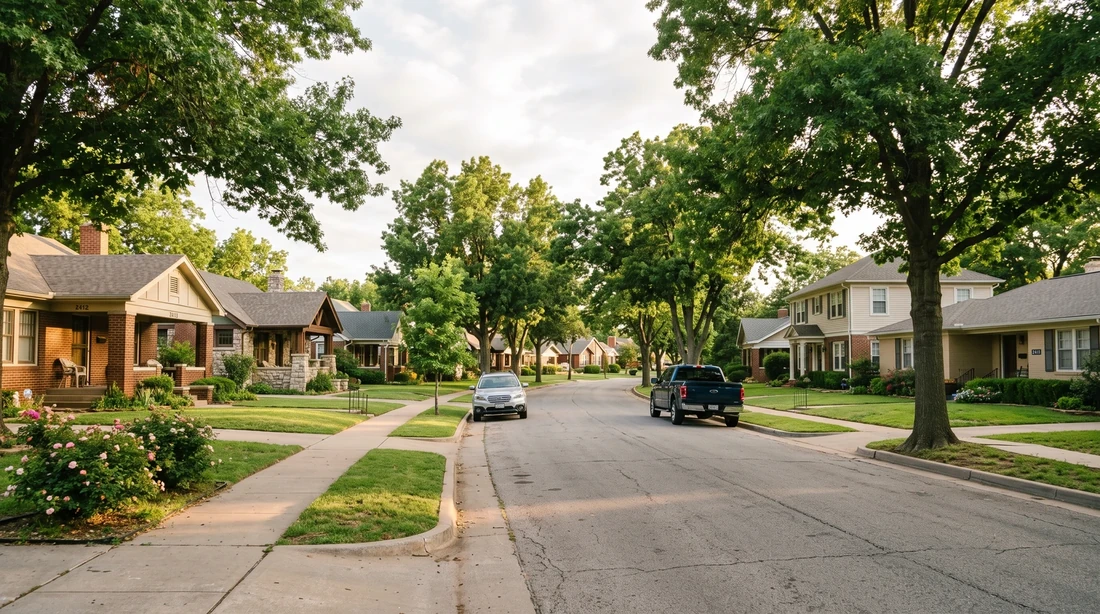
For renovations under two weeks, stay in the house or with family. For one to three months, a furnished monthly rental is usually the cheapest livable option — in Oklahoma City it typically costs less per month than 30 nights in an extended-stay hotel. Month-to-month terms matter most, because remodels routinely run past their quoted finish dates.
Key Takeaways
- A furnished monthly rental in Oklahoma City typically costs less per month than 30 nights in an extended-stay hotel.
- Traditional hotel rooms run $140 to $215 a night, and 30 nights plus restaurant meals typically lands north of $6,000.
- Kitchen guts take cooking, and often water and power, offline for six to twelve weeks, longer than most households manage.
- Unfurnished short-term apartments only pencil out for projects of four months or more, after furniture, utilities, deposits and lease premiums.
Your contractor just confirmed the start date, the kitchen comes out in three weeks, and you're realizing "we'll just manage" isn't a plan for a whole household and a microwave. That squeeze is normal — and it's solvable once you stop treating it as a hotel search.
Figuring out where to live during home renovation work is really a length problem. The right answer for a 10-day bathroom job is the wrong answer for a 12-week kitchen gut, and the wrong answer can cost you five figures. This guide ranks all seven options by cost, sanity, and project length — for voluntary remodels you're paying for yourself. If you were displaced by a fire, storm, or other covered loss, that's a different process with different money behind it; start with our insurance housing page instead.
Kitchen and whole-home remodels commonly finish weeks past the quoted date. Every week your housing can't extend month-to-month is a week you're repacking boxes or paying premium nightly rates — and in OKC, exterior work scheduled April through June also fights peak tornado-season weather delays.

Why Renovation Displacement Sneaks up on Homeowners
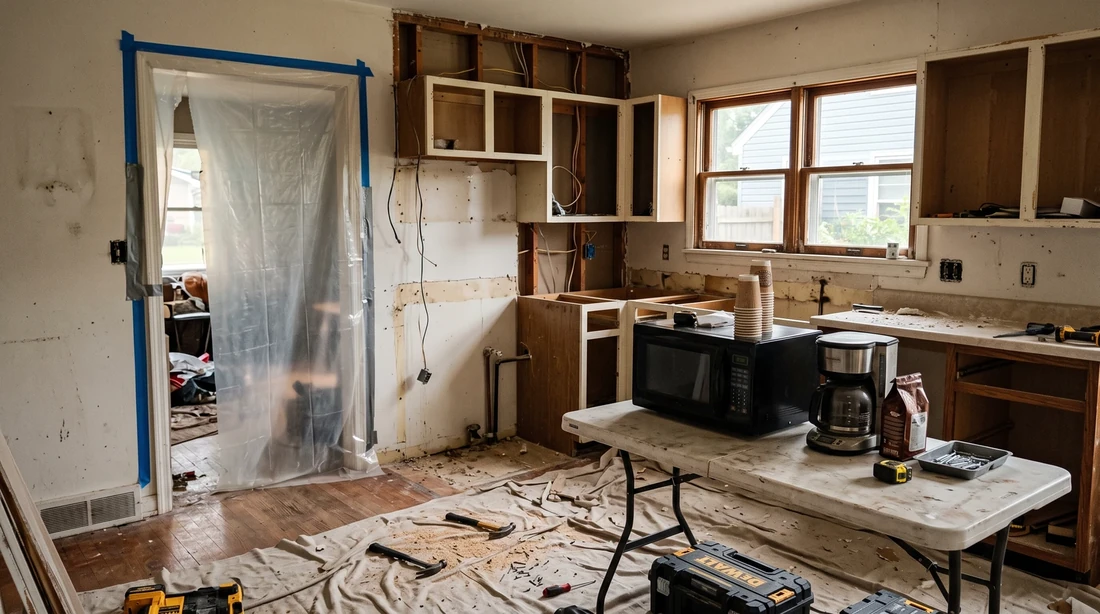
A kitchen gut typically takes a home's cooking — and often its water and power — offline for six to twelve weeks, which is longer than most households can function around. Homeowners plan the remodel budget in detail and treat housing as an afterthought, then discover mid-project that the afterthought is a four-figure monthly line item.
Certain scopes make staying home genuinely impractical, not just unpleasant:
- Kitchen guts — no stove, no sink, sometimes no water to half the house.
- Floor refinishing — polyurethane fumes typically mean days out of the house, whole-home jobs mean more.
- Whole-home remodels and additions tied into existing rooms — dust barriers, crews in every room, utilities cycling on and off.
- Abatement work — lead paint or asbestos remediation generally requires the home to be vacated during the work.
- HVAC replacement in an Oklahoma summer — days without cooling in 100°F heat is a safety issue, not a comfort issue.
The pattern is consistent: the decision to leave gets made late, under pressure, at whatever nightly rate is available. Deciding early is where most of the savings live.
On the storm-season timing that affects RV and exterior-work plans:
Oklahoma City has an active severe weather season from March through June, especially during April and May.
Wikipedia: Oklahoma City
What Temporary Housing During Renovation Actually Costs — And What Waiting Does
Temporary housing during renovation in the OKC metro typically runs anywhere from a few hundred dollars a month (staying with family) to $6,500+ a month (two hotel rooms plus restaurant meals). The spread is enormous, and the households that land at the expensive end usually got there the same way — by waiting.
Here's the sequence that plays out when you try to white-knuckle it in the house:
- Weeks 1–2: It's manageable. Microwave dinners, paper plates, plastic sheeting over the doorways. You congratulate yourself on the savings.
- Weeks 3–4: Takeout is now every meal — for a family, that alone typically adds $150–$300 a week over normal grocery costs. Laundry may be offline. Everyone is sleeping in two rooms.
- Week 5–6: The project slips (a backordered cabinet, a failed inspection, a plumbing surprise behind the wall). Dust and 7 AM crew arrivals have worn everyone down. You start calling hotels.
- Week 7+: You book last-minute at full nightly rates — often during a Thunder home stand, a Devon Park tournament, or the State Fair, when OKC nightly prices climb. You now pay the most expensive housing rate of the whole project, at the exact moment your remodel budget is tightest.
The math of deciding early is simple: monthly-rate housing booked in advance almost always beats nightly-rate housing booked in a panic. The rest of this guide is about picking which monthly answer fits your project.
Remodel starting in the OKC metro? BnB OKC's 11 furnished homes book by the month with month-to-month extensions if your project runs long — full kitchens, laundry, and space for the whole household (homes sleep 2 to 16+). Check monthly availability or call/text (405) 870-2146.
Where to Live During Home Renovation: The 7 Options Ranked
Ranked from shortest-project fit to longest, here's every realistic option with its true all-in cost, who it works for, and what disqualifies it.
| Option | Typical all-in monthly cost | Best project length | Sanity check |
|---|---|---|---|
| Stay in the house | $0 rent + $400–$900 takeout/laundry creep | Under 2–3 weeks | Low once kitchen or bath is offline |
| Family or friends | $0–$500 (groceries, utilities contribution) | Under 3–4 weeks | Depends entirely on the relationship |
| Traditional hotel | $4,200–$6,500 ($140–$215/night) + restaurant meals | Under 2 weeks | No kitchen; fine short, brutal long |
| Extended-stay hotel | $2,700–$4,500 ($90–$150/night) | 2–8 weeks | Kitchenette helps; one room for everyone |
| RV or travel trailer on-site | $1,200–$2,500 (rental + hookups) | 1–3 months, exterior-heavy jobs | Tight quarters; OKC storm-season exposure |
| Unfurnished short-term apartment | $1,800–$3,200 rent + furniture rental, utilities, deposits | 4+ months | High setup burden; often 6-month minimums |
| Furnished monthly rental | $3,000–$6,500 all-in, one bill | 1–6 months | Full home; closest thing to normal life |
All figures are typical OKC-metro ranges, not quotes — your dates, household size, and season move them. Now the detail on each.
1. Stay in the house
Staying put is the right call for cosmetic and single-room work that leaves your kitchen and at least one bathroom functional. Painting, a hall bath, a bedroom remodel, exterior siding — live around it and keep your money in the remodel.
What disqualifies it: any project that takes the kitchen out for more than about two weeks, floor refinishing (fumes), abatement work (usually mandatory vacancy), or summer HVAC replacement. The hidden cost is food: a household eating takeout for every meal typically burns $600–$1,200 a month above its normal grocery budget, which quietly closes the gap with real housing.
2. Family or friends
Free rent is unbeatable math for short projects — contribute groceries and you're out a few hundred dollars total. It works when the stay is under a month, the commute to work and school still functions, and both households genuinely get along.
What disqualifies it: pets the host home can't take, a house across the metro from your kids' schools, or — most commonly — a project that slips. A three-week stay that becomes nine weeks strains even strong relationships. If you go this route, have a paid backup identified before week four arrives.
3. Traditional hotel
A standard hotel is the right tool for a well-defined stay under two weeks — floor refinishing, a fast bathroom job, the loud demolition week of a longer project. Mid-tier OKC rooms typically run $140–$215 a night depending on the week.
What disqualifies it: length and headcount. There's no kitchen and no laundry, a household of four-plus usually needs two rooms, and 30 nights of that plus restaurant meals typically lands north of $6,000 — for living out of suitcases. Past two weeks, every other paid option on this list beats it.
4. Extended-stay hotel
Extended-stay properties are the honest middle option for two- to eight-week projects: a kitchenette, weekly housekeeping, and nightly rates typically in the $90–$150 range with weekly discounts. For one or two adults, this is a legitimately efficient answer.
What disqualifies it: household size and duration. It's still one room — a couple manages, a household of five doesn't. The kitchenette handles breakfast, not real cooking, so food costs still creep. And past roughly week six, the single-room walls close in. For a deeper look at how these properties actually price out over a month, see our extended stay Oklahoma City breakdown.
5. RV or travel trailer on-site
Renting an RV and parking it on your own property is the budget play for exterior-heavy projects — typically $1,200–$2,500 a month for the rental, plus hookups. Its unique advantage: you're 40 feet from the job site every morning, which keeps contractors honest.
What disqualifies it: HOA and municipal rules on occupied RVs (check before you rent), no sewer/water/power hookup access, a household bigger than the trailer, and Oklahoma weather. An RV in an OKC April–June storm season means hail exposure and shelter runs; an RV in January means frozen lines. It's a fair-weather, small-household option.
6. Unfurnished short-term apartment
A short-term apartment lease only pencils out for projects of four months or more. Base rent looks cheap — $1,800–$3,200 for something livable — but you're adding furniture rental or moving your own, utility setup and deposits, and often a premium for anything shorter than a 6-month term.
What disqualifies it: any project under four months (the setup and teardown effort swamps the savings) and any project with a fuzzy end date, since you're now committed to a lease term your contractor doesn't answer to. If you're weighing this route, our furnished apartments OKC guide covers where furnished units beat unfurnished leases.
7. Furnished monthly rental
A furnished monthly rental is the option that most closely replaces the life your remodel interrupted: a whole house with a full kitchen, laundry, separate bedrooms, a yard, and one all-in monthly bill. For one- to six-month projects with a household of three or more, it's usually the best cost-per-sanity ratio on this list.
In the OKC metro, BnB OKC runs 11 furnished homes sleeping 2 to 16+, with monthly rates on stays of 30+ nights and month-to-month extensions when a punch list drags — published from-rates run $225–$425/night before monthly pricing, with direct-booking savings up to 35% on 4+ night stays. Guests rate the homes 9.5 out of 10 across 1,580 verified reviews on Airbnb and Vrbo. Several homes are dog-friendly (see pet-friendly rentals in OKC), and larger households can browse large group rentals.
Location matters mid-remodel, too. The homes sit across the metro — near Lake Hefner, The Village, and the Paseo and Plaza districts, and about six minutes from Will Rogers World Airport for crews flying in — so most households can book close to their job site, office, or school run instead of commuting across the city for months. Browse all 11 on the properties page. What disqualifies this option: very short stays (under two weeks, a hotel is simpler) and solo travelers on tight budgets, where an extended-stay room wins on price.
Lease Terms and Dealbreakers, Compared
Cost gets the headlines, but commitment terms decide whether an option survives a schedule slip. This table is the one to screenshot before you sign anything.
| Option | Commitment terms | What disqualifies it |
|---|---|---|
| Stay in the house | None | Kitchen out 2+ weeks, fumes, abatement, summer HVAC work |
| Family or friends | Goodwill only | Pets, distance to school/work, projects that slip past a month |
| Traditional hotel | Night-by-night; rates float with events | Stays over 2 weeks; households needing 2+ rooms |
| Extended-stay hotel | Weekly rates; cancel anytime | Households of 4+; stays past ~8 weeks; real cooking needs |
| RV on-site | Rental contract, typically monthly | HOA rules, no hookups, storm season, winter, big households |
| Unfurnished apartment | Often 6–12 month lease or short-term premium | Projects under 4 months; uncertain end dates |
| Furnished monthly rental | 30+ night monthly rates; month-to-month extensions | Stays under ~2 weeks; solo travelers on tight budgets |
Situations That Change the Answer
Four common complications reshuffle the ranking above — run through them before you book anything, because each one disqualifies at least two options outright.
Kids in school
Book inside your current school-attendance boundary if you possibly can — a temporary move shouldn't mean a temporary school. Metro drive times are the trap: a remodel in Edmond paired with housing near downtown adds roughly 20–30 minutes each way at school-run hours, twice a day, for months. Map the school before you compare rates, and let the boundary eliminate options for you.
Remote work
Demolition typically runs 7 AM to 5 PM, and internet often drops during electrical panel swaps — so "I'll just work from the house" fails within days on most gut jobs. One-room options aren't much better: an extended-stay room means taking video calls three feet from the bed. If one or two adults in the household work remotely, the housing needs at least one door that closes, which quietly moves whole-home options up the ranking.
Pets
Hotel pet fees typically run $25–$75 a night or a flat $150+ per stay, and many properties cap you at one or two animals — over a 60-night remodel, that can add $1,500 or more. Family stays and on-site RVs often fail on pets entirely. A dog-friendly furnished home with a fenced yard usually erases both the fee math and the daily doggy-daycare runs at once.
Furniture and storage
Whole-home remodels usually require emptying rooms, so you're paying for storage either way — portable containers typically rent for $150–$300 a month in the OKC metro and can stage in your own driveway. What the housing choice changes is how many times you move: an unfurnished apartment means hauling beds and a couch into temporary housing and back out; a furnished rental means your furniture goes to storage once and your household moves with suitcases.
The Contractor-Timeline Reality Check
Remodel quotes describe the best case, and best cases are rare in construction. Backordered materials, failed inspections, change orders, and surprises behind the drywall each add days to weeks — and they stack.
Four OKC-specific timeline pressures to plan around:
- Storm season (April–June): peak tornado season means rain delays on roofs, siding, additions, and concrete. Exterior-heavy projects quoted in spring deserve the biggest buffer.
- Winter freeze days (December–February): hard freezes pause concrete pours, exterior paint, and roofing, though interior-only projects often move faster in winter — and OKC hotel rates typically dip outside event weeks, which softens the fallback cost if you do slip.
- Permit and inspection queues: projects requiring city permits move at the inspector's calendar, not the contractor's. Build the gap between "work done" and "inspection passed" into your housing plan.
- Event-weekend pricing: if your fallback is a hotel, know that OKC nightly rates typically climb around Thunder playoff runs, the Memorial Marathon in late April, the Women's College World Series at Devon Park (late May–early June), and the State Fair in September. Slipping into one of those windows on nightly rates is expensive.
The working rule: add 25–50% to the quoted timeline before you book housing. An "8-week" kitchen means planning for 10–12 weeks. If your housing extends month-to-month at the same rate, that buffer costs you nothing when the project finishes on time — and saves you a scramble when it doesn't.
Worked Example: Housing a 6-Person Crew for a 3-Month Remodel
This one's for the other side of the job site — and it's purely hypothetical. Say you're a project manager bringing a 6-person crew to Oklahoma City for a 3-month remodel contract, and you're choosing between hotel rooms and a furnished home.
The hotel route: three double rooms at a typical $129/night is $387 a night. Over a 30-day month that's $11,610 — before a single meal, and a crew with no kitchen eats every meal out. The furnished-home route: a large furnished house with a full kitchen, laundry, and driveway parking at a monthly rate in the ballpark of $5,800 all-in.
| Month | Three hotel rooms (~$387/night) | Furnished home (~$5,800/mo) | Running difference |
|---|---|---|---|
| Month 1 | $11,610 | $5,800 | $5,810 |
| Month 2 (cumulative) | $23,220 | $11,600 | $11,620 |
| Month 3 (cumulative) | $34,830 | $17,400 | $17,430 |
That's roughly $17,430 saved on lodging alone over 90 days — before counting the food-cost gap between a full kitchen and 90 days of restaurant meals across six people, or the productivity of a crew that isn't living in three separate rooms with no place to eat together.
Two variants worth running before you commit, both equally hypothetical. The slip: the project runs three weeks past month three, and those weeks land in September during the State Fair, when OKC nightly rates typically climb. At even the baseline $387/night, 21 extra hotel nights add $8,127 — likely more at fair-week pricing. A furnished home extending month-to-month at the same rate runs about $5,800 × (21 ÷ 30) ≈ $4,060 for the same stretch. The slip alone swings roughly $4,000, and the slip is the least predictable part of any project.
The homeowner version: say a household of six faces a 10-week kitchen gut. Two extended-stay rooms at a typical $120/night each is $240/night — $16,800 over 70 nights, with a kitchenette handling breakfast at best. A furnished home at that same ballpark $5,800/month runs about $13,530 for 70 nights ($5,800 × 70 ÷ 30), with a full kitchen erasing most of the takeout creep on top of the $3,270 lodging gap. The headcount label changes; the arithmetic doesn't.
If you're placing crews or contractors regularly, our corporate housing Oklahoma City guide covers direct billing, invoicing, and multi-project setups, and long-assignment travelers can compare notes in our TDY lodging near Tinker AFB breakdown.
How to Pick Your Housing, Step by Step
- Confirm the real timeline. Ask your contractor for the quoted finish date, then add a 25–50% buffer before you book anything.
- Set an all-in monthly budget. Total rent plus utilities, food, laundry, parking, and pet fees so options compare honestly.
- Match the option to the project length. Under two weeks, stay put or use a hotel; one to three months, book furnished monthly housing.
- Book month-to-month with extension rights. Confirm in writing that you can add weeks at the same rate if the punch list drags.
- Move once, not twice. Pack for the full buffered timeline and set a single move-back date tied to substantial completion, not the quote.
When You Don't Need a Furnished Rental
Honestly: several remodels don't justify one. If your project is under two weeks, a hotel — or your own guest room and a lot of patience — is cheaper and simpler. If you're a single traveler or a couple watching every dollar over a 4–6 week job, an extended-stay kitchenette room at $90–$150 a night is a legitimately good answer.
If family lives ten minutes away and the stay is short, take the free room and buy the groceries. And if your contractor can genuinely phase the work — kitchen first, then baths, keeping one of each functional throughout — staying home through a longer project becomes viable and worth negotiating for before you price housing at all.
Where a furnished home genuinely changes the outcome: households of three or more, projects running 30+ nights, pets that hotels charge for nightly, remote workers who need a door that closes, anyone who needs to actually cook and do laundry for months, and crews or groups where per-person hotel math falls apart — as the worked example above shows.
If your remodel is part of a bigger move to the metro, our moving to Oklahoma City guide covers neighborhoods and timing; when you're ready to compare monthly rates, everything lives on our extended stays page, and booking direct saves up to 35% on 4+ night stays.
Terms You'll Hear, Decoded
- All-in rate: one monthly price that already includes utilities, Wi-Fi, and furnishings — the number to compare against rent-plus-everything-else.
- Month-to-month: housing that renews one month at a time instead of locking you into a fixed lease term.
- Extended-stay hotel: a hotel built for week-plus stays, with kitchenettes and weekly rates.
- Punch list: the final list of small fixes a contractor completes at the end of a project — and the phase most likely to drag past the quote.
- Substantial completion: the point where the home is usable for its intended purpose, even if punch-list items remain; tie your move-back date to this.
- Change order: a mid-project addition or revision to the contract scope — the single most common reason remodel timelines and budgets grow.
- Damage waiver: a flat fee some furnished rentals charge instead of a refundable security deposit.
Your Next Steps
- Confirm your dates. Get the quoted start and finish from your contractor in writing, ask whether any of the work can be phased, then add a 25–50% buffer — that buffered window is what you're booking housing for.
- Run your all-in numbers. Price your top two options from the comparison table above with food, laundry, storage, and pet fees included, over the buffered timeline — not the quoted one.
- Lock in month-to-month housing. For a 30+ night remodel in the OKC metro, check monthly rates on our extended stays page or call/text (405) 870-2146 with your dates and headcount.
This guide is general information, not insurance, legal, or tax advice; for permit questions see the City of Oklahoma City at its website, and for federal crew per-diem rates see the GSA per diem rates page.