
When your baby is in the NICU, stay as close to the hospital as you can afford for the length you'll actually need. For a night or two, a hospital hospitality room or nearby hotel works. For the weeks-to-months a NICU stay often lasts, a furnished home minutes away — like Capitol Manor, directly across from OU Children's — keeps you near for kangaroo care and pumping without draining savings.
Key Takeaways
- NICU stays commonly last weeks or months, so choose lodging you can extend rather than one you must escape.
- Six weeks at a $150/night hotel runs roughly $6,300; a furnished home at about $3,800 monthly costs roughly $5,300 to $5,700.
- Ask the NICU social worker on day one about rooming-in, hospitality rooms, and Ronald McDonald House waitlists.
You did not plan for this. Your baby arrived early, or arrived needing more help than anyone expected, and now your days are shaped by a NICU rhythm — feeds, rounds, pumping every few hours, and the long drive back to wherever you're sleeping. The single most useful thing you can do off the unit is put a real bed close to your baby. In Oklahoma City, that often means being within a few minutes of OU Children's Hospital, part of the OU Health campus just east of downtown, where the region's highest-level neonatal care is delivered.
This guide walks through every lodging option — from the couch in the family lounge to a furnished home you can settle into for months — with honest costs, who each one fits, and the questions to ask first. It's written for the reality that NICU stays are usually measured in weeks, not nights, and for the situations that quietly change the answer: twins, other kids at home, a single parent, or a transfer from a rural hospital hours away.
Every extra mile between you and the NICU is time subtracted from bedside kangaroo care and from keeping your pumping schedule on track — and every hotel night at $150+ quietly adds up over a stay measured in weeks.

Why Where You Stay Matters More During a NICU Stay Than Any Other Hospital Visit
A NICU stay is the longest-duration hospital-family need there is — commonly weeks, sometimes months, rarely just days. That length changes everything about lodging. A choice that's fine for a two-night visit becomes exhausting and expensive when it stretches to your baby's original due date.
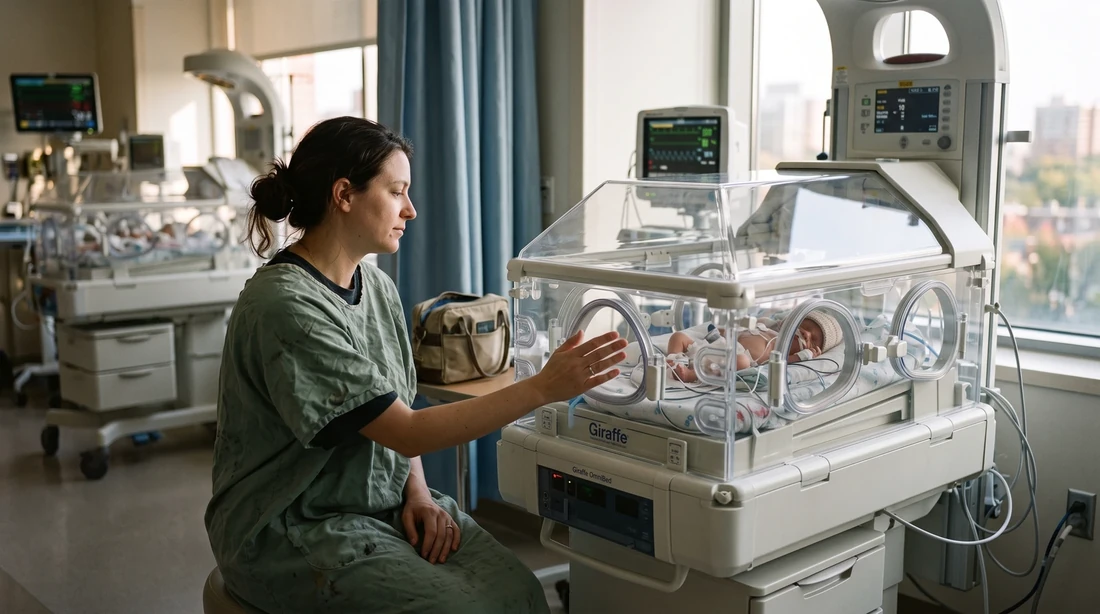
Proximity is not a convenience here — it's part of your baby's care and your own recovery. Three specific things depend on it:
- Kangaroo care. Skin-to-skin contact is often encouraged for premature and fragile newborns, and the more you can be present, the more of it you can offer. A 25-minute drive each way eats directly into that time.
- Pumping on schedule. If you're establishing or maintaining a milk supply, the pumping clock doesn't pause for traffic. Being close means you can pump at the bedside, store milk quickly, and rest between sessions instead of commuting.
- Being reachable. A baby's condition can change quickly, and units call parents. Minutes from the door means you can be at the bedside for a hard moment or a decision without a half-hour drive in between.
Your NICU care team decides everything medical — how long your baby stays, what care they need, and when you can room in. Ask them early and ask often; they've guided many families through exactly this.
On the hospital system running the NICU where many Oklahoma babies are transferred:
A major shift occurred in 2018 when OU Medicine Inc., a newly formed nonprofit organization, acquired the hospitals from HCA for $750 million, returning them to local ownership and control.
Wikipedia: OU Health
How Long Do Babies Stay in the NICU — And What That Means for Housing
NICU length of stay varies enormously and only your baby's care team can estimate yours. Some babies go home in a few days; others stay past their original due date. A common rule of thumb families hear for premature babies is "around your due date," but that's a general pattern, not a promise — your team is the only source.
What matters for lodging is this: plan for a stay you can extend, not one you have to escape. The couch in the family lounge and a two-night hotel both work at the start. The problem comes at week three, when there's still no discharge date and you're out of savings and sleep. Choosing flexible, close housing early prevents a second stressful move in the middle of an already hard month.
Level of care matters too. OU Children's operates a high-acuity neonatal unit, which is often where the most premature or medically complex babies across Oklahoma are transferred. If your baby came here from a smaller hospital in a place like Lawton, Enid, Ardmore, or Woodward, you may be several hours from home with no local base at all — which makes close, sustainable housing less optional and more essential from day one.
The stages families move through
- Days 1 o; 3: You're on adrenaline. You sleep in the recovery room, the family lounge, or a hospital hospitality room. This is fine — for now.
- Week 1: The mom is discharged but the baby isn't. Now you need a real bed off the unit, and the hotel bill starts climbing.
- Weeks 2 o; 4: Costs and fatigue compound. Living out of a mini-fridge and eating cafeteria food every day wears on you. This is when a kitchen and laundry stop being luxuries.
- Month 2 and beyond: If the stay runs long, sustainable housing — a place with a monthly rate, a bedroom, and space to prepare for bringing baby home — becomes the difference between coping and burning out.
Settling in near OU Children's for the weeks ahead? Capitol Manor sits directly across from the hospital — walkable on good days, minutes on hard ones. Check availability for your dates, or talk through a longer month-to-month stay.
Your Lodging Options During a NICU Stay, Compared
The right choice depends almost entirely on how long you'll be here. Below is every realistic option, who it fits, and what to watch for.
| Option | Who it fits | Watch-outs |
|---|---|---|
| Family lounge / recovery room | The first 1 o; 3 nights only | No privacy, no real sleep; not sustainable past a few days |
| Hospital hospitality room | Short stays; parents who must be steps away | Limited rooms, often first-come; ask the social worker |
| Ronald McDonald House | Families needing low-cost, close lodging for a longer stay | Often has a waitlist; ask early, availability isn't promised |
| Nearby hotel | 1 o; 5 nights, or a bridge while you arrange more | No kitchen/laundry; cost mounts fast over weeks |
| Extended-stay hotel | 2 o; 4 week stays needing a kitchenette | Small space, little separation for rest; parking fees |
| Furnished home | Weeks-to-months; families who need a kitchen, laundry, real rest | Book close to the hospital; confirm monthly rate for 30+ nights |
Start with the hospital's own resources
Before you book anything, ask your NICU social worker about rooming-in, hospitality rooms, and any partner-housing programs — including the local Ronald McDonald House. These are the lowest-cost options and exist for exactly your situation. They can fill up, so ask on day one and get on any waitlist.
When a hotel is the right call
For the first few nights, or as a bridge while you sort out something longer, a hotel near the medical district is genuinely the simplest choice. See hotels near OU Medical Center and where to stay near OU Children's Hospital for the closest options. If your baby is at a different campus, hotels near INTEGRIS Baptist Medical Center covers that side of town.
When a furnished home changes the outcome
Once the stay is measured in weeks, a furnished home usually costs less than a hotel and gives you what a hotel can't: a full kitchen to eat real meals, laundry for the endless small loads, and a bedroom door to close. For a NICU family, that's not comfort for its own sake — it's the infrastructure that lets you keep showing up at the bedside for a month. It also gives you a real freezer for storing pumped milk, counter space to clean pump parts, and room for a grandparent or friend who comes to help.
The Daily Logistics a Furnished Home Quietly Solves
Over a NICU stay measured in weeks, the small daily logistics — meals, milk storage, clean laundry, a helper's bed — decide whether you burn out or keep showing up. These are the things that look trivial on day two and feel enormous by week three.
Meals. Cafeteria food and drive-thru every day for a month wears down both your body and your budget — and if you're pumping, keeping protein, fluids, and calories up matters. A kitchen near the medical district changes that; grocery stores in Midtown and along the nearby corridors are only minutes from the OU Health campus, so cooking even a few simple meals a week is realistic between visits.
Milk storage and pump care. A hotel mini-fridge can't hold weeks of pumped milk, and there's rarely a good place to wash and sterilize pump parts. A home gives you a real freezer, a full sink, and counter space — the unglamorous infrastructure that keeps a supply going through a long stay.
A base for a helper. A second bedroom means a grandparent, partner, or friend has somewhere to land and sleep, so care and rest can happen in shifts instead of one exhausted parent trying to do it all.
Work. Many parents keep working remotely or on a reduced FMLA schedule during a long NICU stay. A quiet desk and reliable internet let you take a call or clear an inbox between visits without adding a hotel-lobby scramble to an already hard day.
Situations That Quietly Change Where You Should Stay
The standard advice — close, flexible, kitchen — holds for almost everyone, but a few common circumstances change the priorities enough to plan around them from the start.
| Your situation | What changes | What to prioritize |
|---|---|---|
| Twins or triplets in the NICU | Stays often run longer; more pumping, more visits | Closest possible location; monthly rate; space for extra help |
| Other kids at home | You're splitting time between the unit and siblings | A home with a bedroom for siblings, near enough to shuttle |
| Single parent | No second driver; rest between shifts is critical | Walkable proximity; a place a helper can also sleep |
| Transferred from a rural hospital | No local base; you're here for the duration | Sustainable month-to-month housing from day one |
| Tornado season (Apr o; Jun) | OKC weather can complicate a long commute | Being minutes away, so a warning never keeps you from your baby |
If you have twins or higher-order multiples, plan for a longer stay than a single baby and for double the pumping and visiting rhythm — proximity matters even more. If you have other children at home, a home with a second bedroom lets a partner or grandparent stay with the siblings nearby instead of hours away; and if those siblings are school-aged, a base minutes from campus keeps a school drop-off from turning into an hour lost from the bedside.
If you're a single parent with no second driver, walkable closeness and a place a helper can also sleep are the two things that let you rest at all. And OKC's tornado season peaks April through June; if your stay overlaps it, being minutes from the unit means a storm warning never stands between you and your baby.
OKC Hospitals and the Closest BnB OKC Homes
Capitol Manor sits directly across from OU Medical Center and OU Children's Hospital — the shortest possible distance for a family whose baby is on that unit. The OU Health campus sits just east of downtown near the State Capitol, which means Midtown, Automobile Alley, and downtown pharmacies and groceries are all within minutes, and you skip the interstate commutes that a hotel farther out would force. Here's how our homes line up with the metro's main hospitals.
| Hospital | Closest home | Typical drive time |
|---|---|---|
| OU Children's Hospital / OU Medical Center | Capitol Manor (directly across) | Under 5 min (often walkable) |
| OU Medical district (broader) | Homes near Paseo & Plaza districts | ~10 min |
| INTEGRIS Baptist Medical Center | Homes near Lake Hefner / The Village | ~12 o; 18 min |
| Mercy Hospital Oklahoma City | Homes near Lake Hefner | ~12 o; 15 min |
Drive times are typical and vary with time of day. If your baby is at OU Children's, being across the street means you can go back for an evening feed or a hard moment without committing to a round trip you're too tired to make.
It also means the daily commute doesn't compete with downtown event traffic — Paycom Center and Bricktown are close by, and on Thunder game nights or festival weekends a hotel farther out can turn a five-minute trip into thirty while nearby room rates spike. A home across the street from the unit isn't affected by any of it.
What a Longer NICU Stay Actually Costs — Worked Examples
Here's a hypothetical to show the math. Say your baby is in the OU Children's NICU and the care team's early estimate is roughly six weeks. You need somewhere close for both parents to sleep and reset.
Hotel path: a room near the medical district at about $150/night for 42 nights runs roughly $6,300 — before parking, and with no kitchen or laundry, so you're also buying most meals out.
Furnished home path: a home on a monthly rate — in the ballpark of $3,800 per month for a longer booking — covers the same six weeks for something closer to $5,300 o; $5,700, and that includes a full kitchen and in-unit laundry.
The meals inside those numbers. The kitchen isn't a rounding error. Two parents eating out three times a day easily runs $60 o; $80 daily — call it $70. Over 42 days that's around $2,900 in food alone on the hotel path. Cooking even half your meals at home might cut that to roughly $1,500, a difference of about $1,400 over six weeks that lands on top of the room savings. When people say a hotel "costs more" for a long stay, this hidden meal line is a big part of why.
A longer stay widens the gap. Now imagine an extremely premature baby with an early estimate closer to ten weeks. The hotel path climbs to roughly $10,500 for 70 nights (still no kitchen, still buying meals). Two months on a monthly furnished rate lands closer to $7,600 plus a partial third month — and by then you're cooking most meals, saving several hundred more. The longer the stay, the more decisively the furnished home wins.
The out-of-town family. If your baby was transferred to OU Children's from a rural Oklahoma hospital, you have no local base and one parent may need to be here full time while the other travels back for work or older kids. That's the clearest case for a month-to-month home from day one — you're not paying nightly hotel rates for a stay you already know will run weeks, and a second bedroom means the traveling parent has somewhere to land on visits.
| Option | ~ Per week | ~ Per month |
|---|---|---|
| Hotel (~$150/night) | ~$1,050 | ~$4,500 |
| Extended-stay hotel | ~$700 o; $900 | ~$3,000 o; $3,800 |
| Furnished home (monthly rate) | — | from ~$3,800 |
| Ronald McDonald House | Often donation-based / low | Varies, subject to availability |
Figures are illustrative and hedged; hotel rates fluctuate and Ronald McDonald House costs depend on the local program. Ask each option directly for current pricing. On a 30+ night stay we quote a monthly rate, and direct booking saves up to 35% versus per-night pricing on 4+ nights. Explore our longer-stay options on the extended stays page.
A related scenario shares the same math from the other side of the unit. Two travel nurses on staggered 13-week contracts working the OU medical district can split a single furnished home against that same ~$3,800 monthly rate — roughly $1,900 each — far less than two separate extended-stay rooms, with the housing portion of each stipend stretching further because they're sharing a kitchen and laundry instead of paying twice.
We break that down in the travel nurse housing in Oklahoma City guide, alongside the best neighborhoods for travel nurses in Oklahoma City and how the numbers compare in Furnished Finder vs. Airbnb for travel nurses.
Preparing to Bring Your Baby Home
The last stretch of a NICU stay has its own housing rhythm, and a furnished home helps here in ways a hotel can't. As discharge nears, many units ask parents to room in for a night or two and may run a car-seat tolerance test and feeding checks.
Having a home nearby means you can practice a real routine — sterilizing bottles, storing milk, setting up where the baby will sleep — instead of improvising in a hotel room. It also gives grandparents or a partner a place to stay for those first fragile days after you finally leave the unit, and space to do a big grocery run so you're not scrambling for supplies in the first exhausted week home.
How to Set up Housing While Your Baby Is in the NICU, Step by Step
- Ask your NICU social worker about rooming-in and hospitality rooms. Start with the free, closest resources on day one.
- Get your baby's estimated length of stay from the care team. Let that number, not a guess, shape how long you book for.
- Add Ronald McDonald House to your list and ask about the waitlist. Availability isn't promised, so get on it early.
- Book flexible, close lodging matched to that length. A night or two near the hospital for now; a furnished home for weeks-to-months.
- Confirm parking, kitchen, laundry, and month-to-month terms. These are what make a long stay survivable.
- Keep receipts if any coverage or assistance may apply. Some employers, funds, or programs help with lodging.
When You Don't Need Us
If your baby is likely home within a night or two, don't overthink it — the hospital hospitality room or the nearest hotel is the right, simple choice, and Ronald McDonald House should be your first call for low-cost help on a longer stay.
If a family member lives minutes from the hospital and has a spare room, that's often the best option of all. And if your budget is tight and the stay is short, a basic hotel near the medical district beats overextending yourself. Points or hotel loyalty status can also make a short stay effectively free — use it if you have it.
A furnished home earns its place when the stay stretches past a week or two, when both parents (or a parent and a helper) need to sleep and reset, when you're cooking to save money and stay healthy, when you have twins or other kids to accommodate, when you were transferred from out of town with no local base, and when you want a real space to prepare for finally bringing your baby home.
For OU Children's families specifically, being directly across the street at Capitol Manor can change how present you're able to be. We work with families on monthly rates and can hold a longer conversation about your dates.
Terms You'll Hear, Decoded
- NICU (Neonatal Intensive Care Unit): the hospital unit that cares for newborns who need extra medical support; higher-level units (often called Level III or IV) handle the most premature and medically complex cases, which is why babies are sometimes transferred there from smaller hospitals.
- Kangaroo care: holding your baby skin-to-skin, often encouraged for premature or fragile newborns.
- Rooming-in: staying overnight in or beside your baby's room, usually closer to discharge; policies vary by unit.
- Hospitality room: a hospital-provided sleep room for parents, often limited and first-come.
- Corrected age: a baby's age adjusted for how early they were born — a term you'll hear when discussing milestones and, sometimes, expected length of stay.
- Discharge planning: the process the care team uses to prepare you and your baby to go home, which may include a car-seat test and feeding checks.
- FMLA (Family and Medical Leave Act): a federal law that lets many employees take protected leave for a family member's serious health condition; ask your employer's HR how it applies to you.
- Ronald McDonald House: a charity that offers low-cost lodging near hospitals for families of hospitalized children, subject to availability.
Answers below are general information; your NICU care team and the hospital's social work office are your sources for anything medical or program-specific.
Your Next Steps
- Confirm your baby's estimated length of stay with the NICU care team, and ask the social worker about hospitality rooms and Ronald McDonald House.
- Compare a few nights of hotel cost against a monthly furnished rate using the table above, adding in what you'll spend on meals, so you're not paying nightly prices for a stay that turns into weeks.
- Check availability at Capitol Manor, across from OU Children's, or call or text (405) 870-2146 to talk through a longer month-to-month stay for your dates.
You can learn more about the Ronald McDonald House Charities program and find local family resources through the Visit OKC website. We're rated 9.5 out of 10 across 1,580 verified guest reviews on Airbnb and Vrbo, and we place families near OKC hospitals every month.