
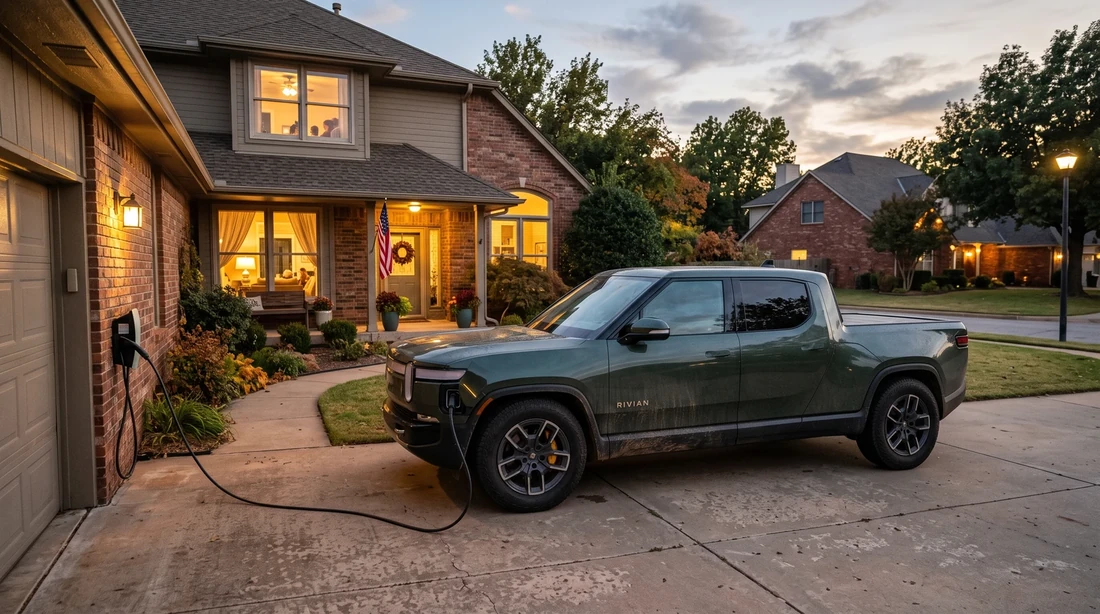
To book an Airbnb with an EV charger in Oklahoma City, confirm the exact outlet before you reserve: most furnished homes offer a standard 120V (Level 1) outlet that adds 3-5 miles of range per hour, while a smaller number have a 240V (Level 2) connection that adds 20-30. Ask what plug the home has, match it to your car, and pack an adapter.
Key Takeaways
- Level 1 120V outlets add 3 to 5 miles of range per hour, while 240V Level 2 connections add 20 to 30.
- Confirm the exact outlet, amperage and connector before booking; a 240V outlet on 30 amps delivers half a 50-amp circuit's power.
- Do not charge through a household extension cord; use your car's mobile connector plugged directly into a properly rated outlet.
- A hard January cold snap can shave 20 to 30% off usable range and slow charging, so park inside a garage when possible.
You're driving an EV across I-35 or I-40, and you don't want to spend your OKC nights babysitting a public charger. The good news: for road-trippers, an overnight top-up at your rental usually beats a fast-charge detour. The catch is that "EV charger" means very different things house to house, a garage outlet, a dedicated Level 2 unit, or nothing but the porch plug.
This guide covers what each charger level delivers, how to confirm what a specific home has before you book, which charger your arrival battery and stay length call for, the cold-weather math, where OKC's public fast chargers sit as backup, and how to set up an overnight charge step by step.
Every road-trip stop at a public DC fast charger typically costs more per kWh than a slow overnight charge at your rental, a home outlet quietly turns your sleep hours into free range.

Why Does EV Charging at Your Rental Matter More Than the Listing Filter Suggests?
An overnight charge at your rental can add 100+ miles of range while you sleep, which is more than most OKC-area day trips ever burn. That single fact changes how you shop: you don't need the fastest charger, you need the right outlet you can reach from your parking spot.
Oklahoma City sits at the crossroads of I-35 and I-40, so most EV guests here are passing through, Dallas to Kansas City, or Memphis to Amarillo. You arrive with a partial battery, you're staying two to five nights, and you want to leave topped off. For that pattern, a plain 240V garage outlet does the job better than a highway detour ever will.
The metro geography helps you here. Will Rogers World Airport is about six minutes from several homes, and OKC's freeway ring, I-35, I-40, I-44, the Kilpatrick Turnpike, and the Turner Turnpike out to Tulsa, puts most of our properties within a few minutes of your route.
A Gaillardia estate on the northwest side hugs the Kilpatrick; homes near Lake Hefner and The Village sit off Lake Hefner Parkway; and central homes in the Paseo and Plaza districts are a short hop off I-44. From those bases, downtown venues are close: Paycom Center is a straightforward downtown drive, and Devon Park in the Wheeler District, just south of downtown, is minutes off I-40.
If your OKC stop is built around a Thunder game at Paycom Center, the Women's College World Series at Devon Park in late May, or the September State Fair of Oklahoma, event-week parking near the venue is often paid and crowded, charging at your home base and driving in already-topped-off spares you that headache entirely. The same logic holds for the late-April OKC Memorial Marathon, when downtown road closures make a full battery and a home base worth more than proximity.
The problem with marketplace filters is that "EV charger available" gets checked for everything from a dedicated wall unit to a 120V outlet near the driveway. Those are not the same amenity. Below is what each one really means.
Devon Park's hosting role goes beyond the Women's College World Series:
Riversport OKC will host the canoe slalom competition, while Devon Park will host the softball competition.
Wikipedia: Oklahoma City
What Do the EV Charger Levels Mean at an Oklahoma City Rental?
The single number that matters is miles of range added per hour, everything else is detail. A Level 1 outlet is fine for a multi-night stay; a Level 2 connection is what you want if you're arriving nearly empty and leaving early.
| Charger level | Outlet / plug | Range added per hour | Best for |
|---|---|---|---|
| Level 1 | Standard 120V household (NEMA 5-15) | ~3-5 miles | Multi-night stays; overnight top-ups |
| Level 2 (outlet) | 240V dryer-style (NEMA 14-50 / 6-50) | ~20-30 miles | Short stays; near-empty arrivals |
| Level 2 (wall unit) | Hardwired J1772 / Tesla connector | ~25-40 miles | Fastest home charging, no adapters |
| DC fast (public only) | CCS / NACS / CHAdeMO | ~150-200+ miles | Quick highway top-ups, not overnight |
Two takeaways. First, a Level 1 outlet over a two-night stay (say 16 hours of parked time) adds roughly 50-80 miles, plenty for a couple of days around town. Second, you almost never charge at a public DC fast charger overnight; those are for a 20-minute splash-and-dash on the road, not a home amenity.
One nuance the filter pages never explain: not all 240V outlets charge at the same speed. A 240V outlet on a 30-amp circuit delivers roughly half the power of one on a 50-amp circuit, so "Level 2" can mean 16 miles per hour or 30 depending on the breaker behind it. If you're arriving near-empty and every hour counts, ask "what amperage?" along with "is it 240V?" Your car's mobile connector also caps at a set amperage regardless of the outlet, so the slower of the two wins.
Which OKC Homes Have EV Outlets or Level 2 Chargers?
Charger setups vary home to home, so the honest answer is: confirm the exact outlet before you book rather than trusting a filter checkbox. BnB OKC operates 11 furnished homes across the metro, and the parking, garage access, and outlet type differ by property, a Gaillardia estate with an attached garage is a different charging situation than a home with a shared driveway.
Here's what to ask when you call (405) 870-2146 or message before booking, so you know exactly what you're getting:
- Is there a garage or driveway outlet within reach of where I'd park? Cable length matters, most mobile connectors are 20-25 feet.
- Is it a 120V outlet or a 240V (dryer-style) outlet, and what amperage? This is the difference between 5 and 30 miles per hour.
- Is there a dedicated Level 2 wall unit, and what connector, J1772 or Tesla/NACS? A Tesla charger at an OKC Airbnb needs no adapter for a Tesla; other EVs use a NACS-to-J1772 adapter.
- Can I run a cable safely without crossing a shared walkway? Covered garages beat open driveways in tornado season (April-June) and OKC summer heat.
Because outlet availability changes with maintenance and by home, we'd rather tell you plainly what's at your chosen property than list an amenity you can't use. That confirmation call takes two minutes and saves you a dead-battery morning.
A word on extension cords, shared circuits, and safety
Do not plan to charge through a household extension cord. Standard extension cords aren't rated for the sustained current an EV pulls for hours, and running one is both a fire risk and something most hosts prohibit, the safe setup is your car's own mobile connector plugged directly into a properly rated outlet.
If the only 240V outlet is the one behind the dryer, ask before assuming you can use it; sharing a circuit means you can't run the dryer and charge at full amperage at the same time. And if the outlet is on an open exterior wall, check that it's covered or weather-protected before you leave a cable connected overnight in an April thunderstorm.
Which Charger Do You Need for Your Arrival Battery and Stay Length?
The right charger for you is a function of two numbers you already know: how full you'll arrive and how many nights you're parked. Use this to decide how hard to push on Level 2 before you book.
| Your situation | Level 1 (120V) enough? | What to do |
|---|---|---|
| Arrive 60%+, stay 2+ nights, light driving | Yes | Any household outlet tops you off overnight |
| Arrive 30-50%, stay 3+ nights | Usually | Level 1 over several nights refills you; Level 2 is a bonus |
| Arrive under 30%, leave early next morning | No | Prioritize a 240V outlet or one public fast charge on arrival |
| Two or more EVs charging at once | Depends | Confirm outlet count; stagger charging or use public for the second car |
| Extended stay (30+ nights) | Yes | Level 1 easily keeps pace with everyday driving |
The pattern most OKC guests fall into, arriving 40-60% for a two-to-four night stop, almost never needs Level 2. Level 2 earns its keep only at the near-empty, leave-early end of the table. One more edge case worth naming: if you're towing a trailer or hauling a full carload of reunion gear, your real-world range runs lower than the dashboard estimate, so treat yourself as if you'll arrive a notch emptier than planned and lean toward a home with a faster outlet.
How Do OKC Winters and Summers Change Charging?
Cold weather can cut your charging speed and range noticeably, which matters more in Oklahoma than road-trippers expect. A hard January cold snap can shave 20-30% off usable range and slow how fast a battery accepts a charge, especially on a slow Level 1 outlet, so the overnight top-up you counted on may come up shorter than the mile-per-hour math suggests.
Two habits fix most of it. Precondition the battery in your car's app before you unplug on a cold morning, and if the home has a garage, park inside, a covered, wind-sheltered space holds heat far better than an open driveway. In OKC's July and August heat, garages help the other direction, keeping the car and cable out of direct sun. Tornado season peaks April through June, so a garage outlet also means you're not running a cable across an open driveway during a storm.
If you drive a Tesla, a Tesla charger at an OKC Airbnb is the simplest setup, plug straight in, no adapter. On a household or dryer outlet, bring your Tesla mobile connector and the matching NEMA adapter, and expect cold nights to add fewer miles per hour than the label promises.
What Does It Cost to Rely on Public Fast Chargers Instead?
Relying only on public DC fast charging during a multi-night stay adds both dollars and time you didn't budget for. Here's how that stacks up if you don't lock in a home outlet.
- Night one: You arrive at 4:00 PM with 20% battery and no home outlet. You drive to a public fast charger and pay a premium per-kWh rate plus, at some stations, an idle or session fee.
- Day two: Any real driving means another public session, you're now scheduling your day around charger locations instead of your reunion or your route.
- Departure morning: You leave with whatever the last public stop gave you, often not a full charge, so your first highway leg out of OKC starts with a range-anxiety detour.
A home outlet erases all three steps: plug in at check-in, wake up topped off, drive out. The convenience is the whole point.
Planning an EV road trip through OKC? Confirm the exact outlet at the home you want before you book, call or text and we'll tell you plainly what's available.
OKC Public Fast Chargers as Your Backup Plan
Even with a home charger, keep one public fast charger saved near your route, batteries and plans change. Oklahoma City's public charging clusters along the I-35 and I-40 corridors and around major retail centers, served by the national networks below.
| Network | Connector | Typical use |
|---|---|---|
| Tesla Supercharger | NACS (adapters for other EVs) | Fastest, most reliable for Tesla drivers |
| Electrify America | CCS / NACS | Highway-corridor DC fast charging |
| EVgo | CCS / CHAdeMO | Urban fast charging near retail |
| Local / L2 stations | J1772 | Slower top-ups at garages, hotels, parks |
Because station locations and pricing change, verify the exact spot and availability in a live app (PlugShare or your car's built-in map) the day you travel rather than trusting a printed list.
If your route runs east-west on I-40 or north-south on I-35, plan your last splash-and-dash for a station near the interchange you'll exit, not the one closest to your rental, you want the top-up on the way out of town, not a backtrack. Treat the public network as insurance, not your main plan, the point of an Airbnb with an EV charger in Oklahoma City is to never think about it after you plug in at check-in.
Worked Example: A 14-Person Reunion That Charges Two EVs Overnight
Here's a clearly hypothetical example to show the math. Say you're organizing a family reunion for fourteen and two of your carloads drove EVs in, one from Dallas up I-35, one from Tulsa on the Turner Turnpike. You want a big home that sleeps the group and lets both cars top up overnight.
You book a large-group furnished home for five nights with a budget in the ballpark of $2,900. With BnB OKC's direct-booking savings of up to 35% on 4+ night stays, booking direct instead of on the marketplace keeps a meaningful slice of that in the reunion fund. Both EVs plug into 240V garage/driveway outlets at 4:00 PM each evening and wake up near full, no reunion morning spent hunting for a charger.
| Line item | Marketplace | Book direct |
|---|---|---|
| 5-night home (base) | ~$2,900 | ~$2,900 |
| Guest service fee (~14%) | ~$406 | $0 |
| Direct-booking savings (up to 35% on 4+ nights) | None | Applied to base |
| Per person (÷14), before EV savings | ~$236 | Lower |
Fees illustrative; marketplace service fees vary by booking. See book direct vs. Airbnb and Airbnb vs. Vrbo fees for the full fee breakdown, and Airbnb vs. hotel for groups for why one big home beats a block of rooms.
How the per-person math scales with group size
The bigger the group sharing one home, the smaller the per-person cost, and the more the direct-booking savings matter. Here's roughly how a five-night stay near that $2,900 base splits out (hypothetical, before any EV savings).
| Group size | Home base (~$2,900) | Per person, direct | Notes |
|---|---|---|---|
| 8 guests | ~$2,900 | ~$363 | Confirm home sleeps 8 comfortably |
| 12 guests | ~$2,900 | ~$242 | Splitting fixed cost wider |
| 14 guests | ~$2,900 | ~$207 | Our homes sleep 2 to 16+ |
| 16 guests | ~$2,900 | ~$181 | Verify sleeping capacity before booking |
The exact figure matters less than the pattern, since your dates and home change the base. One large home charging two EVs overnight beats a block of hotel rooms with no reliable charging on both cost and convenience.
The charging-cost side of the same trip
Now put numbers on the charging itself, still hypothetical. Say each EV carries a 75 kWh battery and both need to go from about 20% to 80% (~45 kWh) twice during the five days. At a public DC fast charger around $0.48/kWh, each fill runs roughly $21.60, so four sessions across both cars land near $86, plus possible idle fees and the drive time to reach a station.
Charging those same 45-kWh fills overnight at a home outlet at residential rates (ballpark $0.13/kWh) is closer to $6 per fill, and at a furnished rental that electricity is typically just part of the stay. Beyond the lower cost per kWh, the home outlet hands your group back the hours you'd otherwise lose to charging stops.
Worked Example: Two Travelers on a Level 1 Outlet
A second hypothetical, scaled down. Say two of you are driving through on the way to Santa Fe, arriving in OKC around 4:00 PM at 45% battery, staying two nights, and doing light sightseeing around the Paseo and Plaza districts. The home has only a standard 120V outlet.
Over roughly 32 hours parked across two nights at ~4 miles per hour, that outlet quietly adds about 120 miles, more than you'll burn cruising a few OKC neighborhoods. You leave near where you arrived, drop by one Supercharger on your way out of town for a quick top-off, and never once rearranged your day around a charger. That's the whole case for Level 1: unglamorous, but it works when you match it to a real itinerary. For a longer stay, that overnight convenience compounds, see extended-stay hotel vs. furnished rental.
What Should You Check Before You Book an EV-Friendly Rental?
These are the gaps between the listing filter and the outlet you can use.
- "EV charger available" with no detail. That checkbox covers everything from a wall unit to a porch plug. Ask for the outlet type and amperage.
- An outlet out of cable reach. Most mobile connectors run 20-25 feet; confirm the outlet sits within reach of where you will park.
- A 240V outlet on a 30-amp circuit. It delivers roughly half the power of a 50-amp one, and your mobile connector caps the rate too.
- The dryer outlet as the only 240V option. A shared circuit means no full-amperage charging while the dryer runs; ask before assuming you can use it.
- An uncovered exterior outlet. Check it is weather-protected before leaving a cable connected through an April thunderstorm.
- Two EVs and one outlet. Confirm the outlet count, then stagger charging or send the second car to a public station.
- Winter range math. A hard cold snap can cut usable range 20-30% and slow a Level 1 charge; plan to arrive a notch emptier than the dashboard says.
How to Charge Your EV Overnight at Your OKC Rental, Step by Step
Set this up right once and it's automatic every night. Five minutes at check-in buys you a full battery by morning.
- Confirm the plug. Ask which outlet or charger the home has and match it to your car's connector before you book.
- Pack your adapters. Bring your car's mobile connector and a NEMA 14-50 or 5-15 adapter so you can plug into whatever the home offers.
- Park within reach. Position your car so the charging cable reaches the outlet without crossing a walkway.
- Start charging at check-in. Plug in when you arrive at 4:00 PM so the car tops up overnight while you sleep.
- Set a charge limit. Cap your charge at 80% in your car's app to protect the battery and free the outlet.
- Plan a fast-charge backup. Save one public DC fast charger near your route in case you need a quick top-up before leaving.
When Do You Not Need an EV Charger at Your Rental?
Be honest with yourself about your battery math. You don't need a home charger if you're arriving with 60%+ and driving very little, plenty of two-night OKC visitors never dip low enough to matter, and a single public top-up on the way out covers the highway leg.
You also may not need it if your car has 300+ miles of range and OKC is just a sleep stop between two longer drives; one strategic fast-charge on arrival or departure can be simpler than fiddling with adapters. And if you're staying near-empty for a single night before an early departure, a Level 1 outlet won't refill you in time anyway, a public DC fast charge on arrival is the smarter move.
A home charger changes the trip when you're arriving near-empty with time to spread the charge over multiple nights, charging more than one EV, settling in for a 30+ night extended stay, or you don't want to plan your days around public stations. If you're already choosing a home for other amenities like an Airbnb in OKC with a pool or an Airbnb in OKC with a hot tub, confirming the outlet is a two-minute add-on to the same booking.
BnB OKC holds a 9.5 out of 10 average across 1,580 verified guest reviews on Airbnb and Vrbo, and several homes are dog-friendly, so an EV road-trip family with a dog can browse pet-friendly OKC rentals and still charge overnight. For the whole reunion, start with large-group rentals in OKC.
Terms You'll Hear, Decoded
- Level 1 charging: Plugging into a standard 120V household outlet; slowest, adds roughly 3-5 miles per hour.
- Level 2 charging: A 240V outlet or wall unit; adds roughly 20-40 miles per hour, ideal for overnight.
- DC fast charging (Level 3): High-power public stations that add 150+ miles in under an hour; not a home amenity.
- Amperage: How much current a circuit delivers; a 240V outlet on 50 amps charges roughly twice as fast as one on 30 amps.
- Preconditioning: Warming (or cooling) the battery via your car's app before you charge or drive so it accepts power faster, especially useful on cold OKC mornings.
- NEMA 14-50: The common 240V dryer-style outlet many home Level 2 chargers plug into; carry the matching adapter for your mobile connector.
- J1772: The standard connector most non-Tesla EVs use for Level 1 and Level 2 charging.
- NACS: The Tesla-style connector now adopted by many automakers; other EVs use an adapter to fit it.
- Idle fee: A per-minute charge some public stations add once your car is full but still plugged in, a cost home charging avoids.
- Mobile connector: The portable charging cable that comes with your car and plugs into a household or dryer outlet.
The Bottom Line
An overnight charge at your rental turns sleep hours into range, and for most two-to-four night OKC stops a plain outlet does the job. Confirm the exact outlet, its amperage, and its reach before you book, pack your mobile connector and adapters, skip household extension cords, and keep one public fast charger saved near your exit interchange as insurance.
- Check your arrival battery and stay length. If you'll arrive under ~40% or stay 3+ nights, prioritize a home with a usable outlet, and account for cold-weather range loss if you're traveling in winter or a fuller carload if you're hauling reunion gear.
- Compare the plug to your car. Note your connector (J1772 or NACS), the outlet amperage if it's 240V, and pack the matching adapter and mobile connector, never a household extension cord.
- Confirm and book. Browse furnished OKC homes or call/text (405) 870-2146 to verify the exact outlet at your home before you reserve.
For live OKC event dates that might shape your charging plan, check the Visit OKC website.