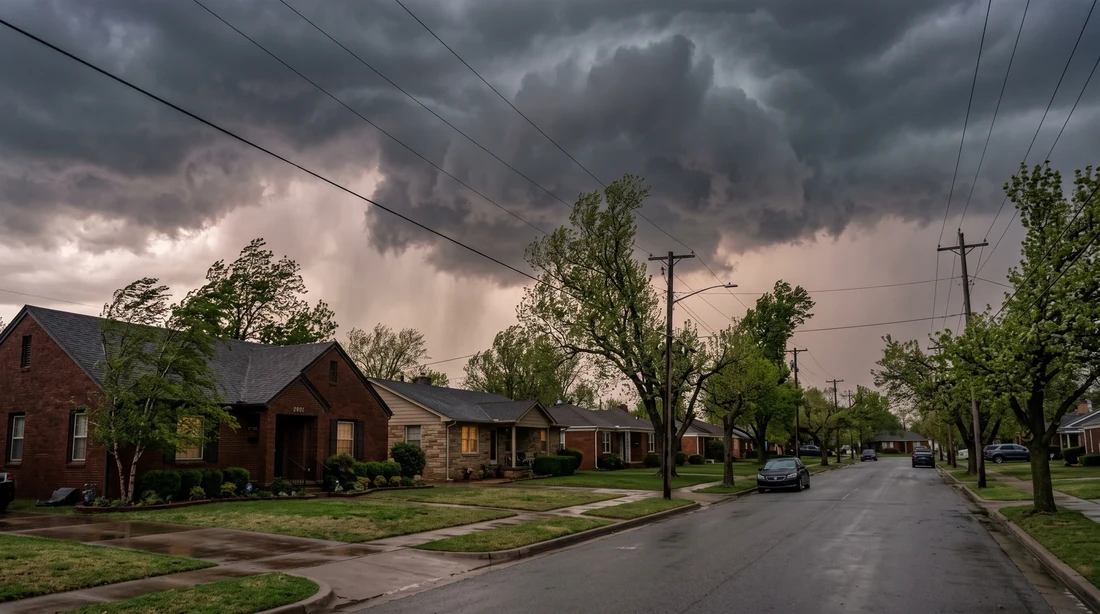
Under Airbnb's Major Disruptive Events Policy — in effect since June 6, 2024 — foreseeable severe weather is usually NOT a free-refund event. A spring storm only qualifies if it triggers another covered event: a government-mandated evacuation order or a large-scale outage of essential utilities (heat, water, or electricity). Airbnb decides whether it applies.
You booked a furnished home for a work trip or a family weekend, the forecast turned violent, and now you're staring at the cancellation policy wondering if you'll lose the money. In tornado country, this is the question every April through June. The honest answer surprises most Oklahoma travelers: a scary forecast, by itself, doesn't unlock a refund.
This is the Airbnb weather cancellation policy decoded for storm country — what the rule actually says, when it pays, when it doesn't, and the bigger situation it points to: when severe weather damages your home, a different system takes over entirely.
Oklahoma's tornado season peaks April through June. The policy that governs your refund was set the moment you booked — not the moment the sirens go off. Know which rule applies before the sky does.
What Airbnb's Major Disruptive Events Policy Actually Changed
On June 6, 2024, Airbnb replaced its old Extenuating Circumstances Policy with the Major Disruptive Events Policy, and the new rules apply to any trip booked on or after that date. The rename wasn't cosmetic — it narrowed and clarified exactly which crises unlock an automatic refund.
When the policy applies to a reservation, it overrides the listing's own cancellation terms. Guests receive refunds or credits regardless of whether the home was booked "Flexible," "Moderate," or "Strict," and hosts can cancel without penalty. One catch that matters: on a covered cancellation, the host receives no payout. And crucially, Airbnb itself determines whether the policy applies to a given location and timeframe — it is not automatic and not decided by the guest.
| Element | Before (Extenuating Circumstances) | After (Major Disruptive Events, June 6 2024) |
|---|---|---|
| Policy name | Extenuating Circumstances Policy | Major Disruptive Events Policy |
| Applies to | Older bookings | Trips booked on or after June 6, 2024 |
| Foreseeable weather | Broader, less defined | Covered only if it triggers another covered event |
| Who decides it applies | Airbnb | Airbnb (location + timeframe) |
| Effect when it applies | Overrides listing policy | Overrides listing policy; host gets no payout |

What Counts as a Covered Event — And What Doesn't
The policy covers a specific list of large-scale disruptions, and severe weather sits in a gray zone. Foreseeable weather — like a hurricane during hurricane season, or spring storms during Oklahoma's severe-weather months — qualifies only if it sets off one of the other covered events. On its own, a forecast is not enough.
Here is the plain-English breakdown for a storm-country trip.
Covered events (refund or credit when Airbnb applies the policy)
- Government-mandated evacuation orders and travel restrictions
- Large-scale outages of essential utilities — heat, water, or electricity
- Government-declared public health emergencies and epidemics (excluding endemic diseases and COVID-19)
- Military actions, war, terrorism, and civil unrest
- Unforeseeable natural disasters
Not covered
- Events affecting your ability to travel rather than the reservation location
- Personal illness or injury
- Non-binding travel advisories (a "watch" or an advisory that doesn't mandate action)
- Unrelated event cancellations (the concert or game you came for got called off)
- Transportation strikes and airline failures
Read those two lists side by side and the logic snaps into focus: the policy protects you when the place you booked becomes unusable or unreachable by official order — not when the weather simply worries you, and not when your flight home is the problem.
Why "Foreseeable" Is the Word That Decides Your Refund
A single word does most of the work in this policy: foreseeable. Severe weather during a known severe-weather season is, by Airbnb's framing, foreseeable — so it doesn't automatically qualify the way a truly unforeseeable disaster might.
What flips foreseeable weather into a covered event is a second trigger. If that spring supercell prompts a mandatory evacuation order for your reservation's area, or knocks out electricity across the neighborhood at scale, the covered-event door opens. A tornado watch, a severe-thunderstorm warning, or your own nerves do not open it.
| Situation | Likely outcome under the policy |
|---|---|
| Severe-storm forecast, no official order | Not a covered event — listing's cancellation terms apply |
| Tornado watch or warning issued | A warning alone is not a mandated evacuation — typically not covered |
| Government-mandated evacuation order for the area | Covered event — refund or credit when Airbnb applies it |
| Storm causes large-scale power/water outage at the home | Covered event — utility outage qualifies |
| Your flight home is canceled by the airline | Not covered — affects travel, not the reservation location |
Because Airbnb makes the call on whether a location and timeframe qualify, the practical move is not to guess. Contact Airbnb directly, document the official order or outage, and let the platform apply the determination — the automatic override only kicks in when Airbnb says it does.
The Bigger Oklahoma Story This Policy Points To
Here's where the refund question becomes almost a footnote. The Major Disruptive Events Policy governs a trip you might lose — a few hundred dollars. But when severe weather damages the home you actually live in, you're not seeking a refund. You need somewhere to live for weeks or months, and a completely different system pays for it: your homeowner's or renter's insurance.
That coverage is called Additional Living Expenses (ALE), sometimes "loss of use." It's the part of your policy that covers the extra cost of living elsewhere while your home is repaired after a covered loss — and it's a far larger sum than any cancellation refund. This is the pivot every Oklahoma storm season forces, and it's the situation we work in every week.
Displaced by storm damage, or placing a family who is? We keep furnished OKC homes ready for insurance stays and can move fast when the clock is short. See how it works or call us directly.
Worked Example: Refund Lost vs. ALE Housing Gained (Hypothetical)
Say a family of four books a $210-per-night furnished home for a four-night OKC weekend, total $840. A severe-weather outbreak rolls in, but no evacuation order is issued and the utilities stay on. Under the Major Disruptive Events Policy, the storm is foreseeable and triggers no covered event — so the listing's cancellation terms apply, and depending on those terms, the family may recover little or nothing of the $840. That's the ceiling of what a cancellation dispute is worth.
Now flip the scenario. The same storm instead damages the family's own roof and makes their house unlivable for repairs. Their insurance opens an ALE claim. A two-room extended-stay hotel setup at roughly $180/night for even eight weeks runs about $10,080 before meals and laundry — while a furnished home billed at a monthly rate over the same period typically stretches the same ALE budget much further, with a full kitchen and space the whole family shares. The numbers are illustrative, but the scale gap is the point: the refund is a rounding error next to the housing decision behind it.
Your Options After Severe Weather — Cancellation vs. Displacement
A furnished 3-bedroom home in OKC typically costs less per month than 30 nights in two hotel rooms — which is why displacement, not cancellation, is where getting the decision right actually matters.
| Your situation | What to do | What it's worth |
|---|---|---|
| Trip disrupted, no official order | Check your listing's cancellation policy; ask host about flexibility | Refund limited to booking terms |
| Trip in an evacuation zone / utility outage | Contact Airbnb; document the order/outage | Refund or credit if Airbnb applies the policy |
| Your home is damaged, short repair (days) | Hotel may be simplest; keep every receipt | Paid via ALE after your deductible |
| Your home is damaged, 30+ day repair | Furnished home on a monthly rate | Kitchen, laundry, space — stretches ALE budget |
How to Handle a Weather-Disrupted Airbnb, Step by Step
- Check your booking date — the Major Disruptive Events Policy applies to trips booked on or after June 6, 2024.
- Confirm whether an official trigger exists — a government-mandated evacuation order or a large-scale utility outage at the location, not just a forecast or warning.
- Document everything — screenshot the official order or outage notice and note dates and times.
- Contact Airbnb directly — the policy applies only when Airbnb determines it does for your location and timeframe.
- If it's not covered, ask the host — many hosts will offer flexibility even when the policy doesn't force a refund.
When You Don't Need a Furnished Home — And When It Changes Everything
If your only problem is a canceled leisure trip, this is a customer-service matter, not a housing one — read the listing's cancellation policy, message the host, and move on. A one- or two-night solo disruption rarely justifies more than a hotel workaround.
But when the storm damages your actual residence and repairs stretch past a few weeks, a furnished home changes the outcome for a displaced family. Kitchens, laundry, separate bedrooms, and a fenced yard for the dog do what two hotel rooms can't — and a monthly rate on a 30+ night stay typically stretches an ALE budget further than nightly hotel rates. That's the line: short and simple, use a hotel; long, with a family or pets, a furnished home is the better use of the coverage.
Terms You'll Hear, Decoded
- Major Disruptive Events Policy — Airbnb's current cancellation-override policy (since June 6, 2024) that refunds guests when a covered large-scale event makes a reservation unusable.
- Foreseeable weather — expected seasonal weather (like spring storms in Oklahoma); it only qualifies for a refund if it triggers another covered event.
- Covered event — an evacuation order, large-scale utility outage, declared health emergency, or unforeseeable disaster that unlocks the refund override.
- Additional Living Expenses (ALE) — the "loss of use" part of a home insurance policy that covers extra costs of living elsewhere after a covered loss.
- Direct billing — when a housing provider bills your carrier or its adjuster directly, arranged only with carrier authorization.
BnB OKC operates 11 furnished homes across the metro and holds a 4.8-star average across 1,247 verified guest reviews on Airbnb, with monthly rates available on 30+ night stays for insurance placements.
FAQs
See the questions below for the situations Oklahoma travelers ask about most.
Your Next Steps
- Check your booking date and the official status. Confirm your trip was booked on or after June 6, 2024, and whether a government-mandated order or utility outage actually exists — a forecast alone won't qualify.
- Gather your documentation. Screenshot any evacuation order or outage notice, and if your home is damaged, photograph everything and open your ALE claim.
- Take the direct action. For a disrupted trip, contact Airbnb; for a displaced family needing furnished housing fast, see insurance housing in OKC or call or text (405) 295-5052.
This guide is general information, not insurance or legal advice; your carrier makes all coverage decisions, and Airbnb determines whether its policy applies to any trip.
Planning around OKC's rules and events? See OKC short-term rental rules, the OKC Airbnb enforcement crackdown, Norman short-term rental license requirements, the Norman hotel tax increase, and the Route 66 Centennial in OKC.
For the full policy text, see this breakdown of Airbnb's Major Disruptive Events Policy.