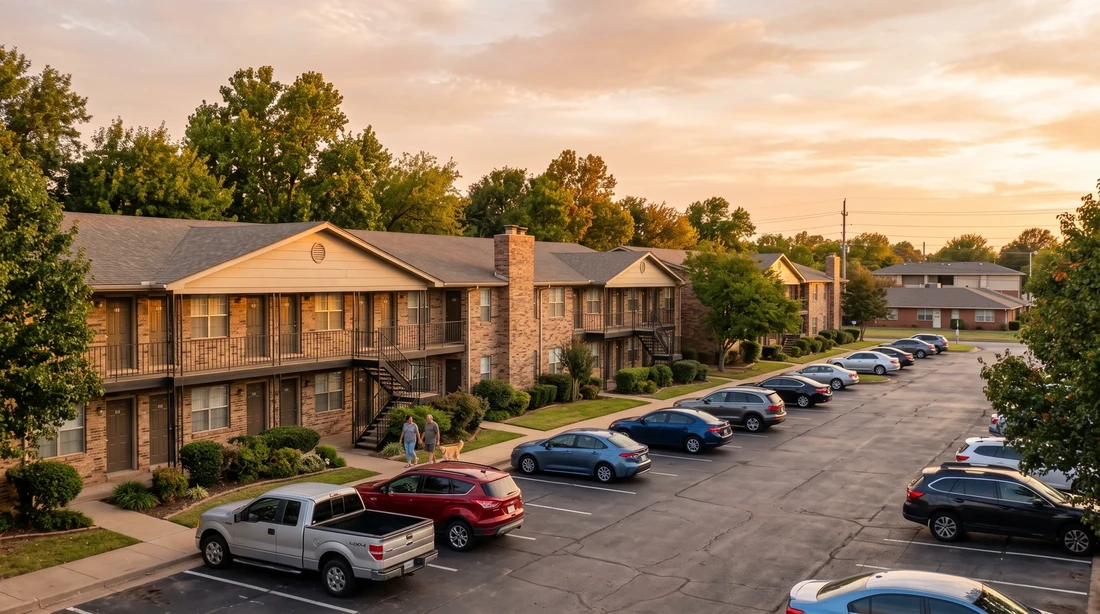
Yes. Most insurers will issue an insurance advance for living expenses (an upfront check drawn against your loss-of-use coverage) when you ask, often within a few days of opening the claim. It covers immediate move-in costs like a deposit, first month's rent, and essentials. It's reconciled against your receipts later; it isn't extra money on top of your coverage.
Key Takeaways
- An ALE advance is early payment against loss-of-use coverage you already carry; it is deducted from your final ALE total, not added to it.
- Advances typically cover a security deposit, first month's rent or lodging, immediate essentials, pet deposits, and extra mileage to work or school.
- Request the advance in the first 24 to 48 hours, keep every receipt, and expect to repay any unused portion at final reconciliation.
- Two hotel rooms run $5,700 to $11,000+ per month, while a furnished OKC home offers monthly rates on stays of 30+ nights.
This guide covers how to ask your insurer for an advance on your living-expense coverage, what that money is for, how much to request, how it gets squared up against your receipts later, and what to check if the advance is denied or delayed. It's written for a family that has just been displaced and needs cash for a deposit this week.
Your apartment just burned, you're standing in a parking lot with two kids and one bag, and the furnished place you found needs a deposit today. You have loss-of-use coverage. What you don't have is cash in hand, and the claim could take weeks. This is the exact moment an ALE advance exists for.
An ALE advance (also called an advance payment, an advance draw, or an insurance claim advance check) is money your carrier releases before your full claim is settled, so a displaced family can put a roof over their heads immediately. You don't have to float the deposit on a credit card and wait. You do have to know to ask, and how.
Every night in a hotel while you wait for a check burns cash you may not have, and it burns ALE budget a furnished home would stretch further. An advance requested in the first 24 to 48 hours is what stops that bleed.

What Is an ALE Advance?
An ALE advance is an early payment against money you're already owed under loss of use. It isn't a bonus, and it isn't a loan. Additional Living Expenses (ALE) coverage reimburses the extra costs of living somewhere else while your home is unlivable. Normally you spend, save receipts, and get reimbursed. An advance flips the order for your first big costs.
A deposit plus first month's rent can be thousands of dollars up front, and most carriers understand a displaced renter can't front that. So they cut an advance check, typically enough to secure housing and buy immediate essentials, and subtract it from your total ALE reimbursement as the claim proceeds.
If you're still learning how loss of use works at all, start with loss-of-use coverage explained, then come back here for the advance mechanics. This guide assumes you already have coverage and need cash now.
On claim timing, one widely cited insurance reference notes:
Insurance policies typically require the insurer to be notified within a reasonable period.
Wikipedia: Home insurance
What Does an ALE Advance Typically Cover?
An advance usually covers the up-front costs that let you move in the same week. Think of it as bridge money for the expenses that hit before any reimbursement cycle could catch up.
- Security deposit on a rental or furnished home
- First month's rent or the first block of nightly lodging
- Immediate essentials: clothes, toiletries, a few days of meals above normal
- Pet deposits or fees if you're relocating with animals
- Extra mileage if the temporary home is farther from work or the kids' school than your old address
An advance is generally not meant for replacing all your destroyed belongings. That's personal-property coverage, a separate part of your policy. It also won't cover luxuries beyond your normal standard of living. "Additional" living expenses means the amount above what you normally spent, and the carrier decides what qualifies. If your old apartment had no laundry and your temporary home does, the coin-laundry line you used to pay may shrink. ALE tracks the difference, up or down.
Can You Still Get Reimbursed If You Already Paid the Deposit?
Yes. If you fronted a deposit or first month on a card before your advance came through, that spending is still eligible ALE and can be reimbursed with the receipt. Many displaced families move first and ask second, because there was no time to wait. Acting fast doesn't forfeit the money.
The advance and the reimbursement are two doors into the same room. If you already paid, keep the lease, the deposit receipt, and the payment confirmation, and submit them as documented ALE. The carrier reimburses them against your limit as if it had advanced the cash first. Fronting it yourself costs you the float and leaves the coverage intact. If cash is tight going forward, you can still ask for an advance to cover the next block of rent so you're not carrying it on a credit card for months.
Does It Work Differently for Renters and Homeowners?
Both renters and homeowners can request an ALE advance, and the mechanics are identical. The size of the pot you're drawing against is calculated differently. On many renters policies the ALE limit is a percentage of your personal-property (contents) coverage. On many homeowner policies it's a percentage of the dwelling coverage, a much larger base number, which usually means a larger ALE ceiling.
That matters for how much you can reasonably ask to advance. A renter with a modest contents limit has a smaller ALE pool, so a $2,800 advance may represent a meaningful chunk of it. A homeowner rebuilding after a fire may have far more room and can often request a larger first draw because the displacement is likely to run months. Either way, the carrier confirms your specific limit. Never assume the percentage.
One wrinkle hits homeowners and skips renters. If there's a mortgage, dwelling-repair checks are often made out jointly to you and the lienholder and can route through an escrow-style release. That does not apply to ALE. Loss-of-use money is yours to spend on housing and goes to you directly. Don't let the two get confused on a call. Ask the adjuster to keep the ALE advance separate from any dwelling proceeds.
How Much Should You Request?
Ask for enough to secure housing and get through the first month, and skip the lump sum you can't yet document. A good first advance covers a deposit, the first month or block of lodging, and a small essentials buffer. Right-sizing the ask speeds approval and avoids owing money back at reconciliation.
| Situation | Rough first-advance ask | Why |
|---|---|---|
| Single traveler, short gap | Often none needed | Card-and-reimburse covers a 1-3 night gap |
| Family, deposit + first month furnished | Low thousands (e.g. ~$2,800) | Covers deposit, first month, essentials buffer |
| Family with pets | Add pet deposit + fees | Extra deposits hit up front, before reimbursement |
| Long homeowner rebuild | Larger first draw, then top-ups | Bigger ALE pool; displacement runs months |
Figures are illustrative starting points rather than quotes. Your adjuster sets the amount against your confirmed limit. When in doubt, ask for the housing cost you can prove with a real quote and add a modest essentials line rather than a round number pulled from the air.
How Is the Advance Reconciled Later?
Whatever you receive as an advance is deducted from your final ALE total. You're spending your own coverage early, and the total doesn't grow. Here's the sequence carriers typically follow.
- Advance issued. You get a check (say $2,800) to secure housing. The carrier logs it against your ALE limit.
- You keep every receipt. Rent, utilities set up in your name, extra mileage, extra meals. Receipts substantiate the claim, and without them the advance can be questioned at reconciliation.
- Ongoing reimbursement. As you submit documented costs, the carrier reimburses the difference between what you've spent and the advance already paid.
- Final reconciliation. When you move home or the claim closes, the carrier tallies total documented ALE. If you spent more than the advance, they pay the balance. If you spent less, you may owe the unused portion back.
That last line matters. An advance is real money you're accountable for. Spend it on real additional living costs and keep the paper trail, and reconciliation is routine. Treat it like a windfall and you can end up owing money back at claim close.
Can You Get a Second Advance If the Displacement Runs Long?
Yes. If your first advance runs out before the home is repaired, you can request another draw against your remaining ALE limit. Long fire and water repairs in the OKC metro can stretch four to six months or more, so a single first-month advance rarely carries the whole displacement.
Once you're in a monthly furnished stay, the cleaner rhythm is often ongoing reimbursement: you submit each month's documented rent and the carrier pays it back. If cash flow is tight, ask for a rolling advance instead. The key is your ALE limit. Every dollar advanced or reimbursed draws it down, and once it's exhausted, the carrier stops paying even if you're still displaced. Track your running total the same way the adjuster does.
Watch the calendar limit too. Some older policies cap loss of use by time (12 or 24 months) rather than by dollars, and a few cap by both. If yours is time-based, the advance doesn't shorten your window. It only changes when you receive the money. Confirm which limit governs yours so a long rebuild doesn't surprise you at month ten.
Displaced right now and need somewhere your kids can live this week? We work with insurance placements and offer monthly rates on 30+ night stays. Furnished, move-in ready, one call.
Where Does the Advance Go Furthest?
A furnished 3-bedroom in OKC typically costs less per month than 30 nights in two hotel rooms, so where you put the advance changes how far your whole ALE budget stretches. The table below compares realistic monthly costs for a displaced family of three.
| Option | Rough monthly cost | What the advance buys |
|---|---|---|
| Two hotel rooms | $5,700-$11,000+ | A few weeks, then the ALE budget runs thin fast |
| Extended-stay hotel (1 suite) | $3,000-$4,500 | Kitchenette, more time, cramped for kids |
| Furnished home (BnB OKC) | Monthly rate on 30+ nights | Full kitchen, laundry, bedrooms, deposit + first block covered |
Hotel figures are typical ranges rather than our rates, so verify current pricing before you book. Our published from-rates run $225 to $425/night with monthly rates on 30+ night stays, and direct-booking savings up to 35% on 4+ night stays. For the full breakdown of why hotels drain ALE, see does renters insurance cover hotel stays.
What Does the Math Look Like? Three Worked Examples
Here's a clearly hypothetical scenario to show the math. Say you're a renter displaced by an apartment fire with two kids, and your adjuster approves a $2,800 ALE advance two days after you file.
- Furnished 3-bedroom deposit: $800
- First month at a monthly rate: $1,900
- Essentials (clothes and a few meals above normal): $100
- Advance used: $2,800
That $2,800 got your family into a home with beds, a kitchen, and laundry the same week, instead of two hotel rooms burning $200+ a night while you wait for reimbursement. Compare floating a hotel. At $189/night for two rooms, one month is roughly $5,670, more than double the advance, gone in 30 days, with no kitchen to cut food costs. The advance placed in a furnished home is the same dollars doing far more work.
Now stretch the same family across a longer repair. Say the fire damage takes four months to make the apartment livable again. The $2,800 advance covered your deposit and month one. For months two through four, you submit each month's documented rent, call it about $1,900/month, for ongoing reimbursement:
- Month 1: covered by the advance
- Months 2 to 4 rent reimbursed: 3 × $1,900 = $5,700
- Extra grocery and mileage over normal, documented: roughly $600
- Deposit refunded at move-out and credited back at reconciliation: minus $800
Total documented ALE lands around $8,200 across the displacement. Because you kept every receipt, the advance folds cleanly into that total at claim close. Nothing is double-counted and nothing surprises you. Had the family instead run two hotel rooms for four months, the lodging alone at $189/night would push past $22,000, likely blowing through a renter's ALE ceiling before the repairs finished.
Now add a dog. Same family, same fire, but this time they're relocating with a pet, and a furnished home that takes animals charges a pet deposit. Build that into the advance before you request it:
- Furnished home deposit: $800
- Pet deposit: $300
- First month at a monthly rate: $1,900
- Essentials buffer: $100
- Right-sized advance ask: $3,100
Asking for $3,100 instead of the round $2,800 decides whether the pet deposit comes out of your own pocket or out of coverage you already carry. Name the pet line to your adjuster specifically. A documented pet deposit tied to a real housing quote is routinely approved, and only if you ask for it up front.
What's Different About Being Displaced in OKC?
In Oklahoma City, when you're displaced can matter as much as how. Tornado season peaks April through June, and severe-weather clusters can displace many families at once, tightening furnished-housing supply. If a spring storm is what put you out, ask for your advance fast. The same 24 to 48 hour window that stops hotel bleed also gets you into a home before demand spikes.
Where you place the advance is a location decision as much as a price one. Families trying to keep kids in the same school district often want a furnished home in the same corridor as the old address, such as The Village, the Lake Hefner area, or the Paseo and Plaza districts, so the school run and work commute don't blow up your mileage line. A cross-town placement that adds 20 miles a day round-trip is real money over four months, and you could have avoided it by naming your corridor.
If a parent works downtown or a family member is being treated near the medical district, a home like Capitol Manor sits directly across from OU Medical Center and OU Children's Hospital, close enough to walk. Several metro homes are about six minutes from Will Rogers World Airport, which matters if a displaced parent travels for work. Naming the drive time you need ("under 15 minutes to the kids' school in The Village," say) helps a host match you faster than a generic "somewhere in OKC."
Pets change the math too. Extra pet deposits hit up front, so build them into the advance you request rather than eating them yourself, and confirm the home takes animals before you quote your adjuster. Several BnB OKC homes are dog-friendly. Browse pet-friendly rentals in OKC if you're relocating with animals.
How to Request an ALE Advance, Step by Step
You request an advance directly from your adjuster. Once your claim number exists, it's usually a five-minute call. Follow these steps in order.
- Confirm your loss-of-use coverage. Check your declarations page for an ALE or "loss of use" limit before you call.
- Open the claim and get your claim number. The advance is tied to it.
- Ask your adjuster directly for an advance. Use the script below, and name the amount and why.
- Send a quick housing quote. A deposit-and-first-month figure from a real rental speeds approval.
- Start saving receipts the day the check clears. Every dollar of ALE needs a paper trail.
- Confirm how the advance reconciles. Ask whether it's deducted from ongoing reimbursement or at final settlement.
The ask script, roughly: "My family is displaced and I need to secure housing this week. I'd like to request an ALE advance of about $2,800 to cover a deposit and first month's rent on a furnished home. Can you release that against my loss-of-use coverage today?" Naming a number and a reason gets faster action than a vague request. If the adjuster hasn't inspected yet, ask whether the advance can be released on the displacement alone. Many carriers issue an emergency advance before the full inspection when the home is obviously unlivable.
Some carriers also use an ALE housing company (see how ALE housing companies work). A third party like Alacrity Solutions books and direct-bills your stay, which can remove the need for an advance entirely. Ask about both.
Who Does What?
Knowing which party owns each step keeps your advance from stalling.
| Task | Who handles it |
|---|---|
| Open the claim, get claim number | You |
| Confirm ALE limit on your policy | You (adjuster confirms) |
| Approve and issue the advance check | Adjuster / carrier |
| Provide a housing quote (deposit + rent) | You + host |
| Set up direct billing (if used) | Carrier / TPA + host |
| Keep and submit receipts | You |
| Reconcile advance at claim close | Carrier |
When Don't You Need an Advance?
If your stay is short, your cash flow is fine, or your carrier is direct-billing, an advance may be unnecessary. A single traveler covering a one- or two-night gap on a card and getting reimbursed rarely needs one. And when the carrier or a placement company direct-bills your housing, the deposit-and-rent crunch never lands on you, so there's nothing to advance.
You might also prefer to skip the accountability. An advance is money you'll have to reconcile receipt by receipt. If you have the cash to float a month and like a clean pay-and-submit rhythm, straight reimbursement is simpler at claim close. The advance is a cash-flow tool and leaves your coverage the same size, so skip it if cash flow isn't your problem.
An advance changes the outcome when you're a family with kids and no cushion to float thousands in deposits, when you're facing a 30-plus-night displacement, or when you're relocating with pets and paying extra deposits. Then it's the difference between a furnished home this week and a credit-card scramble. See temporary housing after a house fire for the full displacement playbook, and browse extended stays when your displacement is clearly going to run into months.
What If the Advance Is Denied or Delayed?
A carrier can decline an advance even when ALE is covered, usually over documentation rather than the merits. If that happens, ask exactly what's missing (a housing quote, proof of displacement, an inspection) and supply it. Check these before you call back:
- Is your claim number on everything you send?
- Did you include a real housing quote with the deposit and first month spelled out?
- Does the adjuster have proof the home is unlivable?
- Did you name a specific amount and reason, including any pet deposit?
- Did you ask whether an emergency advance can be released on the displacement alone, before the inspection?
- Is the ALE advance being kept separate from any dwelling check that routes through a lienholder?
If the whole ALE claim is being questioned, read insurance denied temporary housing for how to respond. And if you're unsure your policy even includes loss of use, start at does renters insurance cover temporary housing.
Terms you'll hear, decoded
- ALE (Additional Living Expenses): the coverage that pays the extra cost of living elsewhere while your home is unlivable.
- Loss of use: the policy section ALE lives under; same idea, common on the declarations page.
- Advance / advance draw: money released early against your coverage, reconciled later.
- Emergency advance: a first check some carriers release on displacement alone, before the full inspection.
- Reconciliation: the final tally comparing your documented spending to what was already advanced.
- ALE limit: the ceiling on loss-of-use payouts, often a percentage of dwelling (homeowners) or contents (renters) coverage, and sometimes capped by time instead of dollars.
- Direct billing: the carrier or TPA pays the housing provider directly, only with carrier authorization.
- Reimbursement: you pay, submit receipts, and the carrier pays you back the covered amount.
- Normal living expenses: the baseline the carrier subtracts. Your "additional" expense is only the amount above what you normally spent before the loss.
Explore insurance housing in OKC or call to talk through your dates. BnB OKC operates 11 furnished homes across the metro and holds a 9.5 out of 10 average across 1,580 verified guest reviews on Airbnb and Vrbo. For general questions on how loss-of-use claims are handled in Oklahoma, the Oklahoma Insurance Department is the primary state resource.

The Bottom Line
An advance is your own loss-of-use money paid early. Ask for a specific amount tied to a real housing quote, keep every receipt, and expect to square it up at claim close.
- Check your declarations page for your ALE / loss-of-use limit, and note whether it's capped by dollars or by time, so you know the size of the pot you're drawing against.
- Get a real housing quote. A deposit-and-first-month figure, plus any pet deposit, speeds the advance when you hand it to your adjuster.
- Call your adjuster with the ask script, then call us: insurance housing options or (405) 870-2146.
This guide is general information, not insurance or legal advice; your carrier makes all coverage decisions.