ALE Solutions is a temporary-housing company that insurance carriers hire to place displaced policyholders — at no separate cost to you, because its placements are paid through your policy's Additional Living Expenses (ALE) coverage. A coordinator books a hotel first, then a longer-term rental. In most cases, you can also propose your own furnished home instead.
Key Takeaways
- ALE Solutions is a carrier-hired housing vendor, but its bills draw down your own Additional Living Expenses limit.
- Most families hear from a coordinator within hours to a day, then move to longer-term housing within one to three weeks.
- Two hotel rooms for five run about $8,700 monthly plus $1,200 to $1,500 dining and $300 to $500 pet costs; a furnished home example is $4,200.
- You can decline unsuitable placements and usually self-source a furnished rental, but get every approval in writing before signing or spending.
What this guide covers: who ALE Solutions is, how a placement runs from the adjuster's referral to move-in, what still comes out of your pocket, and where you get to make your own choices about housing.
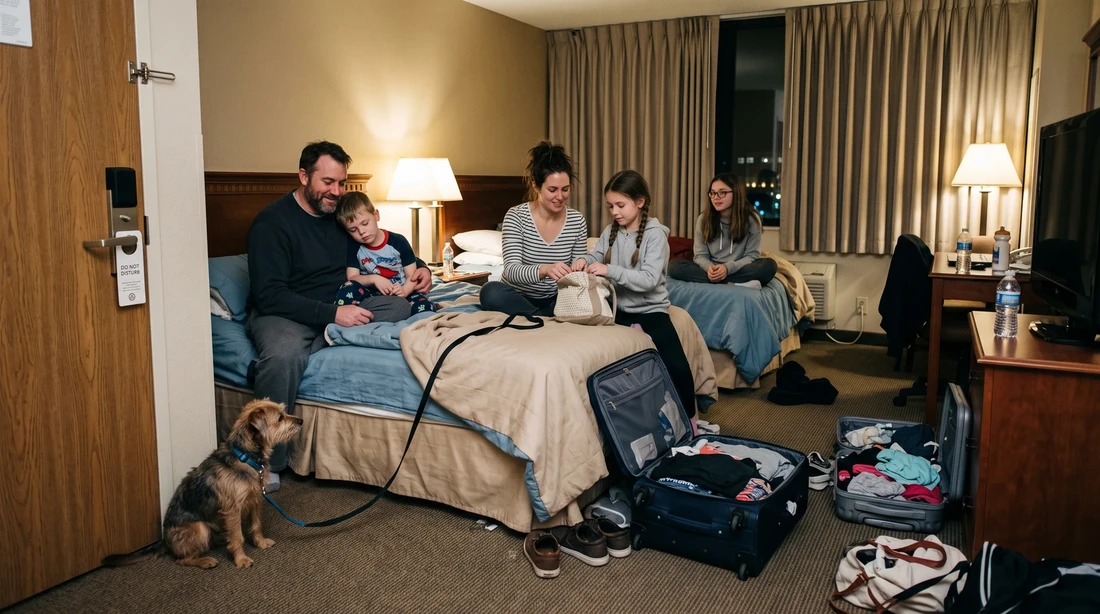
Your adjuster just said "a company called ALE Solutions will reach out about housing," then moved on to the contents inventory. Meanwhile your family of five is split across two hotel rooms, the dog is boarding by the night, and nobody has explained what happens next. Here's who ALE Solutions is, how the placement process runs, where it slows down, and where your choices come in.
There is no deadline to accept a placement. A real clock is running anyway: your ALE dollar limit. Every night a household of five spends in two hotel rooms typically burns two to three times what a furnished home costs, and once the limit is gone, the rest of the rebuild is on you.

What Is ALE Solutions, and Who Pays for It?
ALE Solutions is one of the most common names carriers hand to displaced families. It's a national temporary-housing vendor whose bill is paid from your own Additional Living Expenses coverage. The insurer doesn't pay it out of its own pocket on top of your claim.
When your adjuster refers your file, ALE Solutions assigns a coordinator who sources an emergency hotel, then searches for longer-term housing, and sets up direct billing between the housing provider and your carrier. The coordinator books and the adjuster approves. ALE Solutions never decides what your policy covers. Your carrier does.
It's one of several firms in this role. Alacrity Solutions and other third-party housing administrators do the same job under different logos, and the vendor model works the same way across all of them. We cover that shared machinery in how ALE housing companies work. This guide stays on what happens on your file when the name on it is ALE Solutions.
One fact drives every smart decision that follows: the dollars ALE Solutions spends are your dollars. Every hotel night and every month of rent draws down the same ALE limit that has to last the entire rebuild. If you're unclear on how that limit is set, start with loss of use coverage explained.
Displacement can also cost income; one related federal program:
Unemployment benefits after a disaster Disaster unemployment assistance provides short-term income to people who are out of work due to a disaster.
USAGov: Financial assistance after a disaster
What Happens After the Adjuster Refers Your File?
Most families hear from an ALE Solutions coordinator within hours to a day of the adjuster's referral, and move from a hotel into longer-term housing within one to three weeks.
| Stage | What typically happens | Typical timing |
|---|---|---|
| Loss and claim | Carrier opens the claim; adjuster confirms loss-of-use coverage applies | Day 0 |
| Referral | Adjuster sends your file to ALE Solutions (or a similar vendor) | Day 0-1 |
| First call | A coordinator confirms headcount, pets, school and work locations | Hours to a day after referral |
| Hotel bridge | A short-term hotel is booked, often direct-billed to the carrier | Night 1 |
| Options sent | Longer-term rentals are presented for your review | Week 1-2 (longer after major storms) |
| Lease and move-in | Housing is leased; billing runs between provider and carrier | Weeks 2-4 |
| Extensions | Coordinator checks rebuild progress; adjuster approves added months | Monthly until repairs finish |
Two things stretch that timeline. The first is catastrophe (CAT) events. In the OKC metro, April-June tornado season can put hundreds of displaced households into the same housing search at once, and vendor inventory thins fast. The second is specific needs. A dog, five people, or a particular school zone shrinks the pool of matching options, which is why your first call answers matter so much.
The CAT surge in Oklahoma has a twist most national coordinators miss: it collides with OKC's busiest hotel weeks. The Memorial Marathon lands in late April, and the Women's College World Series fills Devon Park (and the metro's hotel blocks) in late May and early June, squarely inside peak tornado season.
A hotel bridge booked during those windows can get repriced or refused an extension mid-stay, forcing a scramble. September's State Fair of Oklahoma and Thunder home weekends at Paycom Center create the same squeeze on a smaller scale. If your displacement lands near one of those dates, push to get past the hotel stage faster.
If a fire is what displaced you, the first 72 hours have their own moves (securing the property, the contents list, the emergency advance), and we walk those in temporary housing after a house fire.
What Still Comes Out of Your Pocket?
ALE typically pays only the costs above what your household normally spends. Your mortgage, your normal grocery bill, and your regular utilities stay yours throughout the displacement.
The mortgage or rent on the damaged home is still due every month, and ALE doesn't touch it. Groceries and meals work as a difference calculation. If your family of five normally spends around $1,100 a month on food and the hotel-with-no-kitchen months run $2,400-$2,600 in restaurants, many carriers reimburse the roughly $1,300-$1,500 increase instead of the whole restaurant total. That's a hypothetical, but it's the mechanic to expect.
Families routinely forget to claim two "additional" costs. One is extra commute mileage when the temporary home is farther from work or school than your own house was. The other is pet boarding forced by a no-dog hotel. Both are typically claimable, so ask your adjuster and keep a simple log.
Receipts decide everything here. ALE claims are substantiated by documentation, so save every hotel folio, restaurant receipt, laundromat charge, and boarding invoice from night one. Ask your adjuster for a running total of ALE spent each month so the cap never sneaks up on you.
What Does Waiting in the Hotel Cost?
For a household of five, two hotel rooms typically cost two to three times what a furnished home runs per month once dining out, laundry, and pet fees are counted. The hotel is designed as a bridge. Here's what happens when it quietly becomes the destination:
- Nights 1-3: the emergency hotel is booked and direct-billed. Reasonable, intended, fine.
- Weeks 1-2: no kitchen and no laundry means restaurant meals for five and laundromat runs, all of them "additional" expenses charging against the same ALE cap as the rooms.
- Month 1: two rooms plus the dining premium can consume double or triple what a furnished home would have cost, and the running ALE total nobody showed you is climbing.
- Months 2-3: the adjuster starts scrutinizing ongoing hotel bills and asking why longer-term housing hasn't been arranged.
- Month 4 and beyond: the ALE limit runs low before the rebuild finishes, and anything past the cap typically comes out of your pocket, mid-displacement.
If you're a renter rather than a homeowner, the same hotel-burn math applies through your renters policy. See does renters insurance cover hotel stays for how that version works.
A worked example: kitchen fire, five people, one dog, four months
This is hypothetical math, but it's the shape adjusters see every week. Say your family of five (two adults, three kids, one 60-pound dog) loses the kitchen to a fire, and the contractor estimates a four-month rebuild.
Hotel path: two standard rooms at roughly $145/night is $290/night, or about $8,700 per month. Add a dining-out premium in the ballpark of $1,200-$1,500 per month (no kitchen for five people) and pet fees or boarding around $300-$500. That's roughly $10,200-$10,700 per month, or about $41,000-$43,000 over four months.
Furnished home path: a furnished 4-bedroom with a fenced yard at $4,200/month × 4 months = $16,800. The dog is with you, dinner comes off your own stove, and laundry is down the hall.
The difference, roughly $24,000-$26,000, stays inside your ALE limit as headroom for the permit delays and material backorders that almost every rebuild hits. You don't get to keep that money. What you keep is months of coverage you haven't burned.
Variant: the rebuild slips to six months
Rebuilds slip. Permits stall, cabinets backorder, and the contractor finds hidden smoke damage. Run the same hypothetical family against a longer clock. Say your policy sets loss of use at 20% of a $250,000 dwelling limit, which is a $50,000 ALE cap.
On the hotel path at ~$10,450 per month, that $50,000 is exhausted around month five ($50,000 ÷ $10,450 ≈ 4.8 months). The final month-plus of a six-month rebuild, roughly $12,000-$13,000, lands on your own card while you're also paying the mortgage on the burned house.
On the furnished-home path, $4,200 × 6 = $25,200. That's about half the cap, with roughly $24,800 still unspent. Same family, same fire, same policy, and the housing choice in week two decided whether month six was covered.
Variant: you self-source and book direct
Now say that instead of waiting on vendor options, you propose a furnished home you found yourself and your adjuster approves it in writing. Booking direct with a local operator typically beats platform pricing. On BnB OKC homes, direct-booking savings run up to 35% on 4+ night stays, and 30+ night stays move to monthly rates instead of nightly math.
A home near the bottom of our published $225-$425/night from-rate range would run $4,950 for 30 nights at the nightly rate. The monthly-rate structure is what pulls a long stay down toward the $4,200/month shape in the example above. Get the approved monthly figure in writing first, then book.
Displaced in the OKC metro and still in the hotel stage? BnB OKC places insurance families directly — 11 furnished homes sleeping 2 to 16+, several dog-friendly, monthly rates on 30+ night stays, and experience with direct-billed and reimbursed claims. Start an insurance housing request or call/text (405) 870-2146 for same-day availability.
What Are Your Housing Options During the Rebuild?
During a four-month rebuild you have three realistic options: hotel rooms, an extended-stay suite, or a furnished home. For a family they differ far more on livability than on price alone.
| Option | Ballpark monthly cost | What rules it out |
|---|---|---|
| Two standard hotel rooms | ~$8,700 in rooms plus $1,200-$1,500 dining premium | No kitchen or laundry; household split across rooms; many properties cap or refuse dogs |
| One extended-stay suite | ~$3,600-$5,000 | One or two beds for five people; a kitchenette isn't a kitchen; pet fees and size limits are common |
| Furnished 3-4 bedroom home | ~$3,800-$6,500 depending on size and area | Monthly rates usually require 30+ nights; takes days to arrange, not hours |
The extended-stay suite is a fair middle ground for one or two people on a repair measured in weeks. For five people and a dog on a repair measured in months, the math and the sanity both point at a house. That's why coordinators place furnished homes for longer files, and why it's worth asking for one by name. Our extended-stay homes and pet-friendly OKC rentals are the local versions of what a coordinator would source.
Where Do Displaced Families Land in the OKC Metro?
In the OKC metro, school district lines and commute direction usually decide the right temporary home. The nightly rate matters less.
The metro spans multiple school districts (Oklahoma City, Edmond, Moore, Putnam City, Deer Creek and more), and a rental 15 minutes from your damaged house can sit in a different district entirely. Coordinators search by ZIP code, and they won't protect a school zone you never named. Say the district along with the city.
- Northwest OKC (The Village and Lake Hefner): keeps NW-side school routines intact, and Lake Hefner's trails give a cooped-up dog and cooped-up kids somewhere to burn energy during a months-long stay.
- Midtown and the Paseo/Plaza districts: the shortest drives to the OU Medical campus. Capitol Manor sits directly across from OU Medical Center and OU Children's Hospital, which helps if the fire came with follow-up medical appointments.
- Southeast metro (Tinker AFB households): a well-meaning placement in far northwest OKC can add a half-hour each direction to a Tinker commute. Tell the coordinator the base is your anchor, or the map will drift north.
- Airport-side: one of our homes sits 6 minutes from Will Rogers World Airport, which is worth knowing if one parent travels for work while the rebuild runs.
Season matters too. A summer displacement is mostly a logistics problem. An April-June one competes with every other storm-displaced family plus WCWS visitors for the same inventory. If your loss lands in that window, decide fast, because the good three- and four-bedroom options go first.
Can You Refuse a Placement or Choose Your Own Home?
Your ALE benefit belongs to you, the policyholder. ALE Solutions is a convenience your carrier provides, and you aren't required to go through it as a gatekeeper.
You can decline options that don't fit. If the offered rental is 40 minutes from your kids' school, has no yard for the dog, or splits the household across units, say so in writing and ask for alternatives. Coordinators work from the needs list you gave them, and a specific objection produces better options than a vague one.
Many policies pay for housing comparable to your normal standard of living. If you left a 4-bedroom house with a yard, a one-bedroom suite is worth pushing back on, politely, with your policy's loss-of-use language in hand. Wording varies by policy, so confirm yours with your adjuster.
You can usually self-source. Many carriers will reimburse or direct-bill a furnished rental you found yourself, as long as the cost is reasonable and comparable to what the vendor would have arranged. The firm rule is to get every approval in writing before you sign or spend. Unapproved costs are where reimbursement disputes are born.
You can also usually switch homes mid-placement if the first one turns out wrong: a broken HVAC in July, a landlord who wasn't dog-tolerant after all, a rebuild that outlasts the lease. Flag it to both the coordinator and the adjuster, and check the notice period in the temporary lease before you commit to a move date.
Slow down on one offer. Some carriers propose settling ALE as a flat lump sum instead of paying as you go. It can suit a short, certain repair. Rebuilds routinely run long, though, and once the lump sum is accepted, overruns are typically yours. Before agreeing, ask the adjuster to show the calculation and compare it to your real monthly costs across a pessimistic timeline instead of the contractor's best case.
If the coordinator goes quiet (days without options, unreturned calls after a storm surge), document the dates and email your adjuster directly. The carrier owns your claim, and the vendor doesn't. If housing gets denied outright or the file stalls, there's a real escalation path through the adjuster, a supervisor, and the state regulator, which we map in what to do when insurance denies temporary housing.
How ALE Solutions Works, Step by Step
- Confirm your ALE limit. Call your adjuster, ask for the loss-of-use dollar limit in writing, and confirm ALE Solutions has your file.
- Answer the needs call fully. Give the coordinator your exact headcount, pet details, school and work locations, and expected rebuild length.
- Ask about self-sourcing. Ask whether you can propose a furnished rental you found yourself before the vendor's options are sent.
- Compare total monthly cost. Weigh each option against a direct-booked furnished home on rent plus dining, laundry, and pet costs.
- Get the terms in writing. Confirm who pays whom, the notice period, and how extensions work before you move in.
Who Handles What During the Placement?
A placement runs smoothest when everyone's lane is explicit. Most friction comes from tasks each party assumed the other owned.
| Task | Who typically handles it | Your move |
|---|---|---|
| Confirming the ALE dollar limit | Adjuster / carrier | Ask for the number in writing on day one |
| Booking the first hotel nights | ALE Solutions coordinator | Keep every receipt for anything out of pocket |
| Needs list: headcount, dog, schools, accessibility | You | Be specific; vague needs produce generic options |
| Finding longer-term options | Coordinator, or you with approval | Ask whether you may propose a home you found |
| Lease setup and direct billing | Coordinator + carrier | Confirm who pays whom before signing anything |
| Utilities, furnishings, Wi-Fi | Housing provider or host | Verify what's included before move-in day |
| Extension requests | Coordinator + adjuster | Flag rebuild delays 3-4 weeks ahead |
| Move-out notice | You + host | Get the required notice period in writing |
What Should You Ask on the First Call?
Public reviews of national housing vendors, ALE Solutions included, cluster around fit and speed more than billing. The recurring complaints are options far from schools or work, slower responses after major storms, and confusion at extension time.
Treat those themes as a checklist of red flags to rule out early. They say nothing final about any one company. Turn them into four questions and ask them on the first call instead of at week three:
- "How far from our school and work locations will you search?"
- "What's your realistic response time right now? Is there a storm surge in this region?"
- "Does your available inventory here take a 60-pound dog?"
- "Who do I contact, and how far in advance, when the rebuild runs long?"
If the answers don't fit your family, raise self-sourcing with your adjuster now, while the hotel bridge is still covering you.
When Is the Standard Placement the Right Call?
An ALE Solutions placement, taken as offered, is the right answer for plenty of files. If the repair is measured in a couple of weeks, the household is one or two people, there's no pet, and you'd rather touch zero logistics, let the coordinator run it. That's the service working as designed. The same is true if the vendor's first options already fit your school zone and headcount. Don't self-source on principle when the offered home works.
The calculus changes when the file looks like yours: 30 or more nights, a bigger household, a dog, kids who need to stay in their school routine, or anyone working from the kitchen table. Then a full furnished home with a real kitchen, in-house laundry, separate bedrooms, and a fenced yard changes both the monthly math and how livable four months feel. It also changes the six-month math above, since the option with headroom is the one that survives a rebuild delay.
That's the lane we operate in. BnB OKC runs 11 furnished homes across the OKC metro, rated 9.5 out of 10 across 1,580 verified guest reviews on Airbnb and Vrbo, with two homes holding Airbnb's Guest Favorite badge, homes sleeping 2 to 16+, and direct-booking savings up to 35% on 4+ night stays.
Browse the homes, or if a coordinator or adjuster is already on your file, point them to our insurance housing page. We work placements with carriers and firms like Alacrity Solutions and can set up direct billing when your carrier authorizes it. Booking yourself instead? Book direct and keep the paper trail for reimbursement.
What Do the Terms You'll Hear Mean?
- ALE (Additional Living Expenses): the part of your policy that pays costs above your normal living expenses while your home is unlivable.
- Loss of use: the policy section ALE lives under; often set as a percentage of your dwelling coverage.
- Direct billing: the housing provider invoices your carrier straight, so you don't front the rent. It only happens with carrier authorization.
- TPA (third-party administrator): an outside company, like a housing vendor, that a carrier hires to run part of a claim.
- Like-kind (comparable) housing: temporary housing that matches your normal standard of living in bedrooms, function, and general area.
- CAT (catastrophe) event: a large-scale loss like a tornado outbreak that floods vendors with files at once and stretches every timeline.
- ALE advance: an upfront payment some carriers issue against your ALE limit for immediate expenses. It draws down the same cap.
- Notice to vacate: the written heads-up you owe the host, or the host owes you, before the temporary lease ends.
Bottom Line
Get your ALE/loss-of-use dollar limit, any time limit, and the contractor's current rebuild estimate in writing today. Those figures decide everything else. (Renters: your policy likely has this coverage too; see does renters insurance cover temporary housing.)
Then put the coordinator's options next to a direct-booked furnished home. Count rent plus dining, laundry, pet costs, and commute, and run it against a six-month timeline instead of the contractor's estimate alone.
When you're ready, text or call (405) 870-2146 with your headcount, pet, school district, and rebuild timeline, or start at our insurance housing page. We'll tell you same-day what's available for your dates.
If a housing dispute with your carrier stalls, the Oklahoma Insurance Department offers free consumer assistance to Oklahoma policyholders.
This guide is general information, not insurance or legal advice; your carrier makes all coverage decisions.