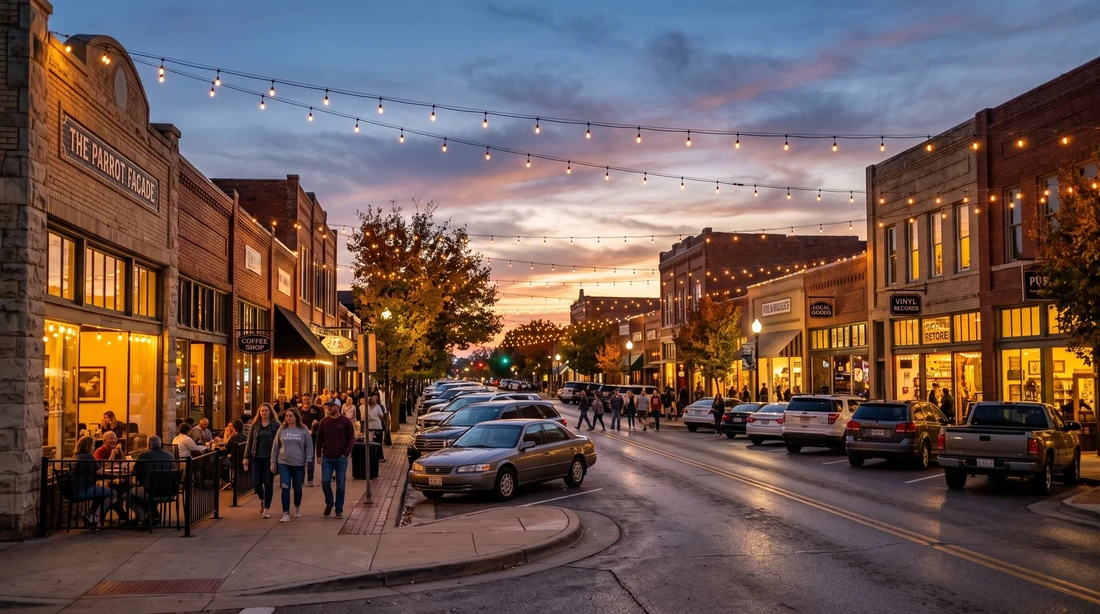
The best suburbs of Oklahoma City for most movers in 2026 are Edmond (top school reputation, 20–25 minutes to downtown), Norman (college-town amenities anchored by OU), and Yukon and Mustang (newer builds at lower prices). Moore is the price-to-location value play, and Midwest City is the budget pick for Tinker AFB commuters.
Key Takeaways
- Edmond ranks first at 20 to 25 minutes downtown with mid-$300Ks prices; Midwest City is cheapest, starting under $200K.
- The metro splits into four commute corridors — north, south, east, west — each anchored to a different job center.
- A six-week gap costs a family of four $6,000 to $7,500 in extended-stay hotels versus roughly $3,900 furnished.
You've sold your house, your new one closes in six weeks, and you're about to commit to a mortgage in a suburb you've mostly seen through a windshield. That gap feels like limbo. It's actually the best research window you'll ever get — six weeks to live in the corridor before you sign for it. This guide ranks the best suburbs of Oklahoma City on the numbers that matter, then shows you how to test-drive your shortlist without hotel bills eating the budget.
A typical sale-to-close gap runs two to eight weeks. A household of four in an extended-stay hotel typically burns $900–$1,400 per week — money a furnished monthly rate would stretch, in a neighborhood that actually teaches you something about where you're buying.

Why Oklahoma City Suburbs Are Harder to Compare Than the Listicles Admit
Oklahoma City's city limits alone cover more than 600 square miles, so "suburb" can mean a 15-minute hop or a 35-minute haul depending on which corridor you pick. Most rankings ignore that and sort by vibes.
The metro really splits into four corridors, each anchored to a different job center. North (Edmond, Deer Creek, Piedmont) points at downtown and the Broadway Extension office spine. South (Moore, Norman) rides I-35 toward OU and the OU Health complex. East (Midwest City, Choctaw) orbits Tinker Air Force Base. West (Yukon, Mustang) sits closest to Will Rogers World Airport and the FAA's Mike Monroney Aeronautical Center.
Pick the corridor your commute anchors to first; rank suburbs inside it second. A "best" suburb 35 minutes against traffic from your job loses to a "third-best" suburb 12 minutes with it — every single workday. If you're new to the metro entirely, start with our broader guide to moving to Oklahoma City and come back here to pick the corridor.
For context on what anchors the downtown job corridor:
The city is headquarters to two Fortune 500 companies: Expand Energy and Devon Energy , as well as being home to Love's Travel Stops & Country Stores , which is ranked thirteenth on Forbes ' list of private companies.
Wikipedia: Oklahoma City
What a Housing Gap — Or the Wrong Suburb — Actually Costs
A six-week gap in an extended-stay hotel typically costs a household of four $6,000–$7,500 before a single restaurant bill, while the same six weeks at a furnished home's monthly rate lands in the ballpark of $3,900 all-in. Here's how the hotel version usually unfolds:
- Week 1: The suite feels manageable. You're paying a nightly rate and telling yourself it's short-term.
- Week 2: Restaurant fatigue sets in. A kitchenette can't cook for four, and food spend quietly doubles.
- Week 4: Your running total passes what a full month in a furnished house would have cost — and you still don't know if your shortlisted suburb's commute is livable at 7:45 AM.
- Week 6: You've spent $6,000+, and the biggest purchase of your life got evaluated from a highway-exit hotel instead of the neighborhood itself.
Now the arithmetic, in a clearly hypothetical example. Say your sale closes May 15 and your new build in Edmond closes July 1 — a 45-night gap for a family of four.
- Extended-stay suite: $149/night × 45 nights = $6,705, plus typically $800–$1,200 in extra dining because there's no real kitchen. Ballpark total: $7,500–$7,900.
- Furnished 3-bedroom at a monthly rate: roughly $2,600/month × 1.5 months = $3,900 all-in — utilities, Wi-Fi, full kitchen, and laundry included, parked in the corridor you're buying in.
That's a difference in the ballpark of $3,600–$4,000 over six weeks — and the cheaper option is the one that lets you grocery-shop, commute, and do school runs from the actual suburb before you close. BnB OKC's 11 furnished homes publish from-rates of $225–$425/night, with monthly rates on 30+ night stays and up to 35% savings when you book direct on 4+ nights.
When the gap stretches: the same family at three months
Builder delays are the most common way a six-week gap becomes a three-month one — a materials backlog or an inspection queue pushes closing, and the notice often arrives with two weeks' warning. Staying hypothetical: same family, sale closed May 15, and the new-build closing slips from July 1 to August 15. That's a 92-night gap.
| Point in the stay | Extended-stay hotel, running total | Furnished monthly rate, running total |
|---|---|---|
| Night 30 | $4,470 + ~$500 extra dining ≈ $4,970 | $2,600 |
| Night 60 | ≈ $9,940 | $5,200 |
| Night 92 | ≈ $15,200 | ≈ $7,970 |
By night 92 the gap between the two columns is roughly $7,200 — and the hotel column isn't even flat. Nightly rates across the metro typically climb during the Women's College World Series at Devon Park (late May–early June), the Memorial Marathon (late April), the State Fair in September, and any Thunder playoff run at Paycom Center.
A locked monthly rate rides through all of it unchanged, and a month-to-month furnished stay extends with a phone call when the builder slips again — a hotel just keeps metering. One more delay cost to flag: a slipped closing can outrun your mortgage rate lock, and lenders typically charge extension fees, so ask your lender about the extension schedule the day you learn the date moved.
Between selling and closing — or testing a suburb before you commit? BnB OKC keeps 11 furnished homes across the metro's north, west, and central corridors, sleeping 2 to 16+, with monthly rates on 30+ night stays. Check dates on our extended stays page or call/text (405) 870-2146.
The Best Suburbs of Oklahoma City, Ranked
Eight suburbs cover the vast majority of OKC-metro home searches: Edmond, Norman, Yukon, Mustang, Moore, Piedmont, Midwest City, and Choctaw. Search "best places to live near Oklahoma City" and every list opens with Edmond — here's the fuller picture, ranked on commute, price, schools, and what daily life actually feels like.
| Rank & suburb | Drive to downtown OKC | Ballpark home price band | Best known for |
|---|---|---|---|
| 1. Edmond | 20–25 min | Mid-$300Ks | School reputation, walkable downtown, Arcadia Lake |
| 2. Norman | 25–35 min | High-$200Ks–low-$300Ks | OU, Campus Corner, its own job base |
| 3. Yukon | ~20 min | High-$200Ks | Newer builds, Route 66 main street, I-40 access |
| 4. Mustang | 20–25 min | High-$200Ks–low-$300Ks | Fast growth, one-high-school identity, airport access |
| 5. Moore | 15–20 min | Mid-$200Ks | Price-to-location value on the I-35 corridor |
| 6. Piedmont | 25–35 min | Mid-$300Ks and up | Acreage lots and new construction |
| 7. Midwest City | ~15 min | High-$100Ks–low-$200Ks | Most affordable; Tinker AFB anchor |
| 8. Choctaw | 25–30 min | Low-$300Ks | Semi-rural acreage within Tinker range |
Price bands are approximate early-2026 ballparks and shift monthly — verify current listings with a licensed local agent before anchoring a budget. Drive times are typical off-peak; add 10–15 minutes at rush hour on I-35 and the Broadway Extension.
1. Edmond — the default answer, for a reason
Edmond sits due north along I-35 and the Broadway Extension, and Edmond Public Schools' reputation is the single biggest driver of its price premium. The University of Central Oklahoma anchors a genuinely walkable downtown with restaurants and a farmers market; Arcadia Lake and Hafer Park handle weekends. The Deer Creek district on Edmond's northwest flank pulls buyers for the same school-driven reasons. Trade-offs: you'll pay the metro's steepest suburban prices, and the Broadway Extension crawls at rush hour. If your budget clears the mid-$300Ks and your job is downtown or north, Edmond is rank one for a reason.
2. Norman — a real city, not a bedroom suburb
Norman is Oklahoma's third-largest city with its own economy: the University of Oklahoma, Norman Regional's health system, and the National Weather Center employ thousands who never commute north at all. Campus Corner and a lively downtown give it the metro's best restaurant-per-capita feel outside OKC's core districts. Trade-offs: it has the longest downtown-OKC commute on this list, and roughly seven home-football Saturdays a year reshape traffic and short-term lodging prices across the whole south metro. If your work is in Norman, it jumps to rank one; if it's downtown OKC, weigh the I-35 grind honestly.
3. Yukon — the west side's steady climber
Yukon runs due west along I-40, with historic Route 66 as its main street and the Czech Festival as its signature fall event. The draw is newer construction at prices meaningfully under Edmond's, quick I-40 and Kilpatrick Turnpike access, and a roughly 20-minute downtown run outside rush hour. It's also one of the most practical bases for anyone training at the FAA's Mike Monroney Aeronautical Center — our guide to FAA Academy housing in Oklahoma City covers that commute in detail. Trade-off: retail sprawl along Garth Brooks Boulevard is the town center for practical purposes.
4. Mustang — growth with a small-town spine
Mustang, southwest of the city, has been among the metro's fastest-growing suburbs for a decade, and its one-high-school structure gives the town an identity larger suburbs lose. It sits about 15 minutes from Will Rogers World Airport, which matters if you fly for work. Housing stock skews new — think 2010s-and-later neighborhoods. Trade-offs: dining and services still trail the population boom, and section-line roads are catching up with the traffic. Buyers priced out of Edmond who want new construction and don't work on the far north side should shortlist Mustang against Yukon.
5. Moore — the value play on I-35
Moore is wedged between OKC and Norman on I-35, giving it a 15–20 minute downtown run and roughly 15 minutes to Tinker — the best price-to-location ratio on this list. Moore Public Schools is among the state's largest districts.
Address the obvious honestly: Moore took direct hits from major tornadoes in 1999 and 2013, rebuilt with some of the metro's newest housing stock as a result, and storm shelters or safe rooms are common line items in newer listings — ask for them. The whole metro shares tornado risk (season peaks April–June); Moore is simply the suburb that priced the lesson in.
6. Piedmont — acreage without leaving the metro
Piedmont, on the metro's northwest shoulder, sells what closer-in suburbs can't: half-acre-plus lots, new construction, and open horizon, often within the well-regarded Piedmont or adjacent Deer Creek school boundaries. Trade-offs are structural: services are thin, so groceries and most errands mean a drive, and the downtown commute stretches to 25–35 minutes. If your search keeps surfacing phrases like "shop," "acreage," or "no HOA," Piedmont belongs on your shortlist; if you want walkable anything, it doesn't.
7. Midwest City — the budget and Tinker pick
Midwest City is the most affordable suburb on this list, with a price band that starts under $200K, and it exists because of Tinker Air Force Base — often cited as Oklahoma's largest single-site employer. Rose State College adds a second anchor. Housing stock skews mid-century, which cuts both ways: character and mature trees, but budget for updates. For PCS moves, TDY rotations, and contractors, the math is hard to beat — our TDY lodging near Tinker AFB guide covers the short-term side of that equation.
8. Choctaw — semi-rural, Tinker-adjacent
Choctaw pushes the east metro toward genuinely semi-rural living: acreage lots, horses on some streets, and a small-town core, all while keeping Tinker within a 15–20 minute drive. The low-$300Ks band mostly reflects land, not luxury finish. Trade-offs: the downtown OKC run is 25–30 minutes on a good day, and nearly everything else — shopping, dining, big-box errands — routes through Midwest City. It ranks eighth for the average buyer and much higher for the specific buyer who wants land plus a Tinker commute.
The inner-loop wild cards: The Village, Nichols Hills, and Bethany
Three enclaves inside the loop out-commute every true suburb on this list, and most rankings skip them entirely. The Village, tucked between Lake Hefner and the Western Avenue corridor, offers mid-century homes at prices that undercut Edmond by a wide margin with a 10–15 minute downtown run. Nichols Hills is the metro's blue-chip enclave — its own city, its own police force, and prices that start where Edmond's top out.
Bethany, on the near west side around Southern Nazarene University, pairs Route 66 character with some of the shortest west-corridor commutes anywhere. None of the three offers new construction at scale — if that's your requirement, stay on the main list. If commute minutes matter more than new drywall, tour all three before signing anything in a suburb 25 minutes out.
What Changes the Answer: Remote Work, School Calendars, Pets, and Builder Delays
The ranking above assumes a downtown commuter buying on a normal timeline — change one variable and the order reshuffles. These are the four variables that reshuffle it most often.
You work remotely. The corridor rule collapses entirely, and the ranking re-sorts on price per square foot and daily amenities. Yukon and Mustang climb hard — their only real penalty was distance from north-side jobs. Norman climbs for anyone who wants restaurants and a downtown without paying Edmond prices, because the I-35 grind stops mattering. Piedmont and Choctaw become genuine contenders for acreage buyers, with one caveat: verify internet service by street address, not by town, before you write an offer on the metro's edges — coverage maps get patchy fast past the section lines.
You're moving mid-school-year. Metro districts typically require proof of residency inside the attendance zone to enroll, and whether a 30-plus-night furnished address satisfies that varies by district policy. Some enrollment offices accept a purchase contract plus a temporary local address; others want a utility bill or lease. Call the specific district's enrollment office before you book gap housing — a ten-minute call can save you from a suburb-hopping mid-semester scramble.
The dog is moving too. Hotel pet policies commonly stack nightly or per-stay fees that quietly add hundreds of dollars across a six-week gap, and many extended-stay properties cap pet size or count. Several BnB OKC homes are dog-friendly with fenced yards, which also lets you answer a question Zillow can't: how your dog handles the actual neighborhood's walks, traffic, and storm noise.
The builder slips the date. Treat any new-build closing date as an estimate until the final walkthrough is scheduled. A month-to-month furnished stay absorbs a slipped date with an extension call; a hotel keeps metering nightly, and an apartment lease can't shrink or stretch. Run the three-month table above before you assume your gap ends when the contract says it does — and ask your lender what a rate-lock extension costs at 15, 30, and 45 days.
One seasonal note that touches every scenario: the metro's spring listing surge overlaps tornado season, April through June. That's the season of maximum inventory and maximum roof claims — ask about roof age and shelter or safe-room presence on every showing, and expect insurance quotes to vary more between houses than between suburbs. Winter shopping means thinner inventory but noticeably less competition per listing.
Where to Live During the Gap: Six-Week Housing Options Compared
For a 30-to-60-night gap, a furnished home at a monthly rate typically costs 35–45% less all-in than the equivalent extended-stay hotel nights for a household of four. Here is how the realistic options stack up for a six-week sale-to-close gap.
| Option | Typical 6-week all-in | Lease terms | What disqualifies it |
|---|---|---|---|
| Furnished home, monthly rate | ~$3,900 (≈$2,600/mo × 1.5) | 30+ nights, no lease; utilities & Wi-Fi included | Gaps under ~2 weeks price closer to nightly rates |
| Extended-stay hotel suite | $6,300–$7,500 + dining out | Night-to-night, cancel anytime | One room for four people; kitchenette only |
| Corporate housing provider | $4,500–$6,500 | 30-day minimums, invoiced | Built for employer billing, not self-paying families |
| Unfurnished apartment | Rent looks cheap; deposits + furniture don't | Usually 6–12 month lease minimum | The lease minimum itself, for a 6-week gap |
| Rent-back from your buyer | $0–$2,000 (negotiated) | Written into the sale contract | Buyers' lenders often cap it near 60 days — and you're stuck researching your new suburb from your old one |
A rent-back is genuinely the cheapest bridge when your buyer agrees — negotiate it before you list, not after. When they don't, the furnished-home column wins on both cost and usefulness: you spend the gap living in the corridor you're about to buy in. The deeper comparisons live in our guides to extended stay Oklahoma City options and furnished apartments in OKC; if an employer is paying, see corporate housing in Oklahoma City instead.
BnB OKC's homes hold a 9.5 out of 10 average across 1,580 verified guest reviews on Airbnb and Vrbo, two carry Airbnb's Guest Favorite badge, and several are dog-friendly with fenced yards — browse pet-friendly rentals in OKC if the dog is moving too. Homes sit near Lake Hefner, The Village, the Paseo and Plaza districts, and 6 minutes from Will Rogers Airport — positioned for north-, west-, and central-corridor test drives.
How to Try an OKC Suburb Before You Buy
A 30-night furnished stay near your top-pick suburb turns the biggest guess in home buying into observed data. Here's the sequence:
- Shortlist two suburbs. Narrow to your top two using commute corridor, price band, and school district, then drop the rest.
- Book a furnished month. Reserve a 30+ night furnished home near your top pick so you're paying a monthly rate, not a nightly one.
- Drive the real commute. Do your actual work run at 7:45 AM on a Tuesday, not a Saturday-afternoon scouting drive.
- Live the weekly routine. Run groceries, gyms, practices, and Friday dinner from the house for two full weeks.
- Write the offer from the neighborhood. Tour homes with your agent while living ten minutes away, and negotiate without a hotel-bill clock ticking.
Step 5 is the quiet financial edge: buyers negotiating from a nightly-rate hotel routinely accept worse terms just to stop the meter. A monthly rate removes that pressure entirely — see current availability on our properties page.
When You Don't Need a Furnished Home
Plenty of suburb searches don't need us, and it's worth saying plainly. A hotel is the right call if you're a solo house-hunter in town for a weekend of showings, if your gap is under a week, or if loyalty points make two or three nights effectively free. A negotiated rent-back beats everything on price when your buyer's lender allows it.
If a relocation package includes employer-billed corporate housing, use it. And if you're a renter relocating with a flexible lease-end date, you may be able to engineer your way to zero gap at all — overlap the lease with closing by a week and skip temporary housing entirely.
The 14-to-29-night band is the genuine gray zone: monthly rates haven't kicked in yet, so compare a nightly-rate furnished home — where booking direct saves up to 35% on 4+ night stays — against a suite honestly, and let bedrooms, kitchen, and laundry break the tie.
The furnished-home math changes the outcome in specific situations: gaps of 30+ nights where monthly rates apply, households that need real bedrooms and a real kitchen instead of a suite, a dog that hotels surcharge nightly, a builder date you don't fully trust, and — the case this whole article is about — anyone about to sign a 30-year mortgage in a suburb they've never actually lived in. Six weeks of residence beats sixty hours of Zillow.
Terms You'll Hear, Decoded
- Rent-back (leaseback): a contract clause letting you stay in the home you just sold, paying your buyer rent for a set period — lenders often cap it near 60 days.
- Bridge loan: short-term financing that lets you buy the new home before the old one's equity is freed up, typically at higher rates.
- Sale-to-close gap: the stretch between your sale closing and your purchase closing when you own zero houses — commonly two to eight weeks.
- Contingency: a condition (financing, inspection, sale of your current home) that must clear before a purchase contract closes.
- Earnest money: the deposit that holds a home under contract, credited at closing or at risk if you walk without a contingency.
- Rate lock: your lender's promise to hold a mortgage rate through closing — if a builder delay pushes past it, extension fees typically apply.
- Proof of residency: the document (lease, utility bill, or sometimes a purchase contract) a school district requires to enroll kids at an address — policies vary by district.
- Monthly rate: discounted furnished-home pricing on 30+ night stays that replaces nightly-rate math with a flat monthly figure.

Your Next Steps
- Confirm your gap. Pin down both closing dates, count the exact nights you'll be between homes, and ask your builder or seller's agent how firm the second date really is — the answer changes at 14 nights and again at 30.
- Run the two-column math. Price 45 hotel nights for your household against a furnished monthly rate near your top-pick suburb, dining included — then re-run it at 92 nights so a builder delay can't ambush the budget.
- Book the test drive. Check 30+ night availability near your shortlisted corridor on our extended stays page, or call/text (405) 870-2146 for same-week options.
This guide is general information, not financial, lending, or real-estate advice; verify current prices, school data, and contract terms with licensed local professionals. For official city services and data, see the City of Oklahoma City website; for district and event info across the metro, see the Visit OKC website.