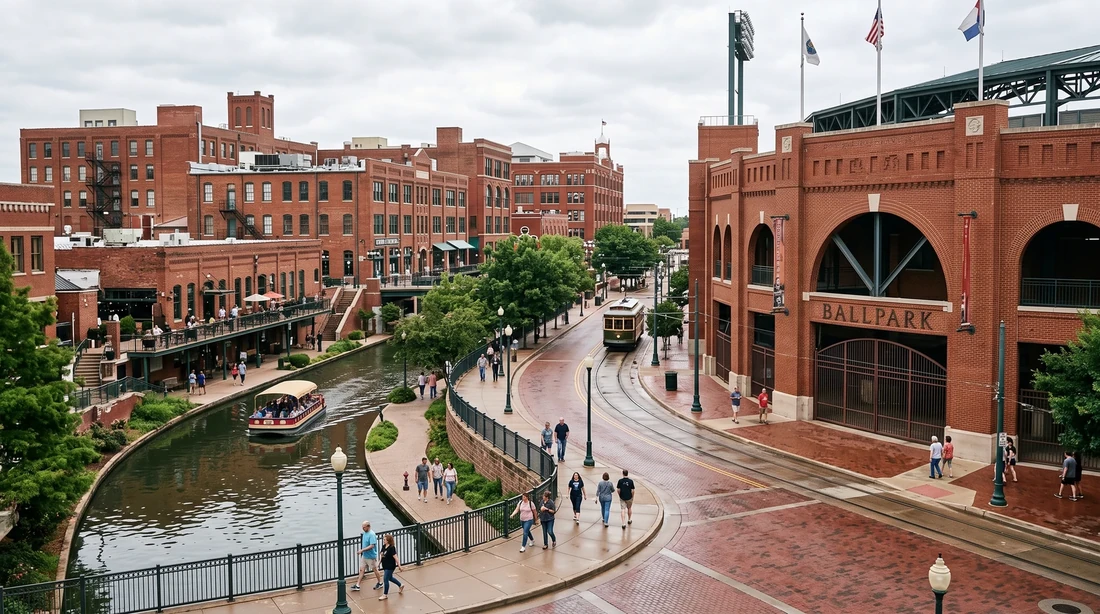
The Big 12 Baseball Tournament is played at Chickasaw Bricktown Ballpark in downtown Oklahoma City, typically over about five days in mid-to-late May, drawing multi-day fan families from across the conference's baseball-playing schools. If your group stays three or more nights, one furnished house near Bricktown usually costs less than several downtown hotel rooms per night — with a kitchen, laundry, and space to gather between sessions.
Key Takeaways
- The Big 12 Baseball Tournament runs at Chickasaw Bricktown Ballpark over about five days in mid-to-late May.
- Double elimination means a team stays until it loses twice, so two-night plans often stretch to five.
- Hypothetically, twelve fans need four downtown rooms at $220 for five nights ($4,400) versus one house near $520 nightly ($2,600).
- Late-May OKC also hosts the Women's College World Series at Devon Park, and tornado season peaks April through June.
You booked flights the second your team clinched a bid, and now four to twelve relatives are asking where everyone sleeps. Tournament week in Bricktown is a moving target: multiple games a day, a double-elimination bracket that stretches a two-night plan into five, and downtown rooms that thin out fast once seedings drop. Take a breath — the smart move here isn't a scramble of separate hotel reservations, it's one home base you can walk from.
Downtown lodging near Bricktown Ballpark tends to tighten and rise as tournament week approaches, and elimination-bracket teams often need to extend stays mid-week. Locking a group house early — before your seed is even set — is how families avoid the last-minute split across three hotels at the highest walk-up rates.

Why the Big 12 Baseball Tournament Fills OKC's Downtown Stays
A single Big 12 baseball week can bring fans from a large slate of conference schools into a few square blocks of downtown Oklahoma City. Chickasaw Bricktown Ballpark sits inside the Bricktown entertainment district, so the demand isn't just for beds — it's for beds you can walk back to after a night game.
Unlike a one-night event, tournament baseball is a multi-day commitment for any team that keeps winning. A family that flies in for their opener can end up needing three or four extra nights if the bracket breaks their way. That uncertainty is exactly what makes per-night hotel booking painful and a flexible week-long house valuable.
It's also not the only crowd competing for the same rooms. Late May in OKC is the busiest stretch of the sports calendar: the Women's College World Series lands at Devon Park in the same late-May-to-early-June window, the Thunder can still be running a deep playoff series at Paycom Center a few blocks from the ballpark, and the OKC Memorial Marathon closes out April right before.
Knowing which venue your event uses — Bricktown Ballpark for Big 12 baseball, Devon Park for the WCWS — keeps you from booking near the wrong ballpark, and knowing the whole calendar is busy is why you book early. When two events overlap in the same week, the rooms that vanish first are exactly the walkable-downtown ones every fanbase wants.
On how Bricktown's ballpark and canal came to be:
The city added a new baseball park ; a central library; renovations to the civic center , convention center , and fairgrounds; and a water canal in the Bricktown entertainment district.
Wikipedia: Oklahoma City
How the Big 12 Baseball Tournament Schedule and Sessions Work
The tournament is a bracketed championship, not a single game — which means your ideal check-in and checkout depend on how deep your team goes. Most years it spans roughly five days, with early rounds front-loaded across day and night sessions, and the title game on the final day.
Here's the mechanic that wrecks two-night travel plans: it's double elimination, so a team doesn't go home until it loses twice. A club can lose its opener, drop into the losers' bracket, win four straight, and still be playing on the final day. The flip side is just as unpredictable — a top seed can go two-and-out in 36 hours. You cannot know your travel window when you book flights, which is precisely why a flexible home base beats a locked stack of hotel nights.
A typical tournament day runs two or three games stacked back-to-back, often a midday first pitch and an evening nightcap under the lights. Games are usually sold as sessions rather than single tickets, so an afternoon session and an evening session on the same day are frequently two separate admissions. Confirm the current-year bracket format, session structure, and exact dates on the official Big 12 site before you lock travel, then use the pattern below to plan a stay that flexes.
| Tournament stage | Typical timing | Stay guidance |
|---|---|---|
| Opening rounds | First 1–2 days | Arrive the night before your team's opener; book a home that allows extension |
| Middle bracket | Days 2–4 | Elimination games can add nights fast — hold flexible checkout if you can |
| Semifinals | Day 4–5 | Downtown fills as fewer teams remain but crowds concentrate |
| Championship | Final day | Highest walk-up demand; a booked home base removes the scramble entirely |
The planning takeaway: book for your realistic deep run, not your first game. A group house with a whole-week rate is easier to shorten than a stack of hotel nights is to extend when rooms are gone. Regular-season standings and the conference bracket usually firm up only in the days right before first pitch — so if you wait for certainty, you're booking into the tightest, priciest part of the market.
Two OKC-specific wrinkles are worth planning around. First, tornado season peaks April through June, and a May afternoon storm can push a session back hours or into the next day. Rain delays don't just move a game — they can shift your whole family's day and, in a long delay, add a night.
Second, late May afternoons in Oklahoma run hot and humid, and a day-session crowd bakes in the sun before an evening game; a nearby home to shower, cool off, and reset between the day and night session is a comfort a hotel lobby can't match. A place with a kitchen and living room is a far better place to wait out a storm cell or the midday heat than a hotel room, and it's another reason flexible checkout matters more here than at a fair-weather event.
What a Tournament Week Actually Costs: Hotels vs. A Group House
For a fan family of eight to twelve staying three-plus nights, a single furnished house near Bricktown usually costs less per night than the multiple downtown hotel rooms the same group would need. The gap widens every night you stay, because a house is one nightly rate while hotels multiply room by room.
Here's the sequence of what happens to your budget as the week runs long:
- Two-night plan: You book two hotel rooms for the opener, expecting a quick trip.
- Team wins: You need two more nights — but your rooms are booked out or repriced higher for the busier back half.
- Split stay: Half the family moves to a second hotel across downtown, and now you're driving between two lobbies and paying two parking fees.
- Championship day: Walk-up rates peak; anyone who didn't lock a room is paying the most for the least choice.
A whole-house booking skips that ladder. You reserve one home for the full possible run, keep the group together, and cook breakfast instead of paying for twelve restaurant meals a day.
Beyond the Room: Parking, Meals, and the Bricktown Canal
Lodging is only part of a five-day tournament budget — parking and meals quietly add up, and a walkable home base cuts both. Every session you can walk to from a downtown-adjacent home is event parking and ride-share you don't pay for, and a kitchen turns three restaurant meals a day for twelve people into one grocery run.
Parking is a bigger line than most families expect during a busy downtown week. Event lots and garages near the ballpark charge a premium on game days, and a two-session day can mean paying twice or feeding a meter you keep leaving. A group that parks once at a home and walks — or makes one shared drive and one parking payment — keeps that money for tickets and food instead.
Bricktown itself is the reason walkability pays off. The district wraps a mile-long canal lined with restaurants, and a water taxi runs it; the ballpark gates sit steps from that action. When your group can drop bags at a home, walk to a day session, come back to regroup, and walk out again for a night game, you've turned a logistics headache into a stroll.
| Cost line | Hotel path (multiple rooms) | Group-house path |
|---|---|---|
| Parking | Nightly fee per room's car, plus event parking | Park once at the home; walk or one shared drive |
| Breakfast | Twelve people out, or hotel add-ons | One kitchen, one grocery run |
| Laundry | Pack for the full run or pay hotel laundry | In-home laundry mid-week; pack light |
| Gathering space | Crowd into rooms or a lobby | Shared living room for the whole crew |
Bringing the whole family to the Big 12 tournament? Bricktown-area group homes book out as seedings drop — check availability for your dates and keep everyone under one roof.
See large-group rentals in OKC | Call or text (405) 870-2146
Big 12 Baseball Championship: Where to Stay by Group Size
The right lodging for the tournament comes down to how many travel together and how long you'll stay. BnB OKC runs 11 furnished homes across the metro sleeping 2 to 16+, with a 9.5 out of 10 average across 1,580 verified guest reviews on Airbnb and Vrbo and from-rates of $225–$425/night. Direct booking saves up to 35% on stays of 4+ nights — which is most tournament trips.
| Group size | Best-fit stay | Per-person cost band (per night, hedged) |
|---|---|---|
| 2–4 fans | Smaller furnished home or extended-stay setup | Lower — but hotel points may win for 1–2 nights |
| 5–8 fans | 3–4 bedroom furnished home with kitchen | Typically well below two hotel rooms per person |
| 9–12 fans | Large home sleeping 12+, one gathering space | Lowest per person once split across the group |
| 13–16+ fans | Estate-size home or two nearby homes | Lowest per person; keeps the fanbase together |
For traveling families splitting rooms and cars, keeping everyone in one place is the whole point. If your group is really two families teaming up, our family reunion rentals in OKC guide covers how to size a shared house, and team house rentals in OKC is worth a read if you're housing an actual travel squad or a large booster group.
Fly-in vs. drive-in fanbases
Big 12 baseball pulls both drive-in fans from nearer campuses and fly-in fans from farther ones, and that changes where a home base helps most. Will Rogers World Airport serves the metro, and our homes sit about 6 minutes from it — so a fly-in family can land, grab one rental van, and reach a single house rather than shuttling to scattered hotels.
Drive-in fans often bring more cars, which makes a home with room for multiple vehicles more valuable than a hotel garage charging by the car. If half your group drives and half flies, a single home is also the one meeting point where everyone converges without three sets of check-in times to coordinate.
Traveling with grandparents, kids, or a dog
Multi-generation trips stack needs a hotel room handles poorly. Young kids often need a nap between a day and night session, and a home gives them a bedroom instead of a stroller in a stadium concourse. Grandparents on a three-generation trip appreciate a ground-floor bedroom and a full bathroom to themselves rather than a distant elevator ride and a shared hallway — features you can ask about home by home.
Several of our homes are dog-friendly, so families who don't want to board a pet for five days can bring it along — see pet-friendly rentals in OKC. A fenced yard, a kitchen for early feedings, and a quiet room for a nap matter far more on a five-day stay than on a one-night trip, which is exactly the tournament use case.
Bricktown Walkability and Distance to the Ballpark
Chickasaw Bricktown Ballpark sits at the heart of the Bricktown district, so a downtown-adjacent home lets you park once and walk to the canal, restaurants, and the gates. That walkability is a real cost lever — every session you walk to is parking and ride-share you don't pay for during a five-day event.
Walkability also fills the dead hours between a day and night session, when a family with tickets to both is stuck downtown for a few hours. Within Bricktown you can take the canal water taxi, grab a meal along the water, or duck into the district's shops out of the sun; a short hop puts you at Scissortail Park's green space or the shops and coffee of Automobile Alley. A home base a few minutes out lets the group split — nappers and grandparents rest, everyone else explores — then regroup for first pitch.
| Stay area | Approx. drive to ballpark | Best for |
|---|---|---|
| Bricktown / downtown | Walkable to a few minutes | Walk-everything trips, night games |
| Midtown / Plaza / Paseo | ~5–10 minutes | Restaurants plus a short drive, quieter blocks |
| The Village / north metro | ~15–20 minutes | Larger homes, more space per dollar |
| Near Will Rogers Airport | ~15 minutes | Fly-in groups; our homes sit ~6 minutes from the airport |
If a home a few minutes out gets your group a full extra bedroom and a fenced yard, the short drive to Bricktown often pays for itself. Note that homes downtown fill first, so a nearby district can be the smarter book when the tournament tightens. A ten-minute drive from the Plaza or Paseo also usually means easier, cheaper street or driveway parking than jockeying for a downtown garage on a two-session day.
A Hypothetical Tournament-Week Budget
Here's a clearly hypothetical example to show the math. Say a three-generation fan family of twelve gathers for a Big 12 tournament trip and, because their team keeps winning, ends up staying five nights.
Hotel path: Twelve people need about four downtown rooms. At a busy-week rate in the ballpark of $220/night, that's 4 rooms × $220 × 5 nights = $4,400 — before parking and eating every meal out.
Group-house path: One large furnished home sleeping 12+ in the ballpark of $520/night during tournament week × 5 nights ≈ $2,600. Split twelve ways, that's about $217 per person for the whole stay — roughly $43 a night each — plus a kitchen for breakfasts and a laundry room.
That's a hypothetical difference of about $1,800 on lodging alone, and the family stays together instead of splitting across lobbies. Layer in the extras and the gap grows: four cars in downtown garages at, say, $20/night each across five nights is roughly $400 the house group mostly avoids, and breakfast for twelve out every morning at even $12 a head is about $720 across five days that a kitchen turns into one grocery run.
A smaller-group variant: Say only six fans travel for three nights. Two hotel rooms at $220/night × 3 = $1,320. A 3–4 bedroom furnished home in the ballpark of $340/night × 3 ≈ $1,020 — about $170 per person total, plus the kitchen and living room the hotel rooms don't include.
An extend-into-the-final variant: Say that same family of twelve booked three nights expecting an early exit, but the team runs the losers' bracket and plays on day five. Two more downtown hotel nights bought on the busy back half — if any rooms remain — often price above the opening-night rate; four rooms at a walk-up $270/night × 2 adds about $2,160 to the bill, and only if you can find four rooms in the same hotel. A home booked for the full possible run simply absorbs those nights at the rate you already locked.
An early-elimination variant: Here's the other side of that flexibility line. Say you booked hotel rooms for five nights to be safe, but your team goes two-and-out. Now you're eating three unused nights of non-refundable rooms. A home booked with a clear early-departure policy lets you ask about shortening instead — always confirm those terms before you reserve. Actual rates vary by home, dates, and length of stay; ask for a quote on your exact nights.
How to Book a Group House for the Big 12 Tournament, Step by Step
Booking a whole home for tournament week is simple if you do it in the right order — before your seed is even set.
- Estimate your deep run. Book for the nights you'd need if your team advances, not just the opener.
- Count heads and beds. Total your group and match it to a home that sleeps everyone comfortably.
- Pick your radius. Decide between walkable Bricktown or a short-drive district for more space.
- Book direct for the discount. Reserve 4+ nights direct to save up to 35% versus per-night rates.
- Confirm parking and check-in. Verify parking for multiple cars and note check-in 4:00 PM, checkout 11:00 AM.
- Ask about flexibility. Confirm what happens if your team is eliminated early or plays into the final day.
You can start any of this by phone — a quick call or text sorts dates, headcount, and the right home in one conversation. If you're still working out tickets, remember games sell by session, so line up your session tickets and your lodging dates against the same bracket so a night session doesn't strand you without a room. Booking direct also keeps that flexibility conversation with the operator who actually manages the home.
Terms You'll Hear, Decoded
- Double-elimination bracket: A team stays alive until it loses twice, which is why a winning run — even from the losers' bracket — can add several unplanned nights to your trip.
- Losers' bracket: Where a team drops after its first loss; teams can win their way back to the final from here, extending their week and yours.
- Session ticket: One admission covering the game or games in a set time block (afternoon or evening), rather than a single game.
- Walk-up rate: The last-minute hotel price on the busy back half of the week — usually the highest you'll pay.
- Whole-home rate: One nightly price for the entire house regardless of how many sleep in it, versus paying per hotel room.
- Seed: Your team's bracket ranking, which sets its game times — and it's often not final until days before, so book lodging before it's set.
When You Don't Need a Whole House
A hotel is genuinely the right call for some tournament trips, and it's worth being honest about that. If you're a solo fan or a couple staying one or two nights, a downtown hotel — especially one where you'll burn loyalty points — is simple and hard to beat on a short stay.
Same if your team is a single-game long shot and you're only committing to the opener, or if you want a lobby, valet, and daily housekeeping and don't care about a kitchen. For a quick in-and-out where you'll eat every meal in Bricktown anyway, a house's advantages barely come into play.
A furnished group house changes the outcome when the numbers or the logistics shift: five or more travelers, three or more nights, or a family that wants to cook, do laundry, and stay together. Those are the trips where multiple hotel rooms multiply and a single home's kitchen, laundry, and shared living space actually save money and hassle — and where a ground-floor bedroom for grandparents or a fenced yard for a dog is worth more than a rewards point.
The same math holds for OKC's other big draws — see how it plays out for the AQHA World Show, Cattlemen's Congress housing, and stays near the OKC fairgrounds.
Your Next Steps
- Confirm the current-year dates and format for the Big 12 tournament at Bricktown Ballpark, and plan for your team's realistic deep run — not just the opener.
- Count your group and compare multiple hotel rooms against one furnished home for the same nights, using the tables above, and factor in parking and meals.
- Lock your home base: browse large-group rentals in OKC or call/text (405) 870-2146 for same-week availability and a quote on your exact dates.
Verify this year's schedule and tickets at the official Big 12 Conference site, and see what's happening around the ballpark at Visit OKC.