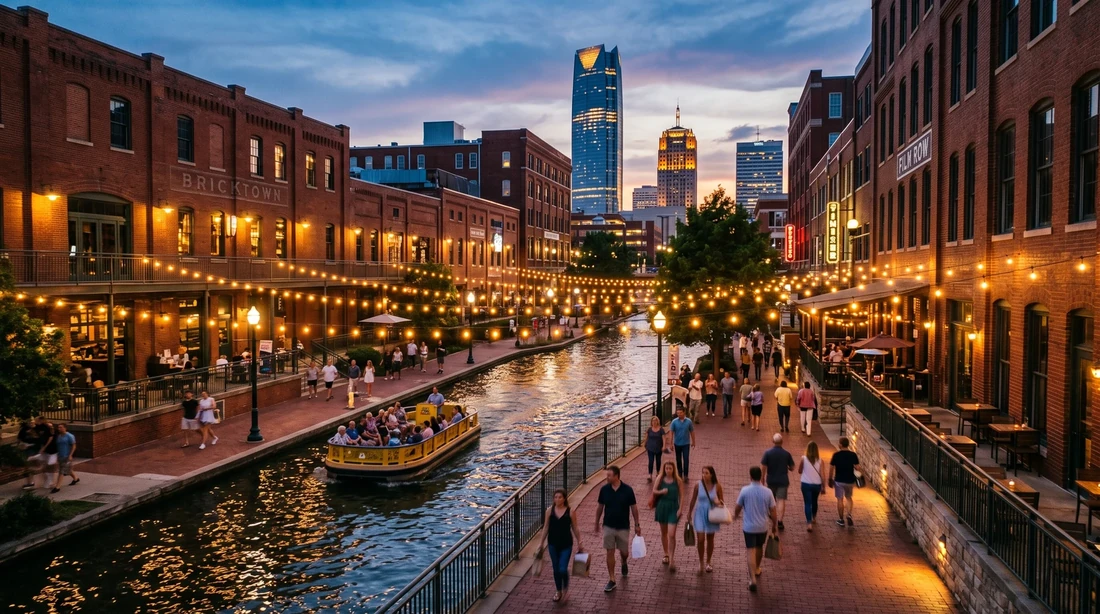
The deadCenter Film Festival is Oklahoma's largest film festival, held each June in downtown Oklahoma City with screenings, filmmaker panels, and after-parties concentrated in Bricktown, Film Row, and the arts district. Most out-of-town attendees stay 3–5 nights. Book lodging early — festival weekends compress downtown supply, and a furnished home lets a whole crew or family stay together.
Key Takeaways
- deadCenter runs each June in downtown Oklahoma City, with screenings clustered in Bricktown, Film Row, and the arts district.
- Most out-of-town attendees stay three to five nights, making lodging a base for the week rather than a room.
- Published from-rates run $165 to $425 per night, monthly rates apply on 30+ night stays, and homes sleep 2 to 16+.
- Drive times to the downtown core range from 5 to 10 minutes for midtown homes to 20 to 25 minutes from Gaillardia.
If you're coming to the deadCenter Film Festival, three things shape your trip more than the program does: the screenings cluster downtown, the good stuff happens at night, and June in Oklahoma City runs hot with a real tornado-season tail. Whether you're a filmmaker bringing a five-person production team or a cinephile chasing shorts blocks, where you sleep decides how much of the festival you actually catch.
This guide covers the festival layout, passes versus single tickets, downtown parking and the OKC Streetcar, the party and networking rhythm, and the housing math that thin listicle pages skip — including the crew angle: one house for the whole production team instead of scattered hotel rooms.
Festival dates land in June and are announced on deadCenter's official calendar; downtown lodging tightens as the dates approach and overlaps with other June demand. Lock your dates and your beds before the schedule drops, not after.

Why deadCenter Weekend Is Different From a Normal OKC Trip
deadCenter draws filmmakers, industry guests, students, and film lovers into a tight downtown footprint for several days each June. That concentration is the whole point — you can walk between a morning panel, an afternoon shorts block, and a late screening — but it also means the lodging closest to the action gets claimed first.
The festival is a multi-day event, not a single screening. Serious attendees build a schedule across documentary blocks, narrative features, Oklahoma-made films, and industry sessions. Most out-of-town guests stay three to five nights, which changes the housing question from "a room for the night" to "a base for the week."
Two realities push people toward a furnished home. First, the after-parties and networking dinners run late, so proximity beats everything. Second, June in OKC is hot and humid, with tornado season peaking April through June — you want a real indoor base with a kitchen and laundry, not a cramped room you only use to sleep. A house also gives you air-conditioned space to spread out during the hottest afternoon hours between screening blocks, which a single hotel room rarely does for a group.
The filmmaker and crew angle nobody else covers
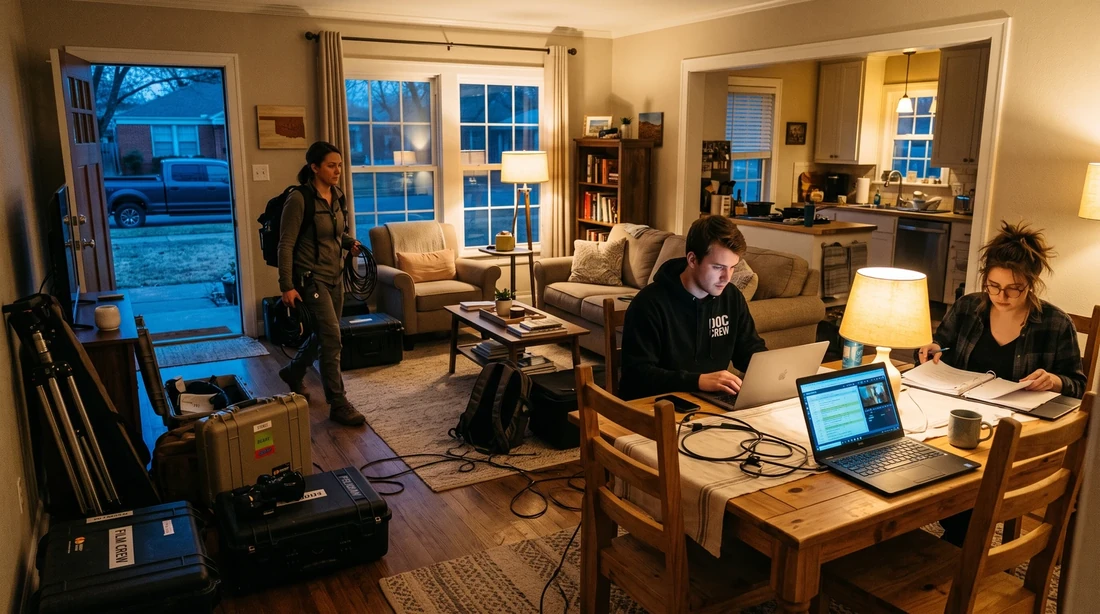
If you're bringing a production team, cast, or festival delegation, the smart move is one house for the whole group instead of four hotel rooms on different floors. A furnished home gives your crew a shared living room to debrief screenings, a kitchen to feed people before a long day, and one address for rideshares. It also usually costs less per person than separate rooms once you're past a night or two.
The crew angle goes deeper than cost. A house gives you a real table to lay out your festival schedule, wall space and outlets to charge camera batteries and laptops, and quiet corners for a filmmaker to run pitch calls between screenings. If your film is showing, you can host a small cast-and-crew gathering at the house instead of paying for a venue.
Homes in our collection sleep from 2 to 16+, so a small documentary crew and a large ensemble cast fit the same model — you just size the house to the headcount. For splitting costs across a group, our team house rentals OKC guide walks through the per-person math the same way a crew would.
Extending into a shoot or residency
Some filmmakers come for deadCenter and stay on to scout locations, shoot, or edit — Oklahoma's film incentives have pulled more productions to the metro in recent years. If your trip stretches past the festival, monthly rates apply on 30+ night stays, which turns a festival base into an affordable production base. A single fixed address also simplifies receiving equipment shipments and coordinating a rotating crew, since you're not re-checking into a new hotel block every few days. Our extended stays page covers how longer bookings work, including laundry, workspace, and month-to-month flexibility if a shoot runs long.
On the Film Row district where festival venues cluster:
The Jones Assembly, a 1,600 capacity venue located in downtown within the city's historic Film Row district.
Wikipedia: Oklahoma City
Passes vs. Single Tickets: How to Plan Your Access
deadCenter sells both all-access passes and single-screening tickets, and which you buy depends entirely on how many films you plan to see. Check the festival's official ticketing page for current pricing — it changes year to year, so we won't quote a figure we can't verify.
The rule of thumb: if you plan to see more than a handful of films or attend industry events, a pass almost always beats buying singles. Passes also typically bundle party or lounge access that single tickets don't. A casual attendee catching one or two blocks is fine with single tickets.
Students and emerging filmmakers should look for reduced-rate options — many festivals offer student or filmmaker pricing tiers, and if your short is selected you may receive complimentary or discounted access. Verify what your selection includes on the festival's filmmaker page before buying anything, since a submitted-and-accepted film often changes the math entirely.
| Attendee type | Access that usually fits | Lodging that fits |
|---|---|---|
| Filmmaker / industry guest | All-access or premium pass (parties, lounge, panels) | Central home for the crew; workspace matters |
| Full-weekend cinephile | All-access pass, multiple blocks a day | Downtown-adjacent 1–2 bedroom or shared group home |
| Student / emerging filmmaker | Student or filmmaker-rate pass; check selection perks | Shared group home split with peers, per-person cost low |
| Two-day visitor | Multi-film or day pass | Midtown or Paseo home, 5–10 minute rides |
| Local / light attendee | Single tickets for one or two films | No lodging needed — drive in |
| Family seeing a relative's film | Single tickets or day passes for the group | One large home so everyone stays together |
Buy passes early. Popular screenings and premieres can sell out even for pass holders through reserved-seat systems, so once you have access, reserve the specific screenings you care about as soon as the schedule is live.
Where the Festival Actually Happens (and Your Drive Time to It)
deadCenter's venues cluster in and around downtown Oklahoma City, and staying central is worth more than any other lodging decision. Screenings, panels, and parties have historically used downtown theaters, Bricktown's cinema, the arts district, and the Film Row corridor just west of downtown — a walkable core with rideshare filling the gaps.
Below is a general distance guide from BnB OKC home areas to the downtown festival core. Treat drive times as typical, off-peak estimates; June evenings and event traffic add minutes.
| Home area | Typical drive to downtown | Best for |
|---|---|---|
| Downtown-adjacent / midtown homes | 5–10 minutes | Walk-or-short-ride access to venues and parties |
| Paseo & Plaza districts | ~10 minutes | Arts-scene guests who want dinner and galleries nearby |
| The Village / north metro | 15–20 minutes | Larger homes for full crews at a quieter base |
| Lake Hefner area | ~20 minutes | Bigger group homes, pool and outdoor space |
| Gaillardia estates (north) | 20–25 minutes | Large delegations wanting an upscale group base |
If you're flying in, note our homes sit about 6 minutes from Will Rogers World Airport, which serves the whole metro — easy for cast and crew arriving on different flights. Rather than each person Ubering separately to a hotel, everyone converges on one address, which is simpler when a delegation lands across a full travel day.
Parking, the streetcar, and getting around downtown
Downtown parking is the logistics detail most festival guides skip — and it changes how you plan your evenings. Bricktown and Film Row rely on paid garages and lots that fill on busy June nights, so many attendees park once and walk or split late-night rideshares between venues and after-parties. A home with driveway or off-street parking means your crew's vehicles sit safely at the base while you ride downtown together — no hunting for a garage spot after a midnight party, and no paying event-rate parking every night.
Once you're downtown, the OKC Streetcar loops through the core — connecting Bricktown, the central business district, Midtown, and Automobile Alley — which can save you the walk between venues in June heat. Many attendees drive in once, park, and use the streetcar and short rideshares to hop between screening clusters and evening events. If your home is central, you can leave the car at the base for the whole festival and never re-park.
Where to eat between screenings
Food logistics matter more than people expect on a packed festival day, and it's another reason a kitchen earns its keep. Bricktown and Midtown restaurants fill fast on busy June weekends, and a table for a group of eight between a 4 p.m. shorts block and a 7 p.m. feature can be hard to grab on short notice.
The Paseo and Plaza districts add walkable dinner-and-gallery options a short ride from the venues. Having a full kitchen at the house means your group can eat breakfast before the first panel and stock snacks and drinks — you skip at least one restaurant line a day and the standing reservation scramble.
The Parties, Panels, and Networking Rhythm
deadCenter is as much a networking event as a screening series — the connections happen at the parties, filmmaker lounges, and Q&As, not just in the theater. Opening night, filmmaker mixers, and the awards celebration are where industry guests actually meet each other.
Plan your energy accordingly. A single big day might run a 10 a.m. panel, midday shorts, an evening feature, and a party that goes past midnight. That pace is the exact reason a home base with real beds, a full kitchen, and coffee for the morning after outperforms a hotel room — especially for a group keeping different schedules. A house lets night owls stumble in late without waking the early-panel crowd, and it gives a family a place to feed the kids dinner before an evening screening instead of chasing a downtown table on a packed weekend.
What Festival Weekend Lodging Really Costs
A furnished group home in OKC typically costs less per person than separate hotel rooms once your stay passes two or three nights — and it keeps your crew or family under one roof. Downtown hotel rooms during a busy June weekend can climb, and a team of five in five separate rooms multiplies fast.
Here's what happens if you wait to book:
- Now: Full range of home sizes and dates available; direct-booking savings of up to 35% on 4+ night stays apply.
- As the schedule drops: Attendees commit, the most central homes and largest group homes get claimed first.
- Weeks out: June demand overlaps with other events; remaining options skew smaller or farther from downtown.
- Festival week: You take what's left — often scattered hotel rooms at peak rates, defeating the whole "stay together" plan.
Bringing a crew or a crowd for deadCenter weekend? Homes near downtown book out as June fills. Check availability for your festival dates and keep your whole team under one roof.
Group Size to Home to per-Person Cost: The Honest Math
Per-person nightly cost drops sharply as your group grows, because one furnished home absorbs a crew that would otherwise need multiple hotel rooms. Our published from-rates run $225–$425/night depending on the home and season, and monthly rates apply on 30+ night stays.
| Group size | Home fit | Per-person cost band |
|---|---|---|
| 2–4 (small doc crew, couple) | 1–2 bedroom home | Higher per person — but full kitchen & laundry |
| 5–8 (production team, friend group) | 3–4 bedroom home | Mid — clearly beats separate rooms |
| 9–12 (cast + crew, family) | 5+ bedroom / large group home | Low per person once split |
| 13–16+ (full delegation) | Largest group homes | Lowest per person — one address, one bill |
Cost bands are directional, not quotes — exact nightly rates depend on the specific home and dates. For the largest groups, browse our large group rentals in OKC, and if you're weighing a pool for the June heat, see our OKC rentals with pools.
A Worked Example: A Family of Twelve in Town for the Festival (Hypothetical)
This example is hypothetical, but the arithmetic is real. Say a three-generation family of twelve comes in for a long deadCenter weekend — grandparents, two adult couples, and the kids — to see an Oklahoma-made film a relative worked on. They want to stay together for four nights, and the grandparents need a bedroom that doesn't require stairs.
Option A — hotel rooms: Twelve people need about five rooms. At a busy-June downtown rate of, say, $185/night, that's five rooms × $185 × 4 nights = $3,700 — before parking, and with the family split across floors and no shared kitchen.
Option B — one large furnished home: A single group home in the ballpark of $650/night for four nights runs $2,600, close to our anchor for this trip. That's $2,600 total, or about $217 per person for the whole stay — one kitchen for family breakfasts, a living room to gather in after screenings, a ground-floor bedroom so the grandparents skip the stairs, and one address for rides downtown.
The home comes in roughly $1,100 under the split-room setup and keeps everyone together. On a 4+ night stay, booking direct can save up to 35% versus third-party listing prices, widening the gap further. Factor in parking — five hotel rooms often mean paying nightly garage fees, while the home's driveway is free — and the gap widens again. For multi-generation gatherings specifically, our family reunion rentals OKC guide covers sleeping arrangements and space planning in more depth.
A second example: a six-person production crew (hypothetical)
Now flip to a smaller party. A documentary team of six — director, producer, two crew, and two subjects — comes in for three nights to premiere and shoot festival B-roll. Three hotel rooms at $185/night for three nights is 3 × $185 × 3 = $1,665, with gear scattered across separate rooms and no shared workspace.
A 3–4 bedroom home in the ballpark of $425/night for three nights runs $1,275 — about $213 per person total — with a living room to review footage, a kitchen to skip restaurant lines before a 10 a.m. panel, and one place to store gear. That's roughly $390 less than the rooms, and the crew works and eats together instead of texting across a hotel hallway. Numbers are directional; exact rates depend on the home and dates.
A third example: eight film students splitting a house (hypothetical)
Consider a group of eight film students in for four nights on tight budgets. Doubling up in four hotel rooms at $185/night is 4 × $185 × 4 = $2,960 — still crowded, still no kitchen, still scattered. A five-bedroom home in the ballpark of $500/night for four nights runs $2,000, or about $250 per person for the whole stay, with a kitchen for cheap group meals, a living room to trade festival notes, and beds for everyone.
That's roughly $960 less than the room stack, and the money they save on meals by cooking instead of eating out for four days stretches the trip further. For a group pooling one bill, our team house rentals OKC guide shows how to split it cleanly.
How to Plan Your deadCenter Film Festival Stay, Step by Step
- Confirm the festival dates on deadCenter's official calendar and count your nights, including arrival and party nights.
- Decide passes vs. single tickets based on how many films and industry events you'll attend, then buy access early.
- Set your headcount — crew, cast, or family — and match it to a home size that keeps everyone together.
- Check availability for your exact dates and book while central and large homes are still open.
- Book direct to save up to 35% on 4+ night stays, and confirm check-in (4:00 PM) and checkout (11:00 AM).
- Reserve your screenings once the schedule is live, and map your drive time to the downtown core.
Prefer to skip fees and talk to a real operator? Book direct or call and we'll match your group to a home.
When You Don't Need a Furnished Home for deadCenter
A furnished home isn't the right call for every festivalgoer, and honesty here matters. If you're a solo attendee or a couple in town for just one or two nights, a downtown hotel with loyalty points may be simpler and cost less than a whole home — you're barely using the space. A single filmmaker traveling light who only needs a bed between screenings, or a local who's just driving in for one block, doesn't need a base at all. If you have family in the metro, crashing with them for a two-night visit obviously beats booking anything.
An extended-stay hotel is a middle option worth naming: for one or two travelers staying a week with a kitchenette, it can pencil out fine, though you lose the shared living space, the driveway, and the room to spread out that a group actually needs. The furnished-home math wins decisively once you have more than a couple of people or you want a real kitchen and separate bedrooms.
A furnished home changes the outcome when the numbers or the logistics shift: groups of five or more, stays of three-plus nights, families with kids, anyone bringing a pet, a crew that needs a shared workspace and kitchen, or a filmmaker extending into a shoot. That's when "stay together, cook, and spread out" beats a stack of hotel rooms — on both cost and sanity.
If mobility is a factor for an older guest, a home with a ground-floor bedroom and no elevator wait is a practical advantage over a high-floor hotel room. Several of our homes are dog-friendly; see pet-friendly rentals in OKC if you're traveling with one.
June in OKC also books up around other draws — the tail end of the Women's College World Series at Devon Park overlaps the early-June window, so central lodging demand isn't just the festival. If you're comparing event weekends, our hotels near OKC fairgrounds guide shows how event traffic reshapes supply, and for winter delegations our Cattlemen's Congress housing and AQHA World Show where to stay guides use the same group-home model.
Festival Terms, Decoded
A few words you'll see across deadCenter's site and program, in plain English:
- All-access pass — one credential covering most screenings, panels, and often parties for the whole festival.
- Shorts block — a single ticketed session bundling several short films back-to-back, usually by theme.
- Q&A — a moderated conversation with the filmmakers after a screening; where a lot of the connection happens.
- Filmmaker lounge — a pass-holder space for industry guests to meet, rest, and network between screenings.
- Reserved seating — many premieres assign seats even to pass holders, so you claim your spot once the schedule is live.
- Oklahoma-made / local block — programming spotlighting films with Oklahoma ties, often the biggest local draw.
- Rush line — the standby queue for a sold-out screening; you may get in if reserved seats go unclaimed, but arrive early.
Why Book With a Local Operator
BnB OKC operates 11 furnished homes across the OKC metro with a 9.5 out of 10 average across 1,580 verified guest reviews on Airbnb and Vrbo, and two homes hold Airbnb's "Guest Favorite" badge. That's a real local operator who knows which homes sit closest to downtown venues and which fit a 12-person delegation — not an aggregator template. Homes sleep 2 to 16+, several are dog-friendly, and monthly rates apply on 30+ night stays for filmmakers extending into a project.
Your Next Steps
- Confirm your dates and headcount — check deadCenter's official calendar and count your crew or family, including party nights.
- Compare a group home to hotel rooms for your exact stay length using the per-person math above.
- Check availability and book at our homes or call/text (405) 870-2146 to match your group to a home near downtown.
For festival dates and the program, see deadCenter's official site, and for broader city planning, VisitOKC lists what else is happening downtown that weekend.