Key Takeaways
- Wind is a covered peril on standard Oklahoma policies, paying for roof, structure, belongings, and temporary housing when uninhabitable.
- Most Oklahoma policies apply a separate wind/hail deductible of 1% to 2% — sometimes 5% — of dwelling coverage, not a flat dollar amount.
- Roof payment schedules settle older roofs at depreciated value, often 40% to 60% of replacement cost, and that depreciation is typically not recoverable.
- Loss of use, commonly 20% to 30% of the dwelling limit, reimburses additional living costs above normal spending, with receipts required.
Does homeowners insurance cover tornado damage? Yes. Wind is a covered peril on standard Oklahoma policies — it pays for your roof, structure, belongings, and temporary housing (ALE) if the home is unlivable. The catch: most Oklahoma policies carry a separate wind/hail deductible of 1%–2% of dwelling coverage, and roof schedules can depreciate older roofs.
What this guide covers: what a standard Oklahoma homeowners policy pays after a tornado, the two lines on your declarations page that decide your out-of-pocket share, how temporary housing coverage works, and the order to file in so nothing gets missed.
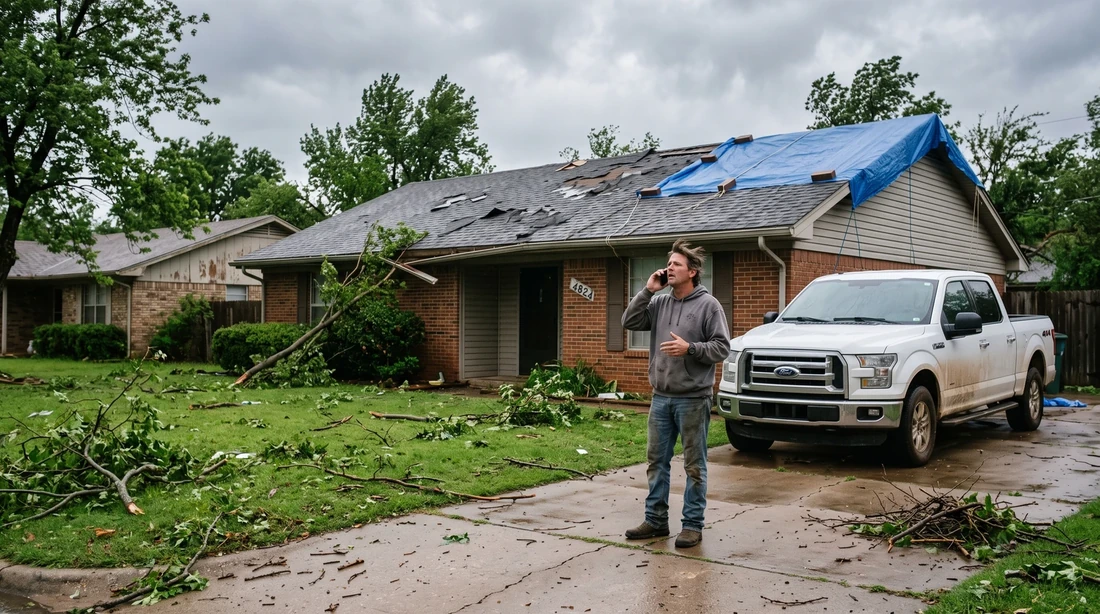
The sirens stopped an hour ago, and now you're standing in the driveway looking at a hole where your roof used to be, with two kids asking where they're sleeping tonight. Take a breath. Most of this is covered.
But two lines buried in your declarations page decide how much comes out of your pocket first, and most Oklahoma homeowners have never read either one. We'll go through both, plus the coverage that pays for somewhere to live while the repairs happen.
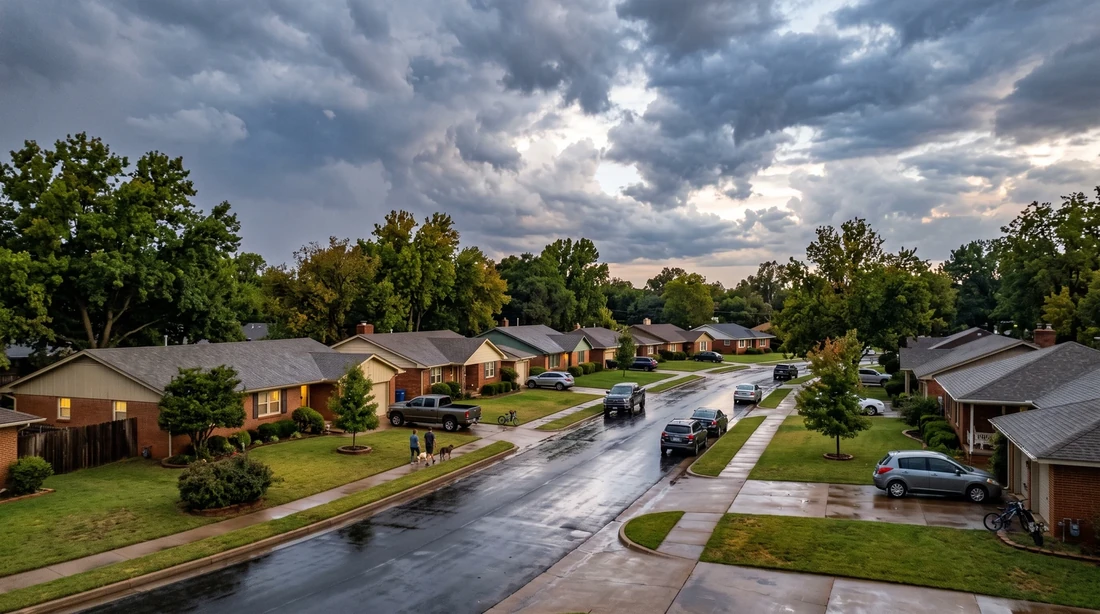
Oklahoma's tornado season peaks April through June. After a major outbreak, thousands of claims hit carriers at once, and adjuster inspections, roofing crews, and furnished rentals all fill in filing order. Every day you wait to report your claim pushes your inspection, your repair start, and your housing options further back in line.

Does Homeowners Insurance Cover Tornado Damage, and Which Parts Pay?
Tornado damage is covered under virtually every standard homeowners policy sold in Oklahoma, because windstorm is a core peril on both named-peril (HO-2) and open-peril (HO-3) policy forms. There is no "tornado exclusion" on a standard policy. If wind tore it, wind coverage responds.
Four different sections of your policy can pay after a strike:
- Dwelling (Coverage A): the house itself, meaning the roof, walls, windows, and attached garage.
- Other structures (Coverage B): detached garages, fences, sheds. This is often capped at a percentage of your dwelling limit. Installed storm shelters and safe rooms typically fall under A or B as well.
- Personal property (Coverage C): furniture, clothes, electronics, whether damaged by wind or by the rain that followed it through the opening.
- Loss of use (Coverage D): the additional cost of living elsewhere while the home is uninhabitable. This is the coverage that pays for temporary housing. The full mechanics live in our guide to loss of use coverage explained.
One thing that does not matter: the EF rating. Whether the National Weather Service calls it an EF1 or an EF4, your adjuster prices the damage in front of them, not the storm's label. A weak tornado that peels a roof and drives rain through the attic can produce a bigger claim than a strong one that only clipped a fence.
So the honest answer to "is it covered" is yes. In Oklahoma, though, "covered" and "paid in full" are two different things. Three mechanisms decide the gap: your wind/hail percentage deductible, your roof's settlement basis, and the rules around ALE. One plain statement before we get into them: your carrier and adjuster make every coverage decision on your specific claim. What follows is how these policies commonly work, and it is no promise about yours.
Industry loss data shows how much premium wind and hail consume:
According to the 2008 Insurance Information Institute factbook, for every $100 of premium, in 2005 on average $16 went to fire and lightning, $30 to wind and hail, $11 to water damage and freezing, $4 for other causes, and $2 for theft.
Wikipedia: Home insurance
How Does a Wind and Hail Deductible Work in Oklahoma?
Most Oklahoma homeowners policies now carry a separate wind/hail deductible calculated as 1% to 2% (sometimes 5%) of your dwelling coverage instead of a flat dollar amount. It applies instead of your regular all-peril deductible whenever wind or hail causes the damage, which in Oklahoma is most of the time.
Two things catch homeowners off guard. First, the percentage is applied to your dwelling limit, not the size of the loss, so a modest roof claim on a well-insured house can still trigger a five-figure deductible at 5%. Second, because dwelling limits typically rise each year with inflation endorsements, your deductible quietly grows even if you never touch the policy.
| Dwelling coverage | 1% deductible | 2% deductible | 5% deductible |
|---|---|---|---|
| $200,000 | $2,000 | $4,000 | $10,000 |
| $280,000 | $2,800 | $5,600 | $14,000 |
| $350,000 | $3,500 | $7,000 | $17,500 |
| $500,000 | $5,000 | $10,000 | $25,000 |
Your exact figure is on your declarations page, usually on a line labeled "Wind/Hail" or "Windstorm or Hail Deductible." Some carriers offer a flat-dollar buyback for extra premium. Whether that trade makes sense depends on your roof age and how much cash you could produce the week after a storm. If your dwelling limit went up at your last renewal (most do), recalculate the deductible now. It isn't the number you remember agreeing to.
Why Might an Older Roof Not Be Paid in Full?
A roof payment schedule settles a tornado-damaged roof at its depreciated value, often in the ballpark of 40% to 60% of replacement cost once an asphalt-shingle roof passes its mid-teens. These endorsements have spread rapidly across Oklahoma policies because wind and hail losses here are so frequent.
The distinction that matters is replacement cost value (RCV) versus actual cash value (ACV):
- RCV: the carrier pays what a new roof costs today, usually in two checks. ACV comes up front, then recoverable depreciation after the work is done.
- ACV or scheduled settlement: the carrier pays replacement cost minus depreciation based on the roof's age and material, and that depreciation is typically not recoverable. The gap is yours.
Look for an endorsement on your declarations page with a name like "Roof Surfaces Payment Schedule" or "ACV Roof Settlement." Some schedules also carve out cosmetic damage, so dents on a metal roof that don't cause leaks may be excluded entirely. If you're not sure which basis you have, ask your agent the question in writing before storm season: "If wind takes my roof this year, do I get RCV or a scheduled amount?"
What Else Changes What a Tornado Claim Pays?
Beyond the deductible and the roof schedule, five smaller mechanisms routinely change what a tornado damage insurance claim pays in Oklahoma.
- Matching. A tornado rarely damages a roof or siding evenly. If one slope is destroyed and your shingle line has been discontinued, whether the carrier pays to replace the undamaged sections so everything matches varies by policy and carrier. There is no automatic right to matching. Ask the adjuster in writing whether matching applies before repairs are scoped.
- Ordinance or law. Replacing a roof in the OKC metro can trigger current building-code requirements, such as re-decking or updated fastening, that didn't exist when the house was built. Base dwelling coverage rebuilds what you had. Code-upgrade costs come from ordinance-or-law coverage, often included at around 10% of your dwelling limit when it's included at all.
- Two-party checks. If you have a mortgage, structural claim checks are typically made out to you and the lender. Lenders commonly endorse and release funds in inspection-based stages, which can add weeks to the repair start. Your family spends those weeks in temporary housing.
- Contents pay ACV first. Personal property is commonly settled at actual cash value up front, with the depreciation released only after you replace items and submit receipts. Many policies put a time limit on claiming that recoverable depreciation, so don't let the second half of your contents money quietly expire.
- A neighbor's tree. If a neighbor's tree lands on your house, your own policy covers the damage and you file with your carrier, not theirs. Your carrier may pursue the neighbor's insurer only if negligence is provable, such as a dead tree they'd been warned about in writing.
Red Flags After the Storm
- Storm-chaser contractors. After major Oklahoma outbreaks, out-of-state crews canvass hard-hit corridors like Moore, Norman, and El Reno within days.
- An offer to "eat your deductible." Deductible-waiving schemes can amount to insurance fraud.
- An unregistered roofer. Oklahoma requires roofing contractors to register with the state. Verify registration and local references before signing anything.
- An assignment of benefits you haven't read closely. Never sign one you don't fully understand.
- A tarp that never went up. Damage you could reasonably have prevented is the kind carriers typically won't pay for.
When Does Tornado Damage Trigger Temporary Housing Coverage (ALE)?
If a tornado leaves your home uninhabitable, the loss-of-use section of a standard policy pays the additional cost of living somewhere else during repairs. That section is commonly set at 20% to 30% of your dwelling limit. Most families have never used it, and then they need it the same night.
Three rules shape how it pays:
- The trigger is a covered peril making the home unfit to live in. A missing roof, structural damage, or utilities knocked out by damage to the house typically qualify. A neighborhood power outage with an undamaged home typically does not. And if the loss itself is excluded (say, flooding), ALE doesn't trigger either.
- "Additional" means above your normal spending. The carrier reimburses the hotel or rental cost and the extra food expense, not your entire grocery bill. Your mortgage doesn't pause.
- Receipts substantiate everything. ALE is a reimbursement coverage unless your carrier or its TPA authorizes direct billing to a housing provider.
There's a tornado-specific wrinkle here called civil authority coverage. If your home is untouched but officials bar access to your street while crews clear downed lines and gas leaks from a strike nearby, many policies pay ALE for a short window, commonly up to about two weeks. On the worst night of your year, that's the difference between a covered hotel bill and an out-of-pocket one.
Pets add another layer. Hotel pet fees and boarding costs are not automatically ALE. Some adjusters approve them and some don't, so ask before you spend. Several of our pet-friendly OKC rentals have fenced yards, which sidesteps the boarding question entirely on longer displacements. The same loss-of-use mechanics apply whatever the peril, by the way. The sequence after a kitchen fire runs nearly identically, as covered in temporary housing after a house fire.
If your adjuster balks at housing or cuts it off before repairs finish, that fight has its own playbook: see what to do when insurance denies temporary housing. And if you'd rather have a professional handle the placement and billing paperwork, that's what insurance housing placement exists for.
What Does a Tornado Claim Cost You? Worked Examples
Here's a fully hypothetical scenario to make the math concrete. Say you and your two kids own a home insured for $280,000 in dwelling coverage. An EF2 comes through in May, takes most of the roof, and drives rain through two bedrooms. The adjuster estimates three months of repairs, and the home is declared uninhabitable.
- Wind/hail deductible: 1% × $280,000 = $2,800 out of your pocket before the first claim dollar arrives.
- Roof gap: if replacement runs $18,000 and your policy's roof schedule depreciates a 16-year shingle roof by roughly half, the roof portion pays about $9,000. That leaves around $9,000 on you, on top of the deductible.
- ALE ceiling: if loss of use is 20% of dwelling, that's 0.20 × $280,000 = $56,000 available for housing and extra living costs. It's a real budget, though not an unlimited one.
Now the housing math for those three months. A two-queen suite at roughly $150/night runs about $150 × 90 = $13,500. Add restaurant meals for three people at, say, $50/day above normal, another $4,500, and you're at a ballpark of $18,000 in ALE draw with no kitchen, no laundry, and no yard.
A furnished three-bedroom on a 30+ night monthly rate typically lands in the ballpark of $4,200 to $5,500/month in the OKC metro. That's $12,600 to $16,500 for the same three months, with a kitchen and washer that pull the extra-food line back toward zero. Same displacement, meaningfully slower ALE burn, and the kids each get a door that closes.
Variant: same house, worse policy terms. Now run the identical loss with a 2% wind/hail deductible and an ACV roof settlement, a combination common on older OKC-metro homes. The deductible becomes 2% × $280,000 = $5,600, and the roof gap stays around $9,000. Your out-of-pocket before any other repair shortfall is roughly $14,600 instead of $11,800. That's nearly $3,000 more from a single percentage point you may never have noticed at renewal, and it's why step four of the filing checklist below tells you to confirm both numbers in writing on day one.
There's a calendar cost too. A May strike with a three-month repair estimate puts your move-home date in August, right at the start of the school year. Repair estimates slip more often than they hold, which is why families in this position typically pick temporary housing they could extend month-to-month near the kids' existing schools rather than the first available hotel across the metro.
What Does Waiting Cost After a Tornado?
A tornado claim has a sequence, and delay compounds at every stage of it.
- First 48 hours: your policy requires you to mitigate further damage. An untarped roof that lets three more rainstorms in can turn into a partially denied claim, because carriers typically won't pay for damage you could reasonably have prevented.
- Week one: claims after a major outbreak are worked largely in filing order, and carriers fly in catastrophe (CAT) adjusters to work the backlog. Reporting on day one versus day ten can move your inspection by weeks.
- Weeks two through six: hotel nights accrue at full nightly rates while you wait. Every undocumented or unnecessary night is ALE budget you can't get back when repairs run long.
- Month two and beyond: ALE approvals typically run in blocks. If you haven't submitted receipts or asked for an extension before the block ends, reimbursement can stall right when repair timelines slip.
Tornado damage put your family out of the house? BnB OKC places displaced Oklahoma households in 11 furnished metro homes — a 9.5 out of 10 average across 1,580 verified guest reviews on Airbnb and Vrbo — and works directly with adjusters and TPAs like Alacrity Solutions. Monthly rates on 30+ night stays; several homes are dog-friendly.
See insurance housing options or call/text (405) 870-2146.
What Does Homeowners Insurance Typically Cover After a Tornado, Item by Item?
Most tornado losses fall into a dozen predictable categories, and each one has a specific catch to know before the adjuster arrives.
| Damage | Typically covered? | The catch |
|---|---|---|
| Roof torn off or shingle loss | Yes — windstorm peril | Roof schedules may pay depreciated value on older roofs |
| Structural damage to walls/windows | Yes | Wind/hail percentage deductible applies to the whole claim |
| Detached garage, fence, shed, storm shelter | Yes — other structures | Often capped at a percentage of your dwelling limit |
| Furniture, clothes, electronics | Yes — personal property | ACV first; recoverable depreciation requires replacement receipts |
| Rain damage after the roof opened | Typically yes | Requires a storm-created opening; long-term wear is excluded |
| Tree removal | Often, with limits | Many policies cap per-tree and per-loss removal amounts |
| Neighbor's tree onto your house | Yes — your policy responds | Your carrier may pursue the neighbor only if negligence is provable |
| Food spoilage from outage | Sometimes | Small sublimit, if the policy includes it at all |
| Flood or rising water from the same storm | No | Requires separate flood coverage (NFIP or private) |
| Your car in the driveway | No — not homeowners | Auto comprehensive coverage handles it |
| Temporary housing while unlivable | Yes — loss of use/ALE | Reimbursement-based; receipts required; "additional" costs only |
The flood row surprises people every spring. The same supercell can produce both a tornado and flash flooding, and only the wind half is a homeowners claim. Flood damage needs a separate policy through the National Flood Insurance Program or a private flood insurer. Rain entering through a storm-created opening in the roof is typically a covered homeowners loss, but water rising from the ground is not. No flood policy typically means no coverage for that portion, and no ALE trigger from it either.
Hotel, Extended-Stay, or Furnished Home for Three Months?
For a household of three on a 90-day tornado displacement, the monthly cost gap between housing options is smaller than the ALE-burn gap. Kitchens and laundry change the food and incidentals lines, and the rent line is only part of the bill.
| Option | Ballpark monthly cost | Kitchen / laundry | Approx. 3-month ALE draw |
|---|---|---|---|
| Hotel suite (~$150/night) | ~$4,500 + ~$1,500 extra food | No / no | ~$18,000 |
| Extended-stay hotel (~$110–$140/night) | ~$3,300–$4,200 | Kitchenette / shared | ~$11,000–$14,000 |
| Furnished home, 30+ night monthly rate | ~$4,200–$5,500 | Full kitchen / in-home washer | ~$12,600–$16,500 |
| Staying with family | ~$0 lodging | Shared | Minimal — ALE pays only actual additional costs |
Two notes on reading that table honestly. Extended-stay hotels can beat a furnished home on pure monthly cost for one or two people. The furnished home wins on space, school proximity, and pets, and not always on price. Staying with family draws almost nothing from ALE, which preserves budget if repairs run long, but a spare bedroom rarely survives three months with two kids in it.
Our furnished homes sit across the metro, near Lake Hefner, The Village, the Paseo and Plaza districts, and six minutes from Will Rogers World Airport, so one of them usually keeps your existing commute and school run intact.
How to File a Tornado Damage Insurance Claim, Step by Step
- Report the claim. Call your carrier or file in the app the same day; write down your claim number and the adjuster's direct line.
- Mitigate further damage. Tarp the roof, board broken windows, and keep every receipt, since reasonable emergency repairs are typically reimbursable.
- Document everything. Photograph and video the roof, every room, and damaged belongings before anything is moved or thrown away.
- Confirm three numbers. Ask your adjuster to put your wind/hail deductible, your roof settlement basis (RCV or ACV), and your loss-of-use limit in writing.
- Arrange temporary housing. Get ALE authorization before you book; on repairs longer than 30 days, a monthly furnished rate typically stretches the budget further than nightly hotels.
- Track and submit receipts. Log housing, meals above your normal spend, and mileage, and submit to your adjuster on a regular schedule.
What If You Rent Instead of Own?
Renters hit by the same tornado are covered by a different split. The landlord's policy covers the building, and your renters policy covers your belongings and your temporary housing. There's no wind/hail percentage deductible on a building you don't insure, so your renters deductible is typically a flat few hundred dollars.
The part renters most often don't know they have is loss of use. Here's a hypothetical to size it: a renter with two kids carries $30,000 in personal property coverage, and the policy sets loss of use at 30% of that. That's a $9,000 housing budget, not $56,000. If the tornado guts the building and repairs take two months, a $150/night hotel burns $150 × 60 = $9,000, the entire limit, before a single extra restaurant meal.
A furnished two-bedroom on a monthly rate in the ballpark of $3,600 to $4,200 runs $7,200 to $8,400 for the same two months, with a kitchen. That can be the difference between finishing the displacement inside your limit and finishing it on your credit card. The full breakdown lives in does renters insurance cover temporary housing.
When Is a Hotel Enough, and When Does a Furnished Home Help?
Be honest with yourself about the size of the displacement before you build a housing plan around it. If repairs will take a week or two, a hotel is the right call. It's flexible, there's no lease, and hotel points soften the bill.
A single adult displaced for a month often does fine in an extended-stay suite at a lower monthly cost than any furnished house. And if the total damage lands near or under your percentage deductible, talk to your agent about whether filing even makes sense. A claim that pays you nothing can still count against your claim history.
The math flips on longer displacements. Once repairs cross 30 days, which is common after structural tornado damage, a household with kids in school, a dog, and a real need for a kitchen and laundry typically stretches its ALE budget further in a furnished home on a monthly rate than in two hotel rooms. Month-to-month extensions matter just as much.
Tornado repair timelines slip when materials backlog after an outbreak, and renegotiating a hotel block in week ten is a worse position than extending a furnished home that's already yours. That's the situation ALE housing companies exist for, and it's why our extended-stay homes run on 30+ night monthly rates with direct-booking savings of up to 35% on 4+ night stays.
Terms You'll Hear, Decoded
- Wind/hail deductible: a separate deductible for wind and hail claims, usually a percentage of your dwelling coverage rather than a flat amount.
- Roof payment schedule: an endorsement that pays roof claims at a depreciated amount based on the roof's age and material.
- ACV (actual cash value): replacement cost minus depreciation. It's what the item or roof is worth today, not what a new one costs.
- RCV (replacement cost value): what it costs to replace with new, typically paid in two stages with depreciation released after repairs.
- Recoverable depreciation: the held-back second payment on an RCV claim, released after you complete repairs or replace items and submit receipts, often with a time limit.
- Ordinance or law coverage: the part of a policy (often around 10% of dwelling, when included) that pays for code-required upgrades your old construction didn't have.
- ALE / loss of use: the policy section that pays your additional living costs (housing, extra food, mileage) while a covered loss makes the home unlivable.
- CAT adjuster: a catastrophe adjuster deployed after large events like a tornado outbreak to work the surge of claims, often from out of state.
- Direct billing: the carrier or its TPA paying a housing provider directly, which happens only with the carrier's written authorization.
Your Next Steps
- Pull your declarations page tonight. Find the wind/hail deductible line, the roof settlement endorsement, and your Coverage D (loss of use) limit. Those three numbers are your whole tornado exposure, and every one may have changed at your last renewal.
- Run your own version of the math. Multiply your dwelling limit by your deductible percentage, then compare 90 hotel nights against a monthly furnished rate for your household size using the tables above.
- If you're already displaced, get housing moving today. Start at insurance housing or call/text (405) 870-2146. We can coordinate directly with your adjuster on a tornado claim placement.
For questions about your policy rights or to file a complaint about a claim, the Oklahoma Insurance Department is the state regulator; the City of Oklahoma City publishes local severe-weather and storm-shelter resources.
Bottom Line
Tornado damage is a covered peril on a standard Oklahoma homeowners policy. What you pay first comes down to your wind/hail percentage deductible and whether your roof settles at RCV or a schedule, so read both lines before storm season. If the house is unlivable, loss of use pays the extra cost of living elsewhere, and on a long repair a monthly furnished rate usually makes that budget last. Your carrier decides every claim, so get the numbers in writing.
This guide is general information, not insurance or legal advice; your carrier makes all coverage decisions.