Yes. Most homeowners policies pay for hotel stays through loss-of-use coverage (Coverage D) when a covered loss — fire, burst pipe, storm damage — makes your home unlivable. It typically reimburses hotel nights, pet fees, and extra meal costs above your normal spending, up to a capped dollar limit, with receipts. Your carrier makes the final coverage call.
Key Takeaways
- Loss-of-use coverage (Coverage D) typically pays hotel costs when a covered peril makes a home uninhabitable; limits often run 10 to 30% of dwelling coverage.
- Hotel nights are usually covered from the first night, before an adjuster is assigned; report the claim same day and ask about an ALE advance.
- Reimbursement is the default payment path; direct billing requires written carrier authorization and is more common with monthly furnished housing than nightly hotels.
- In the article's hypothetical, two hotel rooms with meals and pet fees cost about $10,950 monthly, versus $4,200 for a furnished four-bedroom.
What this guide covers: when homeowners insurance starts paying for a hotel, whether you pay up front or the carrier bills the hotel, how fast hotel nights drain your limit, and when a furnished home makes more sense. It also walks through the steps for getting the stay paid and who handles each task.
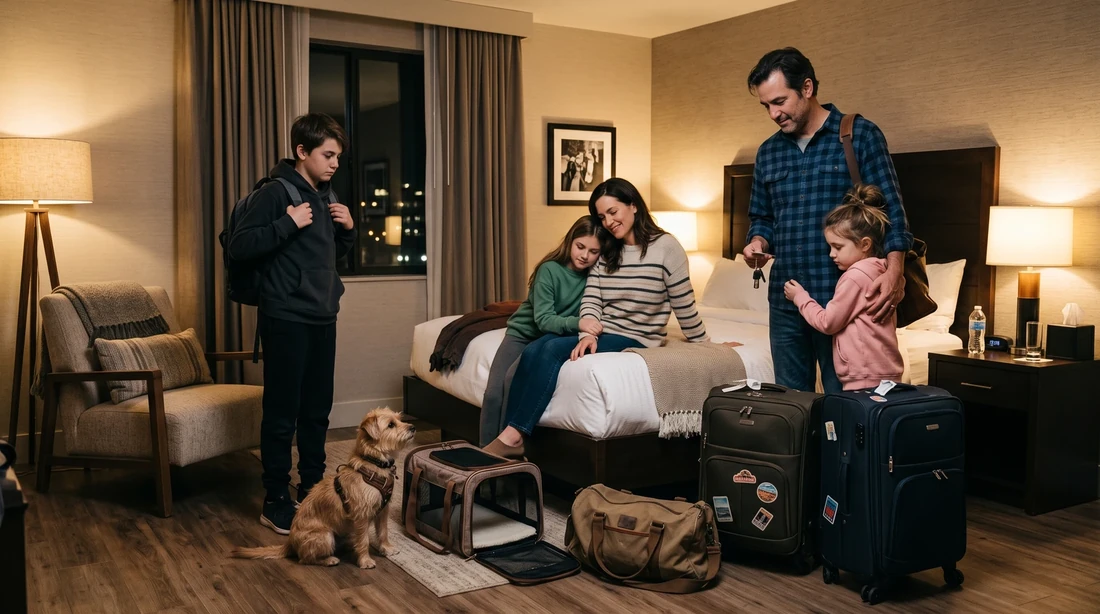
The kitchen fire is out, the smoke damage isn't, and your family of five, plus the dog, needs somewhere to sleep tonight. Booking that first hotel room feels like a gamble when you don't know what your policy pays. The short answer to "does homeowners insurance pay for a hotel stay" is yes; the useful answer is how, for how long, and who hands the front desk a credit card.
There's no calendar deadline on most hotel claims, there's a meter. Every hotel night bills against a capped loss-of-use limit that has to fund your entire displacement, often four to six months on a fire rebuild. The sooner you shift to lower-cost monthly housing, the further that limit stretches.

How Does Homeowners Insurance Pay for Hotel Stays?
Loss-of-use coverage, Coverage D on a standard homeowners policy, typically pays hotel and temporary-housing costs when a covered peril makes your home uninhabitable. It comes built into most standard homeowners forms, so there is no separate policy to buy.
Three conditions usually have to line up. The damage must come from a covered peril (fire, wind, a burst pipe, not flood, which standard homeowners policies typically exclude). The home must be uninhabitable. Unpleasant doesn't count. And the costs must be "additional", above what you'd normally spend living at home.
Your limit is commonly set as a percentage of your dwelling coverage, often somewhere in the 10-30% range depending on the policy, and some policies add a time cap (12 or 24 months). Check your declarations page for the exact Coverage D number. For the full mechanics, what counts, what doesn't, and how limits work, see our deeper guide to loss of use coverage explained.
One quick lane change: if you rent your home rather than own it, the rules run through your renters policy instead, that's covered in does renters insurance cover hotel stays. Everything below is written for homeowners.
On the flood gap standard homeowners policies leave:
Special insurance, including flood insurance , can be purchased for these possibilities.
Wikipedia: Home insurance
Does Homeowners Insurance Pay for a Hotel Stay From the First Night?
In most cases, hotel nights are covered from the very first night your home is uninhabitable from a covered loss, even before an adjuster has been assigned. You do not have to wait for approval to sleep somewhere safe; you have to document what you spend.
Call your carrier's claims line the same day. Many carriers can issue an emergency ALE advance, a check, a prepaid card, or an authorization, so you're not floating everything yourself. If they can't do it that night, book a reasonable room, keep the folio, and submit it. "Reasonable" is the standard adjusters apply: a household that lived in a four-bedroom home can typically justify two connecting rooms; a suite at the priciest downtown property invites pushback.
What about evacuations and civil authority orders?
You don't always need damage to your own house. If authorities bar you from your home, a gas leak on the block, a neighborhood evacuation after a tornado, many policies pay lodging under a civil-authority or "prohibited use" provision, typically capped at around two weeks. This matters in the OKC metro, where tornado season peaks April through June: after a major storm, hotel inventory tightens fast across the metro at exactly the moment hundreds of households need rooms, so calling your claims line early gets you into the queue before rates and vacancy turn against you.
Is the home uninhabitable or just inconvenient?
The habitability call belongs to the adjuster, not to you, and it's where first-night disputes start. No safe kitchen after a fire, no water, no power, or active smoke-odor remediation usually qualifies. A single damaged room in an otherwise livable house usually doesn't. If your claim gets pushed back on habitability grounds, our guide on what to do when insurance denied temporary housing walks the escalation path.
Will Insurance Reimburse You or Bill the Hotel Directly?
Home insurance hotel reimbursement is the default arrangement: you pay the hotel, you submit receipts, and the carrier pays you back, direct billing happens only when the carrier or its housing vendor authorizes it in advance. Knowing which lane you're in on night one prevents a nasty credit-card surprise in month two.
There are three payment paths, and they behave very differently:
- Reimbursement (most common). You front the cost and submit receipts. Cycles vary by carrier but often run a few weeks, which means a family carrying two rooms can be floating thousands of dollars at any given time. Submit receipts weekly, not in one pile at the end.
- ALE advance. The carrier issues money up front against your Coverage D limit, then reconciles it against receipts. Ask for this explicitly on the first call, many adjusters can arrange it but won't volunteer it.
- Direct billing. The carrier, or a third-party administrator (TPA) it hires, such as Alacrity Solutions, places you in housing and pays the provider directly. Nothing touches your card. This only happens with written authorization; a hotel clerk's assurance that "insurance will handle it" is not authorization.
Direct billing is far more common with monthly furnished housing than with nightly hotel stays, because carriers prefer one predictable invoice over thirty folios. That's the machinery behind placement firms, and it's explained in how ALE housing companies work. BnB OKC works with Alacrity Solutions on insurance placements and can direct-bill when your carrier authorizes it.
What Do Hotel Nights Really Cost Your Claim by Week Two?
For a household in two hotel rooms, week two is when the arithmetic turns against the hotel, and when most adjusters start steering the conversation toward monthly housing. Here's the typical sequence, stage by stage:
- Nights 1-3, emergency lodging. Nobody scrutinizes a reasonable room while your house is smoking. Book, keep receipts, report the claim.
- Week 1, the adjuster arrives. Habitability gets confirmed, the rebuild scope gets estimated, and you learn if you're looking at three weeks or four months.
- Week 2, the burn rate becomes visible. Two rooms plus restaurant meals has typically crossed $4,000-$5,000. The adjuster asks about your longer-term plan, because they can read the same math you can.
- Month 1, the transition push. If you're still in a hotel, your ALE is draining at roughly two to three times what a furnished monthly rental would cost. Some carriers set a firm transition date.
- Months 2-4+, the limit is the ceiling. Rebuilds slip, permits, materials, contractor schedules. Households that burned their limit on hotel months early can face out-of-pocket housing before the house is done. The full displacement arc is mapped in temporary housing after a house fire.
| Stage | What typically happens | Running hotel-route cost |
|---|---|---|
| Nights 1-3 | Emergency lodging; claim reported; receipts start | ~$900-$1,100 |
| End of week 1 | Adjuster assigned; habitability and rebuild scope set | ~$2,300-$2,800 |
| End of week 2 | Adjuster asks for a longer-term housing plan | ~$4,600-$5,600 |
| End of month 1 | Carrier pushes transition to monthly housing | ~$10,000-$11,000 with meals and pet fees |
| Month 4 | Rebuild finishing, if the limit held out | ~$40,000+ on the hotel route |
A worked example: family of five, a dog, and a four-month rebuild
This scenario is hypothetical, but the arithmetic is the kind your adjuster runs. Say a kitchen fire puts your family of five and your dog out for a four-month rebuild, and your policy's ALE limit is $60,000 (20% of a $300,000 dwelling limit).
The hotel route: two rooms at roughly $145/night each is $290/night, about $8,700 per month. Add a typical $25/night pet fee (~$750/month) and restaurant meals running maybe $50/day above your normal grocery spending (~$1,500/month). That's in the ballpark of $10,950 per month, or roughly $43,800 over four months, about 73% of a $60,000 limit.
The furnished-home route: a furnished four-bedroom at $4,200/month runs $16,800 over the same four months, about 28% of the limit. The dog moves in instead of racking up nightly fees, the full kitchen pulls food spending back toward normal, and roughly $27,000 of ALE stays in reserve for the rebuild delays that four-month projects routinely hit. For reference, BnB OKC's published from-rates run $225-$425/night, with monthly rates on 30+ night stays and several dog-friendly homes.
Variant: a hybrid month, extended-stay first, furnished home second
Same hypothetical family, different sequencing. Suppose the adjuster's rebuild scope isn't confirmed until day 10, so you spend the first two weeks in two extended-stay studios at roughly $95/night each ($190/night, about $2,660 for 14 nights), then move to the $4,200/month furnished home for the remaining three and a half months (~$14,700). Total: roughly $17,360, still less than two months on the two-room hotel route. The lesson: even if you can't commit to monthly housing on night one, every week you move down-market saves the claim four figures.
Displaced in the OKC metro and watching hotel nights eat your loss-of-use limit? BnB OKC places insurance families in 11 furnished homes sleeping 2 to 16+, several dog-friendly, with monthly rates on 30+ night stays and direct billing when your carrier authorizes it. Start an insurance housing request or call/text (405) 870-2146.
How Do a Hotel, an Extended-Stay, and a Furnished Home Compare?
Your Coverage D dollars are fungible, carriers typically care about reasonableness and receipts, not whether the roof over you says "hotel." Here's how the three main options compare for a larger household with a pet, using hypothetical OKC-market figures:
| Option | Typical monthly cost | What you get | What disqualifies it |
|---|---|---|---|
| Standard hotel (two rooms) | ~$8,700-$10,000 + pet fees and meals out | Daily housekeeping, no commitment, instant availability | No kitchen or laundry; many properties cap pet size or count; burns ALE fastest |
| Extended-stay hotel (two studios) | ~$5,400-$7,200 | Kitchenettes, weekly rates, on-site laundry | Household split across two studio units; two-burner kitchenettes strain full-family cooking |
| Furnished home (3-4 BR) | ~$3,500-$6,500 on monthly rates | Full kitchen, in-unit laundry, yard, real bedrooms, dog-friendly options | Usually needs a 30+ night commitment; less useful for stays under two weeks |
| Staying with relatives | $0 lodging | Free roof, familiar faces | ALE typically pays only documented extra costs, not a stipend; four months strains any spare room |
If the furnished route fits, browse extended stays in OKC or, with a dog in tow, pet-friendly rentals in OKCbooking direct also saves up to 35% on 4+ night stays versus platform pricing.
How to Get a Hotel Stay Paid by Homeowners Insurance, Step by Step
- Call the claims line the day you're displaced. Report the loss, confirm the home is uninhabitable, and ask whether lodging is reimbursed, advanced, or direct-billed.
- Book a reasonable hotel and save every receipt. Folio, pet fees, parking, and meal receipts all substantiate your ALE claim.
- Get your loss-of-use limit in writing. Ask for the Coverage D dollar amount and any time limit so you can budget the whole displacement.
- Document your normal living costs. ALE pays costs above normal, so your usual grocery and utility spending sets the baseline.
- Compare monthly housing before week two. Get furnished-home quotes so your adjuster can approve a lower monthly cost than two hotel rooms.
- Submit receipts weekly, not at the end. Regular submissions keep reimbursements flowing and surface problems while they're still small.
Which Situations Change the Hotel Math?
The two-room hotel baseline shifts by thousands of dollars depending on when you're displaced, where your kids go to school, and whether your rebuild finishes on schedule. These four situations are where the standard advice breaks.
Your displacement lands on an OKC event weekend
OKC hotel rates don't sit still, a displacement that starts during the Women's College World Series or the Memorial Marathon meets a metro where visiting fans have already booked the affordable rooms. Hypothetically, two rooms that typically run $145 each can push toward $220 each downtown in late May and early June; over ten nights that's roughly $4,400 instead of $2,900, about $1,500 more for the same ten nights. Adjusters still apply the "reasonable" standard, so screenshot the going rates the day you book; documented market conditions defend a higher folio.
| When | What squeezes hotel inventory | What it means for your claim |
|---|---|---|
| Late April | OKC Memorial Marathon weekend | Downtown and Midtown rates jump; book farther out or push the monthly-housing conversation early |
| April, June | Tornado season peak, storm-displaced households compete for rooms | Post-storm vacancy tightens metro-wide within hours; call the claims line the same day |
| Late May, early June | Women's College World Series at Devon Park | A week-plus of compressed inventory that overlaps tornado season, the worst window to be rate-shopping |
| September | State Fair of Oklahoma | Rooms near the fairgrounds and I-44 corridor fill for two-plus weeks |
| October, April | Thunder home games at Paycom Center | Downtown weekend rates rise game night by game night |
Keeping kids in their school zone
Hotel inventory and school districts rarely overlap: OKC's rooms cluster downtown and in Bricktown, along the Meridian Avenue corridor near Will Rogers World Airport, and up the Memorial Road strip. If your kids' school sits in The Village, near Lake Hefner, or across the metro from those clusters, a hotel can add a crosstown school run twice a day for four months.
Furnished homes scatter across residential neighborhoods, BnB OKC's 11 homes include options near Lake Hefner, The Village, and the Paseo and Plaza districts, which lets you pick housing by school zone instead of by highway exit. Put the commute in writing when you propose housing to your adjuster; a home that keeps daily routines intact is easier to defend as reasonable than its price tag alone.
The rebuild slips past the estimate
Four-month rebuild estimates routinely slip on permits, material lead times, and contractor scheduling, and the slip is where hotel-heavy claims break. Run the same hypothetical family out to six months: the hotel route at ~$10,950/month reaches roughly $65,700, blowing through a $60,000 limit before the house is finished and leaving about $5,700 (plus anything else charged to ALE) out of pocket.
The furnished route at $4,200/month totals $25,200-42% of the limit, with roughly $34,800 still in reserve. Before you sign any monthly housing, ask in writing how month-to-month extensions work; rebuild dates move, and you want housing that can move with them.
You're paying out of pocket
If the carrier disputes habitability, the loss isn't covered, or your Coverage D limit is thin, the same comparison math applies, you're just the one funding it. Self-payers should skip platform fees entirely: booking direct saves up to 35% on 4+ night stays versus platform pricing, and monthly rates on 30+ night stays compound the difference. Keep documenting receipts anyway; if the coverage dispute later resolves in your favor, the paper trail is what gets you reimbursed retroactively.
When Is a Hotel the Right Call?
A hotel is the correct answer more often than a furnished-housing company likes to admit, for short, uncertain windows. If your displacement is likely one to three nights (a board-up and quick remediation), if the adjuster hasn't yet ruled on habitability, if you're a one- or two-person household who can live comfortably in a single room, or if loyalty points meaningfully offset the cost, book the hotel and don't overthink it. Repairs expected to finish inside two weeks rarely justify a monthly commitment.
The first night is usually a hotel night no matter what: furnished check-ins typically run in the afternoon (BnB OKC's is 4:00 PM), and even a same-day placement takes hours to arrange. Treat night one as a hotel problem and week two as a housing problem.
The calculus flips when the stay crosses roughly 30 nights, when a pet turns every night into a fee, or when the household needs what a room can't provide: a full kitchen that keeps food spending near normal, a washer that runs every day, bedroom doors that close, a fenced yard for the dog.
At that point a furnished home usually costs your claim less per month than two hotel rooms while giving you more house. Guests rate BnB OKC's homes 9.5 out of 10 across 1,580 verified reviews on Airbnb and Vrbo, and two of the homes hold Airbnb's "Guest Favorite" badge, if a placement makes sense for your claim, start at insurance housing.
Who Handles What: You, Your Adjuster, or Your Housing Provider?
Displacement runs smoother when everyone's lane is explicit, most hotel-claim friction comes from assuming someone else was handling a task nobody owned.
| Task | Who handles it | What to watch |
|---|---|---|
| Declaring the home uninhabitable | Adjuster / carrier | Get the determination in writing; it starts the ALE clock |
| Setting the ALE dollar limit | Your policy (declarations page) | Confirm the number early, it's your whole housing budget |
| Booking and paying the emergency hotel | You, unless direct billing is authorized | Verbal "insurance will cover it" is not authorization |
| Saving and submitting receipts | You | Folios, pet fees, parking, meals, weekly submissions |
| Authorizing direct billing | Carrier or its TPA (e.g., Alacrity Solutions) | Ask for the authorization reference in writing |
| Finding monthly furnished housing | You, or an ALE housing company | You can propose your own option to the adjuster |
| Setting booking terms and extensions | Housing provider / host | Ask about month-to-month extensions before signing, rebuilds slip |
What Do the Terms You'll Hear Mean?
- ALE (Additional Living Expenses): the extra costs of living away from home, hotel, extra food, pet boarding, above your normal spending.
- Loss of use (Coverage D): the section of your homeowners policy that funds ALE; the dollar limit lives on your declarations page.
- Declarations page: the summary page at the front of your policy listing each coverage's dollar limit, the fastest way to find your Coverage D number.
- Habitability: the adjuster's determination that your home can't safely be lived in, the trigger for hotel coverage.
- Direct billing: the carrier or its vendor pays the hotel or housing provider directly, with prior written authorization.
- TPA (third-party administrator): a company your carrier hires to manage parts of the claim, including housing placements, Alacrity Solutions is one example.
- Civil authority / prohibited use: a provision paying lodging when officials bar access to your home, even without damage to it, typically capped around two weeks.
- Fair rental value: the alternative Coverage D benefit that applies when the damaged space was rented out rather than lived in.
The Bottom Line
Homeowners insurance usually pays for a hotel through loss-of-use coverage when a covered loss makes your home unlivable, up to a capped dollar limit and with receipts. Hotel nights drain that limit fastest, so the earlier you compare monthly housing, the further the money goes. Your carrier makes the final call. Here is what to do next.
- Confirm your Coverage D limit. Pull your declarations page or call your agent today so you know the dollar ceiling your whole displacement has to fit inside, and note any 12- or 24-month time cap while you're there.
- Compare your week-two math. Price two hotel rooms for a month against a furnished monthly rate for your household size, bring both numbers, plus your kids' school-zone address if it matters, to your adjuster.
- If you're displaced in the OKC metro, get placed. Request options at insurance housing or call/text (405) 870-2146same-day answers on availability, pets, and direct billing.
For Oklahoma-specific policy questions or a consumer complaint, the Oklahoma Insurance Department is the state regulator; to check whether your displacement dates collide with a major event, the citywide calendar at Visit OKC is the official source. This guide is general information, not insurance or legal advice; your carrier makes all coverage decisions.