Yes — homeowners insurance typically pays for storage during repairs. Most carriers cover the pack-out, moving, and storage of your belongings under your contents (personal property) coverage; some route a storage unit's monthly rent through Additional Living Expenses (ALE) instead. Get written authorization before anything moves, and photograph every item before it leaves your house.
Key Takeaways
- Most carriers pay pack-out, moving and storage under contents coverage; some route storage unit rent through Additional Living Expenses instead.
- Get written authorization before anything moves, and photograph and list every item room by room before the pack-out truck arrives.
- Storage destinations vary: vault rent a few hundred dollars monthly, driveway container $150 to $300, self-storage 10×10 climate-controlled $80 to $180.
- In the worked example, pack-out, two months of vault storage and pack-back total about $3,400 on the contents side.
What this guide covers: when a repair turns into a pack-out, where your belongings go and what each option costs, which part of your policy pays for storage, and how picking the right temporary housing can make the storage bill smaller.
Does insurance pay for storage during repairs? For most covered claims, yes. A burst pipe just soaked your floors, and your contractor says the rooms have to be emptied before drying and rebuild can start. Now you have two problems at once: where your belongings go for the next six to eight weeks, and where you go. This guide answers the first one in full, then shows how the right answer to the second one shrinks the first.
Before the pack-out truck arrives: photograph and list every item, room by room. Once your belongings leave your house in someone else's boxes, your ability to prove what you owned, and what condition it was in, leaves with them.

Why Does a Burst Pipe Turn Into a Pack-Out?
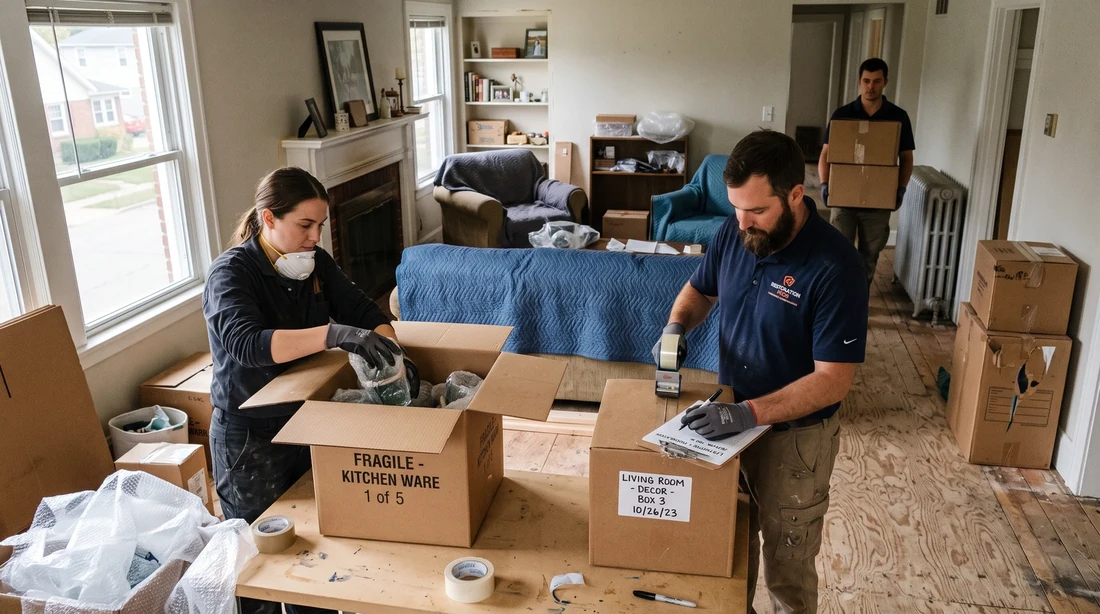
A pack-out happens on most water-loss claims where flooring, drywall, or cabinetry must be replaced, because crews cannot dry and rebuild rooms that are full of furniture. The restoration company boxes, inventories, and moves your contents out so the repair can happen.
Not everything goes to the same place. The crew typically triages contents into three streams: items stored as-is, items sent to contents cleaning (upholstery, rugs, and electronics that took water but can be restored), and items listed as non-salvageable, which move to the personal property side of your claim as a loss.
Who orders all this? Your contractor or mitigation company usually recommends the pack-out, but the adjuster authorizes it as part of the repair scope. That authorization step matters. A pack-out that happens before the carrier signs off can turn into a reimbursement fight later.
Oklahoma City sees two big pack-out seasons. Hard winter freezes burst supply lines in attics and exterior walls, and because so many metro homes sit on slab foundations, the water spreads across whole floors fast. Then April through June, peak tornado season, roof damage lets storm water into ceilings and walls.
The metro's older neighborhoods add a third factor: many mid-century homes around Nichols Hills, Crown Heights, and the Paseo still carry original supply plumbing, so a hard freeze can burst lines in walls that were never insulated for it. Whatever caused the water, the mechanics of storage coverage work the same.
What should you keep out of the boxes?
Some things should never ride to the vault, and the crew won't sort them out for you. Before move day, pack a stay-with-me kit: IDs, passports, vehicle titles, and your insurance paperwork (you'll reference the policy and claim numbers weekly); prescription medications; laptops, chargers, and anything you work with; and the kids' comfort items if children are in the house.
Jewelry, watches, firearms, and small heirlooms deserve special handling. Many homeowners policies apply special sub-limits to these categories, often a fraction of their real value, and a third-party warehouse is the last place you want a valuation dispute over them. Keep them with you, and ask your agent whether scheduled coverage makes sense going forward.
One more filter: anything you'll need mid-claim. Vault access usually requires an appointment and sometimes a retrieval fee, so a forgotten filing cabinet or winter coat can become a two-week wait.
One widely misunderstood limit on standard home policies after water damage:
The insurance is often misunderstood by its purchasers; for example, many believe that mold is covered when it is not a standard coverage.
Wikipedia: Home insurance
Where Do Your Things Go: Vault, Driveway Container, or Self-Storage Unit?
Pack-out storage coverage typically funds one of three destinations, and each trades cost against access differently. Warehouse vaults are the most common on larger water losses because the same company controls the chain of custody from your living room to the shelf.
| Storage option | Typical cost (OKC metro) | Access mid-claim | What disqualifies it |
|---|---|---|---|
| Restoration warehouse vault | Commonly bundled into the pack-out invoice; vault rent is a few hundred dollars a month, often billed straight to the carrier | By appointment only, sometimes with a retrieval fee | Needing weekly access to your things; DIY-managed small claims |
| Portable container in the driveway | Ballpark $150–$300 a month plus delivery fees | Anytime — it's at your house | Crews needing the driveway for dumpsters and lifts; HOA container rules; theft/weather exposure |
| Self-storage unit (10×10, climate-controlled) | Ballpark $80–$180 a month in the OKC metro | During facility hours | No authorized labor to move heavy items; items needing a documented chain of custody |
If access matters (tools, files, seasonal gear), raise it with the adjuster before the pack-out, not after the vault doors close. The practical middle path, covered below, is choosing temporary housing with enough room that your daily-use items never enter storage at all.
What Does Pack-Out Storage Cost, and What Does Waiting Cost?
A full pack-out with two months of storage on a three-bedroom home typically lands in the low thousands of dollars, which is why carriers want to approve it before anything moves. The bill usually has four parts: pack-out labor and materials, transport, monthly vault or unit rent, and the pack-back at the end.
Storage rent itself is the smallest line. Climate-controlled vault space typically runs a few hundred dollars a month; the labor on each end is where most of the money goes. So a repair that slips from six weeks to twelve doesn't double your storage cost. It does extend your housing cost, week by week.
Here's what typically goes wrong at each stage if you wait or skip steps:
- Days 1 to 3: wet furniture and rugs sit in a wet house, wicking moisture. Upholstery and wood take secondary damage that a prompt pack-out and contents cleaning could have stopped.
- Week 1: the contractor can't demo rooms full of furniture, so the repair start date slips, and every slipped week extends the housing bill on your claim.
- Week 2: you rent a storage unit on your own without authorization. Many carriers reimburse it anyway, but an unapproved expense is always the easiest one to dispute.
- Move day: the crew boxes everything with no inventory of your own. Any later disagreement about a missing or damaged item becomes your memory against their box list.
- Month 2 and beyond: repairs drag past any time window your policy puts on stored property, and the tail end of the storage bill lands on you.
A worked example: 7 weeks after a burst pipe
This is hypothetical, but the numbers are in a realistic ballpark for the OKC metro. Say a couple in The Village has a supply line burst during a January freeze, and the repair (new flooring through the main living areas, drywall, and paint) is scoped at seven weeks.
- Pack-out crew, two days of labor plus boxes and padding: about $1,450
- Climate-controlled vault storage, roughly two months: about $500
- Pack-back and placement when repairs finish: about $1,450
That comes to about $3,400 all-in for the contents side. Once it's authorized, the carrier typically pays it as part of the covered repair, and it doesn't come out of the couple's pocket.
Now the housing side of the same seven weeks. A hotel room at roughly $140 a night for 49 nights is in the ballpark of $6,860. That's room only, with every meal eaten out and nowhere to put anything beyond two suitcases. A furnished home on a monthly rate gives the same couple a kitchen, laundry, closets, and a garage, which (as you'll see below) can shrink the storage problem itself.
What happens when 7 weeks becomes 12?
Now stretch the same hypothetical claim. Say the rebuild slips from seven weeks to twelve, a common slide when cabinets are back-ordered or a second trade runs late. The storage side barely moves: one more month of vault rent adds roughly $250, taking the contents bill from about $3,400 to about $3,650.
The housing side is where the slip bites. That same $140-a-night hotel room across 84 nights runs in the ballpark of $11,760, up $4,900 from the seven-week figure. And the room-only number hides the food line. A couple that normally spends about $700 a month on groceries might spend $2,400 a month eating every meal out. The roughly $1,700 monthly difference is the kind of "additional" expense many policies reimburse, but every dollar of it drains the same ALE pool that funds the roof over your head.
A furnished home with a full kitchen keeps the grocery bill at its normal, non-claimable level and puts those ALE dollars back to work on housing. Over twelve weeks, that one difference is worth roughly $5,100 in preserved ALE (three months × $1,700), before counting laundry, a real workspace, or the garage holding everything that stayed out of the vault.
Displaced by a water loss and juggling a pack-out at the same time? Our furnished OKC homes take monthly-rate insurance stays, and the garages and closets mean less of your life goes into a vault. Start an insurance housing request or call/text (405) 870-2146 — same-day placement is often possible.
Does Insurance Pay for Storage During Repairs Under Contents or ALE?
Most carriers pay for storage during repairs through contents coverage, and fewer through ALE. The routing varies by carrier and claim, though, and it changes which limits your storage dollars draw down. Ask your adjuster which bucket applies to you, in writing.
The contents route (Coverage C): here, pack-out and storage are treated as part of protecting and repairing insured property, alongside the mitigation and rebuild scope. On many claims the restoration company bills the carrier directly for it, so you may never see an invoice.
The ALE route: some adjusters treat a storage unit's rent as an "additional living expense" of being displaced, the same category that pays for your temporary housing. If you're new to how that category works, our guide to loss of use coverage explained covers it from the top. If storage comes out of ALE, every storage dollar competes with your housing dollars, because ALE is a capped pool that funds both.
Here's the routing math in numbers. Suppose, hypothetically, your ALE pool caps at $24,000. If the adjuster routes only a self-storage unit's rent through ALE, say $160 a month for three months, that's $480, barely a dent. But if the full $3,400 pack-out package rides the ALE bucket instead, roughly 14% of your housing pool is gone before your first night of temporary lodging. Same expenses, very different pressure on your stay. That's why the bucket question is the first thing to ask in writing.
Non-salvageable items follow different money. Items the cleaning company writes off move to your personal property claim, where many policies pay actual cash value (the depreciated amount) up front and hold back the rest until you replace the item and submit receipts. Keep the write-off list from the pack-out crew. It opens that claim, so treat it as more than a disposal record.
On deductibles: most policies apply one deductible per claim to the overall covered loss, not a separate deductible on the storage line. How it's allocated across the structure, contents, and ALE portions varies by carrier, so ask your adjuster where yours lands rather than assuming the storage invoice arrives with its own out-of-pocket hit.
There's a third piece of policy language to ask about. Many homeowners policies include "property removed" wording that keeps your contents insured while they're stored away from a home that's being repaired, sometimes only for a limited window, often measured in days. If your repair runs long, ask your adjuster whether stored items stay covered for the full duration.
Renters get a version of all this too. A typical renters policy pairs personal property coverage (which can handle storing your things) with loss of use (which handles where you live). Limits are typically lower than on a homeowners policy, so ask what your personal property cap is before assuming a long storage stint fits. Your landlord's insurance covers the building and never your belongings. The mechanics are laid out in does renters insurance cover temporary housing.
Two caveats apply everywhere. First, receipts substantiate everything: pack-out invoices, monthly storage bills, moving charges. Keep them all. Second, the carrier decides. If your adjuster pushes back on a contents storage insurance claim, our walkthrough of what to do when insurance denied temporary housing covers the escalation path, and the same logic applies to disputed storage lines.
How Can Your Temporary Housing Make Room for What You Keep?
The right temporary housing can shrink your storage bill, because every closet, garage bay, and spare room you rent is volume that doesn't have to be vaulted, tracked, and hauled back. Adjusters see this trade-off all the time: contents in storage are contents you can't use for two months.
Think about what you need daily across a 6 to 8 week displacement: work-from-home gear, seasonal clothes, the coffee setup, the dog's crate and food. In a hotel, all of it goes to the vault. In a furnished home with a garage, it comes with you, and anything you keep out is an item that can't be lost, crushed, or disputed in storage.
Location matters more during a pack-out than on an ordinary trip. You'll want to meet your contractor for walk-throughs (weekly is a good rhythm on a rebuild), and if kids are in the house, staying in your own part of the metro keeps school runs intact. Most of the OKC metro sits within about a 25-minute drive of downtown, and our homes cluster around Lake Hefner, The Village, and the Paseo and Plaza districts, with larger estates in Gaillardia, so matching a home to your repair address is usually straightforward. Browse the lineup at our properties page.
| Option | Typical monthly cost (2 people) | Room for belongings | What disqualifies it |
|---|---|---|---|
| Standard hotel room | Roughly $3,900–$5,400 at $130–$180/night, plus dining out | Suitcases only; no kitchen, no storage | Stays past 2–3 weeks; pets at many properties; anything beyond luggage |
| Extended-stay hotel | Roughly $3,000–$4,500 at $100–$150/night | Kitchenette and a closet; still one room | Two people both working from home; more than a carload of kept items |
| Furnished home (monthly rate) | Often comparable or less on 30+ night stays, once dining and laundry savings are counted | Full closets, garage, kitchen, and laundry | Very short stays of a few nights; solo travelers on tight nightly budgets |
BnB OKC operates 11 furnished homes across the Oklahoma City metro, sleeping 2 to 16+, with published from-rates of $225 to $425 a night, monthly rates on 30+ night stays, and direct-booking savings of up to 35% on stays of 4+ nights. Guests rate the homes 9.5 out of 10 across 1,580 verified reviews on Airbnb and Vrbo. We work with Alacrity Solutions on insurance placements, and direct billing is possible when your carrier or its TPA authorizes it. How that authorization works is covered in how ALE housing companies work.
Practical matches for a pack-out situation: several of our homes are dog-friendly with fenced yards (see pet-friendly rentals in OKC), and homes with garages and spare bedrooms are listed under extended stays. If your displacement came from fire rather than water, the housing sequence differs a bit. Temporary housing after a house fire walks through that version, where smoke-affected contents make the cleaning stream much larger.
How to Get Storage Covered During Repairs, Step by Step
- Confirm the coverage bucket. Ask your adjuster in writing whether pack-out and storage fall under contents coverage or ALE on your claim.
- Get written authorization. Have the pack-out, the storage location, and the expected duration approved before anything is moved.
- Inventory everything first. Photograph and list every item, room by room, before the crew boxes it.
- Keep every receipt. Save pack-out invoices, monthly storage bills, and moving charges in one folder to substantiate the claim.
- Match your housing to your stuff. Book temporary housing with closets, a garage, or spare rooms so daily-use items stay with you instead of in a vault.
Who Handles What During a Pack-Out?
On a well-run claim, most of the storage logistics aren't yours to carry. The pieces that are yours, though, are the ones nobody else can do. This split shows where your attention belongs.
| Task | Who handles it |
|---|---|
| Authorize the pack-out, storage location, and duration | Adjuster / carrier |
| Box, inventory, transport, and vault the contents | Restoration company |
| Pre-move photo inventory, room by room | You — before move day, no one else will |
| Pull documents, medications, and valuables before boxing | You — the crew won't sort these for you |
| Monthly storage invoices | Restoration company bills the carrier directly on many claims; otherwise you pay and submit receipts |
| Decide restorable vs. non-salvageable items | Adjuster, with your input and the cleaning company's assessment |
| Temporary housing with room for kept items | You, your ALE housing company, or your host |
| Report storage or transit damage | You — promptly, with your inventory as proof |
What to Check Before Move Day
- You have the adjuster's written approval for the pack-out, the storage location, and the duration.
- You know whether storage rides under contents or ALE on your claim.
- The pack-back is written into the authorization, not assumed.
- Your own room-by-room photo inventory is done.
- Documents, medications, and valuables are out of the boxes and with you.
- You've asked whether a time limit applies to stored property.
When Don't You Need a Pack-Out or a Furnished Home?
If the repair is confined to one or two rooms and finishes inside about two weeks, you may not need a pack-out or a furnished home at all. Crews can often shift furniture to unaffected rooms or a garage, you stay in the house or take a short hotel stint, and the storage question never comes up.
A hotel is also the right call for a single traveler, a points-loyalty stay, or a displacement measured in a few nights. Nobody needs a garage for a long weekend. If you rent and the fix is that short, a straightforward hotel stay under loss of use is usually the simplest path, and does renters insurance cover hotel stays walks through it.
The math flips when the repair crosses roughly the 30-night line, when two people are both working from the room, when a dog is involved, or when the pile of things you'd rather keep with you outgrows two suitcases. At that point a furnished home becomes the cheaper, lower-friction option. The kitchen alone can preserve four figures of ALE over a long rebuild, and every kept item is one less line on the vault manifest. When you're ready to compare, booking direct is where the up-to-35% savings on 4+ nights lives.
Terms You'll Hear, Decoded
- Pack-out: the process of boxing, inventorying, and moving your contents out of the home so repairs can happen.
- Pack-back: the return trip at the end, delivering and placing your contents in the finished home. It's normally part of the same authorized scope.
- Contents coverage (Coverage C): the part of your policy that insures your belongings and, on many claims, funds their storage.
- ALE / loss of use: the coverage that pays displacement costs above your normal living expenses, including temporary housing.
- Special limits: sub-caps many policies place on categories like jewelry, firearms, and cash, often well below the items' real value.
- Actual cash value (ACV): an item's depreciated value; many policies pay ACV on written-off contents first, with the balance released after you replace the item.
- Property removed: policy language that keeps contents insured while stored away from a home under repair, sometimes for a limited window.
- Contents cleaning: professional restoration of water- or smoke-affected items instead of replacing them.
- Direct billing: the vendor invoices the carrier straight, with the carrier's or TPA's authorization, so you never front the cost.
Your Next Steps
- Confirm the bucket and the clock. Ask your adjuster in writing whether storage rides under contents or ALE, whether any time limit applies to stored property, and how your deductible will be applied.
- Build your inventory and stay-with-me kit tonight. Walk every room with your phone, taking photos and making a simple list, and pull documents, medications, and valuables into one tote before the pack-out date is even set.
- Line up housing with room for what you keep. Start at insurance housing or call/text (405) 870-2146 and tell us your repair timeline. We'll match you to a home with the closet and garage space your pack-out plan needs.
If a storage or ALE dispute stalls, the Oklahoma Insurance Department offers consumer assistance for policyholders in the state.
Bottom Line
On most covered claims, pack-out and storage are paid as part of the repair, usually under contents coverage. Get the authorization in writing before anything moves, take your own inventory, and find out which bucket your storage draws from. The bigger money on a long repair is housing, and a home with closets and a garage keeps more of your things, and more of your ALE, out of the vault.
This guide is general information, not insurance or legal advice; your carrier makes all coverage decisions.