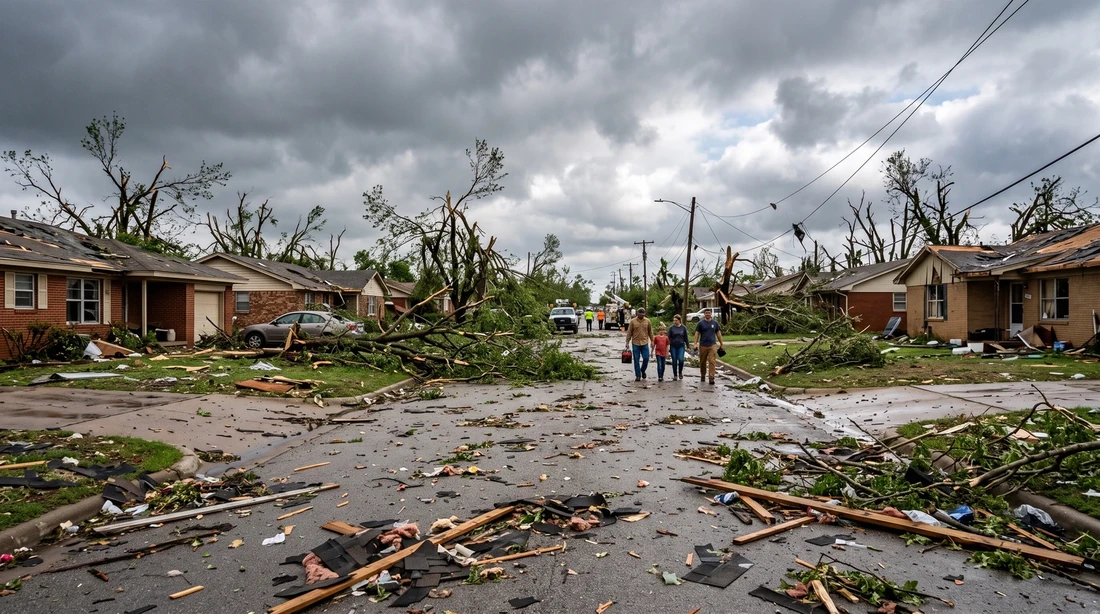
Yes — standard renters insurance typically covers tornado damage. Windstorm and hail are covered perils on most HO-4 renters policies, so your destroyed belongings are covered up to your personal-property limit, and loss-of-use coverage pays your temporary housing costs while the rental is repaired. The building itself is your landlord's insurance problem, not yours.
Key Takeaways
- Standard HO-4 renters policies list windstorm and hail as covered perils; the landlord's insurance covers the building itself.
- Rain entering through a tornado-created opening is typically covered, but rising water requires a separate flood policy.
- Hypothetical family of four, three-month repair: hotel path costs about $17,610 versus $11,700 for a furnished home.
- Loss of use pays only costs above normal spending, so keep receipts for lodging, meals, boarding and mileage.
What this guide covers: which parts of a tornado loss your renters policy pays and which belong to your landlord, what a few months of displacement costs a family in OKC, the housing options and when each makes sense, and how to file so your loss-of-use money lasts.
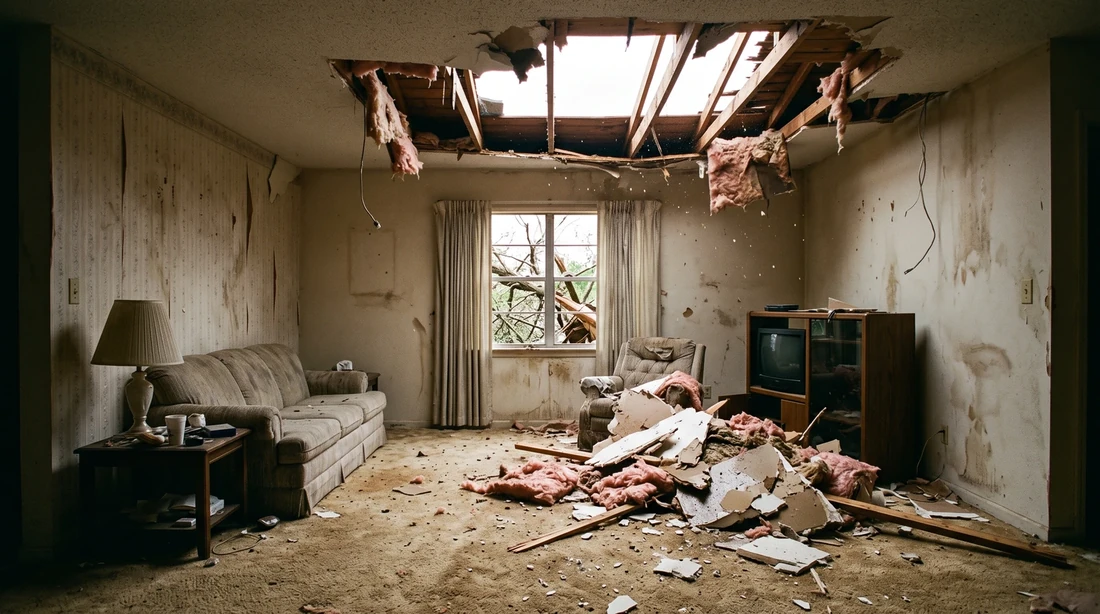
A tornado ran across your part of the metro last night, part of the roof on your rental is gone, and the ceiling in the back bedroom is on the carpet. Your landlord's contractor is talking about a twelve-week repair. That's a frightening morning. It's also a solvable logistics problem, because two separate insurance policies are about to go to work at the same time.
Oklahoma's tornado season peaks April through June, and after a major storm, furnished monthly rentals and extended-stay rooms across the OKC metro get claimed within days. Every unplanned hotel night also spends loss-of-use money that a monthly rate would stretch further. The faster you move to monthly housing, the longer your coverage lasts.

Does Renters Insurance Cover Tornado Damage in Oklahoma?
Most HO-4 renters policies list windstorm and hail as covered perils, which means a tornado that destroys your belongings typically triggers coverage without any special add-on.
The split between policies matters more after a tornado than in almost any other claim. Your landlord's insurance covers the building, and your renters policy covers your belongings and your displacement. The torn roof, the broken windows, the structural repair: all of that is the landlord's claim, on the landlord's timeline. You aren't responsible for paying for the roof. The soaked mattress, the ruined TV, and the three months you can't live there are yours.
Which three coverages can a tornado trigger?
- Personal property: pays to repair or replace your belongings damaged by wind, hail, or rain that entered through a storm-created opening, up to your limit, minus your deductible.
- Loss of use (also called Additional Living Expenses, or ALE): pays the additional costs of living somewhere else while your unit is uninhabitable. That includes lodging, extra food costs above your normal grocery spend, laundry, pet boarding, and extra commuting mileage. The full mechanics are in our guide to loss of use coverage explained.
- Liability: rarely relevant in a tornado claim, but it rides on the same policy.
Is wind-driven rain treated differently from rising water?
Rain that pours through a tornado-created opening, such as a hole in the roof or a blown-out window, is typically covered, because the wind caused the opening. Rising water from the same storm system is another matter. Street flooding seeping under the door or a creek overflowing into a ground-floor unit is typically excluded from renters policies entirely. That risk requires a separate flood policy through the National Flood Insurance Program or a private flood insurer. Sewer backup usually needs its own endorsement too, so ask your agent about both gaps before storm season.
Actual cash value or replacement cost?
How much you get back for belongings depends on which valuation your policy uses. Actual cash value (ACV) pays what your five-year-old couch was worth used, often a fraction of what a new one costs. Replacement cost value (RCV) pays what it costs to buy a comparable new one, usually after you replace it and submit the receipt. After a tornado wipes out a whole apartment's contents, that difference can be thousands of dollars, so check your declarations page now, before you need it.
Which sublimits bite after a total-contents loss?
Even a healthy personal-property limit hides caps inside it. Many policies apply sublimits, commonly a few thousand dollars or less, to specific categories: jewelry and watches, firearms, electronics used for business, cash, and collectibles. A burglary claim rarely hits every cap at once. A tornado that takes the whole apartment often does. If you own items in those categories worth more than the caps, a scheduled personal property endorsement fixes it, but only if it was added before the storm. Ask your agent about it now rather than during a claim.
What is your duty to protect what's left?
Nearly every policy requires you to take reasonable steps to prevent further damage once it's safe. That means moving undamaged belongings away from the open roof, covering furniture with plastic, or paying for a few hours of moving help to get salvageable items into a dry room or storage. Keep those receipts. Carriers typically reimburse reasonable emergency-protection costs as part of the claim, and skipping the effort entirely can complicate coverage for damage that happens afterward.
Is there a separate wind and hail deductible?
Some Oklahoma policies apply a separate (and often higher) deductible to windstorm and hail claims, sometimes a flat dollar amount and sometimes a percentage. This is more common on homeowners policies than renters policies, but it appears on some renters policies written in high-wind states. Your declarations page will say so plainly if it applies. Loss-of-use payments typically aren't reduced by a deductible. Confirm that with your carrier, because every policy reads differently. In every case, your carrier and adjuster make the final coverage decisions. This guide doesn't, and neither does your landlord.
Industry loss data shows how much of home premiums wind claims consume:
According to the 2008 Insurance Information Institute factbook, for every $100 of premium, in 2005 on average $16 went to fire and lightning, $30 to wind and hail, $11 to water damage and freezing, $4 for other causes, and $2 for theft.
Wikipedia: Home insurance
What Does Tornado Displacement Cost, and What Happens While You Wait?
A displaced household of four in Oklahoma City typically spends in the ballpark of $5,000 to $6,500 a month living out of a standard hotel once restaurant meals are counted. That's often $1,500 or more above what a furnished monthly rental with a full kitchen would run.
The costs don't arrive all at once. They accumulate in stages, and each stage you drift through without a plan drains the same fixed loss-of-use limit:
- Night one: you're in whatever hotel had a room, or with friends. Many carriers' 24/7 claim lines can authorize the first few emergency nights, so ask when you file.
- Days 2 to 7: your adjuster inspects your belongings; the landlord's insurer inspects the structure. Somewhere in here comes the habitability call that formally triggers loss of use.
- Weeks 2 to 4: nightly hotel spending compounds. A $160/night room quietly becomes $4,800 by day 30, before a single restaurant meal.
- Month 2: the repair runs on the landlord's contractor's schedule, not yours. Storm-season backlogs across the metro routinely stretch roof and structural work past initial estimates.
- Month 3 and beyond: if you're still paying nightly rates, you're now racing your own dollar limit. Families who moved to a monthly furnished rate in week one typically still have budget left here; families who stayed in hotels often don't.
A worked example: family of four, three-month roof repair (hypothetical)
Say a spring hail-and-tornado event tears open the roof of your rental, and the landlord's contractor quotes a 3-month repair. Two adults, two kids, and here are the two realistic paths, with all numbers hypothetical and rounded:
Hotel path: a double-queen suite at roughly $159/night × 90 nights = $14,310 in lodging. With no kitchen, restaurant and takeout meals typically add about $1,100/month above your normal grocery spend: $3,300 over three months. Total displacement spend ≈ $17,610.
Furnished home path: a furnished 3-bedroom house at a monthly rate of about $3,900 × 3 months = $11,700. A full kitchen and in-unit laundry keep food and laundry costs near normal, so the "additional" expenses beyond lodging stay small.
The difference, roughly $5,910, doesn't go in your pocket. It stays inside your loss-of-use limit as a buffer for the repair delays that tornado-season backlogs make common. One more nuance: loss of use pays only costs above your normal living expenses. If your lease abates rent while the unit is uninhabitable (many do, so check your lease and ask your landlord in writing), your carrier will factor the rent you're no longer paying into its math.
Variant: the repair slips to 4.5 months (hypothetical)
In storm season, slippage is the usual outcome. A single May outbreak can book roofing crews across the metro into fall. Stretch the same family's numbers: the hotel path becomes $159 × 135 nights = $21,465, plus about $4,950 in extra food costs, for roughly $26,415. The furnished path becomes $3,900 × 4.5 months = $17,550.
Now put a realistic limit against those totals. Many renters policies set loss of use as a percentage of the personal-property limit. Hypothetically, 40% of $50,000 is a $20,000 loss-of-use budget. The hotel path burns about $5,870 a month and exhausts that $20,000 around month three and a half, leaving the final weeks self-paid. The furnished path finishes all 4.5 months with roughly $2,450 still inside the limit. Same family, same storm, same policy, and the housing choice in week one decides which ending they get.
Variant: add the family dog (hypothetical)
Most standard hotels won't take a 60-pound dog for 90 nights, so the hotel path usually adds boarding. At roughly $35/night × 90 nights, that's $3,150 on top of the lodging math. Boarding is often reimbursable as an additional living expense, but it drains the same fixed limit as your room. A dog-friendly furnished house with a fenced yard removes that line entirely and keeps the dog with the family. Several of our homes qualify; see pet-friendly rentals in OKC.
Which displacement expenses count?
Loss of use pays the increase over your normal spending, and every dollar needs a receipt behind it. Carriers vary and your adjuster confirms specifics, but here's the typical treatment:
| Expense | Typically counts? | Keep this proof |
|---|---|---|
| Hotel or furnished-rental lodging | Yes — the cost above any rent you're no longer paying | Hotel folio or host invoice |
| Restaurant and takeout meals | Only the increase over normal grocery spend | Itemized receipts |
| Laundromat costs | Yes, if your unit had laundry | Receipts or a dated log |
| Pet boarding | Often | Boarding invoice |
| Extra commute mileage | Often | Mileage log with dates |
| Storage unit for salvaged belongings | Often | Monthly storage invoice |
| Groceries at your normal level | No — not "additional" | — |
Displaced by tornado or hail damage in the OKC metro? We place displaced renters in furnished monthly homes and can coordinate documentation directly with your adjuster — same-day options are often possible. Request insurance housing or call/text (405) 870-2146.
Where Can You Stay After a Tornado?
For repairs running 30 nights or longer, monthly-rate furnished housing typically costs less than nightly hotel rooms while giving you bedrooms, a kitchen, and laundry back.
| Option | Typical monthly cost | Works when | Falls apart when |
|---|---|---|---|
| Standard hotel | ~$4,800–$5,700 lodging, plus restaurant meals | Repair is 1–2 weeks; you need a bed tonight | Stay passes 30 nights; no kitchen or laundry; costs compound |
| Extended-stay hotel | ~$3,300–$4,500 with kitchenette | 1–2 people; 2–6 week repairs | Four people in one room; storm-season sellouts |
| Furnished rental home | ~$3,600–$5,000 monthly rate, full kitchen and laundry | 30+ nights; you need bedrooms, a yard, pet space | Repair is under two weeks; minimum-stay math doesn't pencil |
| Staying with family or friends | ~$0 lodging | Short stays; you want zero spend against your limit | Months-long stays; carriers reimburse only additional costs, so there's little to claim |
Standard hotels are the right first-night answer and the wrong month-two answer. Whether your carrier pays the bill directly or reimburses you afterward is its own question, covered in does renters insurance cover hotel stays.
Extended-stay hotels add a kitchenette and drop the nightly rate, which is enough for one or two people. The problem after a metro-wide storm is supply: adjusters, contractors, and other displaced households all chase the same rooms in the same week.
Furnished rental homes restore normal life with separate bedrooms, a real kitchen, laundry, a driveway, and a yard. BnB OKC operates 11 furnished homes across the OKC metro sleeping 2 to 16+, with published from-rates of $225 to $425/night, monthly rates on 30+ night stays, and up to 35% savings on 4+ night stays when you book direct. The homes sit in livable, drivable parts of the metro, near Lake Hefner, The Village, and the Paseo and Plaza districts, and about 6 minutes from Will Rogers Airport.
That matters after a south-metro or Moore-corridor storm, when a north-side home keeps you 20 to 30 minutes from the damaged rental you'll need to visit for inspections and salvage runs. We work with Alacrity Solutions on insurance placements, and guests rate our homes 9.5 out of 10 across 1,580 verified reviews on Airbnb and Vrbo. Browse extended stays for the monthly-rate homes.
Staying with family costs nothing, which cuts both ways. Because loss of use covers only additional expenses, there's usually little to reimburse beyond modest increased costs your host incurs. It's a fine bridge for the first week while you line up something with a monthly rate.
Which Tornado Situations Change Your Housing Plan?
Pets, school schedules, roommates, and your lease each change what your carrier will reimburse, and which housing option works for the next three months.
You have a dog or cat
Boarding is often a legitimate additional living expense, but it competes with your lodging for the same fixed limit. The hypothetical $3,150 in the example above is real money out of the same $20,000 pot. A furnished home that allows dogs, with a fenced yard, usually beats boarding on both cost and sanity. Whatever you choose, get any pet fees onto a written invoice so the adjuster can evaluate them.
Your kids are mid-semester
A tornado in April displaces kids six weeks before the school year ends, and adjusters generally aim to place you in comparable housing in a comparable location. So say the school constraint out loud when housing is discussed. The OKC metro is drivable, with most crosstown runs at 20 to 30 minutes outside rush hour, but a twice-daily school commute from the wrong side of the metro compounds over three months in both gas and patience. Extra mileage above your normal commute is often reimbursable, so log it with dates.
You have roommates
Unless a roommate is named on your policy, each renter carries their own policy, files their own claim, and draws on their own loss-of-use limit. That works in your favor when you share a furnished house during displacement. Ask the host to split the invoice by person so each roommate submits their share to their own carrier. Two roommates splitting a $3,900 monthly rate are each documenting $1,950, a number most limits handle comfortably.
The rent question
What happens to your rent decides how big "additional" really is. Many leases abate rent while the unit is uninhabitable, and Oklahoma landlord-tenant law generally gives tenants options (sometimes including terminating the lease) when a casualty makes a rental unlivable. Get whatever you and the landlord agree to in writing. If rent abates, the adjuster nets that saved rent against your temporary lodging. If you're somehow still paying rent and paying for housing, tell your adjuster immediately. In that case the full lodging cost is typically additional, which works in your favor.
Your landlord decides not to repair
Sometimes the building is totaled and the landlord takes the insurance payout instead of rebuilding. Loss of use doesn't run forever in that scenario. It typically covers the shortest reasonable time needed to find permanent replacement housing. A month-to-month furnished home is a stable base for that search: kids stay in school, belongings stay in one place, and you house-hunt without a hotel clock ticking. How carriers handle that transition is covered in does renters insurance cover temporary housing.
Who Handles What: You, Your Carrier, or Your Landlord?
Tornado claims stall most often because renters wait on the wrong party. Three different players own three different pieces of your situation.
| Task | Who owns it | Your move |
|---|---|---|
| Repairing the roof and structure | Landlord + their insurer | Request written repair timelines; follow up weekly |
| Belongings inventory and payout | You + your carrier | Photograph everything; submit a room-by-room list |
| Declaring the unit uninhabitable | Your carrier's adjuster | Share the landlord's vacate notice or contractor scope |
| Approving loss-of-use spending | Your adjuster | Get housing budgets approved in writing before booking |
| Finding temporary housing | You (a host can help) | Compare monthly rates; ask hosts for insurance-ready invoices |
| Tracking receipts | You | Keep every lodging, food, laundry, and mileage receipt |
| Direct billing setup | Carrier/TPA + host | Ask whether your carrier authorizes it; connect them to the host |
That last row deserves a sentence. Direct billing, where the carrier or its housing vendor pays the host and you never front the money, happens only with carrier or TPA authorization. How those placements get arranged is covered in how ALE housing companies work.
How to File a Renters Insurance Tornado Claim, Step by Step
- Document the damage. Photograph and video every damaged item and room before you move or clean anything.
- Report the claim. Call your carrier or file in the app within 24 to 48 hours and ask what your loss-of-use limit is.
- Notify your landlord in writing. The structural repair is their claim, and your timeline depends on their contractor.
- Keep every displacement receipt. Lodging, meals, laundry, pet boarding, and extra mileage all substantiate loss-of-use reimbursement.
- Move to a monthly rate fast. Ask your adjuster to approve furnished monthly housing before nightly hotel spend drains your limit.
What Won't Renters Insurance Cover After a Tornado?
Four gaps surprise Oklahoma renters after a storm, and knowing them in advance prevents the worst claim-week shocks.
- The building itself. Walls, roof, windows, HVAC, and appliances the landlord owns are all on the landlord's policy. You have no claim to file for the structure and no obligation to pay for it.
- Rising water. Flooding from the storm system that spawned the tornado is typically excluded. A separate flood policy covers contents against rising water; without one, that portion of a loss is usually uninsured.
- Your vehicle. A tornado-totaled car is a comprehensive auto claim, not a renters claim. Liability-only auto coverage won't pay for it. Belongings that were inside the car, like a laptop or tools, may fall under your renters policy's personal-property coverage instead, so list them on your renters claim.
- A roommate's belongings. Unless your roommate is named on your policy, their property isn't covered. Each renter needs their own policy.
Two smaller items vary by policy. Food spoilage from an extended power outage is covered by some policies with small sublimits, and mold that develops after storm water intrusion is often capped or excluded. Ask your adjuster about both specifically rather than assuming. If the power was out for days, photograph the fridge contents before you toss them, because that spoilage sublimit still requires proof.
And if your carrier agrees the damage is covered but balks at temporary housing (a low nightly cap, a too-short authorization, a "stay with family" suggestion), that fight has a playbook. Start with insurance denied temporary housing before you accept the first answer.
When Is a Hotel the Right Call?
If the contractor says two weeks or less, a hotel is usually the correct choice, and you don't need us.
Short repairs, a single renter, a studio apartment's worth of belongings, hotel points you've been saving, or a carrier with a pre-negotiated hotel rate it prefers to use: in those situations, the flexibility of a nightly room beats a monthly commitment, and setting up a furnished home for ten days rarely pencils out. The same is true if your loss-of-use limit is small and the repair is short. Spend nothing you don't have to.
The math flips when the repair crosses roughly 30 nights, when several people are sharing the space, when a dog needs a yard instead of a crate or a boarding kennel, or when three months of restaurant meals would quietly eat the budget a kitchen would protect.
At that point a furnished monthly home typically costs less per month than the hotel it replaces and makes the same loss-of-use limit last longer. That matters most in tornado season, when repair timelines slip. It's the situation our insurance housing team handles daily, including coordinating invoices and stay documentation your adjuster will ask for.
Terms You'll Hear, Decoded
- HO-4: the standard renters insurance policy form. It covers belongings, loss of use, and liability, but never the building.
- Loss of use / ALE: the coverage that pays your additional living costs while a covered peril makes your unit uninhabitable.
- Covered peril: a cause of loss your policy names or doesn't exclude. Windstorm and hail are typically on the list.
- Habitability: the adjuster's judgment call on whether you can safely live in the unit, which is the decision that switches loss of use on and off.
- Sublimit: a smaller cap inside your personal-property limit for categories like jewelry, firearms, or electronics.
- Actual cash value (ACV): payout based on your item's depreciated used value.
- Replacement cost value (RCV): payout based on what a comparable new item costs, usually paid after you replace it.
- Direct billing: the carrier or its housing vendor pays the temporary-housing host directly, and only with the carrier's authorization.
Your Next Steps
- Pull your declarations page today. Confirm four lines: your personal-property limit, your loss-of-use limit, ACV vs. RCV valuation, and whether a separate wind/hail deductible applies.
- Build your evidence and compare housing math. Walk each room shooting video, list high-value items against your sublimits, and price 30 nights of hotel against one furnished monthly rate for your household size, kitchen and pet costs included.
- If you're displaced now, get placed now. Request a furnished home through insurance housing or call/text (405) 870-2146. We can often present same-day options and invoice in the format your adjuster needs.
If a claim dispute stalls, the Oklahoma Insurance Department offers free consumer assistance, and the City of Oklahoma City publishes storm-debris and emergency-recovery information after major events.
Bottom Line
A standard renters policy typically covers your belongings and your displacement after a tornado, while the building stays on your landlord's policy. Check your limits, your valuation, and any wind/hail deductible on the declarations page. If the repair will run past a month, moving to a monthly furnished rate early is what keeps your loss-of-use limit from running out before the unit is ready.
This guide is general information, not insurance or legal advice; your carrier makes all coverage decisions.