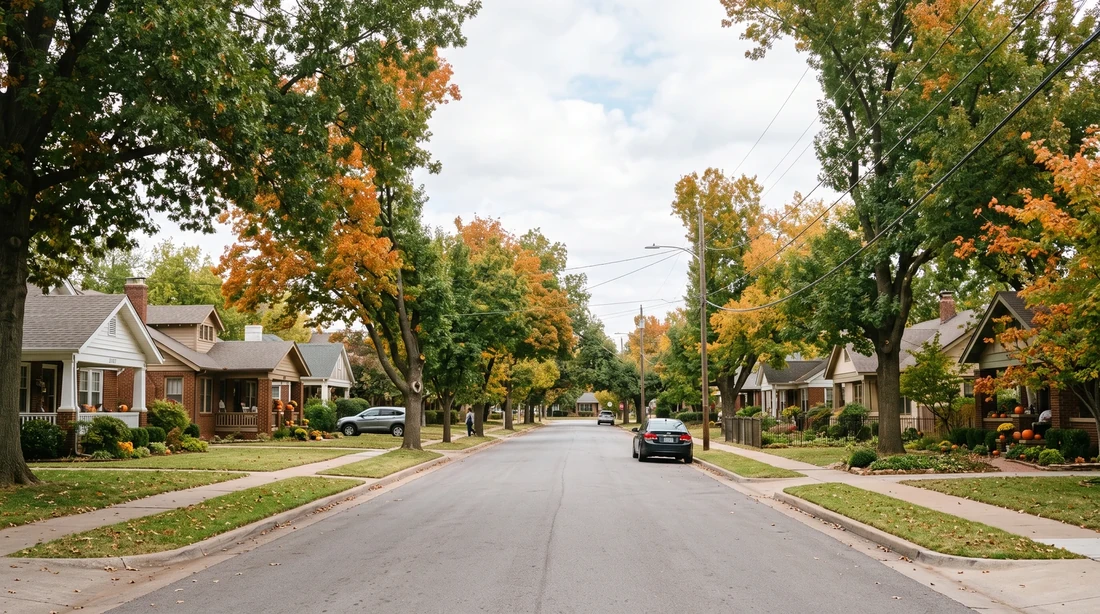
An extended stay with a kitchen in Oklahoma City comes in two very different forms: a hotel kitchenette (mini-fridge, microwave, sometimes a two-burner cooktop, no oven) or a furnished home with a full residential kitchen — full-size fridge, range and oven, dishwasher, real counters and cookware. For 30-plus nights, the full kitchen is what actually cuts your food spend.
Key Takeaways
- Hotel kitchenettes usually lack an oven and dishwasher; full home kitchens add a 4-burner range, oven, full-size fridge and stocked cookware.
- A solo stayer eating out in OKC spends roughly $1,350 to $1,950 per 30 days; cooking instead puts groceries near $350 to $450.
- BnB OKC's 11 furnished metro homes each have a full residential kitchen; many sit about 15 to 25 minutes from Tinker AFB gates.
You searched "extended stay with kitchen" for a reason: you're staying a month or longer, and eating every meal out isn't a plan. Here's the fact most listings hide — a "kitchen" in a hotel usually means a kitchenette, and a two-burner cooktop with no oven quietly pushes you back to takeout. A full kitchen in a furnished OKC home changes your monthly math more than the nightly rate does.
At BnB OKC extended stays, our 11 furnished metro homes each have a full residential kitchen, and we hold a 9.5 out of 10 average across 1,580 verified guest reviews on Airbnb and Vrbo. This guide breaks down kitchenette vs. full kitchen in dollars, then shows who should book which — and where you'll actually shop and cook in the OKC metro.
Every week you cook instead of eating out on a two-burner kitchenette can save a solo stayer $100–$200 in food — money a hotel "kitchen" quietly keeps costing you for the whole stay.

Why "Extended Stay With Kitchen" Almost Never Means a Full Kitchen
The word "kitchen" in extended-stay listings is doing a lot of hidden work. Most budget extended-stay hotels advertise a "kitchen" that is really a kitchenette: a compact refrigerator, a microwave, a small sink, and — if you're lucky — two electric burners. The single missing appliance that matters most is the oven.
Without an oven, you can't roast a sheet-pan dinner, bake, reheat a real casserole, or cook for more than one or two people at once. Add no dishwasher and minimal counter space, and cooking becomes a chore you'll skip after week one.
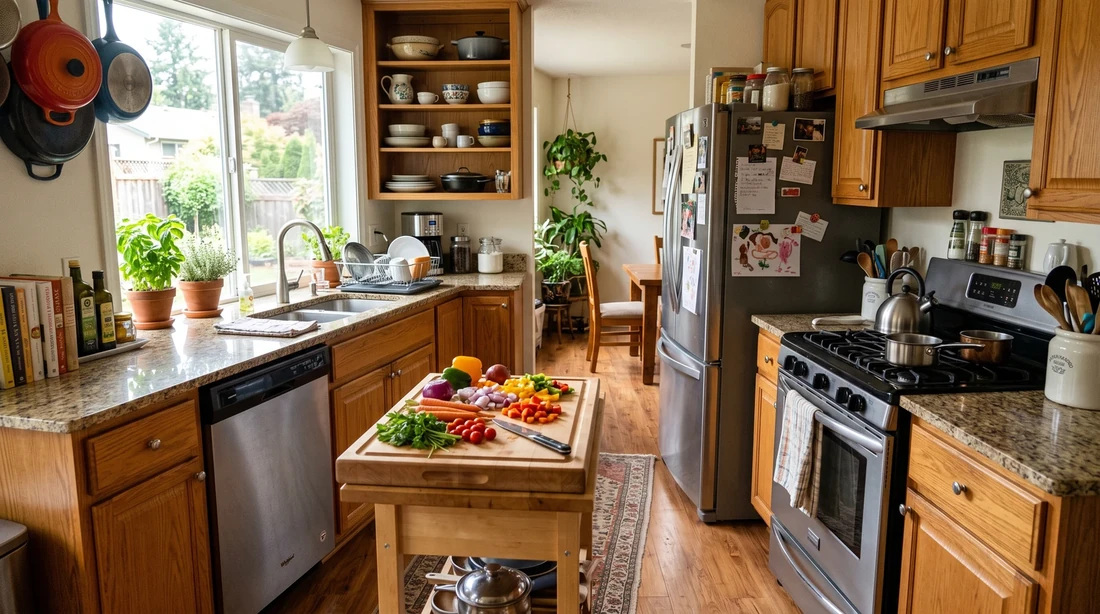
A full residential kitchen — the kind in a house — removes every one of those friction points. That's the difference between a kitchen that looks good in a photo and one you'll actually use for 90 nights.
What each type of kitchen actually includes
| Feature | Hotel kitchenette | Full home kitchen |
|---|---|---|
| Refrigerator | Mini or compact | Full-size |
| Cooktop / range | 1–2 burners (often none) | 4-burner range |
| Oven | Rarely | Yes |
| Dishwasher | No | Usually |
| Cookware & utensils | Minimal or on request | Stocked |
| Counter / prep space | Very limited | Full counters |
| Freezer for batch cooking | Tiny, iced-over | Full-size, real storage |
| Realistic use | Reheating, coffee | Every meal, batch cooking |
On how furnished housing differs structurally from extended-stay hotels:
Corporate housing provides complete temporary housing solutions within a stable residential setting unlike extended stay hotels, which are surrounded by an open parking lot and are filled entirely by transient guests.
Wikipedia: Corporate housing
What a Kitchenette Really Costs You Over 30 Days
The nightly rate is the number you compare first, but food is the number that decides your total. On a 30-day stay, the gap between eating out and cooking in a real kitchen dwarfs a modest difference in room price.
A single stayer eating three meals out in OKC easily spends $45–$65 a day, or roughly $1,350–$1,950 over 30 days. Cook most of those meals in a full kitchen and grocery spend for one person typically lands near $350–$450 a month — a swing of about $1,000.
| Who | Eating out (30 days) | Groceries in a full kitchen | Monthly difference |
|---|---|---|---|
| Solo TDY contractor | ~$1,500 | ~$400 | ~$1,100 |
| Couple | ~$2,600 | ~$650 | ~$1,950 |
| Family of four | ~$4,200 | ~$900 | ~$3,300 |
| 4-person work crew | ~$5,400 | ~$1,100 | ~$4,300 |
These are hypothetical ballpark ranges, not quotes — but the pattern holds every time: the bigger your group, the more a real kitchen saves. A kitchenette that pushes a crew of four back to restaurants can cost more in food than the room itself. That's why the kitchen, not the nightly rate, is the number to lead with on a 30-plus-night stay.
Beyond the Dollars: What a Full Kitchen Actually Lets You Do
The savings are real, but a full kitchen changes more than your food line — it changes whether you can live on a schedule during a long stay. The oven, dishwasher, and full-size freezer are what turn a lodging into a place you can actually run your week from.
If you work shift or odd-hour schedules — common on Tinker and FAA support contracts — a real kitchen means a hot meal at 5 a.m. or 11 p.m. when nothing's open. Batch-cook on your day off, freeze portions, and reheat around your rotation instead of hunting for a drive-through that's serving.
A full kitchen also handles dietary needs a kitchenette can't. Cooking for allergies, diabetes, a training diet, or halal or kosher requirements is nearly impossible on two burners and a microwave — but routine in a stocked home kitchen where you control every ingredient. The same goes for anyone managing food cost against a fixed allowance: you buy the store brand, cook in bulk, and skip the restaurant markup entirely.
There's a quieter payoff too: leftovers. An oven and a full-size fridge mean one dinner becomes two or three lunches, so the real per-meal cost of cooking drops well below what the grocery total suggests. On a kitchenette you throw out what won't fit the mini-fridge, then buy lunch out the next day anyway — paying twice for the same meal you couldn't store.
What Happens If You Settle for the Kitchenette Anyway
The cost of a missing oven isn't one bad night — it compounds across the whole stay. Here's the usual sequence when a long stay lands in a kitchenette:
- Week 1: You buy groceries with good intentions. The two burners handle eggs and pasta, so it feels fine.
- Week 2: No oven and no counter space means every real meal is a hassle. Takeout creeps back in for dinners.
- Week 3: You're eating out 5–6 nights a week. Food spend has quietly passed what a full-kitchen home would have cost in rent AND groceries combined.
- Month 2–3: On a 90-day assignment, that pattern locks in. You've spent thousands on restaurants, per-diem is gone, and the "kitchen" you paid extra for is holding coffee cups.
The fix is choosing the right kitchen on day one, not renegotiating in week three when the food receipts stack up. The table below shows how that gap accumulates across a full three-month stay.
| Month | Kitchenette hotel (room + food) | Full-kitchen home (room + food) | Running savings |
|---|---|---|---|
| Month 1 | ~$4,050 | ~$3,350 | ~$700 |
| Month 2 | ~$4,050 | ~$3,350 | ~$1,400 |
| Month 3 | ~$4,050 | ~$3,350 | ~$2,100 |
| 90-day total | ~$12,150 | ~$10,050 | ~$2,100 |
The nightly rates looked close on day one. It's the compounding food line — month after month — that separates the two totals by roughly a full month's per-diem. And if your assignment extends, the gap keeps widening: on a 180-day stay the same ~$700-a-month swing becomes roughly $4,200, all from a kitchen you never had.
On a 30+ night assignment and need a real kitchen, not a two-burner? See full-kitchen furnished homes for your dates, or talk through your stay length and headcount with a local operator.
Your Options for an Extended Stay With a Full Kitchen in OKC
Not every long stay needs a house — but every long stay needs to weigh the kitchen honestly. Here's how the main options compare on an all-in monthly basis, including the lease terms and setup that tend to disqualify each.
| Option | Kitchen & lease terms | Typical all-in / month* | What disqualifies it |
|---|---|---|---|
| Budget extended-stay hotel | Kitchenette, no oven; night-by-night | $2,000–$2,800 + high food spend | No real cooking; tight for 2+ people |
| Upper-tier extended-stay hotel | Better kitchenette; weekly rate | $2,800–$3,800 + food | Still no oven/dishwasher; no living space |
| Furnished apartment | Full kitchen; often 3–12 month lease | $2,200–$3,500 | Lease minimums; setup, utilities, deposits; often bare |
| Furnished home (BnB OKC) | Full residential kitchen; 30+ night monthly rate | Monthly rates on 30+ nights | Overkill for a 1–3 night trip |
*All-in figures are hypothetical ranges to illustrate structure, not quotes. Our published from-rates are $225–$425/night, with monthly rates on 30+ night stays and up to 35% direct-booking savings on 4+ night stays — ask for your dates.
The lease-term column matters as much as the kitchen. A furnished apartment can look cheaper per month, but you're often signing a fixed 3–12 month lease, wiring a deposit, turning on utilities in your own name, and arriving to a unit that's furnished but not stocked — no cookware, no linens, no coffee maker. A furnished home on a monthly rate skips all of that: one all-in number, a stocked kitchen, and no lease that outlives your assignment.
There's a second hidden line most comparisons miss: laundry and utilities. A budget hotel kitchenette often means coin laundry down the hall and cooking around a single outlet, while a full home usually includes in-unit laundry, all utilities, and Wi-Fi in one number — so you're washing work clothes and running a dishwasher without feeding quarters or watching a meter. If you want the apartment-style breakdown, see furnished apartments in OKC. For the full menu of long-stay choices and how ALE and corporate billing fit, start at the extended stay Oklahoma City guide.
Where You'll Actually Shop and Cook in the OKC Metro
A full kitchen only pays off if groceries are close, and OKC's layout makes that easy from almost any of our homes. The southeast quadrant near Tinker AFB — Midwest City, Del City, and Moore — is stocked with supercenters, warehouse clubs, and full-service grocery stores within a short drive of the gates.
Many of our metro homes sit roughly 15–25 minutes from the Tinker gates depending on traffic and gate, with a full-size fridge and freezer that let you shop once a week instead of daily. That freezer is the quiet workhorse: batch-cook on a Sunday, freeze portions, and you've bought yourself five weeknights of home dinners you'd otherwise eat out.
If your assignment is at the FAA's Mike Monroney Aeronautical Center near Will Rogers World Airport in southwest OKC instead, the grocery access is just as strong along the I-240 and SW corridors, and several homes sit about 6 minutes from the airport. Homes nearer Lake Hefner, The Village, and the Paseo and Plaza districts put you close to northside supermarkets and weekend farmers markets when you want fresh produce for the week's cooking.
Home area, drive time, and grocery access at a glance
| Home area | Closest assignment | Grocery access |
|---|---|---|
| Midwest City / Del City / Moore (SE) | ~15–25 min to Tinker AFB gates | Supercenters & warehouse clubs near the gates |
| Southwest OKC / I-240 corridor | ~6 min to Will Rogers Airport & FAA campus | Full-service stores along SW & I-240 |
| Lake Hefner / The Village (N/NW) | Central-north commutes; downtown ~15–20 min | Northside supermarkets, weekend farmers markets |
| Capitol Manor (central) | Across from OU Medical Center | Midtown & central grocery within minutes |
Seasons matter here too. OKC summers run hot and long, and grilling or a heat-and-eat oven meal beats a fast-food drive-through in July; winters are mild but bring the occasional ice day when you'll be glad you're not making a restaurant run at all. Tornado season peaks April through June — another stretch when a stocked kitchen and a full pantry beat being out on the roads at dinnertime during a warning.
Worked Example: A 90-Day TDY Contractor at Tinker AFB
Say you're a contractor on a 90-day TDY assignment supporting Tinker AFB, with roughly $3,600 a month to cover lodging and meals from your per-diem and rate. You cook — you'd rather not eat drive-through for three months.
Option A — budget extended-stay hotel with a kitchenette. Say $95/night for 90 nights = about $8,550, or ~$2,850/month. No oven, so you eat out most dinners: figure ~$1,200/month in food. All-in: roughly $4,050/month — over budget, and you never cooked a real meal.
Option B — furnished home with a full kitchen. Say a monthly rate lands your room-and-utilities near $2,900/month all-in. You cook most meals: groceries ~$450/month. All-in: about $3,350/month — under your $3,600, with leftovers you can pocket or bank against the assignment.
The nightly rates looked close. The full kitchen is what put ~$700/month back in your pocket. Over a 90-day tour, that's roughly $2,100 — real money on a fixed per-diem.
Variant: a 3-person work crew sharing one home
Now say the same assignment brings three contractors instead of one. In separate budget hotel rooms, that's 3 × ~$2,850 = ~$8,550/month in rooms, plus each eating out at ~$1,200 = ~$3,600 in food — about $12,150/month for the crew, or roughly $4,050 per person.
Put all three in a furnished 3-bedroom home with a full kitchen at, say, $4,200/month all-in: that's ~$1,400 per person for lodging. Split groceries — one big weekly shop, shared dinners — at ~$900/month, and food drops to ~$300 each. Per person: roughly $1,700/month, less than half the hotel line, and everyone eats a real dinner. See TDY lodging near Tinker AFB for location and drive-time specifics, or corporate housing in Oklahoma City for how crew invoicing works.
Variant: a couple relocating on a 60-day house hunt
Say you're a couple moving to OKC for a new job, staying 60 days while you close on a house. Two people in one hotel room with a kitchenette is ~$2,850/month for the room, plus eating out for two at ~$2,600/month — about $5,450/month, and you're living out of a mini-fridge with a moving-truck's worth of pantry staples in the car.
A furnished 2-bedroom home at, say, $3,200/month all-in, with a full kitchen and groceries for two at ~$650/month, runs about $3,850/month — roughly $1,600 saved every month, plus room to host a realtor, unbox slowly, and cook dinner in a real kitchen while you settle in. If that's your situation, the moving to Oklahoma City guide covers the wider relocation timeline.
Variant: the 90-day assignment that extends to 180
TDY assignments stretch — the 90-day contract becomes 120, then 180. That's where a monthly rate and a full kitchen pull furthest ahead of a hotel. On a hotel kitchenette, a 180-day stay locks in that ~$4,050/month all-in for six straight months: about $24,300, with the food line growing every month you can't cook.
A full-kitchen home at ~$3,350/month all-in runs about $20,100 over the same six months — roughly $4,200 saved — and it flexes month-to-month without a new lease or a second deposit when your orders get extended. You never negotiate a fresh contract mid-project; you just keep the home.
If your assignment is at the FAA campus instead, the same kitchen math drives the FAA Academy housing decision.
How to Book an Extended Stay With a Full Kitchen in OKC, Step by Step
- Confirm your dates and headcount. Total nights and number of people set both the rate tier and how much a real kitchen will save you.
- Filter for a full kitchen, not a kitchenette. Ask directly: full-size fridge, range with oven, dishwasher, and stocked cookware.
- Ask for the monthly rate on 30+ nights. Long-stay pricing and direct-booking savings beat the nightly rate you see first.
- Verify what's included. Utilities, Wi-Fi, laundry, and parking should be spelled out so your all-in number is real.
- Book direct or call to hold your dates. Use the extended-stay page or call/text (405) 870-2146 to lock a home before your start date.
When a Kitchenette Is Genuinely Enough — And When a Full Kitchen Changes the Outcome
A hotel kitchenette is the right call for a 1–3 night trip, a single traveler who mostly eats out anyway, or anyone chasing hotel points loyalty on a short stay. If you're in and out in a weekend, don't overthink the oven. A kitchenette is also fine if your assignment truly is short and your per-diem comfortably covers restaurant meals — some travelers would rather never touch a stove.
A full residential kitchen changes the outcome when you're staying 30 nights or more, feeding more than yourself, cooking for dietary or budget reasons, or living on a fixed per-diem where food overruns hurt. The break-even isn't the room rate — it's the point where restaurant meals cost more than groceries plus a slightly higher rent. For most families and crews, that's within the first two weeks.
A few situations tip the scale hard toward a real kitchen. If you're traveling with a pet, a full home with a fenced yard and a kitchen beats a hotel where you're leashing up for every bathroom break and can't cook — see our pet-friendly rentals in OKC.
On a stay that includes school-age children, an oven, dishwasher, and full-size fridge make packed lunches and a weeknight dinner routine practical in a way a two-burner room can't — and a home puts homework space and a real bedtime where a single hotel room can't. On a month-to-month extension — the TDY that stretches from 90 to 120 days — a home with a monthly rate flexes without a new lease, while a hotel bill just keeps climbing.
The math also shifts if your stay is insurance-paid. When a carrier is covering temporary housing under Additional Living Expenses, food above your normal grocery baseline can be reimbursable — but a kitchenette that forces takeout usually costs the claim more than it needs to, and your carrier decides what's reasonable. A full kitchen keeps that food line defensible and closer to your ordinary grocery spend, which is what ALE is meant to restore. Keep your receipts either way. See insurance housing for how displaced-family stays work.
Terms You'll Hear, Decoded
- Kitchenette: A compact cooking setup — mini-fridge, microwave, sometimes two burners, usually no oven or dishwasher.
- Full kitchen: A residential kitchen with a full-size fridge, range and oven, dishwasher, counters, and cookware.
- Furnished vs. equipped: "Furnished" means it has beds and sofas; "equipped" means the kitchen is stocked with pots, pans, dishes, and utensils. A bare furnished apartment can be the first without the second.
- Monthly rate: A discounted rate applied to stays of 30+ nights, lower than the nightly rate times 30.
- All-in cost: Rent plus utilities, Wi-Fi, and fees — the number that actually leaves your account each month.
- Per diem: A fixed daily lodging-and-meals allowance for travel assignments; food overruns come out of your own pocket.
- M&IE: The "meals and incidental expenses" portion of per-diem — the daily food allowance a full kitchen lets you keep instead of spend at restaurants.
- GSA lodging rate: The government's standard daily lodging cap for a location, used to set per-diem on federal travel; check the current OKC figure before you lock a rate.
- Direct billing: When a carrier, TPA, or employer is invoiced for the stay directly instead of you paying and getting reimbursed — arranged in advance, not assumed.
- TDY: "Temporary duty" — a short-term work assignment away from your home base, usually paid on per-diem.
- Additional Living Expenses (ALE): The homeowners-policy coverage that reimburses added costs — including food above your normal baseline — when you're displaced and living elsewhere.
Placing a crew or a 90-day contractor? Get full-kitchen homes matched to your dates and headcount.
Your Next Steps
- Confirm your stay length and how many people you're feeding — this decides how much a full kitchen saves versus a kitchenette.
- Compare your all-in monthly numbers (room + utilities + realistic food) for a kitchenette hotel vs. a full-kitchen home, and check the current GSA lodging rate for OKC if you're on per-diem.
- Book direct at /extended-stays/ or call/text (405) 870-2146 to hold a full-kitchen home for your dates.
This guide is general information to help you compare options; confirm current rates and per-diem figures for your dates before booking.