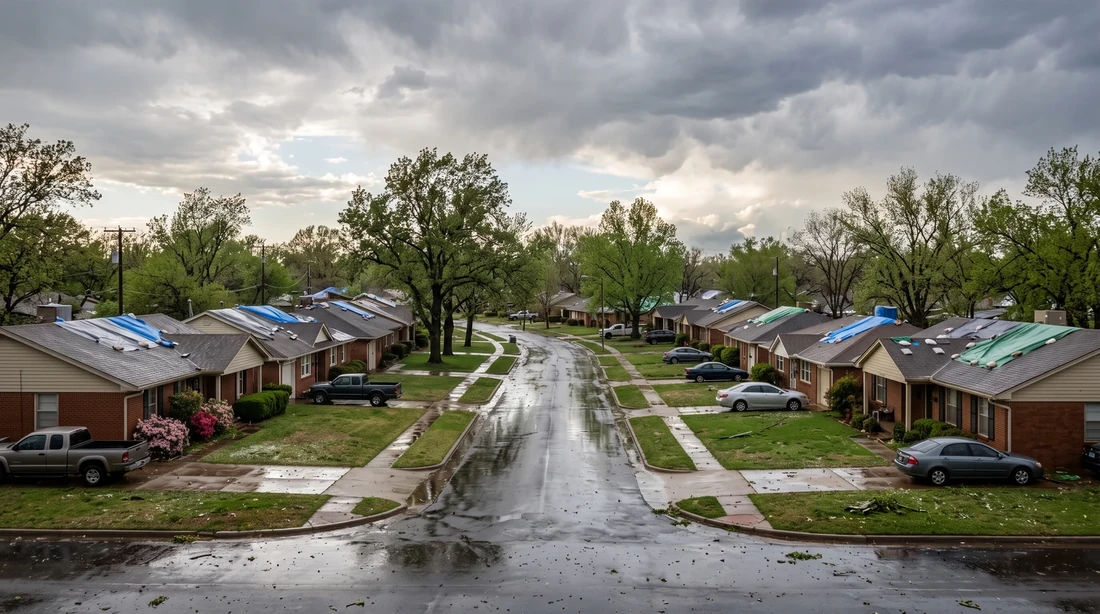
A hail damage roof insurance claim can trigger temporary housing coverage when the roof is compromised and interior water intrusion makes the home unlivable during repairs. Most Oklahoma homeowner policies pay Additional Living Expenses (ALE) under the loss-of-use line while your roof is torn off and rebuilt — but your adjuster, not the roofer, decides whether the home is uninhabitable.
Key Takeaways
- Your adjuster, not the roofer, decides whether hail and water damage make the home legally uninhabitable.
- Many Oklahoma policies use a percentage wind/hail deductible, often 1% or 2% of dwelling coverage, instead of a flat amount.
- Loss-of-use coverage is capped, commonly around 20% to 30% of dwelling coverage, and is often time-limited too.
- Mold can begin growing in wet drywall within 24 to 48 hours, so photograph damage before tarping or teardown.
What this guide covers: when a hail-damaged roof turns into a housing claim, how the Oklahoma wind/hail deductible works, what ALE pays during a re-roof, and how to keep a family housed for a repair that runs months.
Every OKC roofer's website will tell you how to file for a new roof. Almost none tell you what happens when the storm did more than dent shingles: hail cracked the decking, wind peeled a section open, and the next rain soaked your ceilings, insulation, and drywall. If your family of four is now living under tarps and buckets, you have two problems. Someone has to fix the roof, and you need somewhere to sleep for the next three months, paid for by someone.
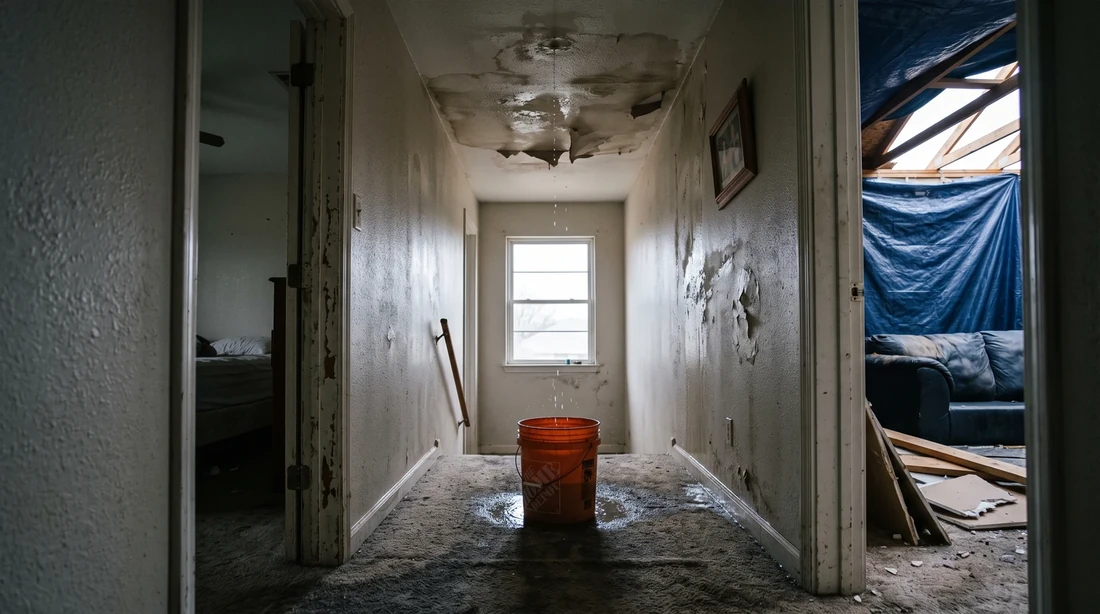
You're standing in a wet hallway wondering if it's even safe to keep the kids here tonight. That feeling is real. The next move is simple: document the damage, get the uninhabitability call in writing, and open your ALE claim alongside the roof claim.
Oklahoma hail claims often carry a proof-of-loss and reporting window, and many policies expect prompt notice after the storm. Every day water sits in your ceiling, the damage (and the repair timeline) grows. Photograph everything before any tarping or teardown begins.

Why Does a Hail-Damaged Roof Make an Oklahoma Home Unlivable?
A cracked roof alone rarely displaces a family. Hail plus water intrusion routinely does. Oklahoma City sits in the heart of hail alley, and the storms that shred roofs from April through June (the same weeks peak tornado season runs) usually arrive with the rain that follows the impact right into the living space.
Here's how a roof claim becomes a housing claim. Hail fractures shingles and the decking underneath. Wind lifts a section. The next storm, often the same night, pushes water through the gap into your attic, then down through insulation into ceilings and walls. Within days you're looking at sagging drywall, soaked carpet, and the early conditions for mold, which can begin to grow in wet drywall in as little as 24 to 48 hours.
A home becomes uninhabitable when core systems or safety are compromised: an open or tarped roof over occupied rooms, active water intrusion, ceiling collapse risk, compromised electrical near wet drywall, or mold growth. During a full re-roof with interior repairs, contractors often need the space cleared for tear-off, decking replacement, drying equipment, and ceiling reconstruction.
Not every phase of a re-roof forces you out, so map the timing of the displacement before you book anything.
| Repair phase | Can you stay? | Why |
|---|---|---|
| Shingle-only replacement, no interior damage | Usually yes | Roof stays weather-tight through the day; no interior work |
| Tear-off with exposed decking overnight | Often no | Open roof over occupied rooms; rain risk during Apr-Jun storms |
| Active water intrusion + drying equipment running | No | Wet drywall, mold risk, loud dehumidifiers and fans for days |
| Ceiling/drywall demolition and rebuild | No | Dust, no ceilings, unsafe footing and exposed electrical |
| Final paint and punch-list | Sometimes | Depends on scope and fumes; adjuster and contractor decide |
Roofer-dominated search results go quiet here. They stop at "we'll handle the insurance for your roof." They skip the parallel claim, loss-of-use coverage, that pays for somewhere to live while the roof over your head is literally gone. Roofers are paid to replace roofs, so their claim help stops at the dwelling repair.
One widely misunderstood point about mold and standard homeowner coverage:
The insurance is often misunderstood by its purchasers; for example, many believe that mold is covered when it is not a standard coverage.
Wikipedia: Home insurance
Does Hail vs. Tornado Roof Damage Change the Housing Claim?
Not much. For the housing side of the claim, hail and tornado damage generally run the same track: wind and hail are both standard covered perils on most Oklahoma homeowner policies, and either one that makes the home unlivable opens loss of use. The difference is scale. A hail hit often means shingles, decking, and a bedroom ceiling. A tornado can take a whole roof structure and the walls beneath it, pushing repairs from weeks into many months.
The longer and more structural the loss, the more your ALE time cap and monthly limit matter, and the more a single furnished home under that limit outperforms open-ended hotel nights. If your loss is broad enough to look like a rebuild rather than a repair, the mechanics in our guide to temporary housing after a house fire apply almost identically.
What Is the Oklahoma Wind/Hail Deductible?
Many Oklahoma homeowner policies carry a separate percentage-based wind/hail deductible, and it is almost always larger than your flat all-perils deductible. Instead of a fixed $1,000, a wind/hail deductible is often 1% or 2% of your dwelling coverage, so the number you pay out of pocket scales with the size of your home. Roofers rarely explain it.
It's the first check written on a hail claim, and it comes out of the roof side, leaving your ALE alone. It won't reduce your housing budget. It does shape whether filing is even worth it for shingle-only damage, and it's the figure roofers quietly gloss over when they promise a "free roof."
| Dwelling coverage | 1% deductible | 2% deductible |
|---|---|---|
| $200,000 | $2,000 | $4,000 |
| $300,000 | $3,000 | $6,000 |
| $400,000 | $4,000 | $8,000 |
Your declarations page is the only place your real deductible type and percentage live. Read it before you assume anything, and remember the deductible is entirely separate from whether ALE pays for temporary housing.
What Does ALE Cover During a Re-Roof?
Additional Living Expenses (ALE) pays the difference between your normal living costs and the higher costs you face while displaced by a covered loss. On a hail claim, that means housing, and sometimes added mileage, laundry, pet boarding, and meals above your usual grocery baseline.
Two things decide whether your hail claim opens ALE:
- The loss must be covered. Wind and hail are standard perils on most Oklahoma homeowner policies. If the roof damage is covered, the resulting displacement usually falls under loss of use.
- The home must be unlivable, or repairs must require you to move out. A few missing shingles with no interior damage generally won't trigger ALE. A tarped roof with soaked ceilings over the bedrooms is a different conversation.
ALE is capped. Many policies set loss-of-use at a percentage of your dwelling coverage, commonly around 20% to 30%, though your declarations page is the only place that number is real. It's also time-limited on many policies (often a set number of months, or "the reasonable time to repair"). The carrier decides all of this. The roofer doesn't, and neither do we.
ALE won't upgrade your lifestyle. It covers reasonable, comparable housing for your household size, so don't expect a beach vacation. And it only pays the additional amount. If your mortgage continues, the carrier typically credits your normal housing cost against the housing bill. This "additional" rule is also why staying with family is rarely the free win it looks like (more on that below).
Which money buckets does a hail claim split into?
A hail claim with interior water usually splits into three distinct coverages, and mixing them up is where families lose money. Dwelling pays to fix the roof, decking, and ceilings. Personal property (contents) pays for what the water ruined inside, like furniture, electronics, and the mattress under the leak, and it has its own limit and often its own ACV-vs-RCV rules.
Loss of use (ALE) pays for you to live elsewhere. Your housing budget is only the ALE bucket, and a soaked couch comes out of contents. Document ruined items with photos and a list, and keep receipts where you have them.
One more cash-flow trap. If you carry a mortgage, your lender is often named on the dwelling repair checks and may release replacement-cost funds in stages as work is verified. That lender holdback can slow the roof money. Your ALE is untouched, since the carrier typically pays or bills it separately.
What Does It Cost If You Wait?
A three-month re-roof with interior repairs is a lot bigger than a hotel weekend. A family of four in two hotel rooms burns ALE budget fast, with no kitchen and no laundry, and the numbers go sideways if you don't plan.
- Storm night: water enters through the compromised roof. You tarp, you place buckets, you photograph. If the ceilings are sagging over bedrooms, you may already need to leave.
- Days 1 to 7: you file the claim, an adjuster is assigned, and you check into a hotel because it's fast. Two rooms at OKC storm-season rates add up quickly with zero kitchen savings.
- Weeks 2 to 4: the scope grows. Decking, insulation, drywall, and ceiling work stretch the timeline past a quick shingle swap, and hotel costs keep accruing against your ALE cap.
- Months 2 and 3: permits, material lead times, and drying delays push the finish date. If you burned early ALE on hotels, you now risk hitting the cap before the roof is done.
The trap is treating a multi-month repair like a two-night stay. Every hotel night with no kitchen and two room rates spends ALE budget a single furnished home would stretch for weeks. April-through-June storm season compounds this. When a widespread hail event hits the metro, hotels fill and roofing crews backlog at the same time, so your nightly rate and your repair timeline get worse together. After a major metro-wide hail event, reputable crews are commonly booked out for weeks, and the family that locks in stable housing early avoids scrambling twice.
Roof torn open and water in the ceilings? Get your family into one furnished OKC home for the whole repair — not two hotel rooms. We work with adjusters and TPAs on insurance placements and offer monthly rates on 30+ night stays.
Hotel, Extended-Stay, or Furnished Home for a 3-Month Re-Roof?
For a displacement measured in months, a furnished home usually costs less per month than two hotel rooms and gives your family a kitchen and laundry ALE won't have to reimburse. The longer the repair, the bigger the gap, because hotel costs accrue nightly while a monthly rate holds flat. Here's the honest comparison for a hail-displaced family of four.
| Option | Typical monthly cost | Kitchen & laundry | Best for |
|---|---|---|---|
| Two hotel rooms | Highest: two nightly rates, taxes, no kitchen | No / limited | 1-14 nights while you arrange longer housing |
| Extended-stay hotel | Moderate: one suite, kitchenette | Kitchenette only | 2-4 weeks, small households |
| Staying with family | Lowest cash, but ALE only pays your added costs | Shared | Short gaps, no pets, nearby relatives |
| Furnished home (BnB OKC) | Monthly rate on 30+ nights, one bill | Full kitchen + laundry | Families, pets, 30-120 day repairs |
Our published from-rates run $225-$425/night depending on the home, with monthly rates on 30+ night stays and up to 35% direct-booking savings on 4+ night stays. Homes sleep 2 to 16+, several are dog-friendly, and we carry a 9.5 out of 10 average across 1,580 verified guest reviews on Airbnb and Vrbo.
Location matters more over three months than most people expect on day one. If your damaged home is in Edmond, Moore, Norman, or northwest OKC near Lake Hefner, keeping your temporary home on the same side of the metro protects the school run, the work commute, and the pediatrician you'd otherwise have to reshuffle for a full semester.
Several of our homes sit near the Lake Hefner, Paseo, Plaza, and The Village areas with quick highway access, and one is 6 minutes from Will Rogers Airport if a relocating spouse is flying in and out during the repair. A 20-minute-shorter drive twice a day, five days a week, adds up fast when the displacement runs the length of a school semester.
A worked example (hypothetical): family of four, 3-month re-roof
Say your family of four evacuates after hail cracked the decking and the next storm soaked the bedroom ceilings. Repairs (tear-off, decking, drying, drywall, paint) are scoped at three months. Your ALE line is $3,900 per month.
The hotel path: two rooms at roughly $150/night is about $300/night, or about $9,000 per month. That's far above a $3,900 ALE cap, plus every meal eaten out because there's no kitchen. In this hypothetical you'd blow the cap in the first two weeks and be fighting for extensions the rest of the repair.
The furnished-home path: one home at a monthly rate that fits inside the $3,900 line, with a full kitchen so grocery costs stay near your normal baseline (which ALE doesn't reimburse anyway) and laundry on site. One bill, one address for the whole three months, and room for the kids to live. One home under the cap beats two hotel rooms over the cap, every month of a long repair.
A second worked example (hypothetical): bigger loss, higher limit
Now say the same family's roof took a wind-and-hail hit that opened the whole back half of the house, and the scope runs closer to five months with structural decking and ceiling rebuild. Their dwelling coverage is $260,000 and their loss-of-use line is 25% of dwelling, spread over the repair. That's roughly $5,417 per month of housing runway if the timeline holds.
The wind/hail deductible at 1% of $260,000 is $2,600, paid once on the roof side, and it doesn't touch the housing math. On the housing side, a hotel path near $9,000-$10,000 a month still overruns the $5,417 line inside three weeks. A single furnished home at a monthly rate well under that figure leaves headroom for the extra mileage and laundry ALE reimburses. You want that headroom when a five-month job hits a two-week material delay.
A third worked example (hypothetical): mold pushes a short job long
Say the hail hit looked minor, one bedroom ceiling stain, so the family stayed put the first week. Then the drywall came down and the crew found mold spreading through the wet insulation, adding remediation before the ceiling could be rebuilt. A three-week job became a nine-week job. This case punishes waiting. The family had already spent two weeks eating out, and only then started shopping for a longer stay after prices had climbed post-storm.
Booking month-to-month furnished housing at the first sign of interior water, before remediation blew up the timeline, would have kept the whole stretch inside one predictable monthly rate under their ALE line. These figures are illustrative. Your rate, your ALE percentage, and your repair timeline are the only real numbers, and your carrier makes the coverage decision.
Why does moving in with family often cost you coverage?
Say instead the family moves in with relatives across town to save money. Because ALE pays only the additional living expense, there's usually no housing invoice to reimburse. You can typically claim the extra utilities, groceries, and mileage you contribute, but you can't claim a full housing payment you never made. Three months of four people sharing a relative's spare rooms is also its own strain, especially with a dog and two school-age kids. A furnished home priced under the ALE line keeps the family together and puts the coverage you're entitled to to work.
Which Edge Cases Do OKC Hail Families Hit?
Most hail displacements aren't clean three-month blocks. They bend around pets, school calendars, and repairs that quietly stretch. Plan for these before they surprise you.
- Pets: hotels that take dogs often add nightly pet fees and cap you at one small pet, which is a real problem for a household with a large dog. ALE can reimburse reasonable added pet costs like boarding, and a pet-friendly rental in OKC keeps the dog with the kids and skips the boarding line entirely.
- Kids in school: a three-month displacement in the spring lands right on the end of the school year. Choosing housing that keeps the same school run avoids mid-semester disruption, and it's a better priority than a marginally cheaper home clear across the metro.
- Repairs that run long: permits, decking availability, and post-storm crew backlogs routinely push finish dates. Ask your adjuster about your time cap early, and pick month-to-month housing so an extension is a phone call instead of a second move.
- A second storm mid-repair: in peak season it happens. Keep documenting. A new event may be a new claim, and your adjuster needs the timeline.
- Supplements when the scope grows: when tear-off reveals more damage than the first estimate, your roofer files a supplement to the carrier for the added work. A growing dwelling scope almost always means a longer repair, so flag it to your adjuster on the ALE side too, before the time cap becomes a problem.
- Contents drying and storage: if soaked furniture and boxes are being dried or stored off-site, that's a contents question rather than an ALE one, and it can add days to when your home is livable again. Ask for the full "back-in-the-home" date along with the "roof done" date.
What if repairs run past my ALE time limit?
Talk to your adjuster before the cap hits. Document why the timeline grew (permits, material lead times, drying delays, or a supplement after tear-off revealed hidden damage), since delays outside your control can support an extension request. The carrier decides on extensions, so keep every communication in writing.
Who Handles What on a Hail Claim?
A hail claim runs two tracks at once, the roof repair and your housing, and different people own different pieces. Knowing who does what keeps you from waiting on the wrong person.
| Task | Who handles it |
|---|---|
| Photograph roof + interior water damage before tarping | You |
| Emergency tarp / water mitigation | You arrange; carrier reimburses reasonable mitigation |
| Determine if home is uninhabitable | Adjuster (get it in writing) |
| Approve ALE / loss-of-use budget | Carrier / adjuster |
| Roof scope, decking, interior repair estimate | Roofer + adjuster |
| Direct billing authorization (if used) | Carrier / TPA (e.g., Alacrity Solutions) |
| Match you to a furnished home for your dates | Local operator (BnB OKC) |
| Save every receipt for ALE substantiation | You |
How to Open a Hail Claim and Get Temporary Housing, Step by Step
The families who avoid the ALE-cap trap do the same five things, in order, in the first week.
- Document before you touch anything. Photograph roof damage, interior water, sagging ceilings, and soaked belongings before tarping or teardown.
- Report the claim promptly. Call your carrier, note wind or hail as the cause, and ask specifically about loss-of-use / ALE coverage.
- Get the uninhabitability call in writing. Ask the adjuster to confirm the home is unlivable during repairs and to state your ALE budget and time limit.
- Line up housing that fits the whole repair. For a multi-month re-roof, book a furnished home under your monthly ALE line instead of open-ended hotel nights.
- Keep every receipt. Housing, added mileage, and laundry substantiate the ALE claim; the carrier reimburses documented additional costs.
If your carrier or adjuster pushes back on housing, read what to do when insurance denies temporary housing before you accept a no. For how billing flows and how a placement gets set up, our guide to how ALE housing companies work walks it through.
When Don't You Need a Furnished Home?
If the hail only dented shingles and no water reached your living space, you probably don't need to move out at all. A roof swap can often happen while you stay home, and there's no ALE to claim. A single missing-shingle repair, a one- or two-night stay while a small patch is done, or a household of one with hotel points to burn are all cases where a hotel or staying put is the right, cheaper call. If your out-of-pocket for the whole thing is a $2,000 deductible and a weekend of hammering overhead, don't overthink the housing question.
A furnished home changes the outcome when the displacement is real and long: a torn-open or tarped roof over occupied rooms, interior water and ceiling reconstruction, a repair measured in months, kids who need routine and a kitchen, or pets who can't live in a hotel. One home under your ALE cap, instead of two hotel rooms over it, can decide whether you finish the repair inside coverage or spend it fighting for extensions. See our extended-stay options and pet-friendly rentals in OKC if that's your situation.
Terms You'll Hear, Decoded
- Additional Living Expenses (ALE): the coverage that pays the extra costs of living elsewhere while your home is repaired after a covered loss.
- Loss of use: the policy section ALE lives in. It responds when a covered loss makes your home uninhabitable.
- Dwelling coverage: the amount your policy insures the structure for; both your ALE cap and your wind/hail deductible are often a percentage of this number.
- Personal property (contents): the separate coverage for belongings the water ruined (furniture, electronics, clothing), with its own limit apart from the roof and your housing.
- Wind/hail deductible: a separate, often percentage-based deductible on wind and hail losses in Oklahoma, usually larger than your flat all-perils deductible.
- Supplement: a request your roofer files when tear-off reveals more damage than the original estimate; it grows the dwelling scope and often the timeline.
- Uninhabitable: the adjuster's determination that you can't safely live in the home during repairs, which is the trigger for ALE.
- ACV vs. RCV: actual cash value pays the depreciated value of your old roof; replacement cost value pays the full cost to replace, often released after the work is done and sometimes routed through your mortgage lender.
- Direct billing: when the carrier or TPA pays the housing provider directly instead of reimbursing you, which happens only with carrier authorization.
- Proof of loss: the documentation (photos, estimates, receipts) that substantiates your claim and your ALE.
If you rent rather than own, see whether renters insurance covers temporary housing and hotel stays.
Bottom Line
A hail claim pays for housing only when the damage makes your home unlivable or the repairs force you out, and your adjuster makes that call. Get it in writing, know your ALE cap and wind/hail deductible, and pick housing that fits the whole repair.
- Check your declarations page for your loss-of-use / ALE limit and time cap, plus your wind/hail deductible type and percentage. Those numbers set your housing budget and your out-of-pocket.
- Gather your storm-night photos and the adjuster's written uninhabitability call so your housing claim is documented from day one.
- Get furnished options that fit your ALE line and dates: see our insurance housing page or call or text (405) 870-2146 for same-day availability.
For official guidance on Oklahoma claims and your rights as a policyholder, the Oklahoma Insurance Department is the primary source.
This guide is general information, not insurance or legal advice; your carrier makes all coverage decisions.