Key Takeaways
- Housing costs run well below the national average, and most Oklahoma City commutes take 15 to 25 minutes door to door.
- Severe weather is a budget line: hail and wind claims push Oklahoma homeowners insurance premiums among the nation's highest.
- The city covers roughly 620 square miles, so plan on one car per driving adult; bus frequency is limited outside the core.
- House-hunting from a hotel typically burns $900 to $1,100 a week, with rooms running $130 to $160 a night while the search drags on.
You have an offer letter, a start date, and one big question you can't answer through listing photos: is Oklahoma City a good place to live, or just a cheap one? This guide is the resident-level answer — what OKC genuinely gets right, what the relocation brochures skip, and how relocating professionals test the city for a month or two before buying a house in it.

So, Is Oklahoma City a Good Place to Live? The Honest Verdict
Oklahoma City rewards people who trade coastal walkability for space, savings, and a 20-minute commute — and it frustrates anyone who ignores the weather. That's the whole answer in one line. Everything below is the detail behind it.
The city has spent two decades reinvesting in itself through the voter-approved MAPS sales-tax programs: a 70-acre downtown park, a whitewater center, a streetcar, an NBA-caliber arena. The result feels genuinely different from OKC's 1990s reputation. But it's still a driving city on the southern Plains, and no arena changes the April sky.
Housing cost is the single biggest reason people say yes to Oklahoma City. Cost-of-living indexes consistently place the metro well below the national average, driven mostly by housing — which is also why the cons (hail insurance, car dependence, summer electric bills) matter: they quietly claw back part of that discount if you don't budget for them.
| Category | The pro | The con |
|---|---|---|
| Housing | Big-city square footage at small-city prices; buying is realistic on a median income | Hail and wind push homeowners insurance premiums among the nation's highest |
| Jobs | Aerospace (Tinker AFB, FAA), energy, healthcare, and tech diversify the base | Fewer corporate headquarters than Dallas or Denver; some niches require travel |
| Getting around | Most commutes run 15–25 minutes; the airport is close-in | Car-dependent sprawl across roughly 620 square miles; limited bus frequency |
| Weather | More sunny days than much of the country; long, mild falls | Tornado season peaks April–June; hail, ice storms, and 100°F summer stretches |
| Lifestyle | NBA Thunder, Riversport whitewater, Paseo and Plaza arts, Scissortail Park | Walkable nightlife concentrates in a handful of districts |
| Taxes | Comparatively low property taxes stretch a housing budget further | State income tax applies, unlike Texas one state south |
On the healthcare side of OKC's employment base:
OU Health Sciences Center is one of the nation's largest independent medical centers, employing over 12,000 people.
Wikipedia: Oklahoma City
The Pros of Living in Oklahoma City
Oklahoma City pairs some of the country's most affordable big-city housing with commutes that rarely pass 25 minutes — a combination almost no metro its size still offers.
Your housing dollar goes unusually far
Buying a house on one professional income is still a normal event in OKC, not a unicorn story. Home prices typically land well under the national median, rents follow the same pattern, and Oklahoma's property taxes run below what most transplants paid back home.
Two tax notes worth knowing before you model a budget: Oklahoma does levy a state income tax (the top rate sits under 5%), and while the state portion of the grocery sales tax was eliminated in 2024, local sales taxes still apply at the register.
The job base is broader than "oil town"
Energy still matters here, but it no longer defines the paycheck map. Tinker Air Force Base, southeast of the city, is one of the state's largest employers and anchors a deep aerospace-maintenance economy — enough that we wrote a separate guide to TDY lodging near Tinker AFB.
The FAA's Mike Monroney Aeronautical Center trains the nation's air traffic controllers here, which is why FAA Academy housing in Oklahoma City is its own housing market. Add OU Health's medical campus, Paycom's tech footprint, and a growing biosciences Innovation District, and the metro's employment base is more diversified than most newcomers expect.
The lifestyle upgrade is real — if recent
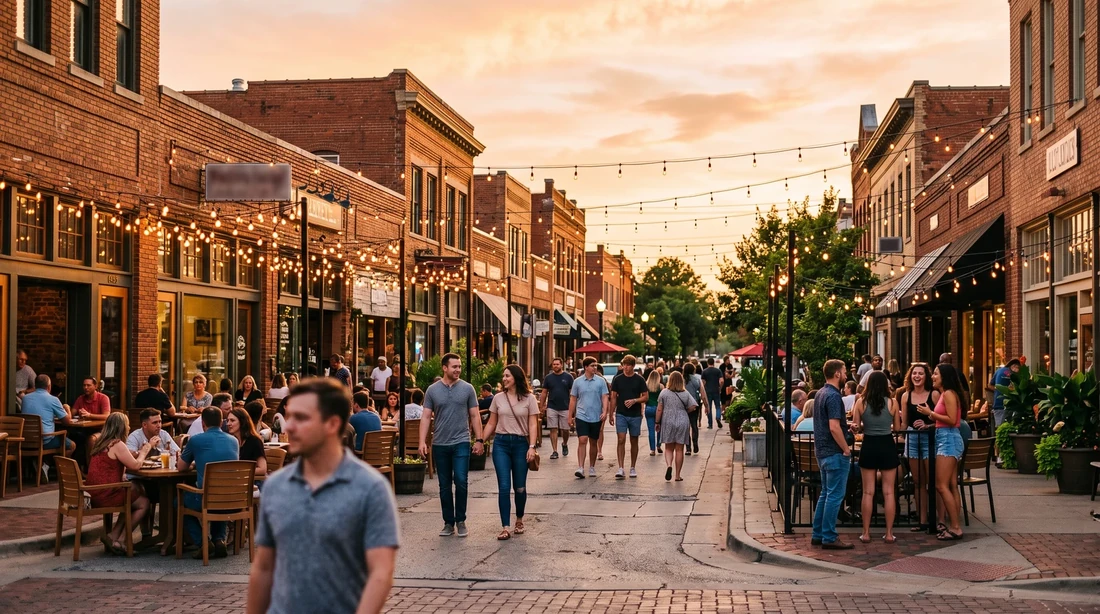
OKC is the smallest market in the NBA, and it treats the Thunder accordingly — Paycom Center on a game night is the city's living room. Beyond basketball: Riversport's man-made whitewater rapids in the Boathouse District, the roughly nine-mile trail loop around Lake Hefner, First Friday art walks in the Paseo, live music in the Plaza District, and Scissortail Park connecting downtown to the river.
The annual calendar has genuine anchors too — the OKC Memorial Marathon in late April, the Women's College World Series at Devon Park in late May and early June, and the State Fair of Oklahoma each September.
Commutes and the airport give you hours back
Most OKC commutes run 15–25 minutes door to door, even suburb-to-downtown. Will Rogers World Airport sits roughly ten minutes from downtown with direct flights to the major hubs — close enough that several of our furnished homes are about six minutes from the terminal. If your job involves frequent travel, this is a quietly enormous quality-of-life line item.
The Cons of Living in Oklahoma City — What the Brochures Skip
The honest cons of Oklahoma City are severe weather, sprawl, and summer heat — and none of the three is small enough to hand-wave.
Severe weather is a budget line, not just a headline
Tornado season peaks April through June, and residents take it seriously: sirens are tested regularly, local TV meteorologists are minor celebrities, and many homes have storm shelters or safe rooms — a feature worth asking about when you buy. Statistically, though, it's hail that does the most cumulative damage to household budgets. Hail and wind claims are the main reason Oklahoma routinely ranks among the most expensive states for homeowners insurance; get real quotes on any house before you offer, not after. Winter brings occasional ice storms that can down power lines for days.
Sprawl means the car is non-negotiable
Oklahoma City covers roughly 620 square miles — one of the largest land areas of any U.S. city — and it's built accordingly. EMBARK runs the bus network and has improved, but frequencies outside the core make it impractical for most commutes, and the OKC Streetcar loops downtown and Bricktown only. Plan on one car per driving adult, with the insurance and fuel that implies. Walkable daily life exists, but it concentrates in Midtown, the Plaza, the Paseo, and a few other districts.
Summer is a season you schedule around
July and August routinely deliver stretches at or above 100°F, with a persistent south wind that makes the heat feel industrial. Electric bills spike, outdoor plans move to early morning or after dark, and lakes and pools stop being amenities and become infrastructure. If you visit only in October, you will not meet the real August — factor it in deliberately.
The geography is flat and the mountains are far
This one is taste, not fact, but transplants mention it: the landscape is open prairie, Dallas is about three hours south, and real mountains are a full day's drive. Two smaller annoyances newcomers report often: that near-constant south wind, and seasonal allergies — cedar pollen in winter, grasses through spring — that hit many transplants harder than they expected. If your weekends require elevation or a coastline, OKC asks you to fly for them.
The Real Math of Living in Oklahoma City
A workable single-professional budget in OKC typically starts lower than in any comparable metro, because the biggest line — housing — is the discounted one. A well-located one-bedroom often rents in the ballpark of $900–$1,100; a three-bedroom house in a solid neighborhood frequently rents for what a one-bedroom costs in Denver or Austin.
The honest offsets: mandatory car ownership, above-average homeowners and auto insurance driven by hail risk, summer electric bills that commonly run well past what spring statements suggest, and the state income tax. Most transplants still come out meaningfully ahead — but the gap is narrower than the home-price headlines alone suggest, and modeling it honestly is exactly what a trial stay is for.
Where People Actually Live: Neighborhoods and Suburbs
OKC's metro sorts into a walkable urban core, established mid-century neighborhoods to the northwest, and fast-growing suburbs on every edge — and your commute barely changes among them.
| Area | Feel | Typical drive to downtown |
|---|---|---|
| Midtown, Plaza & Paseo | Historic homes, arts districts, the metro's most walkable restaurants and nightlife | 5–10 minutes |
| The Village & Lake Hefner corridor | Established mid-century neighborhoods near the lake's trail loop | 15–20 minutes |
| Edmond & Deer Creek | North-metro suburbs, newer builds, larger lots, well-regarded school districts | 20–30 minutes |
| Moore & Norman | South metro along I-35; Norman carries University of Oklahoma energy | 15–30 minutes |
| Yukon & Mustang | West-side new construction with quick airport access | 20–25 minutes |
| Midwest City | East metro directly adjacent to Tinker AFB | About 15 minutes |
Smaller pockets reward a drive-by too: Nichols Hills for established luxury just north of the core, the new-urbanist Wheeler District rising along the river south of downtown, and Automobile Alley's restaurant row on downtown's northern edge.
The trap for relocators: these areas feel interchangeable on a map and completely different at ground level. Edmond and the Plaza District are different cities in everything but jurisdiction. That's the strongest argument for living here month-to-month before you sign a mortgage — our moving to Oklahoma City guide covers the logistics of the move itself once you've picked.
Living in Oklahoma City With Kids: School Districts Redraw the Map
For households with school-age kids, district boundaries — not city limits — decide where the house hunt actually happens. Edmond, Deer Creek, Piedmont, Mustang, and Norman districts draw a large share of relocating households, and homes on the strong side of a boundary line routinely command a price premium. The catch: boundaries don't follow suburb names. Two houses a mile apart in "Edmond" can feed different districts, so verify any specific address with the district itself before you write an offer.
The urban core is served by Oklahoma City Public Schools plus a wide field of charter and application-based options, which some households make work in trade for a Midtown or Paseo address. The kid infrastructure is genuinely strong: the OKC Zoo and Science Museum Oklahoma share the Adventure District on the northeast side, Scissortail Park and the Myriad Botanical Gardens anchor downtown, Riversport runs youth programs in the Boathouse District, and minor-league baseball plays all summer in Bricktown.
A trial month matters most when schools are in the equation, because the school run can't be tested from a hotel. Driving the 7:45 a.m. drop-off from a candidate neighborhood for a few weeks tells you more than any ratings site — and it's one of the most common reasons relocators book 30+ night stays across district lines before committing to one.
When to Move: How OKC's Calendar Changes the Cost
The month you arrive changes both your house-hunting odds and your temporary-housing bill. Spring (March–May) is when listing inventory peaks — and it overlaps the April–June heart of tornado season, so you'll house-hunt with one eye on the forecast. Fall (September–November) brings the metro's best weather and motivated sellers, at the cost of thinner inventory.
Event weekends matter more than newcomers expect in a metro this size. Downtown lodging tightens around the OKC Memorial Marathon in late April, the Women's College World Series fills rooms metro-wide during its Devon Park run from late May into early June, and the State Fair of Oklahoma pulls crowds through September. Nightly rates typically climb around all three — if your start date lands near one, lock housing weeks ahead rather than shopping the week of.
Summer carries its own squeeze: military moving season around Tinker AFB pushes a wave of arriving households through the metro's furnished inventory in June and July, and relocating a household in 100°F heat is a schedule-it-at-dawn job. Winter is typically the cheapest window for temporary housing — offset by the occasional ice storm that can pause everything for a few days.
What Deciding From a Distance Actually Costs
The expensive version of an OKC relocation isn't the house — it's the months of indecision before it, paid at hotel rates. Here's how the tab typically runs when you try to house-hunt from 800 miles away:
- Weeks 1–2: You fly in for a whirlwind weekend, tour eight houses in two days, and fly home without a feel for a single commute or neighborhood after dark.
- Weeks 3–4: Your start date arrives. You check into a hotel "for a couple of weeks" at $130–$160 a night while the search continues on lunch breaks.
- Month 2: The hotel-plus-restaurants tab has crossed $5,000. Pressure builds, and you start widening the search radius or lowering the checklist — not because the market changed, but because your room is 300 square feet.
- Month 3: You write an offer on a house you've walked twice, in a neighborhood you've never driven at 5:30 p.m., partly to make the nightly rate stop.
That last step is the one that costs real money, because a mediocre house purchase dwarfs every hotel bill on the way to it. The fix is boring: make the waiting cheap and livable, so the decision doesn't get rushed.
Relocating to OKC and need a month or three to pick the right neighborhood before you buy? BnB OKC's 11 furnished homes rent month-to-month — monthly rates on 30+ night stays, up to 35% direct savings on 4+ nights, and a 9.5 out of 10 average across 1,580 verified guest reviews on Airbnb and Vrbo.
Check monthly availability · Call or text (405) 870-2146
Your Housing Options While You Decide
A furnished monthly home in OKC typically costs less all-in than 30 hotel nights once food and laundry are counted — and it's the only option that lets you actually live in a candidate neighborhood.
| Option | Typical monthly all-in | Lease terms | What disqualifies it |
|---|---|---|---|
| Standard hotel room | ~$4,800–$6,000 with restaurant meals and laundry service | Nightly; no commitment | No kitchen; one room; pet policies often restrictive |
| Extended-stay hotel | ~$3,200–$4,500; kitchenette trims the food bill | Weekly or monthly | Cramped for more than one person; corridor living for months |
| Unfurnished apartment | ~$1,400–$1,900 rent — plus deposits, furniture, and utility setup | 12-month lease typical | Locks you into a neighborhood before you know it; furnishing a place you'll leave |
| Furnished monthly home | ~$3,800–$5,500 with utilities, Wi-Fi, kitchen, and laundry included | 30+ nights, month-to-month | Overkill for stays under a week |
The unfurnished-apartment row deserves a flag: the sticker rent looks unbeatable, but a 12-month lease defeats the entire purpose of a trial period, and breaking one typically costs one to two months' rent. If you want the full breakdown of the middle options, see our guides to furnished apartments in OKC and extended stay hotels in Oklahoma City; if an employer or relocation company is footing the bill, corporate housing in Oklahoma City covers how that billing works.
A worked example: two months of house-hunting, priced out
Say — hypothetically — you're a relocating professional starting a new OKC job with a partner, a dog, and a plan to buy within 60 days.
The hotel path: a pet-friendly extended-stay room at $139/night × 61 nights ≈ $8,479, plus roughly $25/day in extra restaurant costs over cooking (≈ $1,525) — call it $10,000 for two months of one room and a kitchenette.
The furnished path: a three-bedroom furnished home at a monthly rate in the ballpark of $4,200 runs $4,200 × 2 = $8,400 all-in — utilities, Wi-Fi, a full kitchen, laundry, and a fenced yard for the dog included.
That's roughly $1,600 saved, and the bigger win isn't the money: it's two months of cooking normally, working from a real desk, and learning your candidate neighborhood at ground level before you bid on it. (Numbers are illustrative; our published from-rates run $225–$425/night depending on the home, with monthly rates on 30+ night stays. Several homes are dog-friendly — see our pet-friendly OKC rentals.)
The same math over three months — priced month by month
Now say the search stretches to 90 days — common when you're waiting on a closing. Here's the hypothetical month-by-month tab for the same couple, comparing the extended-stay room ($139/night, roughly $4,170 a month, plus about $750/month in extra restaurant costs) against the furnished home at $4,200/month all-in:
| Stage | Extended-stay hotel path (cumulative) | Furnished monthly home (cumulative) |
|---|---|---|
| End of month 1 | ≈ $4,920 | $4,200 |
| End of month 2 | ≈ $9,840 | $8,400 |
| End of month 3 | ≈ $14,760 | $12,600 |
The gap widens by roughly $720 every month the search runs. And because the furnished path renews month to month, an early closing costs nothing extra: close at day 45 and you're out two months' rent, done. The same early closing on a 12-month apartment lease typically triggers a lease-break fee of one to two months' rent — on top of the furniture you now own and don't need.
How to Test-Drive Oklahoma City Before You Commit, Step by Step
- Book a 30–60 day furnished base. Choose a month-to-month furnished rental near your new job so you can explore without a lease.
- Drive your real commute. Test the route at 8 a.m. and 5:30 p.m. on weekdays, not on a quiet Saturday.
- Spend a full week in each candidate neighborhood. Buy groceries, find a gym, and see what Friday night actually looks like there.
- Price the full cost of owning. Get real quotes for Oklahoma homeowners insurance, which hail and wind push above national norms.
- Make your offer from inside the market. Tour listings the day they post and close on your timeline, not a hotel bill's.
When OKC — Or a Furnished Stay — Isn't the Answer
Honesty first: Oklahoma City is the wrong move for some people, and no pros list changes that. If your non-negotiables are transit-first car-free living, mild summers, mountains within an hour, or a deep bench of Fortune-500 headquarters in your niche, OKC will feel like a compromise every day, and you should weight that heavily. The same goes for anyone whose career ladder genuinely requires a top-five metro's density of employers — Dallas is three hours south for a reason.
On the housing side: if your trial visit is a long weekend, book a hotel and keep your points — a furnished home earns nothing on a two-night stay. Where a furnished monthly home genuinely changes the outcome is the 30-to-90-day window: you're cooking daily, working remotely, moving with a pet or more than one person, or trying to evaluate a neighborhood the way residents experience it.
That's the gap between our extended stays and a hotel floor, and it's why booking direct through our direct-booking page on a 4+ night stay saves up to 35% over platform pricing. You can browse all 11 homes — sleeping 2 to 16+ — on our properties page.
Terms You'll Hear When Relocating, Decoded
- Midterm rental: a furnished stay of roughly one to six months — longer than a vacation booking, shorter than a lease.
- Month-to-month: a term that renews every 30 days, so extending or ending your stay doesn't trigger a lease-break penalty.
- All-in rate: one price that already includes utilities, Wi-Fi, and furnishings — compare it against rent plus those costs, not rent alone.
- Corporate housing: furnished housing billed to an employer or relocation company rather than to you directly.
- MAPS: Oklahoma City's voter-approved, sales-tax-funded capital programs — the reason projects like Scissortail Park and the streetcar exist.
- Storm shelter / safe room: a reinforced in-garage, backyard, or above-ground space rated for tornado winds — a listing feature worth asking about on any OKC house.
- Cost-of-living index: a comparison score where 100 is the national average; OKC consistently scores below it, driven by housing.
- Try-before-you-buy: renting short-term in a neighborhood you're considering purchasing in, so the mortgage decision is made from experience, not listing photos.

Your Next Steps
- Confirm your window. Pin down your start date and how many weeks you realistically need on the ground before signing anything permanent — most careful relocations take 30–90 days, and check whether your arrival lands near a Marathon, WCWS, or State Fair crunch.
- Shortlist and price it. Pick two or three areas from the neighborhood table above (verify school-district lines for exact addresses if kids are in the equation), then price both paths — hotel versus furnished monthly — for your exact dates and headcount.
- Lock in your base. Check monthly availability on our extended stays page or call/text (405) 870-2146 with your dates — we'll match you to a home near the neighborhoods you're testing.
For city services, utilities, and permits once you land, start at the City of Oklahoma City website; for the events calendar that fills OKC weekends, see the Visit OKC website.