A house with visible smoke damage, a soot smell, or a contaminated HVAC system is generally not safe to live in until it's professionally cleaned. Fine soot particles (PM2.5) and volatile chemicals irritate lungs and eyes, and are riskier for kids, asthmatics, and older adults. When soot has spread through the ductwork, most people should move out during remediation.
Key Takeaways
- A home with visible soot, returning smoke odor, or contaminated ductwork is generally unsafe to occupy until professionally cleaned.
- Running the HVAC spreads soot to every room, so a contained kitchen fire can leave residue on distant ceilings.
- Two hotel rooms at $95 nightly total about $17,100 over 90 nights; a furnished home near $3,900 monthly runs about $11,700.
- Photograph soot in far rooms, get a written contamination assessment, and request ALE housing by email to date your ask.
The fire may have been small — a pan on the stove, a wall outlet, a garage mishap — but smoke doesn't stay where it started. It rides your HVAC system into every room, settles into drywall and soft goods, and leaves an acidic film that keeps off-gassing for days. That's why a "minor" kitchen fire so often ends with a family sleeping somewhere else for weeks.
Here's the honest version: whether it's safe to live in a house with smoke damage depends on how far the soot traveled, what burned, and who's breathing the air. Below is how to judge it, the health facts behind the answer, and — the part adjusters fight hardest — how to get temporary housing approved when the fire itself looks tiny on paper.
Smoke residue is acidic and keeps corroding surfaces and off-gassing until it's cleaned — so the days right after a fire matter. Document the damage and start remediation fast, because every day you delay both spreads the residue and burns hotel budget your Additional Living Expenses (ALE) coverage would stretch further in a furnished home.

Why Smoke Damage Makes a Home Unsafe to Live In
Smoke damage is a health problem long before it's a cosmetic one. What looks like a gray haze on the ceiling is a mix of fine particulate, soot, and chemical residue that your body was never meant to breathe indoors for days at a time.
What's actually in the air
The most dangerous part of smoke is the ultra-fine particulate (often called PM2.5) that lodges deep in the lungs. These particles are far too small to see or filter out by opening a window. Alongside them, burned synthetic materials — foam, plastics, electronics, cabinetry glue — release volatile organic compounds (VOCs) and other irritants that keep off-gassing from porous surfaces for days.
You'll notice the symptoms before you understand the cause: scratchy throat, burning eyes, headaches, coughing, tightness in the chest. In a home that smells strongly of smoke, those aren't nerves — they're your airway reacting to what's still airborne.
What burned matters, too. A grease or wood fire leaves mostly carbon soot, while burned plastics, cabinetry, and electronics leave a stickier, more chemical residue that clings to surfaces and is far harder to deodorize. A protein fire — the near-invisible film left when meat or oil scorches with little flame — leaves almost no visible mark but a pungent, penetrating smell that fools people into thinking the house is fine.
Who is most at risk
Smoke residue affects everyone, but the risk isn't evenly shared. Children breathe faster and take in more air relative to body size, so they absorb more particulate per hour in the same room.
- Kids and infants — higher breathing rate, developing lungs, more time indoors and on the floor where heavier soot settles.
- Asthma, COPD, and other respiratory conditions — smoke residue is a known trigger that can turn a manageable condition into an ER visit.
- Older adults and anyone with heart disease — fine particulate is linked to cardiac stress, not just breathing trouble.
- Pregnant residents and immune-compromised people — lower tolerance for airborne irritants overall.
- Pets — dogs, cats, and especially birds have sensitive airways; birds in particular can react severely to smoke residue and off-gassing.
If anyone in your household is in one of these groups, the threshold for leaving a smoke-damaged home is much lower. A haze one person shrugs off can put a child with asthma in the hospital. When a household member has ongoing respiratory needs, families sometimes look for temporary housing close to care — Capitol Manor, for example, sits directly across from OU Medical Center and OU Children's Hospital, which shortens the trip if a child's breathing flares during the weeks you're displaced.
The HVAC problem almost everyone underestimates
The single biggest reason a "small" fire makes a whole house unlivable is the heating and air system. The moment your HVAC runs during or after a fire, it pulls smoke into the ductwork and redistributes soot to every room in the house — bedrooms two floors away, closets, inside cabinets.
That's why a stovetop fire contained in one kitchen can leave soot film on a nursery ceiling. Until the ducts, coils, and blower are cleaned or the system is properly sealed off, running the air conditioning or heat re-contaminates rooms you already wiped down.
OKC makes this harder than a milder climate would. From roughly June through September you're running the AC nearly around the clock, and the winter cold snaps mean you can't simply shut the system off and open windows for weeks. Sealing the ductwork off from occupied rooms is rarely practical here, so a family that would stay put in a mild climate often has to relocate during OKC's temperature extremes just to keep the air conditioner or furnace off while the ducts are cleaned.
Standard home policies commonly list smoke among covered perils:
Common coverage areas are events such as lightning, riot, aircraft, explosion, vandalism, smoke, theft, windstorm or hail, falling objects, volcanic eruption, snow, sleet, and weight of ice.
Wikipedia: Home insurance
How to Tell If Your Smoke-Damaged House Is Livable Right Now
Use your senses and your household first, then a professional assessment. A home is likely unsafe to occupy right now if any of the following are true.
- A persistent smoke or acrid odor that returns after you air the house out — odor means active off-gassing.
- Visible soot film, gray haze, or oily residue on walls, ceilings, or inside cabinets and closets.
- Soot or smell present in rooms far from the fire, or coming from the vents — a sign the HVAC spread it.
- Anyone in the home developing a cough, sore throat, burning eyes, or headaches that ease when they leave.
- Charred building materials, water damage from firefighting, or the power/gas shut off for safety.
A fire-restoration company or industrial hygienist can test surfaces and air and tell you which rooms are affected and how deep the residue goes. Your insurer often pays for this assessment as part of the claim — and the report becomes your best evidence for temporary housing.
"Can I just live in the unaffected part of the house?"
Sometimes — but far less often than people hope, and almost never while the HVAC is contaminated. A shared duct system means "the clean end of the house" isn't really sealed off from the smoke unless a restoration crew has physically contained and negative-pressured the work area.
Partial occupancy also complicates the claim: an adjuster who sees you camped in a back bedroom may argue the home was habitable all along. If a hygienist's report clears specific rooms and the system is isolated, staying in part of the house can work; short of that, split occupancy usually isn't worth the exposure or the argument.
What It Costs If You Stay — Or Wait to Act
Living in a lightly smoke-damaged home to "save money" usually costs more than leaving, because unremediated soot spreads and the acidic residue keeps damaging surfaces. There's a real sequence here, and each stage you skip makes the next one worse.
- Days 1–2: Acidic soot etches metal, glass, and finishes; odor sets deeper into porous materials the longer it sits.
- Week 1: Soft goods (mattresses, upholstery, clothing) absorb odor that's harder and costlier to remove later — sometimes not at all.
- Weeks 2+: Occupants with respiratory sensitivity accumulate exposure; symptoms compound rather than fade.
- If you wait on the claim: Undocumented hotel nights pile up, and an adjuster who sees you "still living there" may question whether the home was ever truly unlivable.
That last point is the trap. If your family keeps sleeping in a smoke-damaged house because the fire looked minor, the carrier can later argue the home was habitable — and that fight is much harder to win after the fact than it is up front.
Displaced by smoke damage and need somewhere your family can breathe tonight? BnB OKC has furnished homes across the metro with full kitchens and laundry — and we place insurance guests directly. Same-day options when they're available.
Your Temporary-Housing Options While the Smoke Damage Is Remediated
For a smoke-damage displacement, a furnished home usually beats a hotel on both health and cost once you pass a week or two. You need clean air, a real kitchen (you may have lost yours), and room for the whole family — not two hotel rooms and a mini-fridge.
| Option | Typical monthly range | Best for |
|---|---|---|
| Two hotel rooms (family of four) | ~$5,700+ at $95/room/night | 1–7 nights while you assess damage |
| Extended-stay hotel suite | ~$3,000–$4,500 | 2–4 weeks, small households, kitchenette needs |
| Staying with family/friends | $0 out of pocket | Very short gaps, no pets, no space or privacy conflict |
| Furnished home (BnB OKC) | Monthly rates on 30+ nights; direct savings up to 35% on 4+ nights | Families, pets, 30+ day remediation, full kitchen + laundry |
Hotel rates vary by property and season — verify current pricing directly. Staying with family is free but rarely holds for a multi-week remediation with kids and a dog; the space runs out and the goodwill wears thin. An extended-stay suite bridges a few weeks, but the kitchenette and single room strain a family of four fast. What doesn't change is the shape: a furnished home consolidates everyone under one roof with a kitchen and laundry. See how loss-of-use coverage explained pays for that, and what renters insurance covers for temporary housing if you rent.
Relocating with pets during remediation
Pets complicate the hotel math and the health picture at once. Most hotels charge pet fees or cap the number of animals, and a dog cooped in one room with a family of four for weeks is its own problem. Birds and other small animals are especially sensitive to smoke residue and should be out of the home before remediation, not during it. Several BnB OKC homes are dog-friendly with fenced yards, which is why families relocating with animals often skip the hotel entirely — see pet-friendly rentals in OKC.
How the claim and housing move together
| Stage | What happens | Your housing move |
|---|---|---|
| Fire out / same day | Ensure safety, don't run HVAC, photograph everything | Book 1–2 nights somewhere safe immediately |
| Report the claim | Carrier opens claim, assigns adjuster | Ask about ALE and direct billing right away |
| Assessment | Restoration company / hygienist scopes soot spread | Get the report naming affected rooms + HVAC |
| ALE approved | Adjuster authorizes temporary housing budget | Move into a furnished home for the repair window |
| Remediation + repairs | Cleaning, deodorizing, HVAC, rebuild | Save every receipt; extend if repairs run long |
Who handles what
Displacement gets less overwhelming when you know which job belongs to whom. Most of the friction happens when a family tries to do the adjuster's job, or waits on the carrier to do theirs.
| Task | Who handles it |
|---|---|
| Photograph soot and log symptoms | You |
| Written contamination assessment | Restoration company / hygienist (carrier often pays) |
| Approve the ALE housing budget | Adjuster |
| Authorize direct billing to a housing provider | Carrier / TPA (e.g., Alacrity Solutions) |
| Provide the furnished home and invoice the carrier | Host / operator (BnB OKC) |
| Keep receipts and request extensions if repairs overrun | You |
How to Get Your Adjuster to Agree the Home Is Unlivable — Even After a Small Fire
This is where kitchen-fire families get lowballed. The fire looks minor, so the adjuster's first instinct is that you can stay put and clean up. Your job is to document that smoke and soot — not flames — made the home unsafe, and to make that case in writing before you're worn down. Follow these steps in order.
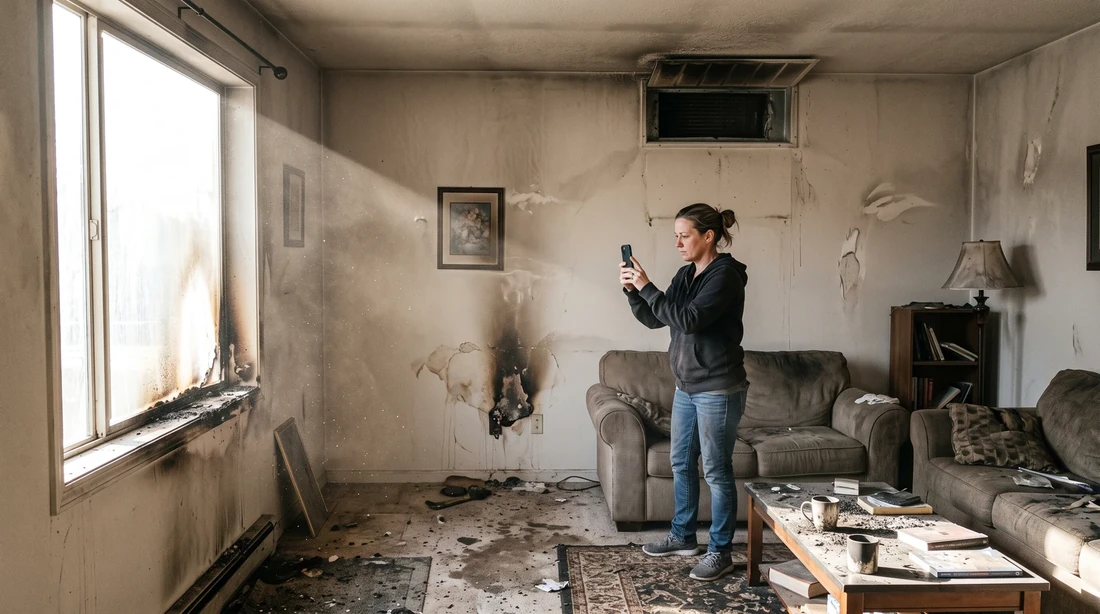
- Photograph the smoke evidence, not just the fire. Capture soot film on walls, ceilings, and inside cabinets in rooms far from the fire, plus residue at the HVAC vents.
- Get a professional assessment in writing. Have a restoration company or industrial hygienist document soot spread, HVAC contamination, and affected rooms — a report beats your opinion.
- Tie it to health, specifically. Note any household members with asthma, respiratory conditions, or young children, and any symptoms that appear at home and ease away from it.
- Ask directly for ALE and put it in writing. Request temporary housing under your loss-of-use coverage by email so there's a paper trail of the date you asked.
- Keep every receipt and log every night. Hotel, furnished home, extra mileage, and meals above normal — receipts substantiate the ALE claim.
- Escalate if you're stalled. Ask for the assessment in writing, request a supervisor, and involve the Oklahoma Insurance Department if the delay is unreasonable.
If the adjuster still won't move, read what to do when insurance denies temporary housing. And if you're at the very start of a displacement, temporary housing after a house fire walks the whole first week.
One more back-half note: many carriers or their third-party administrators can bill a furnished-home provider directly once housing is authorized — so you may not have to front the money. Here's how ALE housing companies work and what direct billing requires.
A Worked Example: Family of Four, 3-Month Remediation
Here's a hypothetical to show the math. Say a stovetop fire in a family-of-four home is put out fast, but the HVAC spread soot through the house, and remediation plus repairs run about three months.
Two hotel rooms at $95/room/night = $190/night. Over 90 nights that's about $17,100 — with no kitchen, so restaurant meals add hundreds more per week.
A furnished home on a monthly insurance rate — say roughly $3,900/month in this example — runs about $11,700 for three months, with a full kitchen and laundry that also cut the food and cleaning spend.
In this hypothetical the furnished home saves on the order of $5,400 over three months versus two hotel rooms, and stretches the ALE budget if repairs overrun. Your actual figures depend on your policy limits, the home, and the season — verify current rates and confirm your ALE cap with your adjuster. (Numbers are illustrative, not a quote.)
What the kitchen actually saves
The meal difference is bigger than most families expect. In the hotel scenario, a family of four with no kitchen might spend around $90/day above their normal grocery bill eating out — roughly $2,700 a month, and ALE only reimburses the amount above what you'd normally spend. In the furnished home, cooking most meals might add only $500–$600/month above normal. Over three months that's another $6,000-plus difference that lands squarely on the food line of your ALE claim.
A second variant: when the ALE cap is the real constraint
Now say the same family's policy caps loss-of-use at $15,000. Two hotel rooms at $190/night burn through that cap in about 79 nights — roughly two and a half months — leaving nothing for the final weeks of repair or the extra meals. The furnished home at $3,900/month spends about $11,700 across the full three months, leaving roughly $3,300 under the cap for mileage, laundry, and above-normal food.
Same coverage, very different outcome — because the nightly hotel rate, not the length of the repair, is what empties the cap early. If your repair timeline is uncertain (HVAC replacement and deodorizing often push a job past its first estimate), preserving cap headroom is the whole game.
When You Don't Need to Move Out — And When You Do
Not every smoke smell means you have to leave. If the incident was tiny — light odor from burnt food, no visible soot, no symptoms, HVAC never ran during the fire — airing the house out and a professional cleaning of the affected area may be enough to stay. A single adult with no respiratory issues has more room to tough out a couple of nights than a family does, and if you're covering a one- or two-night gap yourself, a hotel with loyalty points may be the simplest call.
You genuinely need to relocate when the assessment finds soot in the ductwork or in rooms beyond the fire, a persistent odor that returns, or any household member developing symptoms — and especially when remediation will take more than a few days with the HVAC out of service. In OKC's temperature extremes, a home without working heating or cooling during remediation is often unlivable on that basis alone.
For families, pets, or anyone with asthma facing a 30-plus-day repair, a furnished home with clean air, a kitchen, and space is where a local operator changes the outcome. BnB OKC runs 11 furnished homes across the metro — near Lake Hefner, the Village, and the Paseo and Plaza districts — and holds a 9.5 out of 10 average across 1,580 verified guest reviews on Airbnb and Vrbo, so the place you land is a real home, not a gamble.
Note the season, too. If your fire falls during OKC's April–June tornado season, restoration crews and rental supply can both tighten as storms damage other homes at the same time — one more reason to line up housing early rather than after you're exhausted.
Terms You'll Hear, Decoded
- Additional Living Expenses (ALE): The part of your policy that pays for temporary housing and extra costs above your normal living expenses while your home is unlivable.
- Loss of use: The coverage section that triggers ALE — it applies when a covered peril makes the home uninhabitable.
- Remediation: The professional cleaning, deodorizing, and HVAC decontamination that removes smoke residue and its smell.
- Off-gassing: The slow release of trapped chemicals and odor from porous materials like drywall, carpet, and upholstery after a fire — the reason a house that "smells better" one day is bad again the next.
- Direct billing: When the carrier or its administrator pays the housing provider directly, so you don't front the cost — only happens with authorization.
- Industrial hygienist: A specialist who tests air and surfaces and documents contamination — their report is strong evidence the home is unsafe.
- Particulate (PM2.5): The ultra-fine soot particles in smoke that lodge deep in the lungs and can't be filtered by simply opening a window.
Related OKC Insurance-Housing Guides
If a hotel is your bridge for the first few nights, check whether renters insurance covers hotel stays before you book. When you're ready to compare full setups, browse our insurance housing and pet-friendly rentals in OKC if you're relocating with animals.
Your Next Steps
- Confirm the scope. Get a written restoration or hygienist assessment naming which rooms are affected and whether the HVAC is contaminated — that's your habitability evidence.
- Compare your real numbers. Check your policy's ALE/loss-of-use limit, then compare hotel nights against a monthly furnished-home rate for your repair window — and watch the cap, not just the nightly price.
- Reach out. Call or text BnB OKC at (405) 870-2146 or request placement through our insurance housing page — we work with adjusters and TPAs like Alacrity Solutions on direct billing.
This guide is general information, not insurance, legal, or medical advice; your carrier makes all coverage decisions.