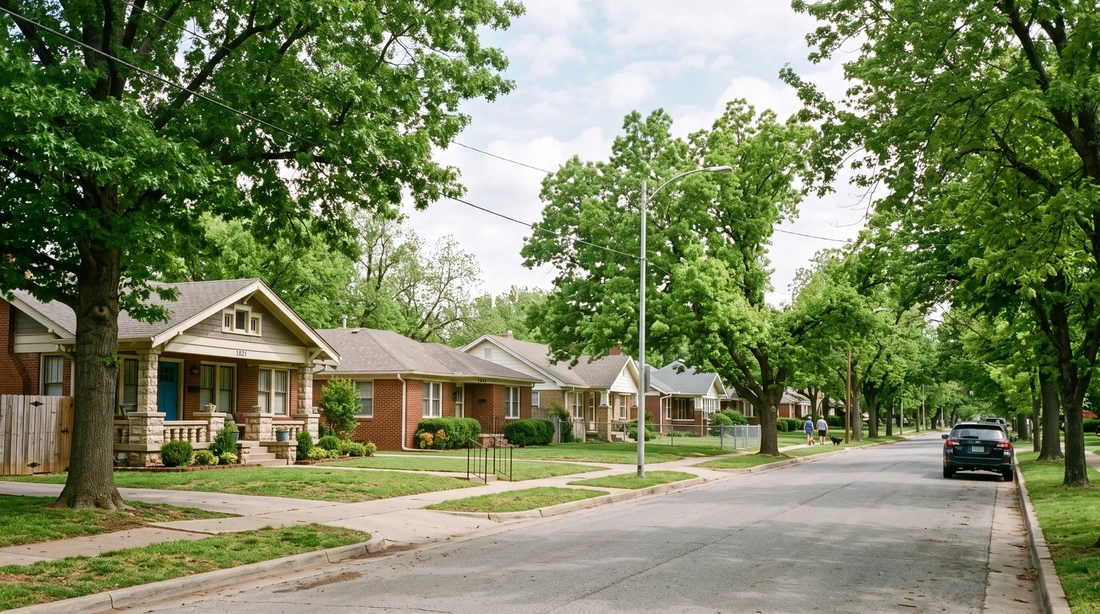
Since February 16, 2025, an Oklahoma City home share can be rented a maximum of 10 nights per month unless the operator holds a special exception permit from the Board of Adjustment. Stays of 30 consecutive days or more sit outside these home-share rules entirely, so long-term and monthly rentals aren't capped.
Key takeaways
- Since February 16, 2025, an Oklahoma City home share without a special exception permit can be rented a maximum of 10 nights per month.
- The permit that lifts the cap comes from the Board of Adjustment and carries a $300 filing fee.
- Special-exception short-term rentals cannot exceed 10% of the homes on any single block.
- Stays of 30 consecutive days or more sit outside the home-share rules, so monthly rentals are not capped.
If you searched "OKC Airbnb 10 night limit," you're probably one of two people. You're a traveler who keeps hitting unavailable on calendars that used to be open, or you're a host doing the math on a listing that can now only book about a third of the month. Both experiences trace back to the same 2025 city ordinance.
The rule is real, it's in effect for 2026, and it reshaped which OKC listings you can actually book for a longer trip. Here's exactly what changed and how to route around it.
The 10-night monthly cap has applied to unpermitted OKC home shares since February 16, 2025. It renews every calendar month — a host who books 10 nights can't accept more until the next month begins, which is why casual-listing calendars now go dark so often.

What actually changed in OKC's 2025 short-term rental ordinance
The headline change: a home share with no special exception permit may only be rented 10 nights in any given month. That single line is the most disruptive piece of the ordinance for both guests and hosts.
Before the change, a licensed OKC home share could book far more freely across a month. Now, without a permit, an operator hits a hard 10-night ceiling and the calendar closes. The permit that lifts the cap is a special exception granted by the city's Board of Adjustment, and it carries a $300 filing fee (per the Airbnb Help Center and OKCMAR).
The permit isn't a rubber stamp, either. Special-exception short-term rentals cannot exceed 10% of the homes on any single block (Avalara; OKC Fox). Once a block hits that share, additional operators there can't escape the cap — a built-in limit on how many casual listings can convert to full-time.
Two more mechanics matter. Under the home-share rules, any single rental may not exceed 30 consecutive days per guest. And violating the ordinance can lead the Board of Adjustment to deny a license application or renewal for one year (Avalara; OKC Fox) — a real cost that pushes compliant hosts toward the permit or out of the short-term lane.
Old rule vs. new rule
| Element | Before Feb 16, 2025 | Under the 2025 ordinance |
|---|---|---|
| Nights per month (no permit) | Effectively open for licensed home shares | Capped at 10 nights per month |
| How to book more nights | Not required | Special exception from Board of Adjustment ($300 filing fee) |
| Block density limit | None specified | Special-exception STRs ≤ 10% of homes per block |
| Max length of one stay (home share) | General STR rules | Cannot exceed 30 consecutive days per guest |
| Penalty for violations | — | License denial or non-renewal for one year |
| Stays over 30 days | General rules | No home-sharing license required at all |
City rules are not the only limit a host may face:
In addition to government-imposed restrictions, many homeowner associations also limit short-term rentals.
Wikipedia: Airbnb
Why your calendar keeps saying "unavailable"
A casual OKC listing without a special exception can only sell 10 nights a month — so for the other ~20 nights, its calendar is legally closed. That's the mechanic behind the frustration guests are describing in 2026.
Oklahoma City had 1,902 Airbnb listings as of July 4, 2025, running an average 61% occupancy at a $109 average daily rate (Airbtics). A 61% occupancy figure means a typical listing sold well over half its nights — far above 10 nights in a 30-day month. The cap forces unpermitted operators to give up the back two-thirds of the month, which thins availability for exactly the multi-night trips travelers are trying to book.
If you've been trying to string together a week, or a mid-length work stay, on a small casual listing, you'll see gaps that don't make sense until you know the rule. The listing isn't booked solid — it's capped out.
What this means if you're an OKC guest planning a longer stay
The cleanest way around the 10-night cap is to book a stay of 30 nights or more — because properties rented exclusively for periods over 30 days don't require a home-sharing license at all (Airbnb Help Center). That's the exact lane our extended-stay homes operate in.
This isn't a loophole; it's how the ordinance is written. The home-share regime — the 10-night cap, the permit, the block density limit — governs short casual stays. Longer-term furnished rentals are a different category. If your plan is a month or more (relocation, an insurance displacement, a work rotation, a construction delay), the cap simply doesn't touch you.
BnB OKC runs 11 furnished homes across the metro with monthly rates on 30+ night stays, and we hold a 9.5 out of 10 average across 1,580 verified guest reviews on Airbnb and Vrbo. Homes sleep 2 to 16+, several are dog-friendly, and check-in is 4:00 PM with checkout at 11:00 AM. Because these are booked as longer stays, you won't hit a mid-month "unavailable" wall.
Hitting capped calendars for a longer OKC trip? Our furnished homes book by the month and sit outside the 10-night home-share rules. Check availability for your dates.
A hypothetical: 45 nights during a home repair
Say a kitchen fire pushes a family of four out of their house for about six weeks while repairs finish. On casual short-term listings, the 10-night cap turns that into a scramble — hopping between three or four small listings, each closing after its 10 nights, re-packing every week and a half.
Booked instead as a single 45-night furnished stay, the same family stays in one home the whole time. As a hypothetical, a monthly-rate furnished home avoids the cap entirely because the stay exceeds 30 days, so the calendar never locks mid-repair. One address, one set of keys, one lease-style booking — and, on insurance-paid displacements, one clean receipt trail. (Figures are illustrative; your dates and rate determine actual cost.)
Guests vs. hosts: who the rule hits and how
| You are… | What the cap does | Your best move |
|---|---|---|
| A guest wanting 3–14 nights | Fewer casual listings available; more "unavailable" gaps | Book a permitted STR or a hotel; check dates early |
| A guest wanting 30+ nights | Not affected — over-30-day rentals are exempt | Book a monthly furnished home in the extended-stay lane |
| A displaced / insurance family | Casual listings can't cover a multi-month stay | Book one 30+ night furnished home; keep receipts |
| A casual host (no permit) | Hard 10-night monthly ceiling | Weigh the $300 special exception vs. pivoting to 30+ day rentals |
| A host on a dense block | May be blocked by the 10%-per-block limit | Confirm block status before applying for a permit |
Timeline of the change
- Before Feb 16, 2025: Licensed OKC home shares booked without a monthly night cap.
- February 16, 2025: The ordinance takes effect — 10 nights per month for unpermitted home shares, a $300 special exception to lift it, a 10%-per-block density limit, a 30-consecutive-day stay ceiling, and one-year denial for violations.
- Through 2025: With 1,902 listings averaging 61% occupancy, casual calendars begin closing mid-month as operators hit the cap.
- 2026: The rules remain in force. Guests routing longer trips increasingly land in the over-30-day lane, which the ordinance leaves unregulated as home shares.
For the full regulatory picture beyond the night cap, see our guide to OKC short-term rental rules, and how enforcement is playing out in our piece on the OKC Airbnb enforcement crackdown. If your search is over the line in Cleveland County, compare the Norman short-term rental license requirements too.
When the 10-night cap doesn't matter to you
If you only need one or two nights, the cap rarely changes your trip — plenty of permitted listings and hotels handle short OKC visits, and a single traveler chasing loyalty points may prefer a hotel anyway. Booking early still helps around big dates like the Women's College World Series at Devon Park or a Route 66 Centennial weekend.
The cap starts to change the outcome when you need length and stability: a stay past two weeks, a family with kids or pets, a work rotation, or an insurance displacement running weeks to months. That's when a single furnished home booked over 30 days beats a chain of capped casual listings — one move-in, a full kitchen and laundry, and no mid-month calendar wall. If you're placing a displaced household, our insurance housing lane and pet-friendly homes are built for exactly that.
Terms you'll hear, decoded
- Home share: OKC's term for a short-term rental of a dwelling; the 10-night monthly cap applies to these without a permit.
- Special exception: A Board of Adjustment approval ($300 filing fee) that lets a home share exceed the 10-night cap.
- Board of Adjustment: The city body that grants special exceptions and can deny a license for a year after violations.
- 10%-per-block limit: A density rule capping special-exception STRs at 10% of the homes on any single block.
- Over-30-day rental: A stay of more than 30 days, which does not require a home-sharing license at all.
Your Next Steps
- Confirm your length of stay. Under 30 nights, you're inside the home-share rules and may hit the 10-night cap; 30+ nights, you're exempt.
- Compare your options. For a longer trip, price a single monthly furnished home against stitching together capped casual listings — including move-in hassle and receipts.
- Lock your dates. Book an extended-stay home that isn't affected by the cap, or call/text (405) 870-2146 for same-day availability.