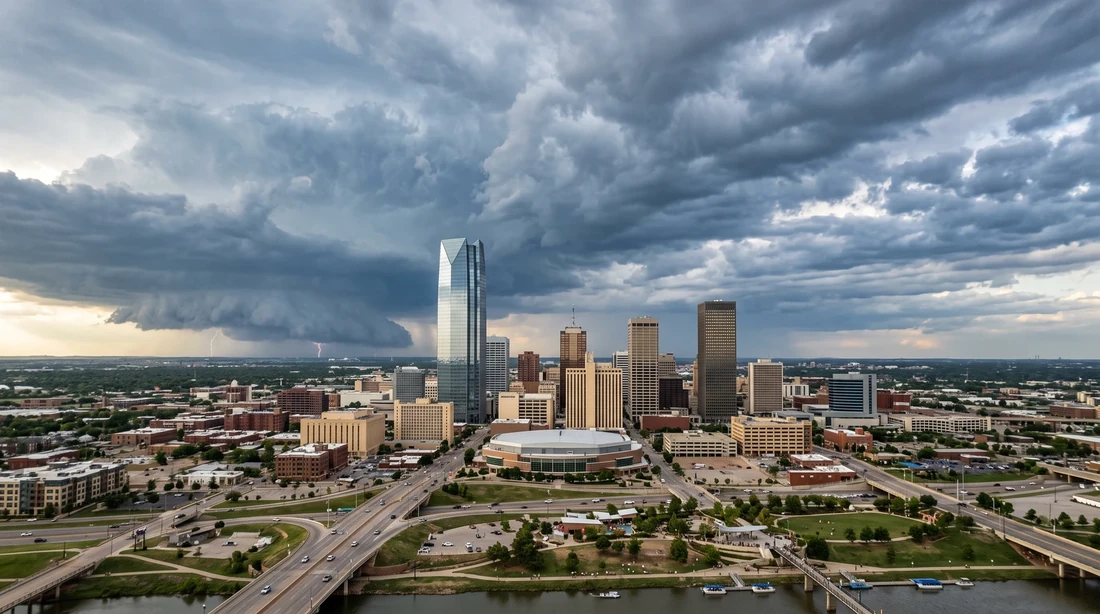
Yes, it is generally safe to visit Oklahoma City during tornado season. Peak activity runs April through June, but violent tornadoes on any single trip day are rare. Most spring storms mean rain, wind, and a watch that passes. Know the difference between a watch and a warning, pick lodging with a sturdy interior room, and you're fine.
Key Takeaways
- April, May and June account for most of Oklahoma's tornado activity, with May typically the busiest month.
- A watch means conditions are favorable; a warning means a tornado is happening near you — shelter immediately.
- At a rental, go to the lowest interior room without exterior windows, cover up, and wait for the all-clear.
- Illustrative math: four hotel rooms near $155/night run about $1,860 for three nights; one eight-sleeper home lands near $1,200 to $1,425.
This guide covers when Oklahoma City storms peak month by month, the difference between a watch and a warning, what to do if a siren sounds while you're at a rental, how locals handle spring storms, what to prepare before you arrive, where to stay for a spring event, and the rare case where a storm turns into an insurance-housing situation.
You booked an OKC game weekend for you and seven friends, and then someone in the group text posted a video of a wedge tornado and asked if the whole trip is a mistake. It isn't. Oklahoma City sees storms every spring the way Denver sees snow. Locals plan around them without a second thought, and so can you.
The real clock: Oklahoma City's severe-weather season peaks late April through early June, the same window as the Women's College World Series and the Memorial Marathon. Spring event weekends book out early and land in prime storm season, so lock lodging with a real interior shelter room well ahead.

Why Does Oklahoma City Have a Tornado Season at All?
Oklahoma City sits near the center of what meteorologists call Tornado Alley, where warm Gulf moisture collides with dry air off the high plains. That clash fuels the supercell thunderstorms that can spin up tornadoes. It's geography. It is also why the metro has some of the best storm science and warning infrastructure in the world.
The National Weather Center in Norman, about 20 minutes south of downtown, houses forecasters and researchers who study these exact storms. The practical upshot for a visitor is that severe weather here is seasonal and forecastable. Storms build in the afternoon and evening as daytime heat peaks, and forecasters usually flag a risky day a full day or two out. You will almost never be surprised.
Most "severe weather" days produce a loud, brief thunderstorm (heavy rain, hail, gusty wind, maybe a tornado watch) and then clear skies. Tornadoes touching populated ground on your specific travel dates are uncommon. The city runs normally through nearly all of storm season, and the odds that a given afternoon storm produces a tornado over your particular block are very low even in May.
For historical context on how often tornadoes reach the city:
The Oklahoma City metropolitan area is one of the most tornado-prone major cities in the world, with about 150 tornadoes striking within the city limits since 1890.
Wikipedia: Oklahoma City
When Is Oklahoma City Tornado Season, Month by Month?
The single most useful fact for a traveler: April, May, and June account for the large majority of Oklahoma's tornado activity, with May typically the busiest month. Book outside that window and your storm odds drop sharply. Book inside it and you plan a little.
| Month | Storm risk | What it means for your trip |
|---|---|---|
| Jan to Mar | Low, rising late | Occasional storms; cold snaps and ice more likely than tornadoes. |
| April | Rising to high | Season ramps up; Memorial Marathon weekend falls here. Watch forecasts. |
| May | Peak | Busiest month. Expect at least one active storm day on a week-long trip. |
| June | High, easing late | Still active early; WCWS crowds the calendar. Tapers by late June. |
| Jul to Sep | Low | Hot and mostly dry; State Fair season in September is generally calm. |
| Oct to Nov | Low secondary bump | A small fall severe-weather uptick, far milder than spring. |
| Dec | Low | Winter weather, not tornadoes, is the concern. |
If your dates are flexible and you're storm-shy, aim for late summer or fall. If your trip is anchored to a spring event (a Thunder playoff run at Paycom Center, the Women's College World Series, or the marathon), you're traveling in peak season and this guide is written for you.
What Is the Difference Between a Tornado Watch and a Warning?
Here is the distinction that separates panic from calm. A watch means conditions are favorable. A warning means take shelter now. Locals treat these two words completely differently, and once you do too, spring weather stops being scary.
| Term | What it means | What you do |
|---|---|---|
| Tornado Watch | Conditions could produce tornadoes over a large area, often for several hours. | Stay aware. Keep your phone on. Carry on with plans but know your shelter spot. |
| Tornado Warning | A tornado is happening or radar-indicated near you, right now. | Go to your shelter immediately. This is the action word. |
| Severe Thunderstorm Warning | Damaging wind or large hail. No tornado, but still dangerous outside. | Get indoors, away from windows. Move your car under cover if hail threatens. |
| Outdoor sirens | Community sirens sound for a warning in your area. They are for people outside. | Treat as a cue to check your phone and shelter. Don't wait for a second siren. |
A common visitor mistake is hearing "tornado watch" on the morning news and canceling the whole day. Don't. A watch can cover the entire metro for six hours while nothing touches ground. The moment to act is a warning for your specific location, and your phone will scream it via Wireless Emergency Alerts, no app required.
Turn on emergency alerts before your trip (they're on by default on most phones). Download a radar app if you like, and if a big severe day is forecast, follow any Oklahoma City TV meteorologist's live stream. They track storms street by street and are remarkably calm and specific. Note that the outdoor sirens you'll hear are designed to warn people who are outside. If you're indoors with your phone on, you may not hear them clearly, so don't rely on sirens as your only signal.
What Happens If You Wait or Ignore the Warning?
The danger of storm season is treating a warning like a watch. Here is the honest sequence of getting caught out.
- You ignore the watch entirely. Usually fine, except you've now stopped tracking a day forecasters flagged as risky, so a warning may surprise you.
- A warning fires and you're driving. Vehicles and highway overpasses are among the worst places to be. You need a sturdy building fast, and if you're on I-35, I-40, or the Kilpatrick Turnpike in unfamiliar territory you may not know where one is.
- A warning fires and you're at a restaurant or event. Venues have plans; follow staff instructions and move to interior areas. Do not run to your car to "beat it home."
- A warning fires at your rental and you don't know your shelter room. You waste precious minutes figuring out where to go. Know it in advance and this stage never happens.
The fix for every stage is the same and takes five minutes on arrival. Identify the safest interior spot at your lodging, keep your phone alerts on, and treat a warning as immediate. That's the entire skill.
If a warning fires while you're driving in OKC
Driving is the one scenario where visitors get into real trouble, because you're most likely to be caught out sightseeing or heading to a venue. Do not shelter under a highway overpass. Wind accelerates under them and they offer no protection. If a tornado warning fires while you're driving and traffic allows, get off at the next exit and into a sturdy building: a gas station, big-box store, restaurant, or your hotel lobby.
If you cannot reach a building and cannot safely drive away from the storm, park, stay belted in with your head below the windows, and cover up. Most warning-day driving problems are avoidable by not starting a road trip across the metro when a high-risk afternoon is forecast.
Booking a spring game weekend or event trip for a group? Our OKC homes have interior rooms, full kitchens, and space for eight-plus, and we handle storm-displacement housing for local families too. Check availability for your dates.
What Should You Do If Sirens Sound While You're at a Rental?
If a tornado warning hits while you're at your Oklahoma City rental, the plan is short and you can rehearse it in one minute. The goal is to put as many walls between you and the outside as possible, on the lowest floor.
- Get to the lowest interior room. A basement is best; otherwise an interior bathroom, closet, or hallway with no exterior windows.
- Cover up. Crouch low, protect your head and neck with your arms, and pull a mattress, cushions, or heavy blankets over the group.
- Stay away from windows and exterior walls. Flying glass and debris cause most injuries. Doors to the outside are not shelter.
- Keep shoes and a charged phone with you. After a storm, debris is everywhere and you'll want light and communication.
- Wait for the all-clear. Don't leave shelter until the warning expires or a meteorologist confirms the storm has passed your area.
Most warnings last well under an hour, and most pass without the tornado ever reaching your street. You are sheltering as a precaution. For a group of eight, the practical move is deciding your shelter room together the moment you drop bags, so nobody's confused if an alert fires that night. Traveling with kids?
Make the shelter spot a quick game before bed on day one so it feels routine, and keep shoes lined up by the room so no one is barefoot on debris later. Traveling with a dog? Keep the leash and a crate near the shelter room. A panicked dog is much easier to keep safe if it's already contained.
Hail, rental cars, and your stuff
Most spring storm damage a visitor experiences is hail on a parked car. Severe thunderstorm warnings often mention hail up to golf-ball size or larger, which can dent panels and crack windshields. If you're driving a rental, park under a covered garage, a carport, or at least close to a building when hail threatens, and understand your rental's damage coverage before you need it. A furnished home with a garage or covered parking sidesteps this entirely. A hotel with a parking structure does too. It's a small thing that saves a big out-of-pocket surprise.
How Do Locals Live With Spring Storms?
Oklahomans don't dread storm season. They respect it and go about their lives. That mindset is the most reassuring thing a visitor can borrow. Here is how it looks in practice.
- They check the forecast, not the sky. A glance at the evening forecast tells them if tomorrow is a "weather day" worth planning around.
- They know their trusted meteorologist. OKC's TV weather teams are local celebrities for good reason. Coverage is granular and calm.
- They don't cancel plans for a watch. Kids still go to school, games still happen, dinner reservations stand.
- They have a shelter spot and move fast for a warning. The whole family knows exactly where to go and doesn't debate it.
Storms here are usually a spectacular light show and a hard rain. Many visitors leave having seen an impressive Great Plains thunderstorm from a safe indoor spot and call it a highlight rather than a scare.
What Should You Prepare Before You Arrive?
Five minutes of prep before your flight removes almost all of storm season's uncertainty. The single most important step is confirming your phone's emergency alerts are on. They're the automatic warning system that works with no app and no local knowledge.
- Confirm Wireless Emergency Alerts are enabled in your phone's notification settings before you leave home.
- Pack a portable battery bank. If power flickers during a storm, you'll want a charged phone for alerts and light.
- Note a weather app or a local TV station's stream so you can watch live coverage on a high-risk afternoon.
- On arrival, walk to your shelter room and point it out to everyone in your group.
- Keep shoes and a small flashlight near that room for the small chance you shelter after dark.
Spring in OKC also swings between warm and chilly, so pack layers and a rain jacket. Most of your "weather days" will just be wet.
Where Should You Stay for a Storm-Season Event?
If your trip is anchored to a spring event, staying within a short drive of the venue means less time on the road on a potentially stormy afternoon, the exact time you'd rather be near shelter than on the highway. Most of the OKC metro's marquee venues sit within about 20 minutes of central lodging.
| Venue | Event / season | Approx. drive from central OKC lodging |
|---|---|---|
| Paycom Center | Thunder games (playoffs May to June) | Downtown, 5 to 10 min |
| Devon Park | Women's College World Series (late May to early June) | Near downtown, about 10 min |
| Memorial Marathon route | Late April | Downtown / midtown start, 5 to 15 min |
| OKC Fairgrounds | Year-round events | West of downtown, about 10 to 15 min |
| Will Rogers World Airport | Arrivals / departures | About 6 min from some homes; 15 to 20 min from downtown |
Neighborhoods like the Paseo and Plaza districts, The Village, and areas near Lake Hefner all sit within an easy metro drive of these venues, and homes with garages or basements give you both shelter and covered parking. For a detailed venue-by-venue lodging breakdown, see our guide to staying near the OKC fairgrounds.
Storms and OKC's spring event calendar
Several of Oklahoma City's biggest events land squarely in peak storm season, so if you're coming for one, plan for both crowds and weather. The Women's College World Series at Devon Park runs late May into early June, the absolute peak. The OKC Memorial Marathon is late April, an outdoor event that organizers monitor closely for weather. Thunder playoff games at Paycom Center can stretch through May and June.
Winter and fall events sit outside storm season entirely. The Cattlemen's Congress in January and the AQHA World Show in the fall bring big crowds but calm skies. If those calmer-weather events fit your schedule and you're storm-shy, they're the easy alternative.
What Does a Spring Game Weekend Cost for Eight Friends?
Say your group of eight books an OKC game weekend in mid-May, peak storm season, and wants one place together with a real shelter option instead of splitting across hotel rooms. Here is roughly how the math shakes out (illustrative figures; check live rates for your dates).
The hypothetical: a $1,500 lodging budget for three nights.
- Four hotel rooms at about $155/night = ~$620/night, or ~$1,860 for three nights. That is over budget, and your group is scattered down a hallway with no shared shelter plan.
- One large furnished home from our direct rates, in the ballpark of $400 to $475/night for a home that sleeps eight, lands near $1,200 to $1,425 for three nights. That is inside your $1,500 budget, everyone under one roof, with a designated interior shelter room, a kitchen, and laundry.
Per person, the home works out to roughly $150 to $180 for the whole weekend, versus the hotel's ~$230 each, split awkwardly across rooms. The home also means one shelter conversation for the whole group instead of eight people in four rooms wondering where to go if an alert sounds.
A week-long variant: stretch the same eight friends to seven nights in peak May and the direct home rate, at say $425/night, runs about $2,975 for the week, roughly $372 per person. Because stays of four-plus nights qualify for up to 35% off our direct rates, the effective nightly cost drops well below what four hotel rooms would total over the same week. See large-group rentals in OKC for homes that sleep eight and up, and note our book-direct savings of up to 35% on stays of four-plus nights.
Where Do Storm Season and Insurance Housing Meet?
Here is the situation most travel guides skip. The same spring storms that give visitors a light rain can, in a bad year, damage local homes, and displaced Oklahoma families need furnished housing fast. That's a large part of what we do. When a covered loss makes a home unlivable, a homeowner's policy often includes Additional Living Expenses (ALE) to pay for temporary lodging.
We work with adjusters and third-party administrators like Alacrity Solutions to place displaced households in furnished homes on 30-plus-night stays, often with carrier-authorized direct billing. If you're an OKC resident reading this after storm damage rather than a visitor, the insurance-housing hub is your starting point, and our team can move same-day.
A hypothetical displacement example: say a May hailstorm and wind event makes a family of four's roof and second floor unlivable, and repairs are estimated at four months. Thirty nights of two hotel rooms at $150 each runs about $9,000 a month with no kitchen and no laundry, the kind of number that burns through an ALE budget fast.
A furnished four-bedroom on our monthly rate for a 30-plus-night stay typically lands well under that, keeps the family together with a kitchen to control food costs, and (when the carrier authorizes it) can be direct-billed so the family isn't fronting the money. Your carrier makes all coverage decisions, so confirm your ALE line before assuming any figure.
For visitors, the connection matters too. The homes built to house displaced families for months (full kitchens, laundry, real living space, sturdy construction) are the same homes that make a comfortable, storm-ready group stay. It's why an event weekend and a relocation use the same inventory.
When Do You Not Need a Furnished Home for Storm Season?
Be honest with yourself about the trip. A hotel is the right call for a one- or two-night solo or couples visit, especially if you're loyal to a points program and don't need a kitchen or shared space. Downtown hotels are close to Paycom Center and Bricktown, and any modern hotel has an interior-hallway shelter plan its staff will direct you to.
You also don't need a home if your dates fall well outside April to June. Storm risk is low the rest of the year, and lodging choice comes down to convenience and budget.
A furnished home changes the outcome when you're a group of six-plus, want everyone under one roof, are staying 30 nights or longer, are traveling with kids or a dog, or want a kitchen and laundry to control costs on a spring event weekend. Covered parking to protect a car from hail is a quieter but real reason too. For groups specifically, see team house rentals in OKC and family reunion rentals. Both cover the same one-roof logic that also makes storm sheltering simpler.
How to Handle a Spring Storm Day in OKC, Step by Step
This is the whole routine, in the order locals do it.
- Check the evening forecast. It tells you whether tomorrow is a "weather day" worth planning around.
- Keep your phone alerts on. Wireless Emergency Alerts fire for a warning at your location with no app and no local knowledge.
- Treat a watch as information. Carry on with plans, but know your shelter spot and keep an eye on the sky and your phone.
- Stay off the highway on a high-risk afternoon. Don't start a road trip across the metro when forecasters have flagged the day.
- Move to shelter the moment a warning fires. Lowest interior room, away from windows, cover up, shoes and phone with you.
- Wait for the all-clear. Leave shelter only when the warning expires or a meteorologist confirms the storm has passed your area.
What to Check Before You Book a Spring Trip
These are the places a storm-season trip usually goes wrong.
- Canceling a day over a watch. A watch can cover the whole metro for six hours while nothing touches ground. A warning for your location is the action word.
- Relying on outdoor sirens. They are built for people outside. Indoors with your phone on, you may not hear them clearly.
- Not knowing your shelter room. Pick it the moment you drop bags so nobody wastes minutes if an alert fires that night.
- Sheltering under an overpass. Wind accelerates under them and they offer no protection. Get off at the next exit and into a sturdy building.
- Parking a rental car in the open. Hail on a parked car is the most common storm damage a visitor sees. Covered parking or a garage sidesteps it.
- Booking late for a spring event. The WCWS, the Memorial Marathon, and Thunder playoff dates book out early and land in peak season, so lock lodging with an interior room well ahead.
Terms you'll hear, decoded
- Tornado Watch: Conditions favor tornadoes over a wide area for hours. Stay alert, don't panic.
- Tornado Warning: A tornado is occurring or radar-indicated near you. Shelter immediately.
- Severe Thunderstorm Warning: Damaging wind or large hail is happening or imminent. Get indoors and away from windows even though no tornado is indicated.
- Wireless Emergency Alert (WEA): The loud automatic alert your phone gets for a warning in your location, no app needed.
- Additional Living Expenses (ALE): The homeowners-policy coverage that can reimburse temporary lodging when a covered loss makes a home unlivable.
- Direct billing: When a carrier or its administrator pays a housing provider directly, so a displaced family isn't fronting the cost. Only with authorization.
- Storm cellar / safe room: A below-ground or reinforced interior space built specifically to shelter from tornadoes.
These are worth knowing for a visitor sheltering through one warning and for a local working through a claim after real damage.
The Bottom Line
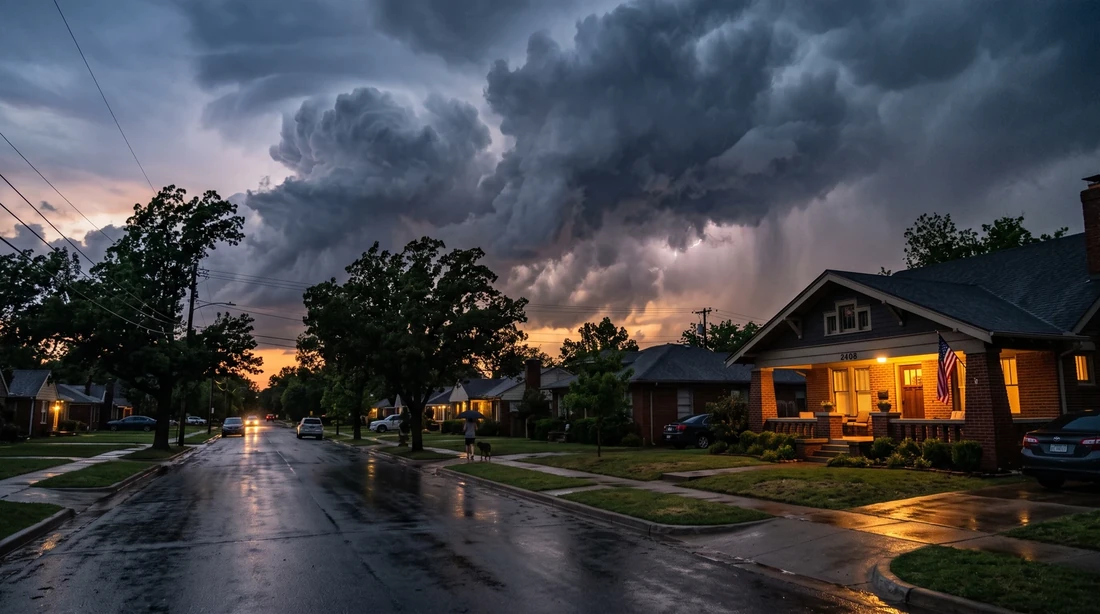
Check whether your dates fall in April to June. If so, you're in peak season, so turn on your phone's emergency alerts and note your lodging's interior shelter room on arrival. For six-plus travelers, compare one home against splitting into hotel rooms. One home is usually cheaper per person and gives you a single, clear shelter plan and covered parking.
Booking a spring game weekend, or a local family needing storm-loss housing? Visit /insurance-housing/ or call or text (405) 870-2146 for same-day options. Our OKC homes hold a 9.5 out of 10 average across 1,580 verified guest reviews on Airbnb and Vrbo, with two "Guest Favorite" homes, real numbers you can check before you book. For official warnings and preparedness guidance, follow the National Weather Service and local authorities, and see VisitOKC for the current event calendar.
This guide is general safety and travel information, not insurance or legal advice; your carrier makes all coverage decisions. For life-threatening weather, follow official National Weather Service warnings and local authorities.