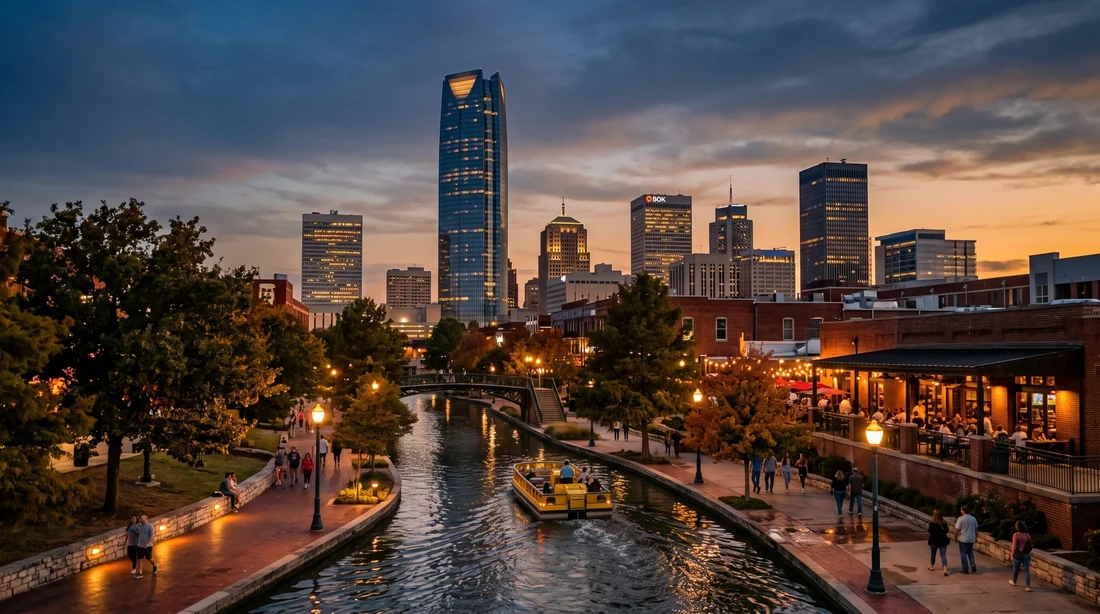
Oklahoma City is the larger metro — roughly 700,000 residents versus Tulsa's 410,000 — with more jobs (Tinker AFB, the FAA, Devon Energy), NBA basketball at Paycom Center, and a bigger airport. Tulsa is smaller, more walkable, arts-forward, and famously pays remote workers to relocate. OKC fits crews, corporate stays, and government contracts; Tulsa fits remote workers and art lovers.
Key Takeaways
- Oklahoma City has roughly 700,000 residents versus Tulsa's 410,000, with jobs at Tinker AFB, the FAA, and Devon Energy.
- Hypothetical 6-person, 3-month crew stay: three hotel rooms about $32,400 before tax versus a furnished home about $17,400.
- Tornado season peaks April through June statewide, while December through February is the quietest, cheapest moving window in either city.
- Whole-home inventory thins under 30 days out; homes sleeping 8 to 16 start filling 30 to 60 days out and on event weekends.
If you're weighing Oklahoma City vs Tulsa, the single fact that decides most stays is why you're coming. Are you standing up a work crew, reporting to Tinker or the FAA, or chasing a remote-work incentive? OKC is the state's employment engine and the government-contract hub; Tulsa is the smaller, greener, arts-first alternative 100 miles up the Turner Turnpike.
We run 11 furnished homes across the OKC metro and place work crews, relocating families, and insurance guests all year, so this guide leads with the practical stuff — jobs, rent, commute, schools, weather, and what a multi-month stay actually costs — not a tourist listicle. Our OKC first-hand knowledge is why the extended-stay math below is specific rather than generic, and it's backed by a 9.5 out of 10 average across 1,580 verified guest reviews on Airbnb and Vrbo.
Corporate housing and large furnished homes book out fastest at the start of the quarter and around big OKC events — Thunder playoff runs at Paycom Center, the Women's College World Series at Devon Park (late May–early June), the OKC Memorial Marathon in late April, and the State Fair of Oklahoma in September. If your project or move has a firm date, lock lodging early — every week of hotel rooms you burn is budget a monthly furnished rate would have stretched.

Oklahoma City vs Tulsa: The Head-to-Head Data
Oklahoma City is about 70% larger than Tulsa by population and carries the state's biggest concentration of federal, energy, and healthcare jobs. Tulsa counters with a denser downtown, a stronger arts identity, and a cash relocation program for remote workers. Here is the comparison laid out.
| Factor | Oklahoma City | Tulsa |
|---|---|---|
| Metro size | Larger — the state capital, ~700k city population | Smaller — ~410k city population |
| Major employers | Tinker AFB, FAA Mike Monroney Center, Devon Energy, Paycom, OU Medical, state government | ONEOK, Williams, American Airlines maintenance base, aerospace, energy |
| Remote-work incentive | None citywide | Tulsa Remote reportedly pays eligible remote workers to relocate |
| Pro sports | NBA — Oklahoma City Thunder at Paycom Center | Minor-league and college; BOK Center concerts/events |
| Entertainment core | Bricktown, Scissortail Park, Riversport rapids, The Paseo | Gathering Place, Cain's Ballroom, downtown art-deco district |
| Airport | Will Rogers World Airport — larger, more nonstops | Tulsa International — smaller |
| Feel | Spread out, car-first, big-city amenities | Compact, greener, more walkable downtown |
Jobs and employers
Oklahoma City holds the state's largest job base, anchored by defense, aviation, and energy. Tinker Air Force Base and the FAA's Mike Monroney Aeronautical Center alone drive tens of thousands of jobs and a steady stream of contractors, TDY personnel, and training students. Add Devon Energy, Paycom, OU Medical Center, and state government, and you get constant demand for corporate and extended-stay housing.
Tulsa's economy leans on energy midstream companies like ONEOK and Williams, plus a large American Airlines maintenance operation and a growing tech-and-aerospace scene. It's a real economy — just smaller and less contract-driven than OKC's. If your work is federal, aviation-training, or energy-project-based, OKC will almost always have the assignment; if it's midstream corporate or airline maintenance, Tulsa competes.
Rent and cost of living
Both cities are among the most affordable metros of their size in the country, and neither will shock you after a coastal move. OKC's market is bigger and deeper, which matters when you need multiple furnished units at once for a crew. Tulsa's housing runs comparable, sometimes slightly lower, with fewer large corporate-housing options — a real constraint when you need one home that sleeps six or more people under a single monthly rate.
Beyond rent, the everyday numbers track closely: Oklahoma has no local wage income tax quirks that separate the two cities, groceries and utilities sit near the national midpoint, and summer air-conditioning is the line item that surprises newcomers most — Oklahoma summers run hot enough that a poorly-insulated hotel or apartment bleeds power. On a multi-month stay, a well-run furnished home with the utilities bundled into one monthly rate removes the guesswork of a separate power bill during July and August peaks.
Commute and getting around
Both cities are car-first, but commutes are short by big-metro standards — most cross-town drives run 20–30 minutes. OKC is more spread out, so where you base matters. A home in The Village or near Lake Hefner sits about 15–20 minutes from downtown; our Capitol Manor home is directly across from OU Medical Center and OU Children's Hospital, and several homes are 6 minutes from Will Rogers Airport. Tulsa is more compact, so a central base reaches most of town quickly, but you'll find fewer whole-house rental options in the neighborhoods you'd want.
Neither city has meaningful rail transit, so plan on driving in both. The difference is scale: in Tulsa a bad decision on where to base costs you maybe ten extra minutes; in OKC, basing on the wrong side of the metro from your job site can mean a 40-minute cross-town slog twice a day. If your assignment is at Tinker in the southeast and you rent northwest near Lake Hefner, you'll cross the entire city at rush hour — worth avoiding on a three-month stay.
Neighborhoods and where to base in OKC
Because OKC is spread out, the neighborhood decides your daily drive more than the city line does. Downtown and Bricktown put you next to Paycom Center and Scissortail Park but are the priciest and least parking-friendly. The Paseo and Plaza districts offer walkable arts corridors a few minutes north of downtown. Gaillardia and the northwest suburbs give you quiet estates near Gaillardia Country Club and easy Kilpatrick Turnpike access to the airport and northwest job sites. If your work is at Tinker, base southeast to avoid crossing the whole metro every morning.
Our Lakefront Manor overlooks Twin Lakes with an infinity pool and sits close to Lake Hefner's trails — a strong pick for a crew that wants space to decompress after work, or a family that wants a yard. Match the home to the reason for the stay: airport-heavy travelers want the six-minute Will Rogers homes; hospital families want Capitol Manor across from OU Medical; northwest job sites pair with the Kilpatrick-adjacent homes.
Weather and seasons
Both cities share Oklahoma's climate: hot summers, mild-but-icy winters, and a spring severe-weather season. Tornado season peaks April through June across the state, so a spring relocation to either city means you'll want a home with interior sheltering space and you should know the local warning routine. Summer highs regularly top the 90s, making a full-kitchen home with reliable air conditioning far more livable than a cramped hotel room for a long stay. Winter brings occasional ice storms that can shut down travel for a day or two in either metro.
Season also moves price. A summer relocation lands squarely in event season — the Memorial Marathon in late April, the Women's College World Series at Devon Park bridging late May into June, and Thunder playoff dates all tighten OKC lodging and push nightly rates up. A winter move (December through February) is the quietest, cheapest window in either city, but leave a buffer for the occasional ice day that can delay a moving truck. If your dates are flexible, a January crew start costs less and books easier than a June one.
Schools and families
OKC's larger footprint means more school districts and enrollment options across its suburbs — Edmond, Moore, Norman, and the northwest districts all draw relocating families. Tulsa offers respected suburban districts in a more contained area, which some families prefer for shorter commutes. Either way, base your temporary furnished home inside the district you're eyeing so a school move doesn't force a mid-lease relocation, and drive the neighborhood at both morning rush and school pickup before you sign a longer lease.
Healthcare capacity
Oklahoma City carries the larger medical footprint of the two cities, anchored by OU Medical Center and OU Children's Hospital in a dense downtown medical district. For a family relocating with an ongoing medical need — a child in specialty care, a parent managing a chronic condition — OKC's concentration of hospitals and specialists is a genuine tiebreaker, and it's why families in treatment often base at Capitol Manor directly across from OU Medical. Tulsa has solid regional hospital systems and will cover routine needs comfortably, but the deepest specialty capacity in the state sits in OKC.
Entertainment: Thunder, Bricktown, Riversport vs Tulsa's scene
Oklahoma City is the only metro in the state with a major pro team — the Oklahoma City Thunder — and its entertainment district, Bricktown, packs restaurants, the canal, and the ballpark into a walkable core. Add Scissortail Park, the Riversport whitewater rapids, and The Paseo arts district and you have a big-league night out. Devon Park hosts the Women's College World Series each early summer, drawing crowds that tighten lodging citywide.
Tulsa answers with the Gathering Place (one of the country's most celebrated riverfront parks), the legendary Cain's Ballroom, a dense downtown art-deco district, and the BOK Center for concerts. If your priority is walkable arts and green space over pro sports, Tulsa is compelling.
For context on the severe-weather risk in the OKC metro:
Since weather records have been kept beginning in 1890, Oklahoma City has been struck by 13 violent tornadoes , 11 of which were rated F4 or EF4 on the Fujita and Enhanced Fujita scales , and two which were rated F5 or EF5.
Wikipedia: Oklahoma City
What a Multi-Month Stay Actually Costs
For any stay past a few weeks, a furnished home almost always beats a block of hotel rooms — and that math is the same in either city. A furnished home with a full kitchen and laundry on a monthly rate typically costs far less than the equivalent nights across multiple hotel rooms. Here's how the all-in options stack up for a work crew or relocating team.
| Option | All-in monthly (est.) | Best for |
|---|---|---|
| Multiple hotel rooms (crew of 6, 3 rooms) | Highest — nightly rates plus tax, no kitchen | Stays under ~2 weeks |
| Extended-stay hotel (per room) | Mid — kitchenettes, weekly rates | Solo travelers, 2–4 weeks |
| Furnished home (whole-house monthly) | Lowest per person — full kitchen, laundry, shared living | Crews, families, 30+ nights |
The gap widens the longer you stay and the more people you house. Six people in one large furnished home share a kitchen and living space at one monthly rate; six people in hotels means three-plus rooms billed nightly with tax on every one. To compare which format fits your lease length and headcount, here's how the terms break down.
| Option | Typical lease terms | What disqualifies it |
|---|---|---|
| Standard hotel rooms | Night-to-night, no commitment | Stays over 2 weeks or crews of 4+ — cost and no kitchen |
| Extended-stay hotel | Weekly or monthly per room | Families or crews needing shared living and full laundry |
| Furnished whole-home (monthly) | 30+ nights, monthly rate, direct billing possible | One- or two-night trips, single travelers on points |
| Unfurnished 12-month lease | Year-long, tenant furnishes | Any stay under a year or where you can't buy furniture |
What happens if you wait to book
Furnished-home availability tightens in a predictable sequence, and the cost of waiting is real in dollars, not just stress.
- 90+ days out: widest choice of large whole-home options, best monthly rates, and room to match the home to your job site and headcount.
- 30–60 days out: the biggest homes (sleeping 8–16) start to fill around quarter-start and event weekends; you may split a crew across two smaller homes.
- Under 30 days: whole-home inventory thins, and you may default to stacked hotel rooms at nightly rates plus tax — the most expensive outcome for a crew.
- Event weekends (WCWS, marathon, Thunder playoffs, State Fair): citywide nightly pricing rises and the largest homes are the first to go; a firm date deserves an early lock.
Housing a crew or relocating a team to OKC? We place work crews and multi-month guests across 11 furnished homes with monthly rates on 30+ night stays. Check availability for your dates and headcount.
Worked Example: Housing a 6-Person Crew for 3 Months in OKC
Here's a clearly hypothetical example with the arithmetic shown. Say you're a project manager standing up a 6-person crew in Oklahoma City for a 3-month job near Tinker or a downtown site.
Hotel route: three double rooms at roughly $120/night is about $360/night. Over 90 nights that's around $32,400 before tax — and nobody has a real kitchen or laundry.
Furnished-home route: a single large furnished home that sleeps the crew at a monthly rate in the ballpark of $5,800/month runs about $17,400 for the 3 months — with a full kitchen, laundry, and shared living space that keeps the crew together and cuts restaurant spend.
That's roughly $15,000 saved over the quarter in this hypothetical, plus per-diem meal money the crew keeps by cooking. Per person, the furnished home works out to about $967/month, or roughly $32/night each — versus the hotel's $60/night per person before tax. Your exact numbers depend on dates, home size, and season — our published from-rates run $225–$425/night, with up to 35% direct-booking savings on 4+ night stays.
| Month | Furnished home (est.) | Running total |
|---|---|---|
| Month 1 | ~$5,800 | ~$5,800 |
| Month 2 | ~$5,800 | ~$11,600 |
| Month 3 | ~$5,800 | ~$17,400 |
Variant: the same crew in Tulsa instead of OKC
Now run that same 6-person crew in Tulsa to see how the vs decision plays out on cost. Tulsa's nightly hotel rates often run slightly lower, so three rooms at roughly $110/night is about $330/night, or near $29,700 over 90 nights before tax.
The catch is inventory: Tulsa has fewer large whole-home options, so a crew of six may need two smaller furnished homes rather than one, which can erode the per-person savings and split the team across two addresses. The lesson isn't that Tulsa is more expensive — it's that OKC's deeper market makes the one-home-for-the-whole-crew play easier to pull off, which is exactly what keeps a project team together and the math clean.
Variant: relocating a family of four while a house closes
Say that same project manager is moving a family of four to OKC and needs 45 days of furnished housing while a home purchase closes. Two adjoining hotel rooms at roughly $130/night runs about $260/night, or near $11,700 over 45 nights before tax — with the kids doing homework on a hotel bed.
A furnished 3-bedroom at a monthly-equivalent rate in the ballpark of $5,800/month prorates to roughly $8,700 for the 45 days, with a kitchen, laundry, and a yard, saving around $3,000 while you settle. If the closing slips, a month-to-month furnished extension is a phone call, not a re-booking scramble.
Variant: a family relocating with a dog
Pets change the hotel math sharply. Say the same family brings a dog on that 45-day move: many hotels charge a pet fee of roughly $25–$50 per night, which on 45 nights adds $1,100–$2,250 on top of the room rate — and most hotel rooms have no yard and strict weight limits.
Several of our OKC homes are dog-friendly with fenced yards, so a pet joins the monthly rate rather than piling on nightly fees. For a multi-month stay with a dog, that difference alone can decide the format. See our pet-friendly rentals in OKC for the homes that allow dogs.
Variant: a remote worker trying a month before committing
If you're a remote worker weighing Tulsa's relocation incentive against OKC's bigger-city pull, a one-month furnished stay lets you test-drive daily life before signing a 12-month lease. A single furnished home or furnished apartment for 30 nights costs far less than an unfurnished lease plus buying furniture you'd move again — and you can extend month-to-month if the city fits. Many remote workers do exactly this in one city, then drive the 90-minute Turner Turnpike to scout the other for a weekend before deciding.
For deeper cost breakdowns and lease-term details, see our guides to corporate housing in Oklahoma City and extended stays in Oklahoma City.
Which City Fits You? The Verdict by Persona
The right answer depends entirely on who's moving. Here's the honest breakdown.
Young professional
Oklahoma City wins on raw opportunity — more employers, more nightlife in Bricktown and The Paseo, and the Thunder on winter nights. Tulsa wins if you want a compact, walkable downtown and a stronger live-music and arts identity. Both are affordable enough to save money in your twenties.
Family
It's close. OKC offers more school options, more jobs for two-income households, big amenities like Scissortail Park and Riversport, and deeper healthcare capacity. Tulsa counters with the Gathering Place and a more contained feel. Look at where the job is, confirm the school district, and drive both neighborhoods at rush hour before deciding.
Remote worker
Tulsa has a distinct edge here because of its remote-worker relocation incentive, which reportedly pays eligible remote employees to move. If you can work from anywhere and want cash plus a walkable base, Tulsa is worth a hard look. OKC still wins if you want a bigger city and easier flights out of Will Rogers World Airport — a real factor if you fly for work.
Work crew or contractor
Oklahoma City is the clear choice for most contract and government work — it's where Tinker, the FAA, and the energy majors are. If your project is here, base your crew near the job site in one furnished home rather than scattering across hotels. See our guides to TDY lodging near Tinker AFB and FAA Academy housing.
Retiree or slower-paced mover
If pace and walkability rank above career opportunity, Tulsa's compact downtown, Gathering Place, and art-deco core make for an easy landing. OKC rewards those who don't mind driving with more healthcare capacity — OU Medical Center anchors a large medical district — and more amenities per capita. Either way, a furnished month lets you test the daily rhythm before a permanent move.
Relocating for good? Our moving to Oklahoma City guide walks the neighborhoods, and furnished apartments in OKC covers shorter-term landing spots.
How to Choose Between OKC and Tulsa for Your Stay, Step by Step
- Anchor on the job or reason. Where is the work, the base, or the school? That location usually decides the city before anything else.
- Check the incentive. If you're a remote worker, confirm whether Tulsa's relocation program fits your employment situation.
- Compare all-in monthly cost. Add hotel rooms plus tax against one furnished home at a monthly rate for your headcount.
- Map the commute. Base within 20–30 minutes of the job site — OKC is spread out, so proximity matters.
- Book the furnished option for 30+ nights. Lock a monthly rate early, before quarter-start and event weekends tighten availability.
When You Don't Need a Furnished Home
If you're visiting for one or two nights, traveling solo, or loyal to a hotel points program, a hotel is genuinely the simpler call — you won't use a kitchen or laundry, and the nightly premium doesn't add up. A quick scouting trip to compare neighborhoods is fine in a hotel, and if your only goal is a weekend to decide between the two cities, don't overthink lodging. Under about two weeks with a single traveler, the extended-stay hotel usually wins on convenience.
A furnished home changes the outcome when you're staying 30 or more nights, housing a crew or family, bringing pets, or want a real kitchen and laundry. That's when the whole-house monthly rate beats stacked hotel rooms and keeps a team together. Several of our homes are dog-friendly, and homes sleep 2 to 16+ — so a crew that would need three or four hotel rooms fits under one roof and one rate.
Terms You'll Hear, Decoded
- Extended stay: Any lodging booked for weeks or months rather than nights, usually with a kitchen and a reduced monthly rate.
- Corporate housing: Furnished homes or apartments rented to companies or crews, typically 30+ nights, billed monthly.
- Per diem: A daily allowance for lodging and meals on work travel; cooking in a furnished home lets travelers keep more of the meal portion.
- GSA rate: The federal government's published maximum lodging and meal reimbursement for a given city, which sets the budget for many contractor and TDY stays.
- TDY: Temporary duty — military or federal travel to a site like Tinker AFB for a defined assignment.
- Monthly rate: A discounted all-in price for stays of 30+ nights, versus paying nightly.
- Direct billing: An arrangement where a company or program pays the host directly rather than reimbursing the traveler, common on crew and corporate placements.
- Month-to-month extension: Continuing a furnished stay beyond the original term at the monthly rate, useful when a project or home closing slips.

Your Next Steps
- Confirm your dates, headcount, and which city the job or move actually requires.
- Compare the all-in monthly furnished-home cost against a block of hotel rooms for your crew or family.
- Check availability at our extended-stay options or call or text (405) 870-2146 to place a crew or book direct — up to 35% off on 4+ night stays.
Planning entertainment for the crew's off hours or scouting as a new resident? The city's official tourism site, VisitOKC, lists current Bricktown and Scissortail Park events, and the City of Oklahoma City website covers city services for new residents.