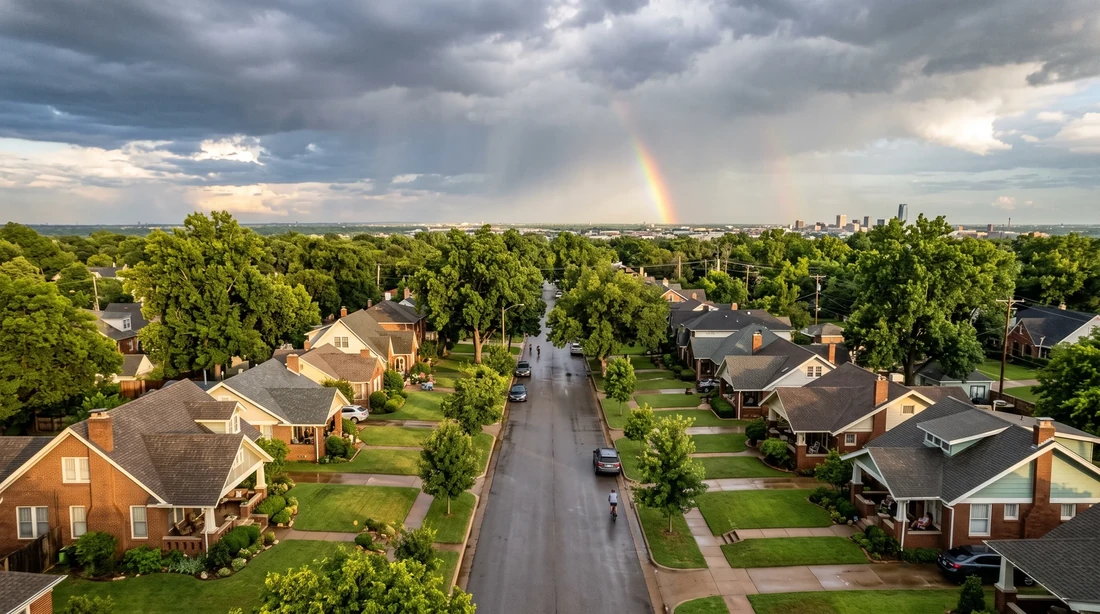
Oklahoma confirmed 105 tornadoes in 2025, well above the long-term average of 59 — including 39 in June, the most active June for tornadoes in state history. That total came right after 2024's all-time record of 152. Storm losses like these are a direct driver of Oklahoma's rising home-insurance premiums.
Key Takeaways
- Oklahoma confirmed 105 tornadoes in 2025, well above the long-term average of 59, right after 2024's all-time record of 152.
- June 2025 brought 39 tornadoes, the most active June for tornadoes in Oklahoma history.
- On March 14, 2025, 90 mph gusts made it the windiest day in Oklahoma Mesonet history and destroyed 530 structures.
- Storm losses like these are a direct driver of Oklahoma's rising home-insurance premiums and of families needing temporary housing.
This guide covers Oklahoma's 2025 tornado, flood, and wind numbers, how those storm losses feed into the home-insurance premiums you keep paying, and what the cycle means for a family whose rebuild is going to take months.
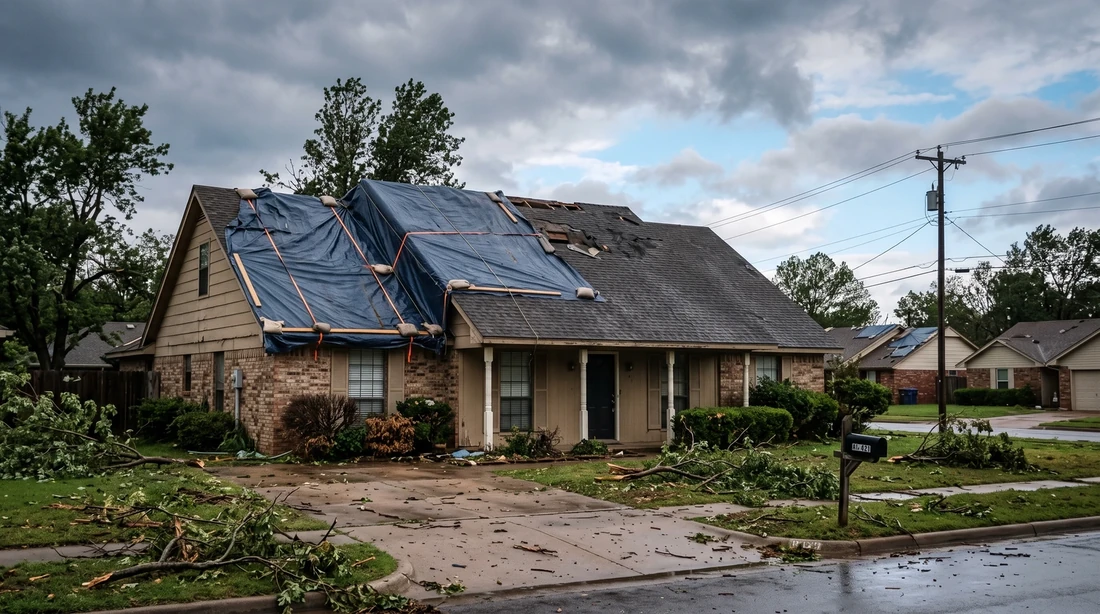
If you are reading this while a tarp flaps on your roof, or while an adjuster's estimate sits on your kitchen counter, the tornado count is more than trivia. It is the reason your renewal jumped and, possibly, the reason your family needs somewhere to live for the next few months.
We run 11 furnished homes across the OKC metro and place displaced families on their carrier's Additional Living Expenses (ALE) coverage, so we watch this storm-and-premium cycle up close. This is a data explainer first. The housing part comes at the end, honestly.
Every week a rebuild drags on, temporary-housing costs accrue against your ALE budget. A furnished home billed monthly typically stretches that budget further than open-ended hotel nights, and only your carrier decides what is covered.

How Many Tornadoes Hit Oklahoma In 2025?
Oklahoma logged 105 tornadoes in 2025 according to News9's year-in-review, nearly double the long-term average of 59. It was the second big year in a row. 2024 set the all-time state record of 152 tornadoes.
The year front-loaded its violence. March produced 15 tornadoes, 14 of them from a single March 4 outbreak. Then June exploded with 39 tornadoes, the most active June for tornadoes in recorded Oklahoma history.
The two strongest storms of the year were both EF3s: one near Arnett and one near McAlester. There was one tornado death, in Pontotoc County.
But 2025 was more than tornadoes. The state recorded seven flooding deaths and 245 flash-flood warnings. April rainfall topped 12 inches statewide, with some spots pushing near 20 inches. And on March 14, a wildfire-and-wind event brought 90 mph gusts, the windiest day in Oklahoma Mesonet history, destroying 530 structures, killing four people, injuring around 200, and knocking out power to 270,000.
Oklahoma City itself has a long tornado record:
The Oklahoma City metropolitan area is one of the most tornado-prone major cities in the world, with about 150 tornadoes striking within the city limits since 1890.
— Wikipedia: Oklahoma City
When Did the 2025 Damage Cluster?
The single most useful way to read the year is by when the damage clustered, because that is when claims spiked and when families were displaced in bunches.
| Period | What the data showed |
|---|---|
| March 2025 | 15 tornadoes (14 from the March 4 outbreak alone) |
| March 14, 2025 | Wind/wildfire event: 90 mph gusts, windiest day in Mesonet history; 530 structures destroyed; 270,000 outages |
| April 2025 | Statewide rainfall topped 12 inches; some spots near 20 inches; widespread flooding |
| June 2025 | 39 tornadoes — the most active June for tornadoes in Oklahoma history |
| Full year 2025 | 105 tornadoes (avg. is 59); two EF3s (near Arnett, near McAlester); 245 flash-flood warnings; 7 flood deaths; 1 tornado death |
Hail damage is the most common homeowners claim type in Oklahoma, according to the Oklahoma Insurance Department (OID). Tornadoes make the news. The routine hail and high-wind claims, thousands of them, year after year, are what quietly set premiums.
Why Does Your Home Insurance Keep Rising in Oklahoma?
In 2023, Oklahoma's top-20 home insurers paid out $129 in claims for every $100 of premium they collected. That is a losing ratio, and carriers recover it by raising rates. The figure improved to $97 per $100 in 2024, per OID, but two years of near- or above-breakeven losses do not reverse quickly.
OID names the drivers plainly: high winds, tornadoes, wildfires, flooding, inflation, and the rising cost of building materials and labor. When a roof costs more to replace and gets replaced more often, the math flows straight to your renewal.
The result is a national outlier. Oklahoma is now the most expensive state in the country for home insurance, averaging $5,298 a year, which is 121.2% above the national average per LendingTree's June 2026 data. In Oklahoma City specifically, NerdWallet's March 2026 figures put the average even higher, around $9,770 a year.
| Metric | Figure | Source / year |
|---|---|---|
| Claims paid per $100 premium (top-20 insurers) | $129 (2023) → $97 (2024) | OID, May 2025 |
| Most common homeowners claim type | Hail damage | OID |
| Oklahoma average annual premium | $5,298 (121.2% above U.S. avg.) | LendingTree, June 2026 |
| Oklahoma City average annual premium | ~$9,770/year | NerdWallet, March 2026 |
| Tornado count | 152 (2024) → 105 (2025) | News9 |
What Does This Mean If You're Facing a Rebuild?
For most homeowners, the storm statistics become personal at one specific moment: a hail-shredded roof or a wind-torn wall makes the home unlivable, and the adjuster approves temporary housing under your Additional Living Expenses (ALE), also called loss-of-use, coverage.
ALE is the part of your policy that pays for the extra cost of living somewhere else while your home is repaired. It is commonly figured as a percentage of your dwelling or personal-property coverage, and it reimburses the amount above your normal living expenses. Receipts substantiate the claim. Your carrier decides what is covered, not the contractor and not us.
Here is why the timing matters. A hail or wind claim during a busy season like Oklahoma's 2025 June (39 tornadoes) means contractors are backed up, materials are scarce, and rebuilds stretch from weeks into months. The longer the rebuild, the more temporary-housing cost accrues against a fixed ALE limit. That is exactly when the type of lodging you choose starts to matter to your family and your budget.
Displaced by an Oklahoma storm and need a place your family can actually live while your home is rebuilt? We place families on ALE coverage in furnished OKC homes and work with carriers and TPAs like Alacrity Solutions. Same-day options available.
A Hypothetical: Four Months on ALE After a Hail-and-Wind Claim
Say a family of four in northwest OKC loses their roof and part of a ceiling in a June hailstorm, and the rebuild is quoted at four months. This is a hypothetical to show the math, not a quote or a promise. Your carrier sets your actual coverage.
Two hotel rooms at roughly $170/night (you need two rooms for four people, and you want a fridge and laundry) runs about $170 × 2 × 120 nights = $40,800 before taxes and with no kitchen to cook in, meaning restaurant meals also draw down ALE.
A furnished home instead: BnB OKC publishes from-rates of $225 to $425/night, with monthly rates on 30+ night stays and direct-booking savings up to 35% on 4+ night stays. A single furnished house with a full kitchen and laundry consolidates the family under one roof and cuts restaurant spend. Because it bills monthly, it typically stretches a fixed ALE limit further than open-ended hotel nights. The exact figure depends on the home and your dates; get a written monthly rate and share it with your adjuster before you commit.
Which Temporary-Housing Option Fits Your Claim?
Not every claim needs a furnished home. Here is the honest breakdown of when each option fits.
| Option | Best when | Watch-out |
|---|---|---|
| Hotel / extended-stay hotel | 1–14 nights; single person or couple; you have loyalty points | No real kitchen; two rooms needed for families; meals draw down ALE fast |
| Furnished home (monthly) | 30+ nights; families; pets; you need a kitchen, laundry, and space to work | Get the monthly rate in writing for your adjuster first |
| Staying with family | Short gap; you have local relatives with room | ALE may not reimburse; strains everyone over months |
How to Line up Housing on ALE, Step by Step
- Find the ALE / loss-of-use line in your policy. Note the dollar limit or percentage and any daily or monthly cap.
- Confirm the adjuster has approved temporary housing in writing. Nothing is covered until the carrier says so.
- Gather a written monthly rate for a furnished home that fits your family size, pets, and rebuild timeline.
- Compare it against two hotel rooms plus meals over the same span, remembering that restaurant meals draw down ALE too.
- Share the written rate with your adjuster before you commit. Direct billing happens only with the carrier's or TPA's authorization.
- Keep every receipt. Receipts substantiate the claim, and the carrier decides what is reimbursed.
What to Check Before You Commit
- No written monthly rate. Your adjuster needs a number on paper before a furnished placement makes sense.
- Hotel by default for a months-long rebuild. Two rooms and three restaurant meals a day burn a fixed ALE limit fast.
- Staying with family and expecting reimbursement. ALE may not reimburse that arrangement, and it strains everyone over months.
- Assuming direct billing is automatic. It only happens with the carrier's or TPA's authorization.
- Treating any of this as a promise. Your carrier, not the contractor and not us, decides what is covered.
When You Don't Need a Furnished Home
If your repair is a few nights to two weeks (a single room, a quick roof patch), a hotel is often the simpler call, especially for a solo traveler or a couple chasing loyalty points. There is no reason to over-solve a two-week gap.
Where a furnished home changes the outcome is the long rebuild: 30-plus nights, a family that needs bedrooms and a kitchen, pets that hotels will not take, or a work-from-home parent who needs a desk and reliable space. Several of our homes are dog-friendly, and homes sleep from 2 to 16-plus. When the calendar says "months," one house usually beats two hotel rooms on both livability and ALE budget.
Terms You'll Hear, Decoded
- ALE (Additional Living Expenses): The policy coverage that pays the extra cost of living elsewhere while your home is repaired.
- Loss of use: Another name for the same coverage. It kicks in when your home is unusable due to a covered loss.
- Loss ratio: Claims paid divided by premiums collected; $129 per $100 means insurers paid out more than they took in.
- Direct billing: When the housing provider bills your carrier or TPA directly. This only happens with the carrier's or TPA's authorization.
- TPA (Third-Party Administrator): A company like Alacrity Solutions that manages placements and claims on a carrier's behalf.
For the full walkthrough of how carrier-paid placements work, see our insurance-housing hub. If you are weighing an extended stay generally, our extended-stay homes and pet-friendly OKC rentals pages show what is available. And if you are a homeowner curious about OKC rental rules, our guides on OKC short-term rental rules and OKC Airbnb enforcement cover it.
According to Airbnb, our homes hold a 4.8-star average across 1,247 verified guest reviews, and two carry Airbnb's "Guest Favorite" badge. That is the kind of track record that matters when your family needs somewhere stable for a season.
This guide is general information, not insurance or legal advice; your carrier makes all coverage decisions.
The Bottom Line
Oklahoma saw 105 tornadoes in 2025 on the heels of 2024's record 152. Hail remains the most common claim, and insurers paid out more than they collected in 2023. Those losses are why your premium keeps climbing. If a storm puts your family out of the house for months, check your ALE line, get a written monthly rate for a furnished home, and share it with your adjuster before you commit. Call or text (405) 295-5052 or use the request form on our insurance-housing page to check same-day availability for your dates.