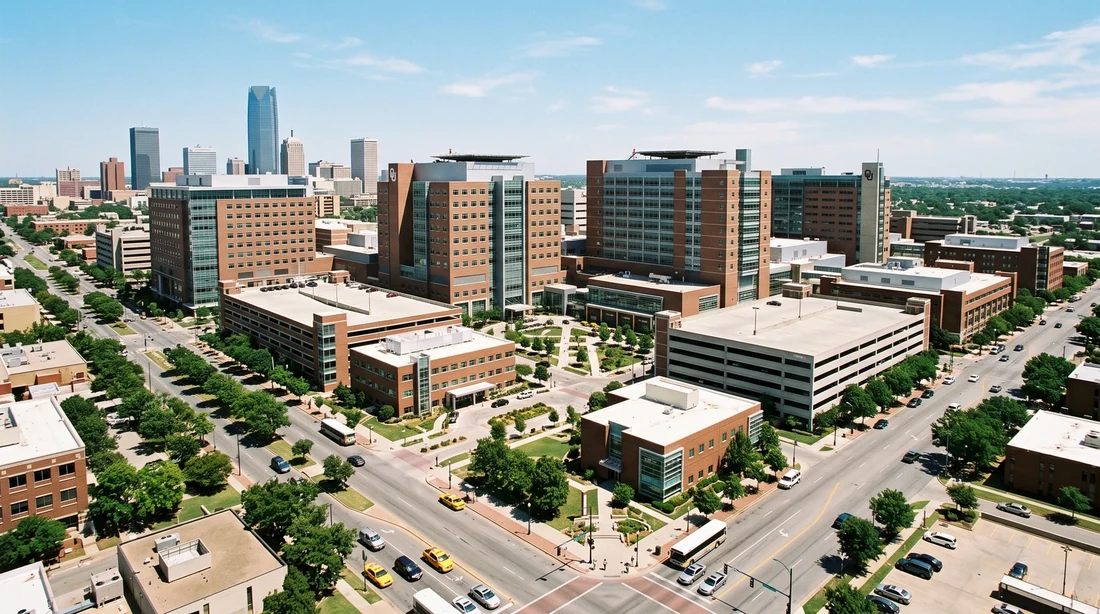
OU Medical Center parking for visitors runs through the campus garages and surface lots off NE 8th, NE 10th, and Lincoln Boulevard, with valet at the main entrances. Visitor rates are typically a few dollars for short stops and a low daily maximum — ask about validation at the desk. Guests staying directly across the street at Capitol Manor can walk over and skip parking entirely.
Key Takeaways
- Visitor parking uses campus garages and surface lots off NE 8th, NE 10th, and Lincoln Boulevard, with valet at main entrances.
- Parking is signed by building, not street, so get the building name when scheduling; Children's parking is signed separately from the adult hospital.
- Validation is not automatic: keep your printed garage ticket and ask at the department, information, or cashier desk before leaving.
- A hypothetical six-week run of 42 trips at about $12 daily, plus a second car and gas, totals roughly $775 to $875.
If a parent starts a six-week course of treatment on the OU Health campus in Oklahoma City, parking becomes a daily, repeating cost you did not budget for. This guide maps the garages and lots, explains the drop-off lanes, spells out how validation and accessible parking work, adds ride-share and seasonal-access tips, and shares the shift-worker tricks regulars use. The one fact that changes everything: Capitol Manor sits directly across the street from OU Medical Center and OU Children's Hospital, so many of our guests walk to the door and never touch a garage.
The OU Health campus is dense — OU Medical Center, Oklahoma Children's Hospital, the Harold Hamm Diabetes Center, and clinic buildings share the same few blocks just north of downtown. Parking is signed by building, not by street name, so knowing which entrance you need before you arrive saves the most time.
Every day you drive in and pay a garage is a cost that repeats. Over a six-week treatment run, daily parking plus gas across town quietly adds up to more than the walkable difference — the math is worked below.

Why Parking at OU Medical Center Is Confusing
The OU Health campus packs several hospitals and clinics into a few blocks, so "OU Medical Center parking" is really a handful of separate garages and lots that each serve different buildings. First-time visitors circle because the sign at the street names a building, not the destination they were told over the phone.
The campus sits just north of downtown OKC, bordered roughly by Lincoln Boulevard to the west and the NE 8th to NE 13th corridor. Oklahoma Children's Hospital, OU Medical Center's main tower, and the outpatient clinics each have their own preferred parking. If you are told to report to "Everett Tower" or "Children's," that tells you which garage — write the building name down when you schedule.
A few realities shape every visit here:
- Visitor garages are separate from employee and physician parking, and separate from patient valet.
- The closest garage to your building may fill by mid-morning on clinic days.
- Rates, hours, and validation can change, so the numbers below are ballparks to confirm at the booth or desk, not quotes.
For context on the campus and its hospitals:
Headquartered in Oklahoma City , OU Health includes three hospitals—University of Oklahoma Medical Center, Oklahoma Children's Hospital OU Health, and OU Health Edmond Medical Center—as well as dozens of clinics and specialty centers across the state.
Wikipedia: OU Health
Visitor Garages and Lots on the OU Health Campus
The garage attached to the building you are visiting is almost always your best bet — it puts you closest and usually qualifies for the same validation. Below is how the main visitor parking areas line up with the buildings they serve on the OU Health campus.
| Parking area (general) | Best for | Watch-outs |
|---|---|---|
| Main hospital visitor garage | OU Medical Center inpatient tower, ICU visits, surgery waiting | Fills first on weekday mornings; keep your ticket for validation |
| Children's Hospital garage | Oklahoma Children's Hospital appointments and family visits | Family-heavy midday; strollers make the covered garage worth it |
| Outpatient / clinic surface lots | Short clinic visits, labs, imaging, follow-ups | Time-limited in places; check posted signs for a max |
| Valet at main entrances | Mobility needs, dropping a patient, bad-weather days | Small valet fee typical; tip cash; not for all-day parking |
Because building names, garage assignments, and rates get renumbered over time, confirm the specific garage with the department when you book the appointment. If you are visiting Oklahoma Children's Hospital, ask specifically for the Children's parking — it is signed separately from the adult hospital.
Drop-off and pick-up points
Every main hospital entrance on the campus has a covered drop-off lane where you can let a patient out at the door before you go park. Use it when a family member is in pain, in a wheelchair, or when the weather is bad. Pull into the lane, let the patient in with a companion, then move your car — the lanes are for active loading, not waiting.
For Oklahoma Children's Hospital, the family drop-off is at the main Children's entrance; a greeter or security officer can point you to the nearest visitor garage from there. Do not leave a car unattended in a drop-off lane — it will be asked to move.
How validation works
Validation can reduce or waive the visitor parking fee, but it is not automatic — you have to ask. Many hospital campuses validate at the department desk, the information/greeter desk, or the cashier for patients and their visitors. Keep your printed garage ticket with you and present it before you leave.
Rules vary by building and by whether you are a patient, a caregiver of an inpatient, or a general visitor, so the honest answer is: ask at the desk of the department you are visiting on day one, and again if you are coming daily. Families of admitted patients often qualify for a reduced multi-day or weekly arrangement — worth asking about at the start of a long stay.
Accessible (ADA) parking and mobility needs
Every visitor garage and surface lot on the campus reserves accessible spaces near the elevators and entrances for vehicles displaying a valid disability placard or plate. If a patient uses a wheelchair, a walker, or tires quickly, combine the drop-off lane with an accessible space: drop them at the covered door first, then park in the reserved spots closest to the elevator bank.
Bring the placard — Oklahoma requires it be hung or displayed whenever you use an accessible space, even briefly. If the reserved spaces near your building are full, ask the greeter or security officer, who can sometimes point you to a closer lot or hold the valet lane. For patients who cannot manage any walk, valet at the main entrance is usually the shortest path from car to door.
What OU Medical Center Visitor Parking Costs
OU Medical Center visitor parking is typically priced in short-stay increments with a daily maximum, plus a separate small fee for valet. Because the campus sets and updates its own rates, treat any figure you see online as a ballpark and confirm the current cost at the garage entrance or cashier.
What matters more than the exact number is the pattern: a single visit is cheap, but a repeated daily visit over weeks turns into a real line item. That is the trap for families settling in near the hospital for a long treatment course — the per-day fee feels trivial, and then you add it up.
- Day one: you pay a daily garage fee, feel fine about it, and forget to ask about validation.
- Week one: you are driving in from a hotel across town, paying parking daily plus gas, and circling for a spot on clinic mornings.
- Week three: the parking and driving have become the most stressful part of the day, and the daily fee has quietly grown into a three-figure total.
- Week six: you total it up and realize a walkable base would have erased the whole category.
Staying near the OU Health campus for weeks of treatment? Capitol Manor is directly across from OU Medical Center and Oklahoma Children's Hospital — walk to the door and skip the garage. Check dates or ask about a monthly rate.
Your Parking Options, Compared
The right parking choice depends on how long you will be on campus and how often you are coming back. A one-time surgery visit and a six-week daily treatment run call for completely different plans.
| Option | Who it fits | Watch-outs |
|---|---|---|
| Visitor garage, pay daily | Occasional visits, single appointments | Cost repeats fast on daily visits; ask for validation every time |
| Valet at the entrance | Mobility needs, weather, dropping a patient | Fee plus tip; not economical for all-day or repeat use |
| Multi-day / caregiver arrangement | Families of admitted (inpatient) patients | Not offered everywhere; you must ask at the department desk |
| Ride-share or drop-off, no car parked | Single visits, no driver available, non-drivers | Surge pricing on event days; still repeats as a daily cost |
| Walk from lodging across the street | Multi-week treatment, families settling in near campus | Requires staying within walking distance (e.g., Capitol Manor) |
If you are still deciding where to sleep during the treatment run, compare the trade-offs in our guides to hotels near OU Medical Center and where to stay near OU Children's Hospital — parking cost is one of the hidden differences between a hotel across town and a walkable furnished home.
Ride-share, no-car, and drop-off alternatives
If you don't have a driver or a car for the day, ride-share drops you right at the covered entrance and removes the parking question entirely — but it is still a daily cost, not a one-time one. Uber and Lyft both serve the campus; have the driver use the same main-entrance drop-off lanes visitors use, then a greeter can direct you inside.
Watch for surge pricing on days when downtown OKC events overlap — Thunder game nights at Paycom Center, the OKC Memorial Marathon in late April, or big weekends can push fares up and slow pickups. If you're coming daily for weeks, ride-share adds up the same way a garage fee does, which is exactly why a walkable base changes the math for long stays.
Getting to the OU Health Campus: Access, Seasons, and Closures
The OU Health campus is reachable in minutes from I-235 and I-40, but the approach and drive time depend heavily on where you're staying and the season. A walkable base removes the drive entirely; from farther out, plan for the OKC realities below.
| Where you're staying | Typical drive to campus | Best for |
|---|---|---|
| Directly across the street (Capitol Manor) | Walk — no drive, no parking | Multi-week treatment, daily visits, families |
| Downtown / Midtown OKC | ~5–10 minutes | Short stays, single appointments |
| The Village / North OKC | ~15–20 minutes via Lincoln or I-235 | Longer stays wanting quieter neighborhoods |
| Lake Hefner / NW OKC | ~20–25 minutes | Families wanting space away from downtown |
Seasons matter on this campus. In late April the OKC Memorial Marathon closes streets across downtown and near the campus for most of a Sunday morning — if you have a weekend appointment that day, leave extra time or plan a walk. Winter ice storms can make the garage ramps and campus hills slow; give yourself margin.
During tornado season (April through June), sudden severe weather can snarl the cross-town drive from a hotel, which is one more reason walkable lodging simplifies a long medical stay. September's State Fair of Oklahoma draws traffic to the fairgrounds west of the campus, not to the hospital itself, but it can thicken the surrounding interstates at rush hour.
How to Park at OU Medical Center as a Visitor, Step by Step
Follow this order to skip the circling and the surprise fees.
- Get the building name when you schedule — "OU Children's," the main tower, or a clinic — so you know which garage.
- Drop the patient first at the covered entrance lane if anyone has trouble walking, then go park.
- Pull a ticket at the visitor garage attached to that building and keep it with you.
- Ask about validation at the department or information desk before you leave, especially for daily or long visits.
- Ask about a caregiver rate if your family member is admitted for a multi-day stay.
- Note your level and row — the campus garages look alike, and you will be tired on the way out.
Shift-Worker and Daily-Visitor Tips
Regulars on the OU Health campus save the most time by arriving before the morning clinic rush and by parking in the same spot every day. If you are a caregiver coming daily — or a travel nurse working the floor — these habits cut the friction.
- Weekday mornings are the crunch; the closest garage to a busy building can fill by mid-morning on clinic days.
- Park on the same level and row each day so you never search for the car after a long shift.
- Keep small bills for valet tips and any cash-only lot.
- If you work nights, ask your employer or the security desk about designated staff parking — visitor garages are not built for shift routines.
- Screenshot your garage level as a photo on your phone the moment you park.
- If you drive an EV, don't count on charging in a visitor garage — availability varies, so charge before you arrive rather than plan around a campus charger.
Travel nurses working the campus have a bigger version of this problem — parking is a daily cost for a 13-week contract. Housing choice drives it. See travel nurse housing in Oklahoma City and the best neighborhoods for travel nurses for how a walkable base changes the math.
A Worked Example: Parking Cost Over a 6-Week Treatment Run
Here is a clearly hypothetical example for a family staying near the hospital during a parent's six-week treatment. The point is to show how the small daily number grows — not to quote a real rate.
Say the treatment runs weekdays for six weeks — about 30 clinic days — plus a handful of weekend visits, call it 42 trips. Assume a hypothetical daily garage fee in the ballpark of $12, and that you sometimes bring a second car for family, adding a few more paid days.
- Base parking: 42 days × ~$12 = about $504
- Extra family car on ~10 days: 10 × ~$12 = about $120
- Gas driving in from a hotel across town, ~20 minutes each way daily: easily $150–$250 over six weeks
- Rough all-in driving-and-parking total: ~$775–$875
Now compare the base itself. A family often has around $3,200 a month in housing budget to work with (whether self-paid or reimbursed). A furnished home within walking distance folds the parking category to zero and removes the daily cross-town drive — so the housing dollars stretch further because the parking-and-gas line disappears. If your treatment base is Capitol Manor, directly across the street, you walk to the appointment and the ~$800 parking-and-driving problem never starts. Actual costs vary; confirm current parking rates on campus and your own housing rate before you plan.
A second variant: a longer NICU or recovery stay
Now stretch the same family further. Say the reason for the stay is a newborn in the NICU or a parent recovering over eight weeks, and someone is at the hospital nearly every day, including weekends — call it 55 trips.
- Parking: 55 days × ~$12 = about $660
- Second car on ~15 days (grandparents helping with other kids): 15 × ~$12 = about $180
- Gas cross-town over eight weeks: roughly $200–$300
- Rough all-in: ~$1,040–$1,140
Against a ~$3,200 monthly housing budget, that's an extra month's worth of parking-and-gas erased by walking across the street — money that can go toward the longer stay itself or toward meals during a hard season. A travel nurse on a 13-week contract hits the same wall from the other direction: roughly 60–65 shift days of parking can run well past $700 before a single tank of gas, which is why the housing decision and the parking decision are really one decision.
When You Don't Need a Walkable Stay
If you are on campus for a single appointment, a one-day surgery, or a short two-night stretch, the visitor garage is the right call — pay the daily fee, ask for validation, and go home. A local resident or someone with a short errand does not need lodging at all, and ride-share to the door can be the simplest choice of all for a one-off.
A walkable furnished home changes the outcome when the visits repeat: a multi-week treatment course, a NICU stay, a parent recovering over weeks, or a travel-nurse contract. In those cases the daily parking fee, the gas, and the mental load of driving and parking every day are the hidden cost — and a home directly across the street removes all three. Families with kids, pets, or the need for a kitchen and laundry during a long stay feel the difference most, because a walkable base also lets one parent stay at bedside while the other manages the household nearby.
Weighing a hotel against a furnished home for a longer stay? Our comparison of hotels near INTEGRIS Baptist shows the same trade-off on OKC's other big hospital campus, and Furnished Finder vs Airbnb for travel nurses breaks down booking channels for long medical stays.
Terms You'll Hear, Decoded
- Validation: a stamp or code from a hospital desk that reduces or waives your garage fee — you must ask for it and keep your ticket.
- Valet: attended parking at the entrance for a small fee plus tip; convenient for drop-offs and mobility needs, not for all-day use.
- Visitor vs. patient parking: separate areas — patients and caregivers of admitted patients sometimes qualify for reduced rates that general visitors don't.
- Caregiver / multi-day rate: a reduced arrangement some campuses offer families of admitted patients; not universal, so ask at the department desk.
- Accessible (ADA) parking: reserved spaces near entrances and elevators for vehicles with a valid disability placard or plate; the placard must be displayed even for a brief stop.
- Drop-off lane: the covered lane at each main entrance for actively loading or unloading a patient — never for waiting or leaving a car unattended.
BnB OKC operates 11 furnished homes across the OKC metro and holds a 9.5 out of 10 average across 1,580 verified guest reviews on Airbnb and Vrbo. Capitol Manor's location across from the OU Health campus is why medical-stay families book it — you can browse our extended stays and insurance housing options, or book direct for up to 35% savings on 4+ night stays.
Your Next Steps
- Confirm the building you are reporting to — OU Medical Center main tower, Oklahoma Children's, or a clinic — so you know the exact garage and can ask about validation on day one.
- Add up your visits. If you'll be on campus more than a few days, tally likely parking days and gas against the cost of a walkable base.
- Skip parking entirely. Check dates at Capitol Manor, directly across from the campus, or call or text (405) 870-2146 for a monthly rate on a longer treatment stay.