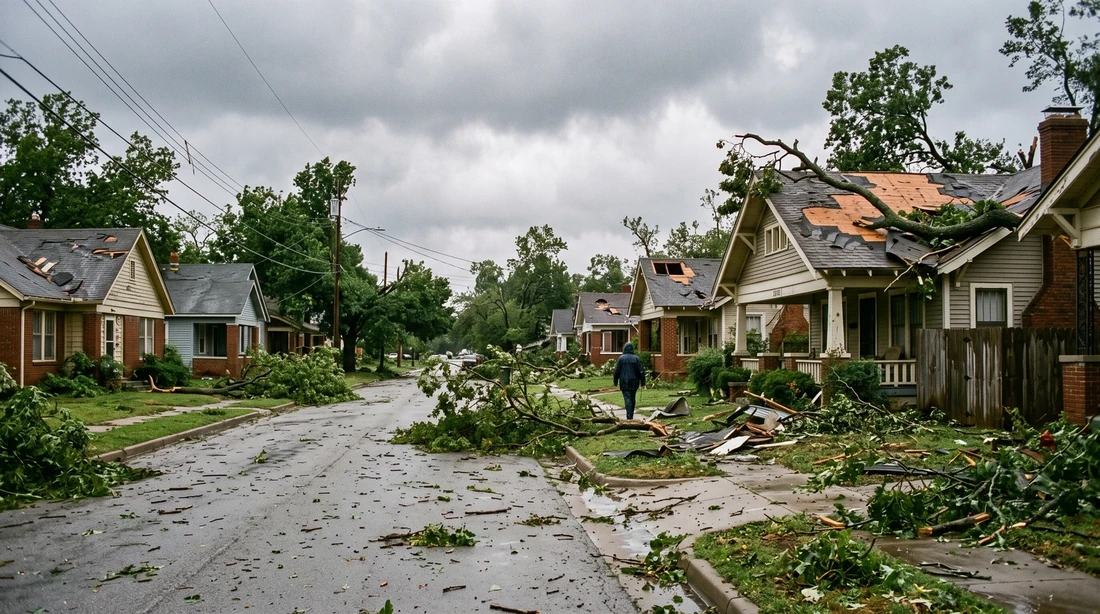
A public adjuster in Oklahoma must be licensed, and the Oklahoma Insurance Department (OID) says to confirm that license and get a written contract before you sign. A 2025 law caps public-adjuster fees at 10% of a settlement — but only for public agencies, not private homeowners. For your house, the percentage in your contract is the whole game, so read it before you sign anything.
Key Takeaways
- The Oklahoma Insurance Department says to confirm a public adjuster's license and get a written contract before signing.
- HB 1501 caps public-adjuster compensation at 10% of the settlement, but only for public agencies and political subdivisions.
- HB 1084 bans the assignment of post-loss benefits as of November 1, 2025, so contractors cannot step in as the claimant.
- Oklahoma insurers must respond to a proof of loss within 60 days under 36 O.S. § 1250.7.
This guide covers what the two November 1, 2025 Oklahoma laws changed, the difference between a public adjuster, an appraiser, and the carrier's adjuster, the free dispute routes to try first, what a fee percentage costs in dollars, and how to vet a public adjuster before you sign.
Your settlement check came in low, a contractor's estimate says the damage is worse, and now a public adjuster is offering to take over your claim for a cut. Two questions are colliding in your head at once. Is this person legitimate, and is the fee worth it? Both have concrete Oklahoma answers, and there are free options most homeowners never try first.
Two Oklahoma laws took effect November 1, 2025. And while your claim drags on, the clock never stops. Oklahoma insurers must respond to a proof of loss within 60 days (36 O.S. § 1250.7), and every week a big disputed claim stalls, your family may still be displaced and paying for somewhere to live.

What Changed in Oklahoma In 2025?
Two bills reshaped how disputed property claims work in Oklahoma as of November 1, 2025. Neither one lowers the fee a private homeowner pays a public adjuster, which is why the details matter more than the headlines.
The first, HB 1501 (36 O.S. § 6224), caps a public adjuster's total compensation (commissions, expenses, and other costs combined) at 10% of the insurance settlement. But per the Property Insurance Coverage Law Blog's read of the statute, that cap applies only to public adjusters representing political subdivisions and public agencies. If you're a private policyholder on a homeowners claim, this cap does not protect you. Whatever percentage your contract states is what you owe.
The second, HB 1084 (36 O.S. § 1230(B)), bans the assignment of post-loss benefits. In plain terms, a contractor can no longer step into your shoes as the claimant. That changes the calculus. If you want someone other than the carrier's own adjuster arguing your claim value, a licensed public adjuster is now your only authorized outside representative.
| Date | Change | Who it affects |
|---|---|---|
| Before Nov 1, 2025 | No statutory PA fee cap; benefit assignment (AOB) allowed in practice | All policyholders and contractors |
| Nov 1, 2025 — HB 1501 | 10% total PA compensation cap | Public agencies / political subdivisions only |
| Nov 1, 2025 — HB 1084 | Post-loss benefit assignment (AOB) banned | Homeowners and contractors |
| Ongoing — 36 O.S. § 1250.7 | Insurer must respond to proof of loss within 60 days; denials in writing citing the specific provision | All first-party claimants |
Major storm claims are a real part of life in the OKC metro.
A second top-of-the-scale tornado occurred on May 20, 2013, when an EF5 —estimated to be 0.5 to 1.3 miles (0.80 to 2.09 km) in width—struck portions of South Oklahoma City, Newcastle and Moore ; 23 people, including eight children at a Moore elementary school, were killed by the tornado.
— Wikipedia: Oklahoma City
Who Pays a Public Adjuster, an Appraiser, and the Carrier's Adjuster?
The single most common point of confusion in Oklahoma claim disputes is mixing up three different roles. They are not interchangeable, and only one of them charges you a percentage of your money.
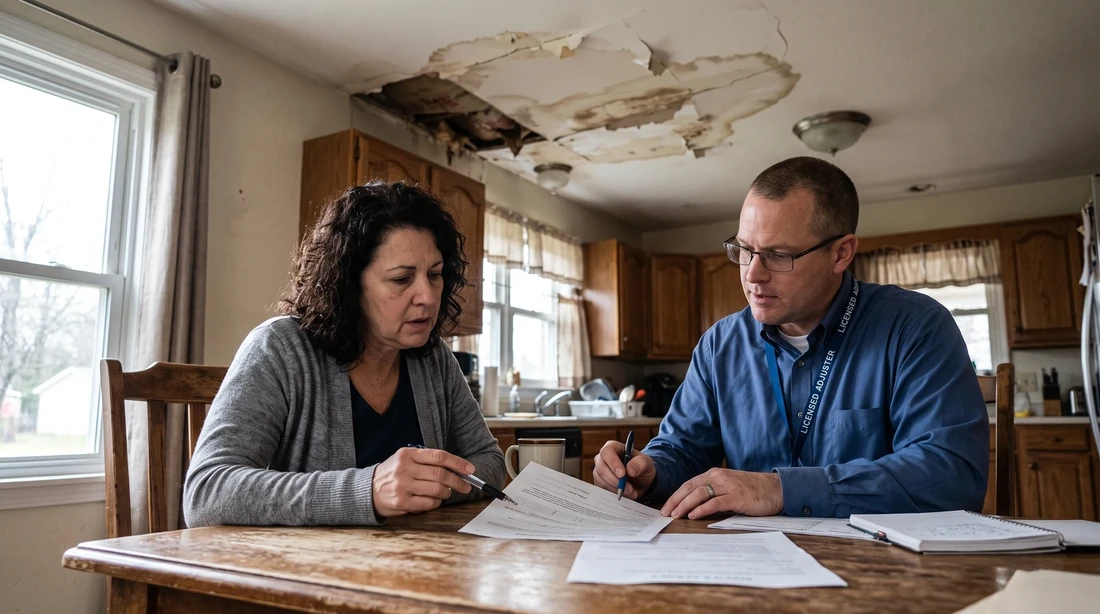
The company or carrier adjuster works for your insurer and is paid by the insurer. Per OID, that adjuster should never ask you for payment. The appraiser is a role invoked under the appraisal clause many policies contain, a way to resolve a valuation dispute without a lawsuit. A public adjuster is a licensed professional you hire to document, present, and negotiate your claim, and they take a percentage of what you recover.
| Role | Who pays them | What they do |
|---|---|---|
| Carrier / company adjuster | Your insurer (never you) | Estimates and settles the claim on the insurer's behalf |
| Appraiser | Each side pays its own; umpire split | Resolves a value dispute under the policy's appraisal clause |
| Public adjuster | You — a % of your settlement | Documents, presents, and negotiates your claim for you |
What Should I Do Before Hiring a Public Adjuster?
OID's guidance is short and firm. If you use a public adjuster, make sure they're licensed and get a written contract before signing. Both steps take minutes, and both prevent the horror stories that clog claim forums: the adjuster who demands more than the agreed commission after the check clears, and the eight-month standoff where a PA estimate towers over the contractor's.
Verify the license first through OID's Licensee Look Up. An unlicensed "adjuster" is a red flag you can catch for free in about a minute. Then read the contract for the one number that governs everything: the percentage, and whether it applies to the whole settlement or only new money the PA recovers above the carrier's first offer.
A big disputed claim can mean months of displacement while the numbers get fought over. Direct-billed furnished housing keeps your family in one stable home — with a kitchen and laundry — so the fight over your settlement doesn't also mean shuffling between hotels. See how insurance placements work, or call us for same-day options.
Insurance & displacement housing in OKC | Call or text (405) 295-5052
What Free Alternatives Do Most Homeowners Skip?
Before signing away a percentage, know that Oklahoma offers two dispute paths that cost you nothing. They don't fit every situation. They do solve a lot of the disputes people hire a PA for.
- File an OID consumer complaint. The Oklahoma Insurance Department takes complaints by phone at 800-522-0071 or through its online portal. This is free and often prompts a carrier to re-examine a lowball offer.
- Request EAGLE mediation. Oklahoma's Supreme Court-certified EAGLE program handles first-party valuation disputes, the "my estimate is higher than theirs" standoff, without a percentage fee eating your recovery.
- Hold the carrier to the 60-day rule. Under 36 O.S. § 1250.7, the insurer must respond to your proof of loss within 60 days and put any denial in writing citing the specific policy provision. A written denial gives you something concrete to challenge.
What Does the PA Percentage Cost in Dollars?
A hypothetical: Here is a clearly hypothetical example to show why the contract percentage is the whole game. Say a kitchen fire produces a first carrier offer of $60,000, and you believe the true loss is closer to $95,000.
A public adjuster on a 10% contract that applies to the entire settlement recovers the full $95,000. Your fee is $9,500, netting you $85,500 (clearly better than the $60,000 you'd have taken alone). But if the PA only gets you to $75,000, your fee is still $7,500 on the whole amount, netting $67,500. That is a $7,500 gain rather than the $15,000 the raw number suggests. Compare a contract that charges 20% only on new money above the $60,000 offer: on a $75,000 recovery, that's 20% of $15,000, or $3,000. The structure decides your take-home as much as the rate does. These figures are hypothetical; your policy, your loss, and your contract determine the real math.
How to Vet a Public Adjuster in Oklahoma, Step by Step
- Verify the license. Search the adjuster's name in OID's Licensee Look Up before any conversation about signing.
- Get the contract in writing. OID says never sign without a written contract. Read every line, including cancellation terms.
- Pin down the fee structure. Confirm the percentage and whether it applies to the total settlement or only new money recovered above the carrier's offer.
- Ask about the free routes first. Confirm you've considered an OID complaint or EAGLE mediation, which cost you nothing.
- Get the timeline in writing. Ask how the PA handles the 60-day insurer response window and what happens if the claim stalls.
- Keep your own records. Save every estimate, photo, and written denial. You own the claim, not the PA.
Red Flags to Check Before You Sign
- No license on OID's Licensee Look Up. Walk away. The check takes about a minute and costs nothing.
- No written contract, or one you were rushed through. OID says never sign without one.
- A percentage that applies to the whole settlement, including the carrier's first offer. Read the hypothetical above. The structure can swallow most of the gain.
- Anyone claiming the 2025 fee cap protects you. HB 1501's 10% cap applies to public agencies and political subdivisions only.
- A contractor asking you to assign your claim. Post-loss assignment of benefits has been banned in Oklahoma since November 1, 2025.
- A carrier adjuster who asks you for payment. Per OID, they never should.
- No one has tried the free routes. An OID complaint and EAGLE mediation cost you nothing and close many valuation gaps.
When Is a Public Adjuster Worth It?
A public adjuster earns their fee on large, complex, or contested losses where the gap between offers is bigger than the percentage. A total house fire, major water damage, or a claim the carrier has denied in writing are the cases where professional documentation and negotiation move real money.
You may not need one for a small, clearly-covered claim, a fast fair offer, or a valuation gap that EAGLE mediation could close for free. The honest test: if the fee is likely to exceed the extra you'd recover, the free OID and mediation paths deserve a try first. Whatever you choose, a long dispute usually means a long displacement. That's where keeping your family in a stable furnished home, instead of burning weeks in hotels, protects your budget and your sanity.
Terms you'll hear, decoded
- Public adjuster (PA): A licensed professional you hire to document and negotiate your claim, paid a percentage of your settlement.
- Carrier / company adjuster: The adjuster paid by your insurer; per OID, they should never ask you for payment.
- Appraisal clause: A policy provision to resolve a value dispute using each side's appraiser and a neutral umpire.
- Assignment of benefits (AOB): Signing your claim rights over to a third party, banned for post-loss benefits in Oklahoma as of Nov 1, 2025 (HB 1084).
- Proof of loss: Your documented claim of what was damaged and its value; insurers must respond within 60 days (36 O.S. § 1250.7).
- EAGLE mediation: Oklahoma's Supreme Court-certified program for first-party valuation disputes, at no percentage cost to you.
While your claim plays out, our insurance housing team can coordinate 30+ night furnished stays so a slow settlement doesn't force your family from hotel to hotel.
Primary sources: the OID Licensee Look Up, OID's After the Disaster guidance, and the Property Insurance Coverage Law Blog analysis of HB 1501 and HB 1084.
The Bottom Line
Confirm the license on OID's Licensee Look Up and find the exact percentage in the written contract, including whether it applies to your whole settlement or only new money. Pull your proof of loss, any written denial citing a specific provision, and the OID complaint line (800-522-0071) so you can compare a free route against a paid one. If a disputed claim is keeping your family displaced, see our insurance-housing options or call (405) 295-5052 for same-day, direct-billed furnished stays.
This guide is general information, not insurance or legal advice; your carrier makes all coverage decisions.