Yes — ALE (loss-of-use) coverage can pay for an RV or travel trailer as temporary housing after a covered loss, including the rental, delivery, hookups, and permits. But it only pays when the total cost is reasonable and comparable to other housing for your household. Your carrier decides, so get it approved in writing before you sign anything.
Key Takeaways
- ALE (loss-of-use) coverage can pay for an RV, including rental, delivery, hookups and permits, if the total cost is reasonable.
- Get written adjuster authorization before renting; costs incurred without approval can be denied, and ALE covers rentals, not RV purchases.
- A seven-week trailer stay for a couple totals about $5,463 versus roughly $5,950 for a furnished home at $3,400 monthly.
- Permits, HOA bans, tornado season, 100-degree summers and freezing winter lines all limit whether a trailer is livable.
This guide covers when ALE will and will not pay for a trailer, the hookup and permit costs the sales pitch leaves out, what Oklahoma's seasons do to RV living, the all-in cost against an extended-stay hotel and a furnished home, three worked examples, and the five steps that keep an RV claim clean.
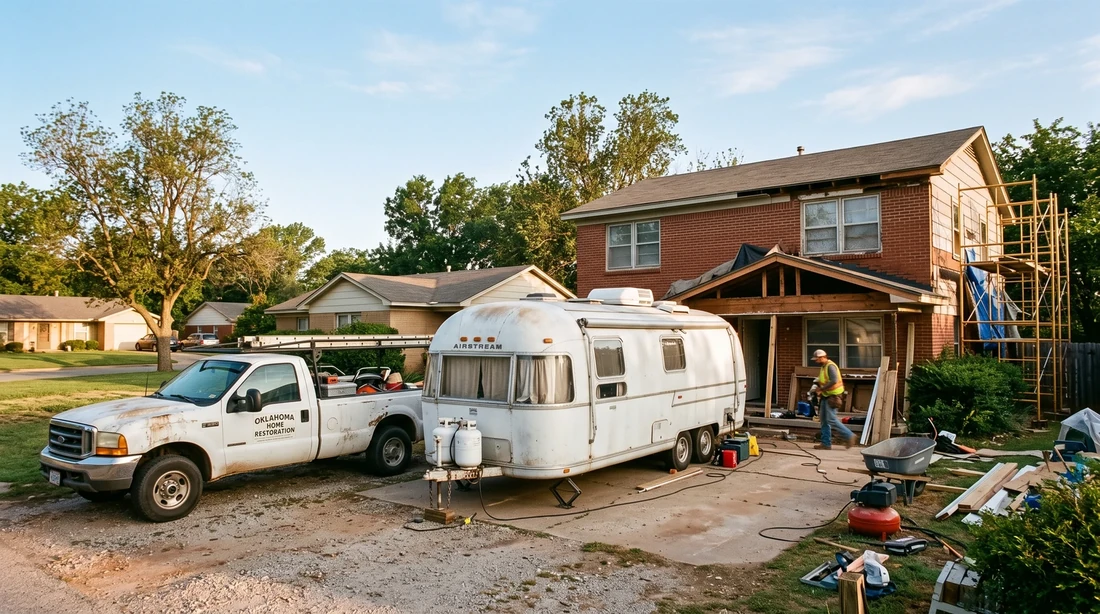
Your house took on water from a burst pipe, a restoration vendor is quoting a six-to-eight-week rebuild, and someone (maybe the contractor, maybe an ad) floated the idea of parking a travel trailer in your own driveway so you can "stay on site." It sounds cheap and convenient. Three things decide whether it works.
First, an RV on your property is not automatically cheaper than a furnished home once you add delivery, hookups, permits, and dump fees. Second, ALE only reimburses what your carrier authorizes in advance, so a trailer you rent on your own can be denied. Third, a 200-square-foot trailer is a very different living space than a house for a two-month rebuild, and in Oklahoma the season you are displaced in changes that math too.
Get written authorization before you rent an RV. Many carriers will not reimburse temporary-housing costs you incur without approval. A signed trailer lease you took on yourself can leave you eating the bill.

Why Does the on-Site RV Idea Come up at All?
The RV-in-the-driveway option is usually pitched for one of three reasons: staying close to the rebuild, keeping pets and pastures, or a belief that it is the cheapest path. Sometimes it is the right call. Often it is not, and knowing which is which saves you weeks of hassle.
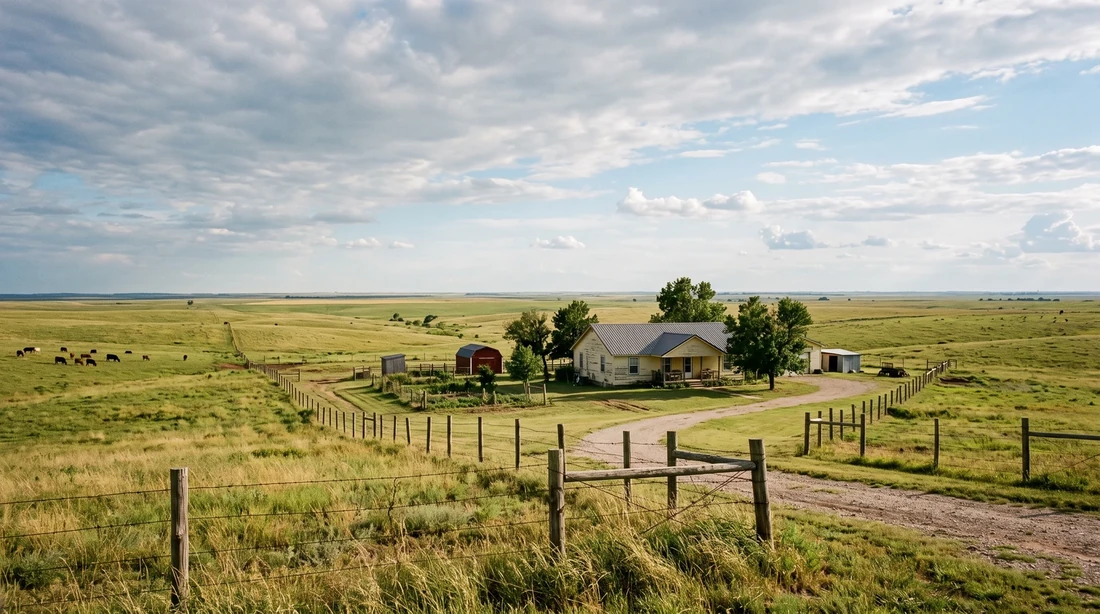
People reach for a trailer when the property has land, animals, or a small business they cannot leave. If you run a working acreage outside the city, say near Tinker AFB to the southeast or on rural land toward El Reno, Tuttle, or Piedmont, being on site to feed livestock or meet contractors every morning is a real reason a trailer beats a house across town. The OKC metro is spread wide, and a rebuild in far Edmond or Norman can put a cross-town furnished home 30 to 40 minutes from your property.
The other driver is money. A trailer rental sticker price can look lower than a monthly furnished-home rate. The sticker is never the total, though, and that gap is where most people get surprised. We price it out below.
ALE (Additional Living Expenses, also called loss-of-use) is the part of your homeowners or renters policy that pays the extra cost of living somewhere else while your home is unlivable. It is the same coverage bucket whether you land in a hotel, a furnished home, or an RV. If you are new to how this works, start with loss of use coverage explained.
On why an uncovered peril leaves you without ALE at all:
However, if something happens to the home, and the event is on the exclusions list, the policy will not provide coverage.
Wikipedia: Home insurance
When Will ALE Pay for an RV, and When Will It Refuse?
ALE typically pays for an RV when it is a reasonable housing choice and the cost is in line with other options for your household size. "Additional" and "reasonable" are the two words that govern everything.
Carriers pay the difference between your normal living costs and your temporary ones. If a rented trailer plus hookups costs a reasonable amount for two people during a covered repair, that is squarely the kind of expense ALE is built for. Keep every receipt. Receipts substantiate ALE claims.
Where it gets denied or trimmed:
- Buying an RV instead of renting. ALE covers rental costs, never the purchase of an asset you keep after the claim closes. If a vendor suggests you buy, expect pushback.
- A luxury coach when a modest trailer would do. Coverage tracks "reasonable," which is a different thing from "nicest." A $6,000 a month diesel motorhome for a couple invites a partial denial.
- Costs incurred without authorization. The most common trap. Get the adjuster's approval in writing first.
- Uncovered perils. If the underlying loss is not covered, there is no ALE. Flood from rising water, for example, is different from a burst indoor pipe.
- Site rent or lot fees that outrun a home. If your city will not allow the trailer on your lot and you have to park it in an RV park, the monthly space rent can erase the savings, and the carrier only owes "reasonable."
Your carrier and adjuster make the final call on all of this. If they have already said no, read insurance denied temporary housing for how to respond.
What Do Hookups, Permits, and the Site Require?
An RV needs power, fresh water, sewer or a dump plan, and, on many OKC-area lots, a permit to be lived in, even on your own land. These are the costs the "just park a trailer" pitch leaves out.
Here is what a trailer on your property requires:
- Electric: Most travel trailers need a 30- or 50-amp connection. A standard house outlet will not run the AC, which matters in an Oklahoma summer. An electrician may need to add a proper hookup, and if your house power is off for the repair, the trailer may have to run on the neighbor's feed or a generator.
- Water: A hose bib works for fresh water, but pressure and freeze protection matter in winter.
- Sewer: Either a sewer connection or regular trips to a dump station, plus tank chemicals.
- Permits: Many municipalities restrict how long you can occupy an RV on a residential lot and require a temporary permit tied to an active building permit. Rules differ between Oklahoma City, Edmond, Norman, Moore, and the unincorporated county, and HOAs often ban RV occupancy outright regardless of city code. Check with your local code office before assuming you can.
- Leveling and tie-down: Setup on an uneven driveway or yard is not free, and Oklahoma wind makes proper anchoring more than a formality.
- The overlooked basics: internet for anyone working from home, weekly trash pickup (an RV park handles it; your driveway does not), mail delivery to a home that is under construction, and driveway or lawn damage from a heavy trailer and its jacks. None of these are large on their own. Together they are another reason "free driveway parking" is not free.
None of this is a dealbreaker on rural acreage with existing hookups. On a suburban lot mid-rebuild, with contractors, dumpsters, and no functioning household plumbing, it is often more friction than it is worth. If the permit is denied, you are back to square one with a trailer you cannot legally live in.
What Do Oklahoma's Seasons Do to RV Living?
The month you are displaced changes whether a trailer is livable at all. Oklahoma's weather is hard on a 200-square-foot box. This is the piece the cost sheet never shows, and it matters more than a few hundred dollars.
Tornado season peaks April through June, and a travel trailer is the single worst place to be during a warning. The National Weather Service routinely tells people to leave mobile structures for a sturdy building. If you are parked beside a gutted house with no safe interior room, you have nowhere to shelter.
Summer is the next problem: OKC regularly runs 100°F-plus in July and August, and a single rooftop AC unit struggles to keep a trailer cool through the afternoon. Winter flips it. Exposed water lines and holding tanks freeze without heat tape and skirting, and an ice storm can strand you and knock out the power a hookup depends on.
| Season | RV living challenge | Furnished home |
|---|---|---|
| Spring (Apr–Jun) | Tornado season peaks; no safe shelter, must evacuate the trailer during warnings | Interior rooms and closets for sheltering |
| Summer (Jul–Aug) | 100°+ heat strains one rooftop AC; small space traps heat | Central AC across the whole home |
| Fall (Sep–Nov) | Mildest stretch; the best window for trailer living | Comfortable; no seasonal penalty |
| Winter (Dec–Feb) | Water lines and tanks freeze; needs heat tape and skirting; ice risk | Full HVAC, no freeze risk |
If your burst-pipe rebuild lands in a spring or summer stretch, which many do since pipe failures spike after winter freezes, the safety and comfort math tilts hard toward a real house.
What Does It Really Cost: RV, Extended-Stay, or Furnished Home?
Once you add delivery, hookups, permits, and dump fees, a rented trailer for a couple often lands within a few hundred dollars of a furnished home, with a fraction of the space. The table below uses typical ballpark ranges. Your quotes will vary.
| Option | Typical monthly cost | Living space & features |
|---|---|---|
| Travel trailer on your property | ~$2,000–$2,800 rental + ~$1,000 one-time setup (delivery, hookup, permit) | ~150–250 sq ft; small kitchen, RV bathroom, on-site to rebuild; you manage sewer/propane |
| Extended-stay hotel (2 rooms or a suite) | ~$3,000–$5,400 (at ~$100–$180/night) | Kitchenette at best; daily housekeeping; no laundry or full kitchen; near amenities |
| Furnished home | Monthly rate on 30+ nights; from-rates start $165/night with up to 35% direct savings on 4+ nights | Full kitchen, real laundry, multiple bedrooms, yard; several BnB OKC homes are dog-friendly |
The trailer's edge shrinks fast. The one-time setup can top $1,000, propane and dump fees recur, and you are still living beside an active construction site with no bathtub, no laundry, and limited AC in July.
What Happens as the Rebuild Drags On?
The longer the repair runs, the more the RV's downsides compound while a furnished home's per-night rate keeps dropping on a monthly basis. Here is the sequence most burst-pipe rebuilds follow.
- Week 1: the scramble. Water is off, floors are drying, and you need somewhere tonight. This is when a hotel or a fast furnished-home placement wins. A trailer takes days to deliver and hook up.
- Weeks 2 to 3: reality sets in. Demolition and drying finish; the real repair timeline (6 to 8 weeks) firms up. If you rushed into a trailer, the small-space fatigue starts here.
- Weeks 4 to 6: the grind. Contractors are on site daily. Living in a trailer beside the work means noise, dust, and no escape. Laundry and cooking in 200 square feet wears on two people.
- Weeks 7 to 8: punch list and overruns. Rebuilds slip. Extensions are common. A furnished home extends on a monthly rate with a phone call; an expiring RV rental and permit are another negotiation.
If you wait to sort housing until the RV falls through, you are re-scrambling weeks in, which is the worst time. For the full arc of a water or fire rebuild, see temporary housing after house fire.
Facing a six-to-eight-week rebuild and weighing a trailer against a real home? We work with adjusters and TPAs on insurance placements and offer monthly rates on 30+ night stays.
See insurance housing options or call/text (405) 870-2146.
A Worked Example: A Couple, a Burst Pipe, 7 Weeks
Here is a hypothetical to show the math. A supply line lets go under the kitchen sink, floods the first floor, and the restoration company quotes seven weeks. It is a covered loss, and ALE is approved. The couple prices the two realistic paths.
The RV path (7 weeks, about 1.75 months):
- Travel trailer rental: $2,400 a month for 1.75 months is $4,200
- Delivery, leveling, and setup (one-time): $600
- Permit plus electric and water hookup (one-time): $400
- Propane, water, dump fees: about $150 a month for 1.75 months is $263
- RV total: about $5,463 for roughly 200 sq ft beside a construction zone
The furnished-home path (7 weeks): a two-bedroom on a monthly rate lands in the ballpark of $3,400 a month, or roughly $5,950 for 1.75 months, with a full kitchen, in-unit laundry, two real bedrooms, and a yard.
The trailer "saves" about $500 over seven weeks. Split across a hard two months, that is a small premium for a full house instead of a camper, and the couple never had to run a sewer hose or pull a permit. When the rebuild slipped to nine weeks, the furnished home extended by phone. The RV permit needed renewing. Figures are illustrative; get real quotes for your dates.
A Second Example: When the Permit Gets Denied Mid-Stream
The false-economy path is the one that costs the most, because switching housing halfway through is where the money leaks. Here is a second hypothetical with the same couple, now with two dogs and a rebuild that slips to 10 weeks.
They rent the trailer for their Edmond lot before checking city rules, betting on the low sticker. Setup runs the same $1,000 or so. Three weeks in, code enforcement flags that their HOA prohibits RV occupancy, so the trailer has to move to an RV park charging $650 a month in space rent, plus their own daily 25-minute drive back to meet contractors.
- Trailer rental: $2,400 a month for 2.5 months is $6,000
- Setup, then re-delivery to the park: about $1,400
- RV park space rent: $650 for 2 months (weeks 4 to 10) is $1,300
- Propane, dump, fuel for the daily drive: about $200 a month for 2.5 months is $500
- RV total: about $9,200 and they still had no yard for two dogs and no laundry
A dog-friendly furnished home at the $3,400 monthly rate would have run about $8,500 across 10 weeks: less money, a fenced yard, real laundry, and no mid-stream move. RVs can work. The permit and lot question has to be answered before you sign, never after.
A Third Example: Displaced in a December Freeze
Winter is where the trailer's hidden costs show up as line items, well beyond discomfort. Same couple, same burst-pipe loss, but the pipe failed during a hard December cold snap and the rebuild runs six weeks (1.5 months) through January.
To keep the trailer livable and the tanks from freezing, they add heated water hose, tank heat tape, and skirting, and they burn propane fast heating a poorly insulated box in single-digit nights.
- Trailer rental: $2,400 a month for 1.5 months is $3,600
- Setup, permit, and hookup (one-time): $1,000
- Winterizing kit (heat tape, heated hose, skirting): about $500
- Propane through a cold January: about $300 a month for 1.5 months is $450
- RV total: about $5,550 plus one ice storm that knocked out power for a day and left them without heat
A furnished home at about $3,400 a month runs about $5,100 for 1.5 months with full HVAC and no freeze risk. In this case it is cheaper than the winterized trailer, before you count the comfort during the storm. Illustrative figures; get real quotes.
How Do Families and Longer Stays Change the Math?
Add kids, a longer rebuild, or a work-from-home routine, and the RV's space deficit stops being an inconvenience and becomes the whole decision. The couple in the examples above has the easiest possible case for a trailer: two adults, no school run, no bunk beds.
A family of four in the same 200 square feet is a different story. One RV bathroom, no space for homework or a home office, and no yard for kids to burn off energy beside a construction zone. A furnished home also keeps a family in a familiar part of the metro, near the same schools in Edmond, Moore, or Norman, or close to the Paseo, Plaza, and Lake Hefner neighborhoods, instead of moving to an RV park across town.
Length matters just as much. On stays past 30 nights, ALE is usually reimbursed against a monthly figure, and a furnished home's monthly rate is built for exactly that. A trailer rental keeps billing weekly or monthly with the setup already sunk, and every extension means re-checking a permit that is often capped at a fixed number of days. If your rebuild is realistically two months or longer, price the home on its monthly rate.
How to Get an RV Approved as Temporary Housing, Step by Step
Do these five things in order to keep an RV claim clean.
- Confirm the loss is covered and ask your adjuster to open ALE/loss-of-use in writing.
- Get real quotes for the trailer rental, delivery, hookups, permit, and monthly dump/propane. The full total, never the sticker.
- Compare against a furnished home or extended-stay for the same weeks so "reasonable" is documented both ways.
- Get written authorization from the adjuster for the chosen option and amount before you sign.
- Keep every receipt and submit them on your carrier's schedule to be reimbursed or direct-billed.
If you would rather skip the sewer-hose logistics, a furnished home covers the same ALE bucket with none of the setup. Here is how ALE housing companies work so you know who arranges what.
Red Flags Before You Sign a Trailer Lease
- No written authorization from the adjuster. The most common trap, and the one that leaves you holding the bill.
- A vendor steering you toward buying. ALE covers rental, never an asset you keep.
- Nobody has called the code office or the HOA. A denied permit mid-stream means a second move and a park space fee.
- A sticker price with no setup line. Delivery, hookup, and permit can top $1,000 before the first night.
- A spring or summer rebuild. Tornado warnings and July heat are the two things a trailer handles worst.
- No plan for sewer, trash, mail, or internet. Small on their own, and together they are the difference between the pitch and the reality.
Who Handles What in an RV or Furnished Placement?
Knowing whose job each task is stops the delays that eat your first week.
| Task | Who handles it |
|---|---|
| Confirm loss is covered; open ALE | Adjuster / carrier |
| Authorize the housing option and amount in writing | Adjuster / carrier or TPA |
| Get trailer/home quotes and compare | You (with host or ALE vendor) |
| Deliver, level, and hook up an RV | RV rental vendor / you |
| Pull the occupancy/temporary permit | You (local code office) |
| Provide furnished home, keys, monthly rate | Host / operator |
| Direct billing (only if authorized) | Carrier/TPA + host |
| Keep and submit receipts | You |
Not sure whether you even qualify for ALE as a tenant? Confirm coverage first with does renters insurance cover temporary housing.
When Is an RV the Right Call?
Choose the trailer when you must stay on site. Choose a furnished home for almost every suburban rebuild longer than a couple of weeks. The honest version follows.
An RV can be the better option if you have rural land with existing 30/50-amp hookups and a sewer connection, livestock or a business you must tend daily, only a one-to-two-week repair, and a mild fall window rather than tornado season or peak heat. In that case the on-site convenience is real and the space tradeoff is short-lived.
A furnished home usually wins for a couple facing 6 to 8 weeks, for a family with kids who need bedrooms and a yard, for anyone with pets who need a fenced yard, for households that want a full kitchen and laundry, for anyone displaced in spring or summer who wants a safe place during storms, and for anyone on a suburban lot or in an HOA where the construction, dust, and permit rules make an on-site trailer more trouble than it is worth.
If you are a renter rather than an owner, confirm your coverage first with does renters insurance cover temporary housing.
And if it is a quick one-or-two-night gap while you decide, a hotel is fine; see does renters insurance cover hotel stays. There is no reason to arrange a trailer for a stay you will be out of before the setup crew even shows up.
Terms You'll Hear, Decoded
- ALE (Additional Living Expenses): The coverage that pays the extra cost of living elsewhere while your home is unlivable after a covered loss.
- Loss of use: The same coverage under a different name; "loss of use" is the policy section, ALE is the reimbursable expense.
- Reasonable/comparable: The standard carriers apply; housing that fits your household and costs in line with alternatives, neither the cheapest nor the fanciest.
- Direct billing: The carrier or TPA pays the housing provider directly, only when they have authorized it in advance.
- TPA (third-party administrator): A company like Alacrity Solutions that arranges housing on the carrier's behalf.
- Occupancy permit: Local approval to live in an RV on a residential lot, often tied to your active building permit and limited by city, county, or HOA rules.
- Shore power: The 30- or 50-amp electrical hookup an RV plugs into; without it, the trailer runs on a generator or its battery, which will not sustain air conditioning.
- Skirting: Insulated panels around the base of a trailer that block wind and help keep water lines and holding tanks from freezing in an Oklahoma winter.
This guide is general information, not insurance or legal advice; your carrier makes all coverage decisions.
The Bottom Line
ALE can pay for a trailer, and it will only pay for a reasonable one that the adjuster approved in writing. Price the full setup, call the code office, and check the season before you sign. For most suburban rebuilds longer than a couple of weeks, a furnished home on a monthly rate costs about the same and lives a great deal better.
- Check your policy's ALE/loss-of-use line and confirm your loss is covered. Call your adjuster and get the coverage opened in writing.
- Gather full quotes both ways: the all-in RV cost (rental, setup, hookups, permit, dump/propane, any lot rent, and winterizing if it is cold) and a monthly furnished-home rate for the same weeks, so "reasonable" is documented. Call your city or county code office about occupancy limits before you sign anything.
- Compare real options for your dates: see insurance housing or call/text (405) 870-2146 for monthly rates on a 6 to 8 week rebuild.