Does homeowners insurance cover sewer backup? Usually not automatically. Standard homeowners policies exclude sewer and drain backup. You typically need a separate sewer backup endorsement (often $40–$250/year) to cover both the damage and the loss-of-use coverage that pays for temporary housing when contaminated water makes your home uninhabitable.
Key Takeaways
- Standard homeowners policies exclude sewer and drain backup; a separate endorsement, often $40 to $250 per year, restores that coverage.
- Sewage is Category-3 black water, making affected areas unsafe to occupy until professional remediation and clearance testing are complete.
- Backup endorsements are commonly capped at $5,000 to $25,000, and many share that limit between property damage and loss of use.
- Two OKC hotel rooms run $150 to $220 nightly plus meals out, while a furnished home offers monthly rates on 30+ night stays.
This guide covers whether a sewer backup is covered at all, why the endorsement is the line that decides it, how long sewage cleanup keeps an OKC family out of the house, what each housing option costs, and how to get placed without burning through a capped limit.
Most homeowners learn this the hard way. Raw sewage backing up through a drain is excluded under a standard policy, unlike a burst pipe or a kitchen fire. It sits behind a rider you had to buy in advance. With the endorsement, your claim (temporary housing included) follows the normal path. Without it, the same flooded basement can be denied even though the water reached the same height.
The second thing plumbing blogs leave out: sewage is Category-3 "black water," the most contaminated classification. The affected part of your home is unsafe to occupy until professional remediation is done. That is what pushes a family into a hotel or a furnished home for weeks rather than days.
Category-3 water does not wait. Sewage soaks drywall, carpet pad, and subfloor within hours, and every day before remediation raises the mold and structural risk, so displacement often starts the same day the backup is discovered.

Why Do Sewer Backups Happen, and What Does Cleanup Involve?
A sewer backup is contaminated water forced back into your home through drains, toilets, or floor drains. It is a different event from water falling from the sky, and that distinction drives every coverage decision that follows.
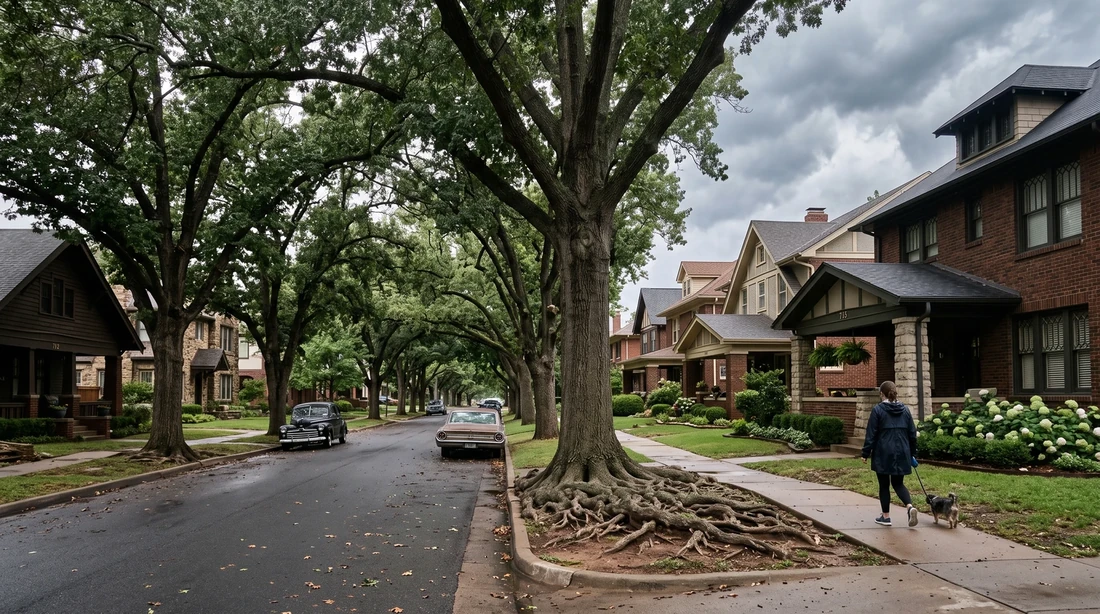
Common causes in the OKC metro include heavy-rain surges overwhelming the municipal main, tree roots invading an aging clay lateral line, grease and debris clogs, and stormwater pushing back through combined drains during storm season. Which homes get hit is no accident. OKC's older tree-lined neighborhoods (Crown Heights, Mesta Park, Edgemere Park, Gatewood, and parts of the Paseo) mix mature root systems with original clay sewer laterals, the exact combination that fails first when the ground saturates.
Timing matters too. OKC's heaviest rain clusters with tornado season, April through June, when a single storm can dump inches in an hour and overwhelm both the city main and your own line at once. That is also the window when remediation companies and adjusters are busiest metro-wide, so cleanup crews and temporary-housing inventory both get thin exactly when demand spikes. A single supercell can crack a roof with hail and back up a sewer in the same hour, which, as you will see below, is two separate coverage buckets under one storm.
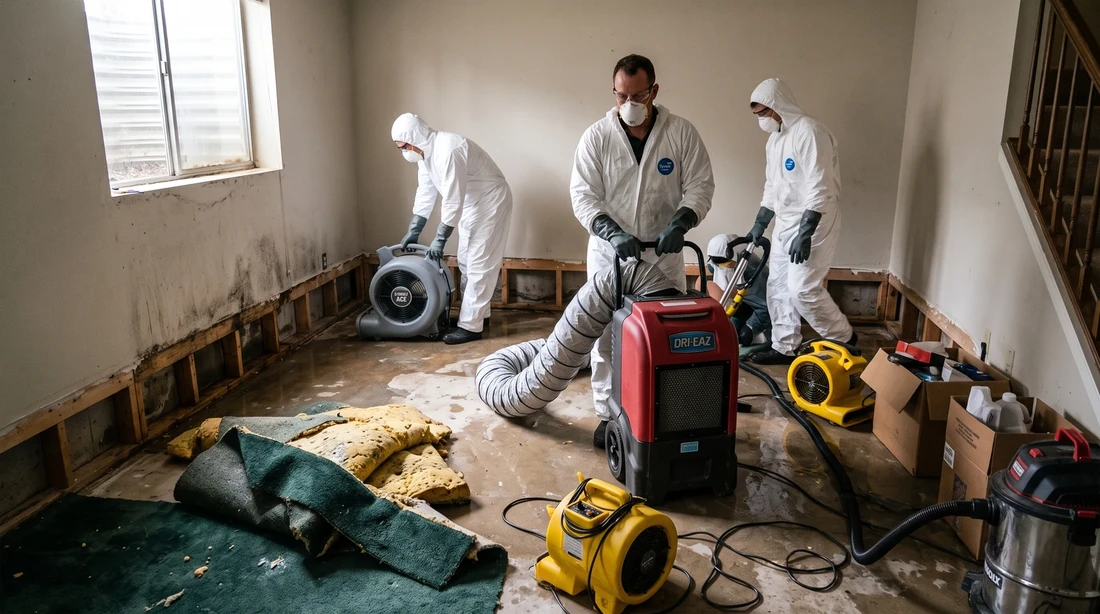
What matters for your family is that the water is Category 3 under the industry restoration standard. It carries bacteria and pathogens. Remediation is far more than a mop and a fan. It typically means extracting the water, removing and disposing of porous materials (carpet, pad, soaked drywall, insulation), antimicrobial treatment, structural drying with commercial equipment, and clearance testing before rebuild.
That process runs anywhere from a few days for a small, caught-early backup to several weeks when the water spread across finished living space. During it, the affected area is off limits. Often the whole home is, if it is a single-level house or the HVAC drew contamination through the ducts.
| Backup severity | Typical remediation + rebuild | Displacement likelihood |
|---|---|---|
| Confined to unfinished basement, caught early | 2-5 days drying, minimal rebuild | Often none; living areas stay usable |
| One finished room, single floor removed | 1-3 weeks | Likely, especially in single-level homes |
| Finished main level, subfloor replaced | 4-12 weeks | Full displacement typical |
| Contamination through HVAC/ductwork | Adds duct cleaning + testing | Whole-home displacement |
On what homeowners wrongly assume their standard policy already covers:
The insurance is often misunderstood by its purchasers; for example, many believe that mold is covered when it is not a standard coverage.
Wikipedia: Home insurance
Does Homeowners Insurance Cover Sewer Backup?
It comes down to one line item: the water/sewer backup endorsement. Without it, most carriers deny the loss because backup through drains is a standard policy exclusion.
Here is how the pieces fit together, so you know what to look for on your own declarations page.
- The endorsement (rider): A small add-on you purchase in advance. It restores coverage for damage from water or sewage that backs up through sewers, drains, or a sump-pump failure. Limits are usually capped, commonly $5,000 to $25,000, sometimes higher and separate from your dwelling limit.
- Loss of use / ALE: This is the part that pays temporary housing. It generally only kicks in when the damage itself is a covered loss. So if the backup is covered by your endorsement, your loss-of-use coverage typically extends to the extra cost of living elsewhere during repairs. No endorsement, no covered loss, and often no ALE either.
- Flood vs. backup: These are different animals. Surface floodwater entering from outside is a flood-policy issue (a separate NFIP or private flood policy). Backup through your drains is the endorsement's territory. Storm-driven backups can blur the line, which is one reason adjusters investigate the water's path carefully.
The sub-limit trap
Many sewer backup endorsements cap property damage and loss of use inside the same total limit. That is the single most expensive surprise. With a fire, dwelling coverage and ALE are usually separate buckets. A $10,000 backup endorsement may have to stretch across demolition, drying, rebuild and your hotel bill.
So the housing option you pick is a math question before it is a comfort question. If cleanup and rebuild eat $7,000 of a $10,000 cap, you have $3,000 left for weeks of housing, and burning it on nightly hotel rooms can exhaust the whole endorsement before your home is livable. Ask your adjuster two things in writing: what the endorsement's total limit is, and whether loss of use shares that limit or has its own.
When one storm causes two claims
A storm that damages your roof and backs up your sewer is two coverage buckets under one weather event. The wind-and-hail roof damage is a standard covered peril paid from your dwelling coverage, with its own ALE that carries no sub-limit. The sewer backup rides on the endorsement's capped limit. If both happen in the same April storm, common in the OKC metro, track them as separate line items so a tight backup cap does not quietly absorb costs that dwelling coverage should pay. Ask your adjuster to split the estimate between the two perils.
| Water event | Coverage source | Pays temporary housing? |
|---|---|---|
| Sewage/drain backup | Sewer backup endorsement (add-on) | Only if endorsement + loss of use apply |
| Sump-pump failure | Usually the same backup endorsement | Same; endorsement must be in force |
| Burst interior pipe | Standard homeowners policy | Yes, ALE typically applies |
| Surface flood from outside | Separate flood policy (NFIP/private) | Depends on flood policy terms |
If you are staring at a denial right now because the endorsement was not on your policy, read insurance denied temporary housing for what to check and how to respond. For the plain-English version of how the housing payment works once a loss is covered, loss of use coverage explained walks through it.
How Long Will You Be Out, and What Does Waiting Cost?
The biggest driver of your temporary-housing cost is how long remediation and rebuild take, more than the nightly rate you pick. A caught-early backup might displace you for a week. A spread across finished space with subfloor replacement can run two to three months.
Here is the realistic sequence after a sewer backup, and what is at stake if a stage stalls.
- Discovery (Day 0): You find the backup. Stop using water immediately, photograph everything before touching it, and call your carrier. Waiting here lets Category-3 water wick further into walls and subfloor.
- Emergency mitigation (Days 0-2): A remediation company extracts water and starts drying. Most policies require you to prevent further damage. Delay can be treated as failure to mitigate and reduce your payout.
- Claim + habitability call (Days 1-5): The adjuster confirms whether your endorsement applies and documents that the home is uninhabitable. This is when temporary housing gets authorized. Every night you wait in a bad situation without documenting it is a night you may not get reimbursed.
- Demolition + drying (Week 1-2): Porous materials come out; commercial dryers run. The home is loud, torn open, and often without functioning bathrooms.
- Rebuild (Weeks 2-12): Drywall, flooring, fixtures, paint. A modest backup finishes fast. A large one drags, and every week is another week of housing cost.
Hotel nights are where budgets quietly break. Two hotel rooms for a family of four in OKC can run $150-$220 a night, plus every restaurant meal because there is no kitchen, and an ALE limit that looked generous burns down fast at that rate. The trap is sharpest when that limit is shared with cleanup costs under the endorsement cap.
Displaced by a sewer backup and need somewhere your family can actually live during weeks of cleanup? We work with adjusters and TPAs like Alacrity Solutions on insurance placements and offer monthly rates on 30+ night stays.
Where Should Your Family Stay During Sewage Cleanup?
For a multi-week sewer-backup displacement, a furnished home usually costs less per month than two hotel rooms and gives your family a kitchen and laundry. Here is how the three main options compare for an OKC family.
| Option | Typical monthly cost | Best for / what disqualifies it |
|---|---|---|
| Two hotel rooms | ~$4,500-$6,600 + every meal out | 1-7 nights, single person; no kitchen, no laundry, pets often refused |
| Extended-stay hotel | ~$3,000-$4,500, kitchenette only | 2-4 weeks, small household; tight space, limited cooking, weak for kids |
| Furnished home (BnB OKC) | Monthly rate on 30+ nights; full kitchen, laundry, yard | 30+ nights, families, pets, groups; overkill for a 1-2 night fix |
BnB OKC has 11 furnished homes across the metro, sleeping 2 to 16+, with published from-rates of $225-$425/night and up to 35% direct savings on stays of 4+ nights. We hold a 9.5 out of 10 average across 1,580 verified guest reviews on Airbnb and Vrbo, and several homes are dog-friendly, which matters because a sewer backup often displaces the family pet too. Browse extended stays or, if you have a dog, pet-friendly rentals in OKC.
Location choice during cleanup is practical. Pick a home that keeps your kids in their existing school boundary, keeps your commute reasonable, and sits near your contractor so you can check on progress.
Our homes span the metro (near Lake Hefner, The Village, the Paseo and Plaza districts, and minutes from major arteries like the Kilpatrick Turnpike, I-44, and I-235), so you can usually stay within a 10-15 minute drive of your torn-open house rather than moving your whole life across town. Being close matters more than people expect. Over a three-month rebuild you will make dozens of trips to meet the adjuster, let in contractors, and salvage belongings.
Who handles what during placement can be confusing, so here is the split.
| Task | Who handles it |
|---|---|
| Photograph damage before cleanup | You |
| Confirm endorsement applies + habitability | Adjuster / carrier |
| Authorize temporary housing budget (ALE) | Carrier / TPA |
| Set up direct billing (if authorized) | Carrier / TPA + host |
| Match home to family size, dates, pets | You + host (BnB OKC) |
| Keep receipts for reimbursement | You |
How to Secure Temporary Housing After a Sewer Backup, Step by Step
Move in this order. It protects your claim and gets your family settled fast.
- Document before you clean. Photograph and video every affected room and item while the water is still there.
- Call your carrier and check the endorsement. Ask directly whether your policy includes water/sewer backup coverage and what the loss-of-use limit is.
- Get the habitability determination in writing. Have the adjuster or remediation company confirm the home is uninhabitable during cleanup.
- Confirm your ALE budget and billing method. Ask the daily or monthly housing amount and whether direct billing is authorized.
- Match a home to your dates and family. Call BnB OKC at (405) 870-2146 with your headcount, pets, and estimated repair timeline.
- Keep every receipt. Housing, meals, laundry, pet boarding: receipts substantiate the ALE claim.
What Does the Math Look Like for a Three-Month Repair?
Say an April storm hits an OKC family of four: hail cracks the roof, stormwater surges back up the finished main level as a sewer backup, and remediation plus rebuild is estimated at three months. Here is how the housing math plays out (illustrative numbers only; your carrier decides your actual coverage).
Two hotel rooms at $180/night for 90 nights comes to $16,200 before a single restaurant meal. Add roughly $2,500 in eating out with no kitchen and you are near $18,700. Their endorsement's loss-of-use limit may not stretch that far, even if the roof half of the claim carries its own uncapped ALE.
A furnished 4-bedroom home at a monthly rate lands around $3,900/month in this hypothetical, about $11,700 for three months. The family cooks their own meals (little to no restaurant spend), does laundry, keeps the kids in one place, and brings the dog. The difference of roughly $7,000 is budget that stays inside their ALE limit instead of burning on hotel rooms.
Second scenario: the shared endorsement cap
Now change one detail. Say the same family has a $15,000 sewer backup endorsement that shares its limit between damage and loss of use. Remediation and rebuild come in at $9,000, leaving $6,000 for housing. At $180/night for two hotel rooms, that $6,000 is gone in about 33 nights, barely a month, and they are paying out of pocket for the remaining eight weeks.
Run the same $6,000 against a $3,900/month furnished home and it covers roughly six weeks with a kitchen that keeps meal costs down. Neither option fully covers a three-month rebuild under a tight shared cap. The furnished home nearly doubles how long the money lasts, though. When the cap is the constraint, the per-night rate stops being a preference and becomes the difference between staying covered and going out of pocket.
Third scenario: the caught-early basement backup
Not every backup means three months away. Say the same family catches a backup confined to an unfinished basement within an hour, and the living areas upstairs stay dry and safe. Remediation is a few days of extraction and drying, no rebuild, and the adjuster determines the home remains habitable. Here the answer flips. They do not move out at all, the endorsement pays cleanup only, and no housing cost is triggered. Confirm the habitability call before you book anything, because a small, contained backup may need zero nights elsewhere.
The through-line: over a multi-week displacement, the kitchen and monthly rate stop the bleed, while a short, contained backup may need no housing at all. For the fire version of this same math, see temporary housing after a house fire.
Which Situations Change the Answer?
The right housing call shifts with your household, your home's layout, and how long the repair runs. A few situations come up often after OKC backups.
- Basement-only, unfinished: If the backup is confined to an unfinished basement and the rest of the home stays habitable, you may not be displaced at all. The claim covers cleanup, not housing. Ask the adjuster whether the living areas remain safe before assuming you need to move out.
- Single-level home: In a slab or single-story house, there is no upstairs to retreat to. Contamination and drying equipment take over the whole footprint, so even a modest backup usually means full displacement.
- Kids and school routine: A months-long rebuild during the school year is easier to weather in a home with separate bedrooms and a kitchen than in one hotel room. Staying inside the same school boundary avoids stacking a school change on top of the disruption.
- Pets: Sewage displaces the dog too, and many hotels refuse pets or charge steep fees. A dog-friendly furnished home avoids boarding costs, which can themselves be an ALE line item. Keep the boarding receipts either way.
- Larger and blended households: A family of six or a multi-generation household cannot fit two hotel rooms without a third, which pushes nightly costs past $270. Our homes sleep up to 16+, so a single furnished house with a ground-floor bedroom keeps everyone under one roof for one predictable monthly rate. See large group rentals in OKC.
- Month-to-month extensions: Rebuilds slip. When drying reveals more damaged subfloor or a contractor hits a backlog, a two-week estimate can become six. Book housing you can extend month-to-month rather than a rigid short block you will have to scramble out of.
- Renters and duplexes: If you rent, the landlord's policy covers the building. Your displacement is on your renters policy, which has its own backup gap. See does renters insurance cover temporary housing and does renters insurance cover hotel stays.
When Is a Hotel the Better Call?
If a small backup is caught early and cleanup takes only a night or two, a hotel is the right, simple call, especially for a single person or a couple with no pets who do not need a kitchen. Points loyalty and a quick fix can make a hotel the cheapest, least-hassle option under a week.
The same is true if the backup is confined to an unfinished basement and your living space stays safe; you may not need to leave at all. And if your endorsement's shared cap is small, a few paid nights during a short drying period can be smarter than committing to a monthly booking you cannot fill.
A furnished home changes the outcome when the displacement runs 30 nights or longer, when you have kids who need routine and space, when there is a pet, when your endorsement cap is shared and every dollar counts, or when the whole home is out of service rather than a corner of it.
Full kitchen, in-unit laundry, separate bedrooms, and a monthly rate are what keep a long cleanup from draining both your ALE budget and your family's patience. If you are unsure how the housing company piece works, read how ALE housing companies work, or call us to talk through your dates before you commit either way.
What to Check Before You Book
These are the places a sewer-backup claim usually goes wrong.
- No endorsement on the declarations page. Backup through drains is excluded under the base policy. If the rider is missing, expect the loss and the housing to be denied, and read the denial guide above before you spend.
- A shared cap you have not asked about. If damage and loss of use come out of the same $10,000 or $15,000 limit, hotel nights can drain it before the home is livable. Get the total and the split in writing.
- No habitability determination in writing. Housing gets authorized on that call. A contained basement backup may need zero nights away, so confirm it before you book anything.
- Cleaning before photographing. Every room and item gets documented while the water is still there. Waiting to mitigate can also be treated as failure to mitigate.
- Two perils lumped into one claim. Hail on the roof and a backup in the basement in the same storm are separate coverage buckets. Ask the adjuster to split the estimate.
- A rigid short booking. A two-week estimate can become six once the subfloor comes up. Book something you can extend month-to-month.
- Missing receipts. Housing, meals, laundry, and pet boarding all need paper behind them to be reimbursed.
Terms you'll hear, decoded
- Sewer backup endorsement: An add-on rider you buy in advance that restores coverage for water or sewage backing up through drains, which is excluded under the base policy.
- Loss of use / ALE: The coverage that pays your extra cost of living elsewhere while a covered loss makes your home uninhabitable.
- Sub-limit: A separate, often lower cap that applies to a specific coverage, like the backup endorsement, which may have to cover both property damage and housing together.
- Category-3 water: The most contaminated water class ("black water"), including sewage. Unsafe to occupy until professional remediation is complete.
- Failure to mitigate: Not taking reasonable steps to limit further damage after a loss, which carriers can cite to reduce a payout.
- Clearance testing: The check remediation crews run to confirm a space is clean and dry enough to rebuild. One gate between cleanup and getting home.
- Concurrent causation: When two perils (say, hail roof damage and a sewer backup) occur together. Carriers assign each to its own coverage, which is why one storm can produce two differently-treated claims.
- Direct billing: When the carrier or TPA pays the housing provider directly, so you do not front the cost. Only with carrier authorization.
The Bottom Line
Check your declarations page for a water or sewer backup endorsement, and note both the total limit and whether loss of use shares it, before you assume anything is covered. Gather your documentation: photos taken before cleanup, the remediation company's habitability note, and every receipt for housing, meals, and pet boarding. Then get placed. Call or text BnB OKC at (405) 870-2146 or visit our insurance housing page with your dates, headcount, pets, and estimated repair timeline.
This guide is general information, not insurance or legal advice; your carrier makes all coverage decisions.