Key Takeaways
- A home counts as uninhabitable only when a covered peril leaves it unsafe for a reasonable person during repairs.
- Photograph and video every failed system within 24 to 48 hours, because mitigation crews haul away the physical proof of damage.
- Flood and earthquake are excluded from standard policies, and standard NFIP flood policies typically include no loss-of-use coverage at all.
- A furnished home runs about $2,800 to $6,000+ monthly, versus roughly $4,500 to $7,000 for a standard hotel with no kitchen or laundry.
Your building manager just taped a notice to the door, your kids' backpacks are still inside, and the hallway smells like a campfire. Whether that unit — or your house — officially counts as uninhabitable is the gateway question of every temporary-housing claim, and the evidence you capture in the next 48 hours shapes the answer.

What "Uninhabitable" Actually Means on an Insurance Claim
Most homeowner and renters policies never define "uninhabitable" — they trigger loss-of-use coverage when a covered loss makes the home "not fit to live in."
Two things have to be true at the same time. First, a covered peril — fire, a tornado, a burst pipe, a car through the wall — caused the damage. Second, a reasonable person can't safely live in the home while it's repaired. Wear-and-tear, deferred maintenance, or a landlord dispute can make a home miserable without making it an insurance claim.
When that trigger flips, Additional Living Expenses (ALE) pays the extra cost of living somewhere else. The full mechanics of how that money works live in our guide to loss of use coverage explained and on our insurance housing hub — this article covers the gate you have to pass through first.
One nuance trips people up constantly: "not fit to live in" is a much lower bar than condemned. A house doesn't need a red tag on the door to be uninhabitable. No running water for three weeks, soot in every air duct, or a tarped hole over the kids' bedroom can all qualify while the structure stands perfectly upright. (Tenant legal rights against a landlord are a separate question under Oklahoma landlord-tenant law — this article is about what your insurer considers unlivable.)
On the mold confusion, one insurance reference notes:
The insurance is often misunderstood by its purchasers; for example, many believe that mold is covered when it is not a standard coverage.
Wikipedia: Home insurance
The System-by-System Uninhabitable Checklist
Adjusters evaluate habitability system by system — water, power, climate, envelope, structure, air, sanitation, and legal access — and a total failure in any one of them can make the whole house uninhabitable.
| System | Typically uninhabitable when… | Typically still livable when… |
|---|---|---|
| Water & plumbing | No running water, contaminated supply, or sewage backing into living areas | One bathroom down in a multi-bath home; a single slow drain |
| Electricity | Power cut for safety, fire-damaged wiring, or a destroyed panel | A few dead outlets or one tripped circuit |
| Heat & cooling | No heat in an Oklahoma cold snap; no AC in an extended 100°+ stretch | A mild-weather outage where fans or space heating bridge the gap |
| Roof & envelope | Open roof deck, a tarped hole over living space, storm-blown windows | A few missing shingles with no interior leak |
| Structure & access | Shifted foundation, collapsed or unsafe stairs, blocked or unsafe entry | Cosmetic cracks; damage limited to a garage or outbuilding |
| Air quality & contamination | Heavy smoke and soot throughout, sewage contamination, disturbed asbestos, carbon monoxide risk | Light odor confined to one room that can be sealed off |
| Sanitation | No working toilet; septic or sewer line failure | Slow but functioning fixtures |
| Civil authority & legal access | Red tag, condemnation, evacuation order, or a safety-based utility disconnection | A contractor's verbal advice with no official order behind it |
Oklahoma's calendar changes how these read. A roof opened up by an April hailstorm is a different claim than the same hole in October, because tornado season (April–June) means the next storm cell may be days away — adjusters know a tarp is not an envelope. Likewise, a dead HVAC system reads differently in a 103° July week or a January ice storm than it does in a mild spring, and a metro-wide ice storm that snaps lines for a week raises the heat question for thousands of homes at once.
Contamination is the system people underestimate. Smoke and soot are corrosive particulates, not just a smell — if soot reached the HVAC ducts, running the system spreads it to every room. Sewage backups, carbon monoxide sources, and asbestos disturbed in pre-1980s homes all bar safe occupancy even when the house looks fine in photos. Mold is the tricky one: it can absolutely make a home unsafe, but many policies limit or exclude mold unless it resulted from a covered water loss — the cause matters as much as the mold itself.
Covered Peril or Not: Oklahoma's Two Habitability Traps
Flood and earthquake are the two Oklahoma disasters most likely to leave a home unlivable with no loss-of-use coverage behind it, because standard policies exclude both.
An unfit house only opens the ALE door when a covered peril caused it. That's where the cause of your damage matters more than the damage itself:
| Cause of damage | Typically triggers ALE? | What to know |
|---|---|---|
| Fire and smoke | Yes | A standard covered peril on homeowner and renters policies |
| Tornado, wind, hail | Yes | Many Oklahoma policies carry a separate wind/hail percentage deductible on the dwelling; ALE typically still applies once the peril is covered |
| Burst pipe / sudden water discharge | Usually | Must be sudden and accidental — a slow leak that ran for months typically isn't covered |
| Flood (rising water) | No | Excluded from standard policies; requires separate flood coverage — and standard NFIP flood policies typically include no loss-of-use coverage at all |
| Earthquake | Not without an endorsement | Earth movement is typically excluded; Oklahoma households need a separate earthquake endorsement for coverage |
| Sewer or drain backup | Often not | Frequently requires a water-backup endorsement added to the policy |
| Wear, rot, gradual leaks, pests | No | Maintenance failures are never a covered peril, however unlivable the result |
| Off-premises utility outage | Typically no | A neighborhood grid failure isn't damage to your home, even if the house is unlivable during it |
The flood row is the one that blindsides people. A flooded house is unquestionably uninhabitable — and standard NFIP flood policies typically pay nothing toward temporary housing, so displaced flood households often lean on savings or disaster assistance rather than ALE. If you're anywhere near a floodplain, check what you actually carry before you need it.
How Adjusters Actually Decide a House Is Not Fit to Live In
An adjuster's habitability call on a house not fit to live in typically weighs five things: which system failed, the season, the repair timeline, any official orders, and what your documentation shows.
Which system, and how completely. Total loss of water, power, or sanitation is close to automatic. Partial failures — one bathroom of two, a smoky bedroom — are where judgment enters, and where your photos and reports carry the weight.
The repair scope. A home can be uninhabitable because of the repairs, not the original damage. Water-remediation drying equipment running 24/7, whole-house rewiring, or asbestos abatement can make an otherwise-standing home unlivable for the duration of the work. Ask your contractor to state in writing whether the home is safe to occupy during each phase, and for how long.
Official orders end the debate. A red tag from the city, a fire marshal's order, an evacuation directive, or a safety-based utility disconnection is what carriers call "prohibited use" or a civil-authority situation — it's the strongest single piece of evidence you can hold.
Third-party readings. For smoke, mold, or sewage questions, an industrial hygienist's air-quality or surface test converts "it smells bad" into a number an adjuster can act on.
Your household's documentation. Medical documentation — for example, a physician's note about a respiratory condition and air quality — can be relevant to whether staying is reasonable. Keep it factual and in writing.
Here's the plain truth every insurance article on this site repeats once: the carrier and adjuster make the habitability decision, not you and not us. Your job is to make the evidence so clear the decision is easy. If it goes against you anyway, there's a dispute path — see insurance denied temporary housing.
Can You Live in the House During Repairs and Still Claim ALE?
ALE pays only the additional costs you actually incur — so staying in a partly damaged home, or with relatives, changes what gets reimbursed, not whether the home qualifies. Three scenarios come up constantly.
You stay while one system is down. If the kitchen is out for six weeks but the home is otherwise safe, many carriers will reimburse the increased cost of meals above what you normally spend — with receipts — even though you never left. You can't claim lodging you never paid for.
You stay with family. Free lodging isn't an incurred cost, so it typically isn't reimbursed — but increased commuting mileage, laundry, and food above your normal spending often are. Some carriers will consider a reasonable payment to a host household; get any arrangement like that approved in writing before assuming it's covered.
You leave a house the adjuster considers livable. If the carrier decides the home was fit to occupy, ALE typically doesn't pay — which is exactly why the documentation below matters more than your own certainty, and why weak habitability claims get pushed back on.
What Waiting to Document — Or Waiting to Leave — Costs You
Every undocumented day after a loss weakens your claim file and burns money you may never get back.
- Nights 1–3: You front a hotel out of pocket. Reimbursement typically requires receipts and an approved ALE claim — no documentation, no reimbursement.
- Week 1: Mitigation crews strip drywall, run scrubbers, and haul debris. The physical evidence of why the house was unlivable leaves in their trailer if you didn't photograph it first.
- Weeks 2–4: Hotel rooms plus three restaurant meals a day start eating a capped ALE budget at roughly double the pace a furnished home with a kitchen would.
- Month 2+: If the file is thin, the adjuster starts asking why you left at all — and a habitability dispute in month two is far harder to win than a documented one in week one.
ALE is almost always a capped pool, not an open tab — every dollar spent inefficiently early is a dollar unavailable if repairs run long.
Adjuster confirmed your home is uninhabitable — or you're waiting on the call and need somewhere tonight? BnB OKC places displaced Oklahoma City households in furnished homes, often same-day, and works with carriers and Alacrity Solutions on insurance placements with direct billing when authorized.
Where You'll Live While the House Is Unfit to Occupy
A furnished home on a monthly rate typically costs less than 30 hotel nights — before you add the restaurant meals a hotel forces on top.
| Option | Typical monthly cost (household of 3–4) | Fit and limits |
|---|---|---|
| Standard hotel (1–2 rooms) | In the ballpark of $4,500–$7,000 with taxes | No kitchen or laundry, so food and laundry costs spike; pet policies vary; two rooms often needed past a few nights |
| Extended-stay hotel | Roughly $3,000–$4,500 | Kitchenette and weekly housekeeping; one shared room wears thin past 30 nights; limited cooking for a full household |
| Furnished home (BnB OKC) | From about $2,800–$6,000+ on monthly rates | Full kitchen, laundry, real bedrooms, yard; monthly rates on 30+ night stays; direct billing possible with carrier authorization |
Hotel-hopping in OKC also has a calendar problem. The Women's College World Series fills Devon Park in late May and early June — squarely inside peak tornado season, so hotel demand spikes at exactly the moment storm displacements do. Add the Memorial Marathon in late April, the State Fair of Oklahoma in September, and Thunder home dates at Paycom Center, and a displaced household bouncing between hotels can face rate jumps and forced moves several times inside one repair timeline. A furnished home on a monthly rate holds one address and one price through all of it.
Where the home sits matters as much as what it costs. Ask about drive times to your kids' school and your workplace before committing — a displacement that keeps school drop-off inside 15 minutes is a different three months than one that doesn't.
BnB OKC operates 11 furnished homes across the metro — near Lake Hefner, The Village, the Paseo and Plaza districts, and about 6 minutes from Will Rogers World Airport — and Capitol Manor sits directly across from OU Medical Center and OU Children's Hospital, a practical fact if anyone in your household has follow-up care after the loss.
The homes sleep 2 to 16+, with published from-rates of $225–$425/night, monthly rates on 30+ night stays, and a 9.5 out of 10 average across 1,580 verified guest reviews on Airbnb and Vrbo. Several homes are dog-friendly — see pet-friendly rentals in OKC — and booking direct saves up to 35% on stays of 4+ nights. Browse extended stays for the homes set up for month-plus displacements, and see how ALE housing companies work for the carrier-side placement pipeline.
A Worked Example: Apartment Fire, Two Kids, $2,800 a Month
Here's a clearly hypothetical scenario with the math shown, because the arithmetic is what decides these choices.
Say a kitchen fire two units over fills your apartment with smoke and soot, the fire marshal clears the building for repairs, and management estimates three months before your unit is livable. You and your two kids are out. Your renters policy carries $40,000 in personal property coverage, and — as many policies do — sets loss of use at a percentage of that. Say yours is 30%: $40,000 × 30% = $12,000 of ALE to cover roughly 90 days.
Option A — extended-stay suite: $129/night plus taxes lands around $135/night. Over 90 nights that's about $12,150 — the entire cap gone on lodging alone, before a single extra meal, laundry run, or mile driven. If repairs slip to month four, you're paying cash.
Option B — furnished 3-bedroom at $2,800/month: three months runs $8,400. That leaves about $3,600 of the cap for the real extras — say $25/day of increased food costs (about $2,250 over 90 days), plus mileage and laundry — with a buffer of roughly $1,000 still standing if the timeline stretches.
Now stretch the same hypothetical claim. Repairs slip from three months to five — common when a rebuild waits on permits, materials, or a re-inspection. The furnished home runs 5 × $2,800 = $14,000, about $2,000 past the $12,000 cap out of pocket. The extended-stay path runs 150 nights × $135 ≈ $20,250 — roughly $8,250 out of pocket. Same delay, a $6,000+ difference in exposure, decided by the choice made in week one.
Flip it the other direction. If the remediation scope is smoke-sealing and duct cleaning only — say 18 days — the math reverses: 18 nights × $135 ≈ $2,430 with zero setup, and a whole home isn't worth the paperwork. How those hotel nights get reimbursed is covered in does renters insurance cover hotel stays.
Whether your regular rent continues during repairs depends on your lease, and remember ALE pays costs above your normal expenses. Renter-specific coverage details live in does renters insurance cover temporary housing, and the full fire-displacement playbook is in temporary housing after a house fire.
The Photos and Paperwork That Prove Uninhabitability
A habitability claim is won with evidence gathered in the first two days, and most of it is your job — not the adjuster's.
| Item | Who handles it |
|---|---|
| Photos and video of every failed system, wide and close | You — before mitigation work begins |
| Red tags, evacuation orders, utility disconnect notices | You collect; the carrier verifies |
| Fire or incident report | You request it from the department |
| Contractor or mitigation scope letter stating the home is unsafe to occupy, and for how long | Contractor writes it; you forward it to the adjuster |
| Habitability decision and ALE authorization | Adjuster and carrier |
| Housing sourcing, rental paperwork, direct-billing setup | Housing provider or host, with carrier/TPA authorization |
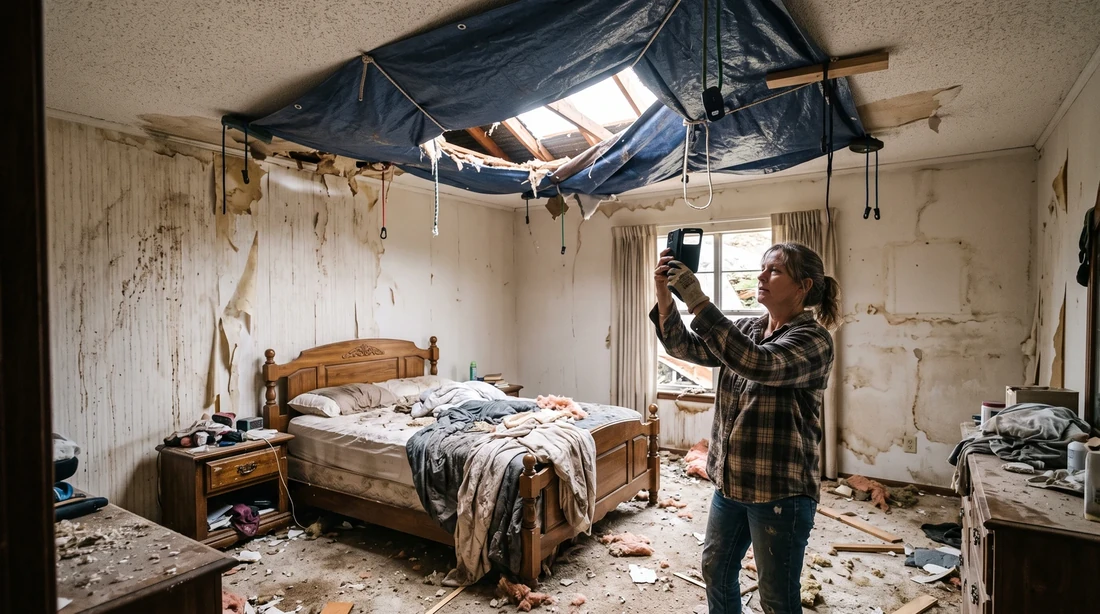
Technique matters. Shoot each failure twice — a wide frame that shows which room it's in, then a close-up of the damage itself. Your phone timestamps everything automatically; don't edit the originals. A single narrated video walkthrough of the whole home, naming each problem out loud as you film it, is often the most persuasive item in the entire file.
How to Document an Uninhabitable House, Step by Step
- Photograph every failed system. Take a wide shot plus a close-up of each one before mitigation crews change anything.
- Record a narrated video walkthrough. Walk every room and say out loud what is broken, wet, burned, or unsafe.
- Collect the official paper. Gather red tags, utility disconnect notices, fire reports, and the contractor's scope letter.
- Report the loss and state which systems are out. Tell your adjuster plainly why you cannot safely stay in the home.
- Get the ALE decision in writing. Ask for the approved budget, the expected duration, and how extensions work.
- Save every displacement receipt. Keep lodging, meals above normal, mileage, laundry, and pet boarding receipts in one folder.
When Your House Is Not Uninhabitable — And When That's Fine
Plenty of real damage leaves a house fully livable, and claiming otherwise damages your credibility on everything else in the file.
One bathroom down in a two-bath home, cosmetic smoke odor in a single sealable room, a repair crew working 8-to-5 in the garage, or a two-day power fix — none of these typically clears the bar, and pushing a weak habitability claim can slow the parts of your claim that are strong.
And when displacement is real but short — a night or two while a panel is replaced, an 18-day duct cleaning — a hotel or extended-stay suite is genuinely the right answer. It's flexible, it's nearby, it works with loyalty points, and setting up a whole home for a couple of weeks helps no one.
Where a furnished home changes the outcome is the 30-plus-night displacement: a household that needs a full kitchen to keep food costs inside a capped ALE budget, laundry on site, separate bedrooms, room for a dog, a location inside the kids' school boundary, and one address at one rate for the entire repair timeline instead of hotel-hopping between the WCWS, the State Fair, and Thunder home weekends. Larger homes that sleep 10–16+ also keep an extended or multi-generational household under one roof instead of scattered across three hotel rooms.
Terms You'll Hear, Decoded
- Uninhabitable / not fit to live in: the policy trigger — a covered loss has made the home unsafe or unreasonable to occupy during repairs.
- Additional Living Expenses (ALE): the coverage that pays costs above your normal living expenses while you're displaced.
- Loss of use: the policy section ALE lives under; usually capped at a percentage of your dwelling or personal property limit.
- Prohibited use / civil authority: coverage that applies when an official order — not just damage — keeps you out of the home.
- Direct billing: the carrier or its housing firm pays the lodging provider directly, but only with written authorization.
- TPA (third-party administrator): a company, like a temporary-housing firm, that a carrier hires to handle part of the claim — often the housing placement itself.
- Mitigation: the emergency work (water extraction, board-up, tear-out) that stops damage from spreading — and erases evidence, so photograph first.
Your Next Steps
- Walk the checklist above tonight. List every essential system that's actually out, pair each one with a wide photo and a close-up, and confirm a covered peril — not maintenance, flood, or unendorsed earthquake — caused it.
- Pull your declarations page and the paper trail. Find your loss-of-use limit and its percentage, then gather any red tag, fire report, disconnect notice, or contractor letter into one folder for the adjuster.
- Line up housing before the hotel bill compounds. If your home is out for weeks, not nights, call or text (405) 870-2146 or start at our insurance housing page — we can coordinate directly with your adjuster or housing firm once placement is authorized.
If a habitability or ALE decision stalls and you can't resolve it with your carrier, the Oklahoma Insurance Department handles consumer assistance and complaints; the City of Oklahoma City is the source for questions about red tags and code enforcement inside city limits; and the NFIP's FloodSmart site is the official NFIP resource for what flood coverage does and doesn't include.
This guide is general information, not insurance or legal advice; your carrier makes all coverage decisions.