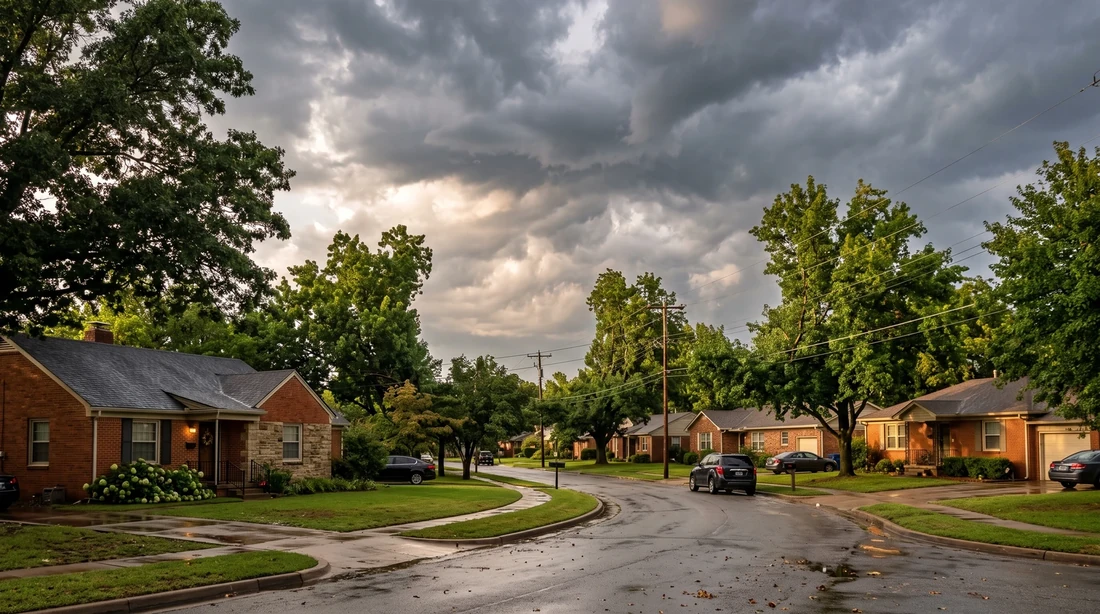
A wind and hail deductible in Oklahoma is a separate — and often much higher — amount you pay out of pocket before storm coverage begins, sometimes a percentage of your home's insured value rather than a flat dollar figure. At Oklahoma's fall 2025 legislative hearings, one homeowner testified her hail deductible jumped from $900 to nearly $10,000 while her premium climbed too.
If you opened your renewal and saw two deductibles instead of one, you're not misreading it. Oklahoma policies increasingly carry a separate, higher deductible just for wind and hail — the state's most common claim. That single line can decide whether a hailstorm costs you a few hundred dollars or five figures.
Here's what changed, why it's happening, and the coverage most homeowners forget: the temporary-housing money (ALE) that pays even while you and your adjuster argue over the roof.
Oklahoma's average home insurance premium hit $5,298 in 2026 — the highest in the nation (LendingTree) — yet that benchmark assumes a flat $1,000 deductible. Real Oklahoma wind/hail deductibles are frequently set far higher and separately, so the number on your policy may be several times that.
What Happened at the 2025 Oklahoma Hearings
At interim legislative studies on September 30 and October 7, 2025, lawmakers heard directly from homeowners about how fast storm costs are shifting onto them. Homeowner Rebekah Williams testified her monthly premium rose from $350 to almost $500 — while her wind and hail deductible rose from $900 to nearly $10,000, according to Oklahoma Watch's October 27, 2025 report.
Insurance Commissioner Glen Mulready summarized the mood plainly: "We clearly have an affordability issue." With the top four carriers holding more than 60% of Oklahoma's market, homeowners have limited room to shop their way out of the trend.
The quiet part is the deductible. Premiums make headlines, but a rising separate wind/hail deductible transfers storm risk back to you without the sticker shock — until you actually file a claim.

Separate Wind and Hail Deductibles, Explained
Most Oklahoma homeowners now carry two deductibles: one "all-peril" figure and a separate, higher deductible that applies only to wind and hail. The Oklahoma Insurance Department (OID) confirms policies here may include higher deductibles specifically for hail, and separate deductibles for that peril in higher-risk areas.
The catch is how the wind/hail number is written. Instead of a flat $1,000, it's often a percentage of your dwelling coverage — commonly 1% to 2%, sometimes higher. On a home insured for $300,000, a 2% wind/hail deductible is $6,000 out of pocket before your carrier pays a cent on the roof.
Because hail is the most common homeowners claim type in Oklahoma, this is the deductible you're most likely to actually meet — and the one worth reading before storm season, not after.
Cosmetic damage exclusions
Oklahoma policies may also carry a cosmetic damage exception, meaning aesthetic-only damage might not be covered at all. Dented gutters, a marked-up metal roof, or dinged siding that still functions can fall outside coverage even after a bad hailstorm. OID advises reviewing these terms directly with your agent — the exclusion language varies by carrier.
Actual cash value vs. replacement cost
OID also warns (June 2026 guidance) that lower-premium policies typically come with higher deductibles, reduced limits, and more exclusions. A big one: actual cash value (ACV) coverage subtracts depreciation, while replacement cost coverage does not. On a 15-year-old roof, ACV can leave you thousands short even after you clear the deductible.
Old Rule vs. New Reality for Oklahoma Homeowners
| Feature | What homeowners assume | What many 2026 policies do |
|---|---|---|
| Deductible structure | One flat deductible for everything | Separate, higher deductible for wind/hail |
| How it's written | Flat dollar amount (e.g., $1,000) | Percentage of dwelling value (1%–2%+) |
| Out of pocket on a $300k home | ~$1,000 | $3,000–$6,000+ at 1%–2% |
| Cosmetic-only damage | Covered | May be excluded |
| Roof payout basis | Full replacement | ACV (depreciation subtracted) on some policies |
Timeline: How Oklahoma's Storm Costs Shifted
| Date | What happened |
|---|---|
| Sept 30 & Oct 7, 2025 | Legislative interim studies hear homeowner testimony on rates and deductibles |
| Oct 27, 2025 | Oklahoma Watch reports one deductible jumping $900 → nearly $10,000; Commissioner Mulready cites an "affordability issue" |
| 2026 | LendingTree ranks Oklahoma's average premium highest in the nation at $5,298 (on a flat $1,000-deductible benchmark) |
| June 24, 2026 | OID guidance flags higher deductibles, reduced limits, and ACV vs. replacement cost as the trade-offs behind lower premiums |
The Coverage That Pays While You Fight the Roof
Here's what gets lost in the deductible debate: your roof deductible and your temporary-housing coverage are two different things. Additional Living Expenses (ALE), also called loss of use, is a separate coverage that pays for somewhere to live when storm damage makes your home uninhabitable — and it typically pays regardless of how the roof dispute is going.
That distinction matters in Oklahoma. Tornado and hail season peaks April through June, and a severe storm can force your family out for weeks while adjusters, contractors, and your carrier sort out the repair scope. The wind/hail deductible governs the repair. ALE governs where you sleep in the meantime.
We work with carriers and adjusters — including through insurance temporary housing placements with Alacrity Solutions — to place displaced Oklahoma City families in furnished homes on monthly terms, so a roof fight doesn't also become a hotel-budget fight.
A worked example (hypothetical)
Say a June hailstorm makes your family of four's home unlivable during repairs. Your dwelling coverage is $300,000 with a 2% wind/hail deductible — that's $6,000 out of pocket before the roof payout starts, and the scope is disputed for six weeks.
Two hotel rooms at, say, $170/night for 42 nights runs roughly $14,280 — and burns ALE budget fast. A furnished 3-bedroom home from BnB OKC at monthly rates (we offer monthly pricing on 30+ night stays; published from-rates run $165–$425/night) keeps the whole family together with a kitchen and laundry, stretching the same ALE dollars far further. The deductible fight is separate; your family still has a real place to live.
Displaced by an Oklahoma storm — or placing a family who is? We hold furnished OKC homes on monthly ALE terms while your roof claim plays out. Same-day options.
How to Find Your Real Wind and Hail Deductible, Step by Step
- Pull your declarations page. It's the summary sheet at the front of your policy, not the fine print.
- Find the wind/hail or windstorm line. Look for a second deductible separate from your all-peril amount.
- Convert any percentage to dollars. Multiply your dwelling coverage by the percentage — 2% of $300,000 is $6,000.
- Check for a cosmetic damage exclusion. Aesthetic-only hail damage may not be covered; confirm the wording.
- Ask your agent about ACV vs. replacement cost. ACV subtracts depreciation and can leave you short on an older roof.
- Confirm your ALE (loss of use) limit. This is the separate coverage that pays for temporary housing while repairs happen.
If any line is unclear, OID's consumer line can walk you through it: 800-522-0071 toll-free, 405-521-2828 in OKC, or 918-295-3700 in Tulsa.
Storm-season housing fills fast when a system moves through the metro — if you're already displaced, it's worth checking extended-stay availability the same day.
Terms You'll Hear, Decoded
- Wind and hail deductible — a separate amount you pay before storm coverage begins, often a percentage of your home's insured value rather than a flat figure.
- Cosmetic damage exclusion — a policy provision that lets carriers decline claims for aesthetic-only damage that doesn't affect function.
- Actual cash value (ACV) — a payout basis that subtracts depreciation, versus replacement cost coverage, which does not.
- Additional Living Expenses (ALE) / loss of use — the coverage that pays for temporary housing and extra costs when your home is uninhabitable, separate from your roof deductible.
- Declarations page — the summary at the front of your policy listing your coverages, limits, and each deductible.
Related Oklahoma Housing News
Insurance isn't the only place Oklahoma housing rules are shifting. See our coverage of the OKC Airbnb enforcement crackdown and the Norman hotel tax increase for how local policy is changing where — and what — Oklahomans pay to stay.
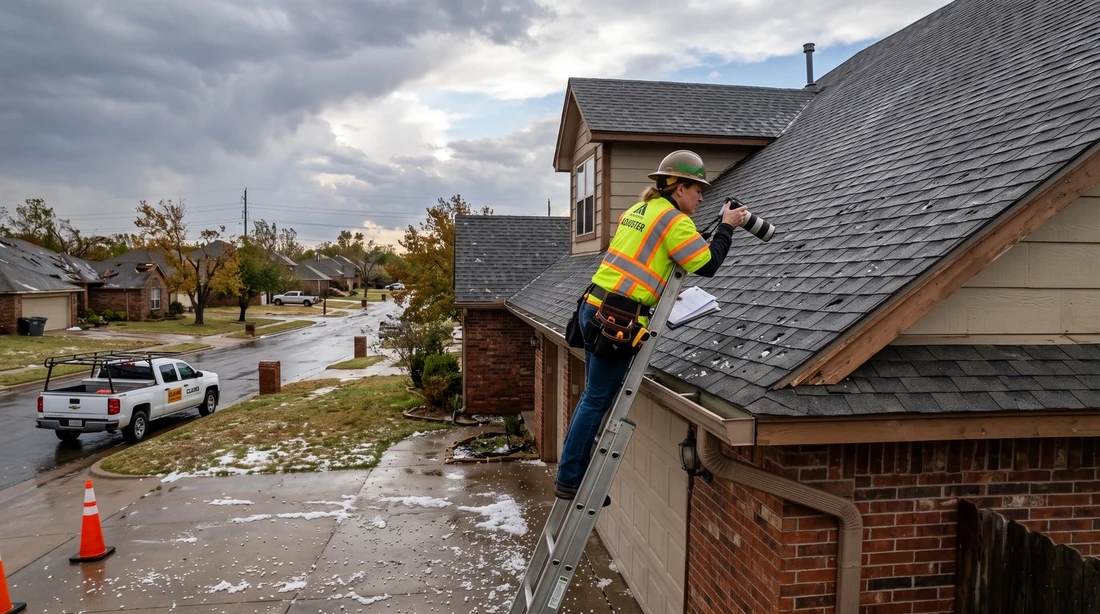
Your Next Steps
- Check your declarations page for a separate wind/hail deductible and convert any percentage to a dollar amount.
- Gather your ALE limit and your agent's contact — or call OID at 800-522-0071 to confirm what your policy covers if a storm displaces you.
- If you're already displaced, see insurance temporary housing options or call/text (405) 295-5052 for same-day furnished homes on monthly ALE terms.
This guide is general information, not insurance or legal advice; your carrier makes all coverage decisions.