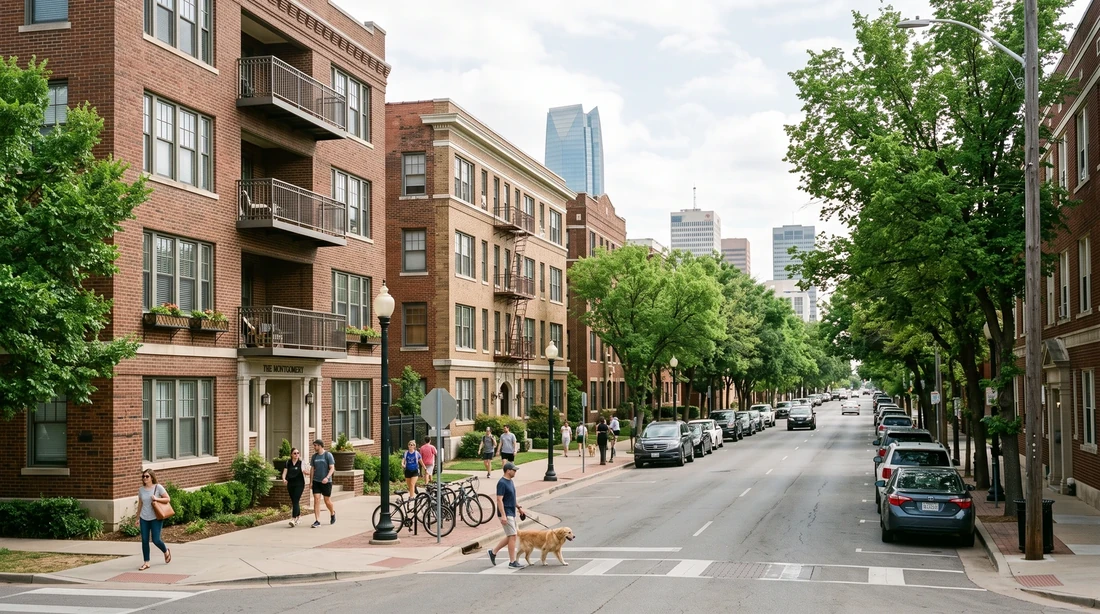
As of 2026, average rent in Oklahoma City typically runs in the ballpark of $900–$1,100 for a 1-bedroom, $1,100–$1,400 for a 2-bedroom, and $1,450–$1,850 for a 3-bedroom apartment, with houses and premium neighborhoods higher. Rent-only figures below exclude furniture, deposits, and utility setup — costs that reshape the math on any stay under a year.
Key Takeaways
- Typical 2026 OKC asking rents run $900 to $1,100 for a 1-bedroom and $1,450 to $1,850 for a 3-bedroom apartment.
- A 2-bedroom runs $1,400 to $1,900 downtown or Deep Deuce, but $1,000 to $1,300 in Moore, south OKC, or Yukon.
- Unfurnished move-in costs commonly exceed $2,000, plus furniture at $150 to $400 monthly and separate utility deposits for electric, gas, water, internet.
- In a hypothetical six-week gap, an unfurnished lease path reaches $4,500 to $6,000, while a furnished stay lands around $3,900 all-in.
OKC remains one of the more affordable large metros in the country, but the number you actually pay depends on two things: how many bedrooms you need and where in the metro you land. Downtown and Nichols Hills cost more; Moore, Yukon, and far northwest OKC cost less. And if you need a place for weeks rather than a full year, the sticker rent isn't the number that matters at all.
This guide breaks down average rent in Oklahoma City by bedroom count and by area, then adds the piece a listings site won't: the real all-in cost of a short unfurnished lease versus a month-to-month furnished stay once you add furniture, deposits, and utility hookups.
Most OKC apartment leases run 12 months minimum. If your real need is 6 weeks, an unfurnished lease charges you for 46 weeks you won't use — or an early-termination fee to leave.

What "Average Rent in Oklahoma City" Actually Measures
Published average-rent figures almost always mean unfurnished, year-lease asking prices — not what you pay to move in. They leave out the deposit, application fees, furniture, and getting the lights turned on. For a family staying a full year, that's a fair number. For anyone in a gap, it undercounts badly.
Two more things move the average. First, bedroom count: adding a bedroom in OKC typically adds a few hundred dollars a month. Second, location: the same 2-bedroom costs meaningfully more in Deep Deuce than in south Moore. We break out both below so you can find your real range instead of a metro-wide blur.
These ranges reflect typical 2026 asking rents across the metro and are refreshed annually. Treat them as a starting point, not a quote — always check current listings for your exact building and dates.
On the article's point about spring storms tightening housing supply:
The Oklahoma City metropolitan area is one of the most tornado-prone major cities in the world, with about 150 tornadoes striking within the city limits since 1890.
Wikipedia: Oklahoma City
Average Rent in Oklahoma City by Bedroom Count
A 3-bedroom in OKC typically costs about $500–$750 more per month than a 1-bedroom. That gap is why families who only need short-term space often find a furnished home cheaper all-in than a bigger unfurnished lease once setup costs are counted.
| Unit size | Typical monthly range | Who it usually fits |
|---|---|---|
| Studio | $800–$950 | Single renter, downtown-adjacent |
| 1 bedroom | $900–$1,100 | Solo or couple |
| 2 bedroom | $1,100–$1,400 | Small family or roommates |
| 3 bedroom (apt) | $1,450–$1,850 | Family, home office |
| 3–4 bedroom (house) | $1,900–$2,500 | Larger family, pets, yard |
Houses skew higher than apartments at the same bedroom count because you're also paying for a yard, a garage, and usually a better school zone. Pet rent and pet deposits add on top of these figures in most buildings.
What moves rent within the same bedroom size
Two identical-looking 2-bedrooms can differ by $300–$500 a month based on building age, amenities, and lease concessions. The ranges above are averages; here's what pushes your number to the top or bottom of the band.
- Building age and finishes: a new Deep Deuce build with quartz counters and a rooftop deck sits well above a 1980s garden apartment in the same neighborhood.
- Amenities: in-unit washer/dryer, a garage or covered parking, a pool, and a gym each add to the rate. Older complexes often have shared laundry and surface parking instead.
- Lease concessions: when a complex has vacancies, you'll see "one month free" or "reduced deposit" specials — usually spread across a 13-month lease, which lowers your effective monthly rent but locks you in longer.
- Floor and view: ground-floor and courtyard-facing units typically rent for less than top-floor units with a skyline view.
- Income and credit screening: most OKC complexes want a credit check plus proof of income around 3x the rent. Weaker credit can mean a larger deposit or a required cosigner — money the average-rent headline never mentions. If you're new to OKC and your job here hasn't started yet, some complexes count that as unverified income, which is a quiet reason relocating households get stuck.
Average Rent in OKC by Area and Neighborhood
Downtown, Midtown, and Nichols Hills sit at the top of OKC rent; Moore, Yukon, and Del City sit near the bottom. The same floor plan can swing several hundred dollars a month depending on which of these you choose.
| Area | Typical 2BR range | Known for |
|---|---|---|
| Downtown / Deep Deuce / Midtown | $1,400–$1,900 | Walkable, new builds, Bricktown |
| Paseo / Plaza District / Uptown | $1,200–$1,600 | Arts districts, restaurants, walkable |
| Nichols Hills / The Village | $1,300–$1,800 | Established, central north |
| NW OKC (near Lake Hefner) | $1,150–$1,500 | Shopping, quick highway access |
| Edmond | $1,200–$1,600 | Schools, suburban north |
| Moore / south OKC | $1,000–$1,300 | Value, near I-35 and Tinker |
| Yukon / far west | $1,000–$1,300 | Value, growing suburb |
If you're weighing where to land, our moving to Oklahoma City guide goes deeper on neighborhoods, commutes, and school zones. For a short-term base, drive time to your job or hospital usually matters more than the rent gap between two nearby areas. The Paseo Arts District and Plaza District trade a little more rent for walkable restaurants and galleries; the far suburbs trade drive time for square footage.
Drive times: why the cheaper area isn't always cheaper
A $200/month rent saving in Yukon can evaporate if your daily commute doubles. OKC is a driving city built around I-35, I-40, I-44, and the Kilpatrick Turnpike, so where you land is really about where you need to be each day.
- Downtown/Midtown to Paycom Center or Bricktown: a walk or a 5-minute drive — the reason downtown rents run highest.
- Paseo or Plaza District to downtown: roughly 5–10 minutes, which is why those arts districts command a premium over the outer suburbs.
- NW OKC near Lake Hefner to downtown: roughly 15–20 minutes on the Hefner Parkway outside rush hour.
- Edmond to downtown: about 20–25 minutes down Broadway Extension or I-35; longer at 8 a.m.
- Moore or south OKC to Tinker AFB: often 15 minutes or less, which is why the south metro fills with Tinker families and contractors.
- Most of the metro to Will Rogers World Airport: the airport sits on the southwest side; several central and NW areas reach it in 15–20 minutes, and BnB OKC homes near it are about 6 minutes out.
If you're relocating for a hospital job or a medical stay, weigh drive time to your campus over the neighborhood's rent rank — Capitol Manor sits directly across from OU Medical Center and OU Children's Hospital, for example, which erases a commute entirely.
When you sign changes what you pay
OKC rents tend to firm up in late spring and summer, when the metro's moving season peaks. Leases turning over in June, July, and August compete with relocating families racing the school calendar and college students, so asking rents and application volume both run higher.
Winter — roughly November through February — is the softer window. Complexes with vacant units are likelier to offer concessions to avoid carrying an empty apartment through the slow season. One more local wrinkle: tornado season peaks April through June, and a bad hail or wind event can briefly tighten supply as displaced households compete for the same units. It's a real reason to have a flexible fallback if your timeline lands in spring.
Here's what waiting into peak season actually costs if your move lands in summer. First, the best-priced units in your bedroom range lease fastest, so you start applying against a thinner list. Next, complexes pull or shrink their concessions when they don't need them to fill space — the "one month free" you saw in January is gone by July.
Then, because you're competing for fewer units, you take what's available rather than what fits, which often means a longer commute or a higher floor plan than you wanted. A flexible month-to-month home lets you sit out that scramble and sign your permanent lease in the soft season instead.
Why the Rent Number Stops Mattering Under a Year
An unfurnished lease shorter than 12 months usually doesn't exist in OKC — so a "cheap" monthly rent hides a stack of one-time costs. Sign a lease for a gap of weeks and you're paying for furniture you'll move twice, deposits you might not fully recover, and utility hookups for a place you barely use.
Here's what actually happens, in order, when someone signs a standard lease for a short need:
- Move-in: first month's rent plus a security deposit (often one month) and application/admin fees — commonly $2,000+ before you unlock the door.
- Furnishing: rented or bought furniture for a bedroom, living room, and kitchen basics — rental packages typically run $150–$400/month, purchases far more.
- Utility setup: electric (OG&E), gas (ONG), water/trash (City of OKC), and internet — each with its own deposit or connection fee, plus days of waiting for appointments.
- Early exit: to leave before 12 months, most leases charge an early-termination fee (often 1–2 months' rent) and may keep the deposit.
- Move-out: you pay to move furniture out and clean, then repeat the whole cycle at your permanent home.
The utility line alone is more than a footnote. Each provider has its own account setup, and several want a deposit if you don't have local credit history — money that comes back only when you close the account.
| Utility | Provider | Typical setup cost |
|---|---|---|
| Electric | OG&E | Deposit often waived with credit; otherwise ~$100–$250 |
| Natural gas | Oklahoma Natural Gas (ONG) | Connection or deposit ~$30–$60+ |
| Water / sewer / trash | City of OKC Utilities | Deposit ~$40–$75 plus account setup |
| Internet | Cox, AT&T, or others | Install + first month, often $75–$150 to start |
None of that shows up in the "average rent" headline. In an OKC summer, the electric bill alone from running the AC against 100-degree afternoons can push utilities to the top of that range — another cost a furnished all-in rate simply folds in. That's the exact gap a furnished, month-to-month home fills: one all-in price, nothing to buy, nothing to disconnect.
Between selling and closing, or new to OKC and not ready to sign a year? Compare a furnished month-to-month home against a full lease before you commit.
See OKC extended-stay homes or call/text (405) 870-2146.
12-Month Lease vs. Month-to-Month Furnished: The Real All-in Math
For any stay under about three to four months, a furnished home is frequently cheaper all-in than an unfurnished lease once you add furniture, deposits, and utilities. The furnished rate looks higher per month, but it's a total price — no add-ons.
| Cost item | Unfurnished 2BR lease | Furnished month-to-month |
|---|---|---|
| Base rent / rate | ~$1,300/mo | Monthly rate (30+ nights) |
| Security deposit | ~$1,300 (one-time) | Included / minimal |
| Furniture | $150–$400/mo | Included |
| Utilities + internet | $200–$350/mo + deposits | Included |
| Lease term | 12 months minimum | Flexible, 30+ nights |
| Early exit | Fee + possible deposit loss | None |
Our furnished homes across the metro come fully equipped — kitchen, laundry, linens, internet, and utilities all in one number. Published from-rates run $225–$425/night, with monthly rates on stays of 30+ nights and up to 35% direct-booking savings on 4+ night stays. See how the model compares in our extended stay Oklahoma City and furnished apartments OKC guides.
Worked Example: A Family in a 6-Week Selling-to-Closing Gap
Say your house sold faster than expected and your new closing is six weeks out — about 42 nights. You're a family of four who needs real bedrooms, a kitchen, and laundry, not two hotel rooms. Here's the arithmetic, all hypothetical.
Unfurnished path: no landlord in OKC rents a 2-bedroom for six weeks, so you'd sign a 12-month lease anyway. Move-in is roughly $1,300 rent + $1,300 deposit = $2,600 before furniture. Add furniture rental (~$300/mo), utilities and internet setup (~$300 plus deposits), then an early-termination fee to leave after six weeks (often one to two months' rent). You're easily past $4,500–$6,000 for a month and a half — and you did it twice, since you'll furnish your new home too.
Furnished path: a fully-equipped furnished home billed at a monthly rate for a ~six-week stay lands in the ballpark of $3,900 all-in — one price covering the home, furniture, utilities, internet, and laundry, with no deposit gauntlet and no lease to break. Same family, real bedrooms, and you unpack once.
The furnished number is higher per month than the bare lease rent — and lower than the lease once everything the lease doesn't include is added back. That's the whole point of pricing total-to-total.
Worked example: when the closing date slips
Closings slip constantly, and that's where the lease math gets ugly and the furnished math barely moves. Say the same family's closing pushes four weeks — now a 10-week stay, about 70 nights. With the furnished home, you extend month-to-month: roughly $3,900 for the first six weeks plus about $2,600 for the added four weeks, so around $6,500 all-in, no penalty and no renegotiation.
With the unfurnished lease, you were already locked into 12 months regardless of the slip, so the delay adds nothing to that path — but you're still owing ten more months of rent for a home you're leaving. The flexibility isn't a luxury here; it's the difference between adjusting and being trapped.
Worked example: a 3-month corporate relocation
Now stretch the same family to a 3-month relocation — a parent starting a new OKC job before the family is ready to buy. At three months, the unfurnished lease math changes but rarely flips. You'd still sign a year and eat the same ~$2,600 move-in, ~$900 in furniture rental over three months, and ~$900 in utilities plus setup deposits — roughly $4,400 for three months of use, still owing nine months of rent or an early-termination fee to walk away.
A furnished home at a monthly rate for the same 90 nights, all-in, typically lands in the ballpark of $8,000–$9,500 depending on home size and season — more in raw dollars than the partial-lease outlay above, but with zero lease obligation, no furniture to buy, no utilities to chase, and the freedom to extend or end month to month.
The honest read: past three to four months, the two paths converge, and beyond that a lease usually wins on pure dollars if you already own furniture. Below three to four months, the furnished all-in almost always wins. Here's how a 3-month furnished stay stacks up month by month.
| Month | Unfurnished lease (running total) | Furnished all-in (running total) |
|---|---|---|
| Move-in / Month 1 | ~$2,600 (deposit + rent) + $600 furniture/utilities = ~$3,200 | ~$2,900 (all included) |
| Month 2 | ~$4,200 | ~$5,800 |
| Month 3 | ~$5,200 + early-exit fee (~$1,300–$2,600) = ~$6,500–$7,800 | ~$8,700 |
| End state | Lease broken or 9 months still owed | Walk away clean, no obligation |
The lease column looks cheaper until you reach the early-exit line — and it assumes you accept a broken-lease mark or the fee. If your relocation might extend, the furnished home's month-to-month flexibility is the value the raw dollars don't show.
Planning a longer corporate relocation instead of a short gap? Our corporate housing Oklahoma City guide covers 3-plus-month setups.
How to Compare a Lease vs. A Furnished Stay, Step by Step
Don't compare the rent rate to the nightly rate — that's apples to oranges. Compare the full cost of each path for your actual number of nights.
- Count your exact gap in nights. A closing date, a start date, or a claim window gives you a real number to price against.
- Pull current asking rents for your bedroom size. Use the ranges above, then confirm against live listings in your target area.
- Add the unfurnished hidden costs. Deposit, application fees, furniture, utility deposits, and any early-termination fee.
- Price the furnished all-in monthly rate. Ask what's included so you're comparing one total number, not a rate plus extras.
- Compare total-to-total. Divide each path by your nights to see the true cost per night, then pick the one that wins for your timeline.
Insurance-Paid Displacement Changes the Comparison
If a fire, storm, or burst pipe put you out of your home, your renters or homeowners policy's Additional Living Expenses (ALE) coverage — not average rent — decides your budget. ALE reimburses the difference between your normal housing costs and the higher cost of temporary housing while your home is repaired, and it's the carrier who approves the amount and duration.
In that situation, a furnished home usually fits far better than a bare lease: it's move-in ready the same week, requires no 12-month commitment your repairs may outlast or fall short of, and produces one clean invoice your adjuster can process. BnB OKC works with Alacrity Solutions on insurance placements, and in many cases the carrier or third-party administrator can arrange direct billing once they authorize it. Our insurance housing page covers how displacement stays work. This is general information, not insurance advice — your carrier makes all coverage decisions.
Displaced by a covered loss and comparing housing on an ALE budget? We can price a furnished home total-to-total and coordinate with your adjuster.
See insurance housing options or call/text (405) 870-2146.
When You Don't Need a Furnished Home
If you're staying a full year or longer and already own furniture, a standard unfurnished lease is almost always the cheaper call. The setup costs amortize over 12 months, and your rent rate is genuinely the number that matters. The same is true if you're a student on a 12-month academic lease, or a couple settling in permanently with a moving truck full of your own furniture already headed to OKC.
A single professional relocating with no furniture is a closer call. If you're solo and staying six months or more, a bare 1-bedroom at ~$1,000 plus a furniture rental and utilities can still beat a furnished rate over that horizon — the setup pain is real, but the months are enough to spread it. Under about three months, or if your dates are uncertain, the furnished all-in usually still wins even for one person, because you're paying full setup for a fraction of the term.
A furnished, month-to-month home changes the outcome in specific situations: a selling-to-closing gap, a job that starts before you're ready to buy, a training rotation, an insurance displacement, or any stay where signing a year and furnishing a place makes no sense. If you're at the FAA Academy or on a TDY at Tinker, the flexible term usually beats a lease you'd have to break.
Families and pet owners especially benefit — real kitchens, laundry, and yards instead of a hotel room, and no pet deposit or breed screening at each new complex. Several of our homes are dog-friendly; see pet-friendly rentals in OKC. Groups and larger families gain the most: our homes sleep anywhere from 2 to 16+, so one address replaces the two or three apartments a big household would otherwise juggle.
Terms You'll Hear, Decoded
- Asking rent: the advertised monthly price — before deposits, fees, furniture, or utilities.
- Security deposit: refundable money held against damage, often equal to one month's rent, sometimes not fully returned.
- Application fee: a usually non-refundable charge (commonly $40–$75 per adult) to run credit and background screening, paid before you're even approved.
- Proration: a partial-month rent charge when you move in mid-month, so your first bill may differ from the headline rent.
- Early-termination fee: what a lease charges you to leave before the 12-month term ends, commonly one to two months' rent.
- Month-to-month: a rental term that renews monthly with no fixed year commitment — standard for furnished stays of 30+ nights.
- All-in rate: a single price that already includes furniture, utilities, and internet, so there are no separate bills to add.
- Lease concession: a discount a complex offers to fill units — often "one month free" spread across a 13-month lease, which lowers the effective monthly rate but extends the commitment.
- Additional Living Expenses (ALE): the loss-of-use coverage in many home and renters policies that reimburses temporary-housing costs above your normal expenses after a covered loss; the carrier sets the amount and duration.
Your Next Steps
- Confirm your exact timeline in nights — your closing date, start date, or displacement window sets which path even makes sense.
- Gather the real numbers to compare: current asking rent for your bedroom size plus deposit, application, furniture, and utility-setup costs, versus one furnished all-in monthly rate.
- Check availability for your dates: browse OKC extended-stay homes or call/text (405) 870-2146 to price your stay total-to-total.
BnB OKC operates 11 furnished homes across the metro and holds a 9.5 out of 10 average across 1,580 verified guest reviews on Airbnb and Vrbo. You can also book direct to keep more of your budget. For citywide context on rent, see the City of Oklahoma City.
This guide is general information, not insurance or legal advice; your carrier makes all coverage decisions.