Key Takeaways
- A furnished OKC home sleeping 8 to 10 typically runs $9,000 to $12,600 monthly all-in, versus $28,000+ for eight individual hotel rooms.
- Hypothetical eight-person Tinker AFB crew: about $34,200 for 90 days in one home against $86,400 in eight hotel rooms.
- Tinker AFB, energy turnarounds and April to June storm restoration drive demand; large homes book weeks out in storm season.
- Screen housing for truck and trailer parking, full kitchen and laundry, dedicated beds, single invoice, and 20 to 25 minute commutes.
Your company just won a 90-day contract at Tinker AFB, mobilization starts in two weeks, and eight contractors need somewhere to sleep that isn't $960 a night across eight hotel rooms. The clock is real — but this is one of the most fixable line items on your whole project budget.

Why Work Crews Keep Landing in Oklahoma City
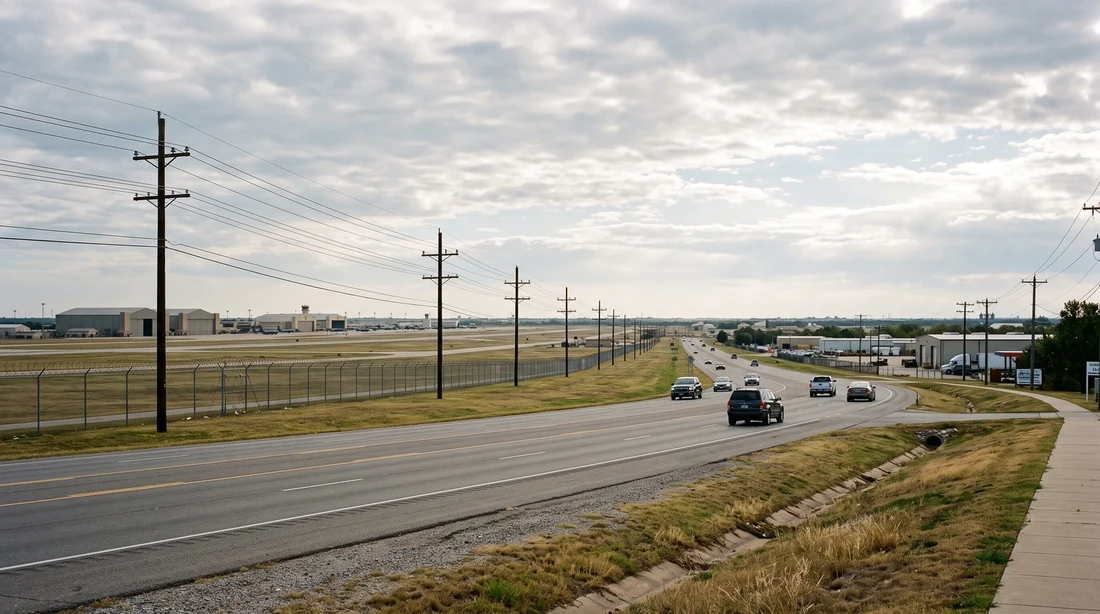
Oklahoma City hosts rotating workforces year-round: Tinker AFB sustainment contracts southeast of the city, energy-sector turnarounds, commercial construction, and April–June storm-restoration surges each bring crews of 4 to 20 into the metro for 30 to 180 days.
Tinker AFB is the single biggest driver of crew housing demand in Oklahoma City. Depot maintenance, sustainment, software, and base construction contracts rotate TDY contractors through in 60-, 90-, and 180-day blocks. When on-base billeting fills, those crews go looking off base — usually on a GSA lodging per diem that a shared whole home beats easily. If your crew is Tinker-bound specifically, the drive-time and gate details live in our TDY lodging near Tinker AFB guide.
Energy-sector work is the second wave. Turnarounds and maintenance outages run on compressed schedules: a crew arrives with trucks and tool trailers, works long shift blocks for four to twelve weeks, then demobilizes on short notice. Those crews need parking a hotel garage can't offer and flexible end dates a lease can't offer.
Then there's weather — and it isn't only spring. OKC's tornado season peaks April through June, and every serious hail or wind event pulls roofing and restoration crews into the metro within days. Oklahoma winters periodically deliver ice storms that do the same thing for utility and line crews, compressing the whole book-fast dynamic into whatever week the ice hits. Add steady commercial construction downtown and along the metro's growth corridors, plus FAA Academy classes soaking up mid-size furnished inventory (see our FAA Academy housing guide), and large-home supply stays tight most of the year.
The takeaway for a project manager: crew housing in Oklahoma City is a book-early market, not a figure-it-out-on-arrival market.
The relocation industry defines the corporate housing option this way:
Corporate housing is a term in the relocation industry that implies renting a furnished apartment, condo, or home on a temporary basis to individuals, military personnel, intern groups, or corporations as an alternative to a traditional hotel or an extended hotel stay.
Wikipedia: Corporate housing
Crew Housing Oklahoma City Costs: The per-Bed Math
A furnished Oklahoma City home sleeping 8–10 typically costs $9,000–$12,600 a month all-in — roughly a third of what eight individual hotel rooms run, and competitive with extended-stay studios once food and laundry are counted.
The metric that matters for crews isn't the nightly rate. It's cost per bed per month, all-in — lodging plus the meals, laundry, and parking the option forces you to buy separately. Judged that way, one house beats a block of rooms almost every time the crew is 4+ people staying 30+ nights.
| Option | Typical monthly total (crew of 8) | Per bed, per month | What's included |
|---|---|---|---|
| 8 single hotel rooms ($110–$130/night) | ~$26,400–$31,200 | ~$3,300–$3,900 | No kitchen; every meal bought; coin or valet laundry |
| 4 double-occupancy hotel rooms | ~$13,200–$16,800 | ~$1,650–$2,100 | Shared rooms, mini-fridge only, no crew common space |
| 4 extended-stay studios (doubled up) | ~$10,800–$13,200 | ~$1,350–$1,650 | Kitchenette per room; tight quarters; car parking only |
| 3 corporate 2BR apartments | ~$9,000–$10,500 | ~$1,125–$1,300 | Furnished; often 90-day minimum lease plus deposits |
| 1 furnished home sleeping 8–10 (BnB OKC, $300–$420/night) | ~$9,000–$12,600 | ~$1,125–$1,575 | Full kitchen, laundry, driveway/street parking, one invoice |
All hotel and apartment figures are typical market ballparks, not quotes. The whole-home band reflects BnB OKC's published from-rates of $225–$425/night across 11 homes, before direct-booking savings of up to 35% on 4+ night stays and monthly rates on 30+ night stays.
And the table understates the gap, because hotels push costs off the folio. Eight crew members eating two restaurant meals a day typically adds thousands per month that a full kitchen and a Sunday grocery run would erase. Coin laundry, paid parking, and zero space to spread out plans or hold a morning huddle all cost you in dollars or in time.
Here's how the hotel default actually plays out over a project:
- Week one: the crew books "temporary" rooms near the job site at rack rates. Nobody negotiates because it's short-term — except it never is.
- Month one: lodging spend crosses ~$28,800 for eight singles. Accounting now reconciles eight separate folios, eight incidental holds, and a stack of meal receipts.
- Month two: the hotel won't guarantee the block through a convention or fair weekend; rates float up; two crew members get relocated to a second property across town.
- Month three: the project extends 30 days. There's no monthly rate to fall back on, and the per-bed cost that looked tolerable in week one has quietly become the project's biggest controllable overrun.
Worked Example: An 8-Person TDY Crew at Tinker AFB for 90 Days
Say — purely as a hypothetical — your firm sends eight TDY contractors to Tinker AFB for a 90-day assignment, and each contractor takes a single hotel room at $120/night.
- Per contractor: $120 × 30 nights = $3,600 per month, or $10,800 over the assignment.
- Crew total: $960/night × 30 = $28,800 per month → roughly $86,400 over 90 days.
Now run the same crew through one furnished home sleeping 8–10 at $380/night with a monthly rate:
- Crew total: $380 × 30 = $11,400 per month → roughly $34,200 over 90 days.
- Per bed: about $1,425 per month — under half the $3,600 single-room figure.
That's in the ballpark of $52,200 kept on the project over one quarter, before counting what a full kitchen saves against 90 days of restaurant meals for eight. And if month three slips into month four, the extension math stays flat: another $11,400 at the monthly rate, versus renegotiating a hotel block that may not exist at any price during a fair or tournament weekend.
| Month | 8 hotel rooms, cumulative | Whole home sleeping 8–10, cumulative | Gap |
|---|---|---|---|
| Month 1 | $28,800 | $11,400 | $17,400 |
| Month 2 | $57,600 | $22,800 | $34,800 |
| Month 3 | $86,400 | $34,200 | $52,200 |
Variant: a 4-person crew for 60 days
The math holds at smaller headcounts — hypothetically, four contractors on a 60-day outage taking four singles at $120/night spend $480 × 30 = $14,400 per month, or $28,800 over the job. A furnished home sleeping 4–6 at $250/night runs $7,500 per month — $15,000 over 60 days, and about $1,875 per bed monthly against the same $3,600 hotel figure. That's roughly $13,800 kept on a two-month job, and the crew gets a kitchen, laundry, and driveway instead of four mini-fridges.
Variant: a 12-person crew split across two homes
Crews bigger than the largest single home split — and still win. Hypothetically, twelve contractors in twelve singles at $120/night burn $1,440 × 30 = $43,200 per month, roughly $129,600 over 90 days. Split the crew across one home sleeping 8–10 at $380/night plus one sleeping 4–6 at $250/night: $630/night × 30 = $18,900 per month, about $56,700 over the quarter and $1,575 per bed. Booking both houses in the same neighborhood keeps the morning huddle at one kitchen table instead of two hotel lobbies across town.
For per-diem crews, note that a shared whole home usually prices each bed well under the federal lodging rate for the area — check the current figure for Oklahoma City on the GSA's per diem tables (linked at the bottom of this guide) and run your own math. Companies that pay lodging directly get the cleaner version: one documented invoice divided per bed on paper, no receipt-chasing.
Mobilizing a crew to OKC? BnB OKC places crews of 2 to 16+ in whole furnished homes with truck and trailer parking, monthly rates on 30+ night stays, and one consolidated invoice — rated 9.5 out of 10 across 1,580 verified guest reviews on Airbnb and Vrbo.
Check crew-ready extended-stay homes or call/text (405) 870-2146 for same-week availability.
Work Crew Rentals in Oklahoma City: Every Option Compared
Five options exist for workforce housing in Oklahoma City, and each one has a specific dealbreaker that knocks it out for most crews.
| Option | Typical terms | What disqualifies it for crews |
|---|---|---|
| Standard hotel block | Nightly; no commitment either way | No kitchen or laundry; eight folios to reconcile; lots rarely fit trailers; blocks get bumped on event weekends |
| Extended-stay hotel | Weekly/monthly rates; flexible exit | Two beds max per room; no crew common space; car parking only; quality varies widely by property |
| Corporate apartments | Often 90-day minimum lease, deposits, application | Lease can outlast a 90-day job; crew splits across units and buildings; slower move-in paperwork |
| Unfurnished rental | 12-month lease; utilities and furniture on you | Weeks of setup lead time; you're the landlord's tenant long after demobilization |
| Furnished whole home (BnB OKC) | Nightly or monthly; 30+ nights unlock monthly rates; month-to-month extensions | Crews larger than the biggest home (16+) may need two houses; large homes scarce in storm season if you book late |
The corporate-apartment trap deserves one extra sentence: a 90-day job with a 90-day minimum lease has zero slack — if the project wraps two weeks early, you're still paying, and if it extends two weeks, you're renegotiating. Our corporate housing in Oklahoma City guide covers when apartments genuinely win (long single-person assignments), and the furnished apartments OKC guide breaks down that market building by building. For solo or two-person assignments over 30 nights, start with the extended stay Oklahoma City overview instead.
The Checklist Crews Actually Screen For
Experienced crew coordinators screen housing on seven concrete features — and most short-term listings fail at least two of them.
Truck and trailer parking
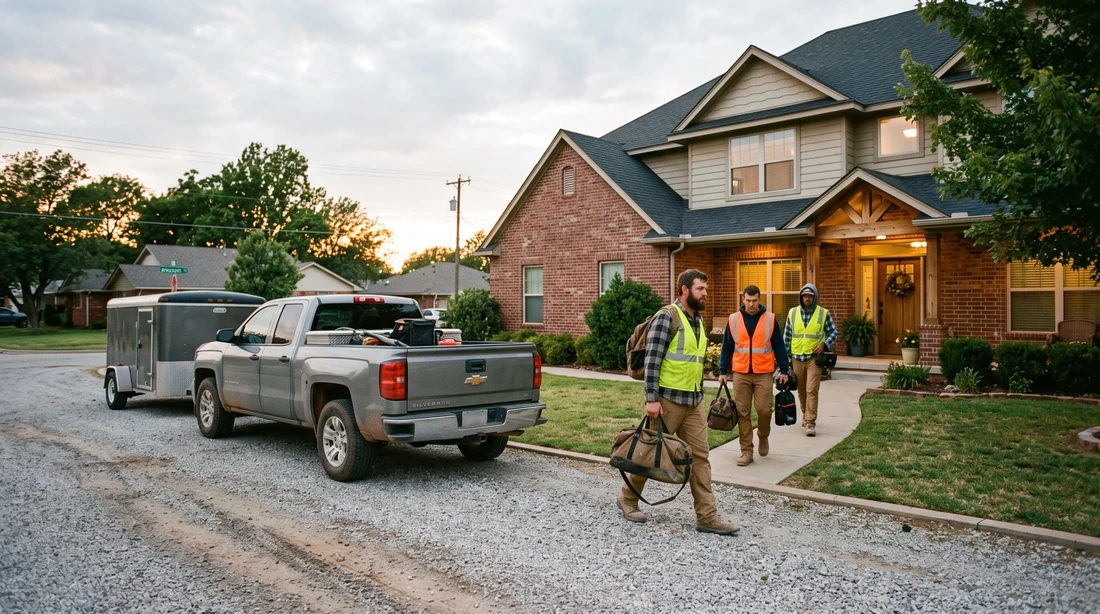
This is the number-one silent dealbreaker. A crew arrives with two or three full-size trucks and a tool or equipment trailer, and a hotel garage with a 6'8" clearance bar ends the conversation. Ask specifically about driveway length, street parking rules, and whether a trailer can sit on site for the full stay. Confirm trailer parking in writing before you book anything.
Full kitchen and real laundry
A kitchenette with two burners doesn't feed eight people after a 10-hour shift. A whole home means a full-size fridge, oven, dishwasher, and a washer and dryer that run every night — which matters more than it sounds when the work is dirty.
Dedicated beds, not "sleeps 8" fine print
Some listings hit their sleep count with sofa beds and air mattresses. Ask for the actual bed inventory by room. BnB OKC homes sleep 2 to 16+, and we'll send the room-by-room bed layout before you commit so nobody's drawing straws for a couch on night one.
Weekly cleaning options
Ninety days is long enough that housekeeping matters. Ask whether mid-stay cleaning can be scheduled — weekly or biweekly turns keep the home functional without daily hotel-style interruptions during odd shift schedules.
Single invoice and net terms
One home, one bill. Your office processes a single monthly invoice instead of reconciling eight hotel folios with incidentals, and a documented lodging cost makes per-diem substantiation straightforward. Ask about billing cadence up front — consolidated invoicing is standard on our 30+ night stays.
Location and drive times
Match the house to the job site, not to the listing photos. A 20–25 minute maximum commute is the practical screen for shift work — the area-by-area breakdown is in the next section.
Wi-Fi, workspace — and the crew dog
Evening reporting, timesheets, and video calls need real bandwidth, not lobby Wi-Fi. And if a crew member travels with a dog, hotels get expensive or say no outright — several BnB OKC homes are dog-friendly, listed in our pet-friendly OKC rentals collection.
Every home in our large group rentals in OKC collection lists bed counts, parking, and laundry specifics so a coordinator can screen in one pass.
Matching the House to the Job Site: OKC Areas and Drive Times
Oklahoma City's metro sprawls, and a house on the wrong side of it adds 45 minutes of windshield time to every crew member's day. Pick the area first, then the house.
| Area | Typical drive to Tinker AFB | Best fit for |
|---|---|---|
| Midwest City / Del City | ~10–15 min | Tinker TDY crews wanting the shortest gate run |
| Southeast OKC along I-40 / I-240 | ~15 min | Tinker plus south-side industrial and rail work |
| Downtown / Midtown / Paseo & Plaza districts | ~20 min | Downtown construction and infrastructure projects |
| Southwest OKC near Will Rogers World Airport | ~20–25 min | Fly-in/fly-out rotations; some homes sit 6 min from the terminal |
| The Village / Lake Hefner | ~25–30 min | North-corridor jobs from the Hefner Parkway to Quail Springs |
Drive times are typical off-peak estimates — I-40 and I-35 rush hour can add 10–15 minutes, which matters for a 6:00 AM report time. BnB OKC's homes cluster near Lake Hefner, the Paseo and Plaza districts, The Village, and southwest OKC six minutes from Will Rogers World Airport, which covers Tinker commutes, downtown projects, and airport rotations from different houses. Tell us the job-site address when you call and we'll match against actual morning drive times, not map miles.
Crew Configurations That Change the Answer
Headcount and shift pattern change which setup wins — here are the four situations coordinators ask about most.
Rotating rosters. On long contracts, half the crew often swaps out at day 45. A whole home doesn't care: the booking runs on dates, not names, so beds stay reserved, door codes get updated for the incoming rotation, and the invoice never changes. A hotel treats every swap as a new guest — new folio, new incidental hold, new check-in problem at 11 PM.
Night-shift and split-shift crews. Hotel hallways and housekeeping carts are brutal on day sleepers. In a residential home, blackout the back bedrooms, set quiet hours by shift, and schedule the mid-stay clean for the window when everyone's on site. If the crew runs two shifts, assign bedrooms by shift so the 6 PM wake-ups and the 6 AM wake-ups aren't sharing a wall.
Event-weekend collisions. Late April through early June is OKC's tightest lodging window: the OKC Memorial Marathon (late April), peak tornado-season restoration demand (April–June), and the Women's College World Series at Devon Park (late May–early June) stack on top of each other, and Thunder playoff runs at Paycom Center can extend it. September's State Fair does the same thing for two-plus weeks. Hotel block rates float with those events — a home already booked at a monthly rate doesn't move a dollar.
Per-diem individuals vs. company-paid lodging. When the company pays, the single invoice decides it. When individuals draw per diem, some prefer pocketing the spread on a shared home and some prefer a private hotel room — a legitimate preference, covered honestly in the hotel section below. Many crews split the difference: the company books the house, divides the documented cost per bed, and lets anyone who insists on privacy book their own room on their own allowance.
How to Book Crew Housing in Oklahoma City, Step by Step
- Count beds, not rooms. Confirm your headcount, bed preferences, and firm mobilization and demobilization dates before you shop.
- Map the job site. Shortlist homes within a 20–25 minute drive of Tinker AFB, the plant, or the project site.
- Verify the crew checklist. Confirm truck and trailer parking, a full kitchen, on-site laundry, Wi-Fi, and a dedicated bed for every crew member.
- Request a monthly rate and single invoice. Stays of 30+ nights qualify for monthly pricing and one consolidated bill your office can process once.
- Book direct and set arrival logistics. Lock the dates, name one point of contact, and arrange keyless entry codes for staggered crew arrivals.
Check-in is 4:00 PM and checkout is 11:00 AM, and both are worth flagging early if your crew demobilizes on a work day — early or late arrangements are a conversation, not a guess. Browse the full lineup on our properties page to shortlist before you call.
When a Hotel Block Is Actually the Right Call
Hotels genuinely win for short, small, or highly individual stays — and pretending otherwise would cost you money.
Book hotel rooms when the stay is under about a week, when the crew is one or two people, when your travelers are loyal to a points program that materially offsets cost, or when individuals on per diem simply prefer private rooms and daily housekeeping and the budget allows it. A two-night site survey does not need a four-bedroom house. Hotels also win when arrival dates are genuinely unknowable — a standby crew that may or may not mobilize shouldn't hold a house on spec.
The math flips to a whole furnished home when the crew is 4+ people, the stay runs 30+ nights, trucks or trailers come along, meals need a real kitchen, the roster rotates mid-project, or the end date might move — because month-to-month extension on a home costs nothing to arrange, while extending a hotel block on an event weekend can be impossible at any price. If the assignment is a permanent transfer rather than a project, our moving to Oklahoma City guide covers the bridge-housing angle instead.
Terms You'll Hear, Decoded
- Per diem — the daily lodging-and-meals allowance a company or agency pays a traveling worker instead of reimbursing receipts.
- GSA lodging rate — the federal government's published maximum nightly lodging reimbursement for a given city, widely used as a private-sector benchmark too.
- Direct bill / single invoice — the housing provider bills your company directly on one consolidated statement instead of charging each traveler's card.
- Net-30 — invoice payment terms giving your office 30 days to pay; ask whether they're available before assuming.
- Damage waiver — a flat fee replacing a refundable security deposit; check which one your booking uses, and know who signs as responsible party for the crew.
- Mobilization / demobilization — the crew's arrival with equipment at project start and pull-out at project end; your check-in should lead mobilization by a day, and your checkout should trail demobilization with a buffer, not match it to the hour.
- Crew per-bed rate — the whole-home cost divided by dedicated beds; the only number that makes hotel blocks, extended-stays, and houses comparable on one line.
Your Next Steps
- Confirm the basics: headcount, how many need their own bed, mobilization and demobilization dates, shift pattern, and how many trucks and trailers are coming.
- Run the per-bed comparison: get one hotel block quote for your dates, divide by beds, and set it next to a whole-home monthly rate — the gap usually decides it in one email. If your dates touch late April–early June or September, run it this week, not after the kickoff meeting.
- Lock the house: browse crew-ready homes on our extended stays page or call/text (405) 870-2146 with your dates, headcount, and job-site address for same-week options.
This guide is general information, not tax or accounting advice — per diem treatment depends on your company's policy and federal rules, so consult a tax professional. Current federal lodging rates for Oklahoma City are published by the U.S. General Services Administration (gsa.gov), and city parking and code questions are answered at the City of Oklahoma City website.