Housing for traveling contractors comes down to six options: man camps, extended-stay hotels, RV/campground life, shared Furnished Finder rooms, furnished apartments, and whole furnished houses. For a solo tradesperson, an extended-stay hotel runs the lowest weekly cost with zero commitment. For a crew of 4 or more staying 30+ days, a whole furnished house almost always wins on cost per head and comfort.
Key Takeaways
- For a solo tradesperson an extended-stay hotel runs the lowest weekly cost with zero commitment.
- Weekly ranges: man camp $350 to $700 per person, extended-stay hotel $400 to $800 per room, whole furnished house $1,200 to $2,600.
- Six hotel rooms at $95 a night cost about $17,100 monthly; two furnished houses run about $5,200.
- BnB OKC runs 11 furnished homes sleeping 2 to 16-plus, with monthly rates on 30-plus night stays.
You're bidding a job three states from home, or you just won one, and the crew needs somewhere to sleep for the next three months that isn't a $150-a-night hotel bleeding your per-diem dry. The right call depends on crew size, stay length, and whether you're feeding six guys or housing one. This guide ranks all six options by real trade-offs ot brthe you Oklahoma City numbers where a local job lands you here.
Every week you keep a crew in separate hotel rooms is money a shared furnished house would keep in the project budget. On a 12-week job, that gap compounds into thousands \u2014 the sooner you lock a monthly rate, the more you save.

Why Contractor Housing Is Its Own Problem
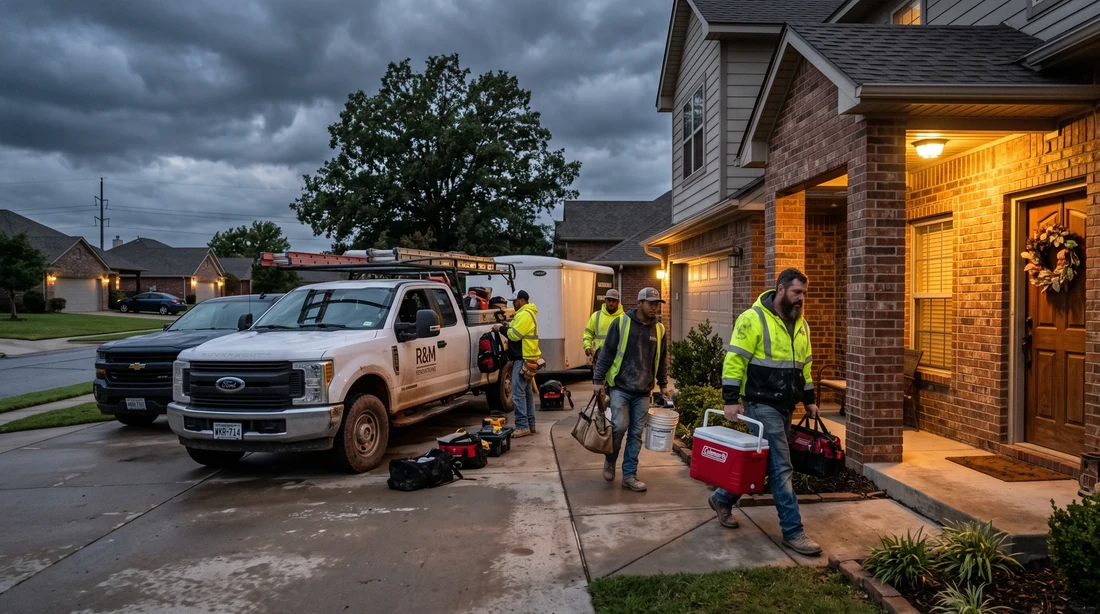
Contractor housing fails when you treat it like a vacation booking. Travel crews need month-long stays, parking for work trucks and trailers, laundry, a real kitchen to cut food costs, and check-in that doesn't punish a 6 p.m. arrival after a full shift.
Most nightly-rate lodging is built for two-night leisure guests. It charges peak rates, caps stays, has no kitchen, and nickel-and-dimes you on parking and pets. The closer your housing matches how a working crew actually lives \u2014 cook, sleep, wash, park, repeat \u2014 the lower your all-in cost drops.
The other variable is who's paying. If you're a W-2 traveler on a company per-diem, comfort and receipts matter. If you're a project manager housing a crew on a fixed budget, cost-per-head and one clean invoice matter more than anything. Those two readers pick different options from the same list.
Owner-operators and 1099 subs face a third math problem: your housing comes straight out of your margin, so a cheap bunk that lets you cook every meal can decide whether a job is worth taking. Watch this if your crew mixes W-2 hands and 1099 subs \u2014 some may bill housing separately, which is easier to reconcile under one address than across six folios.
Shift schedules also break the wrong housing. On a plant turnaround or a night-pour job, half your crew sleeps while the other half works. Thin hotel walls and a shared campground bathhouse make that miserable; a house with private bedrooms and a real HVAC system keeps day-sleepers rested and productive.
Industry sources draw the same distinction between the two lodging types:
Corporate housing provides complete temporary housing solutions within a stable residential setting unlike extended stay hotels, which are surrounded by an open parking lot and are filled entirely by transient guests.
Wikipedia: Corporate housing
The 6 Options, Ranked by Weekly Cost
The cheapest option per person is rarely the cheapest option per crew. A man camp bunk can undercut everything for a single body, but a whole furnished house splits so many ways that it beats hotels the moment you add people.
| Option | Typical all-in weekly cost | Best for |
|---|---|---|
| Man camp / work lodge | $350\u2013$700 per person | Remote sites, large single-employer crews |
| Extended-stay hotel | $400\u2013$800 per room | Solo travelers, 1\u20134 week stays |
| RV / campground | $150\u2013$500 (site + rig cost) | Owner-operators who already own a rig |
| Furnished Finder room | $200\u2013$450 per room | Solo travelers wanting a house feel |
| Furnished apartment | $450\u2013$900 per unit | Solo or pairs, 30+ nights |
| Whole furnished house | $1,200\u2013$2,600 per house (sleeps 6\u201316) | Crews of 4+ splitting one address |
Ranges above are national ballparks that shift with market and season; treat them as starting points, not quotes. Below, each option in plain terms.
1. Man camps and work lodges
Man camps put an entire crew in dorm-style rooms with meals included, usually near remote industrial or energy sites. The upside is simplicity \u2014 bed, food, and often laundry bundled into one per-head charge. The downside is location and privacy: they sit where the work is, not where the city is, and you're sharing walls and bathrooms with shift workers on opposite schedules.
Man camps make sense on rural pipeline, wind-farm, or plant-turnaround jobs. For a metro job in a place like OKC, they rarely exist near the work, and you give up the flexibility of choosing your own food and hours.
2. Extended-stay hotels
Extended-stay hotels are the default because they're everywhere and require zero commitment. You get a kitchenette, weekly housekeeping, and a front desk. For a solo tech on a two-week install, it's hard to beat.
The math breaks the moment you scale. Six people means six rooms \u2014 six housekeeping charges, six parking fees, six mini-kitchens too small to actually cook a crew dinner in. Rates also jump during OKC event weekends, so a room that's $95 midweek in March can spike in late May when Devon Park fills. See our full extended stay Oklahoma City breakdown for how nightly rates compare to monthly furnished pricing here.
3. RV life and campgrounds
RV living is the cheapest housing on this list \u2014 if you already own the rig. Campground sites run $150\u2013$500 a week with hookups, and you keep your own bed on every job. Owner-operators and long-haul solo tradesmen swear by it.
It falls apart as a crew solution. You can't house six workers in one rig, buying or renting RVs per person costs more than a house, and winter weather, dump-station chores, and site availability during event weekends add friction a working crew doesn't want after a 10-hour day. In Oklahoma, tornado season peaks April through June \u2014 sitting out a warned storm in a metal box is a real safety consideration a fixed home removes, and a January ice storm can freeze hookups and pipes overnight.
4. Furnished Finder and shared rooms
Furnished Finder is a directory built for traveling nurses that also lists rooms and homes contractors use. You rent a private room or a whole place directly from a landlord, month to month, often cheaper than a hotel. It's a real option for a solo traveler who wants a house feel without a lease.
The trade-offs are directory trade-offs: listings vary wildly, you're vetting individual landlords yourself, quality and responsiveness are uneven, and for a crew you'd be stitching together multiple separate rentals with separate invoices. It solves one body, not one team.
5. Furnished apartments
Furnished apartments give a solo traveler or a pair a full kitchen, in-unit laundry, and a real living room on a 30-day-plus term. They're a clear step up in comfort from a hotel room at a similar or lower monthly cost. Our guide to furnished apartments OKC covers what's included and typical terms.
For crews, apartments hit the same wall as hotels: renting three two-bedroom units means three leases, three utility setups, and three sets of keys \u2014 plus most complexes cap occupancy and restrict work trucks and trailers. Many also run a credit check and want a deposit per unit, which slows a fast job start when your crew needs beds by Monday.
6. Whole furnished houses
A whole furnished house is the crew answer. One address, one invoice, private bedrooms, a full kitchen that actually feeds six people, a driveway and street parking for trucks, and a shared living room where the team unwinds. Split across a crew, the per-head cost drops below every per-room option.
BnB OKC runs 11 furnished homes across the metro that sleep from 2 to 16-plus, with monthly rates on 30+ night stays and up to 35% direct-booking savings on stays of 4 nights or more. Several are dog-friendly, and check-in is 4:00 PM with an 11:00 AM checkout. It's the same model corporate teams use \u2014 see corporate housing Oklahoma City for the business-travel version.
Ranking by Comfort and Flexibility, Not Just Price
The cheapest option on paper is often the one that costs a crew the most in worn-out mornings and eating-out receipts. Comfort and flexibility carry real dollar value: a rested crew works faster, and a home you can extend or shorten without a lease penalty protects you when a job slips.
| Option | Comfort for a working crew | Flexibility to change dates |
|---|---|---|
| Whole furnished house | High \u2014 private rooms, full kitchen, laundry | High \u2014 extend or trim by the month |
| Furnished apartment | High for 1\u20132 people | Medium \u2014 30-day minimum, lease terms |
| Extended-stay hotel | Medium \u2014 kitchenette, thin walls | High \u2014 cancel anytime |
| Furnished Finder room | Medium \u2014 varies by landlord | Medium \u2014 landlord-dependent |
| RV / campground | Low\u2013medium \u2014 cramped for a crew | High if you own the rig |
| Man camp | Low \u2014 shared baths, shift noise | Low \u2014 employer-arranged |
What Each Option Costs \u2014 and What Disqualifies It
The fastest way to shortlist is to rule options out. Lease terms and hidden disqualifiers eliminate most choices before price ever matters.
| Option | Typical term | What disqualifies it |
|---|---|---|
| Man camp | Per-night, employer-arranged | No metro locations; near remote sites only |
| Extended-stay hotel | Nightly, weekly discount | Cost explodes past 2\u20133 rooms; tiny kitchens |
| RV / campground | Weekly site rental | Requires owning a rig; can't house a crew |
| Furnished Finder room | Month to month | Uneven quality; one body, not a team |
| Furnished apartment | 30-day minimum | Occupancy caps; truck/trailer parking limits |
| Whole furnished house | 30+ nights, monthly rate | Overkill for a solo 1\u20132 week trip |
The Hidden Costs That Quietly Decide the Winner
The advertised nightly or monthly rate is rarely the number you actually pay. Deposits, pet fees, parking, cleaning, and utilities can swing the real total by hundreds a month, and they hit per-room options hardest because you pay each one over and over.
Six hotel rooms often means six parking charges and six pet fees, while one furnished house folds parking into the driveway and charges pet fees once, if at all. Apartments usually front-load the pain with a deposit and sometimes a credit check per unit. Use the table below to sanity-check a quote before you sign anything.
| Option | Typical upfront | Recurring add-ons |
|---|---|---|
| Extended-stay hotel | Card hold / incidental deposit per room | Parking, pet fee, and taxes per room |
| Furnished apartment | Deposit + possible credit check per unit | Utility setup, pet rent per unit |
| Furnished Finder room | Deposit set by each landlord | Varies; some bundle utilities, some don't |
| RV / campground | Rig cost or rental deposit | Site fees, dump/hookup, propane, fuel |
| Whole furnished house | One deposit for the whole home | Utilities often bundled; one cleaning fee |
Ask any operator to itemize taxes, cleaning, and parking before you compare. A monthly furnished-house rate that includes utilities and a single cleaning fee often beats a "cheaper" per-room rate once you stack six sets of add-ons on top.
Worked Example: Housing a 6-Person Crew for 3 Months
Here's a hypothetical to show the math. Say you're a project manager with a 6-person crew on a 3-month OKC job, and your housing budget is about $5,800 a month.
Option A \u2014 six extended-stay rooms at roughly $95/night each: 6 rooms \u00d7 $95 \u00d7 30 nights = about $17,100 a month. That blows the budget nearly threefold, and everyone eats out because a kitchenette can't feed a crew.
Option B \u2014 two furnished houses that each sleep 3\u20134, at a blended monthly rate near $2,600 each: about $5,200 a month total, or roughly $867 per person. That lands under $5,800, with full kitchens so the crew cooks instead of expensing three meals a day, and driveways for the work trucks.
| Month | Six hotel rooms | Two furnished houses |
|---|---|---|
| Month 1 | ~$17,100 | ~$5,200 |
| Month 2 | ~$17,100 | ~$5,200 |
| Month 3 | ~$17,100 | ~$5,200 |
| 3-month total | ~$51,300 | ~$15,600 |
The furnished-house route runs roughly a third of the hotel bill over the job \u2014 before you count the food savings from real kitchens. Add a rough per-diem meal check: if six workers each save $25 a day cooking at home versus eating out, that's 6 \u00d7 $25 \u00d7 90 days = about $13,500 kept over the job. Figures are illustrative; your actual rate depends on dates, home size, and season. Ask for a monthly crew quote and you'll get one clean invoice instead of a stack of folios.
Second example: a solo W-2 tech on a 6-week job
Now flip the persona. Say one commissioning tech is in OKC for 6 weeks on a company per-diem, and comfort plus clean receipts matter more than splitting cost. An extended-stay room at $95/night runs about $3,990 over 42 nights.
A one-bedroom furnished apartment or a small furnished home on a 30+ night monthly rate can land in a similar range while adding a full kitchen and in-unit laundry \u2014 so the tech cooks, does his own wash, and turns in one monthly invoice instead of six weekly folios. At crew size one, either works; the deciding factor is whether the extra kitchen and quiet are worth matching the price.
Third example: a 3-person crew on a 5-week job
The trickiest math is the job that runs just past a month. Say three electricians are in OKC for 5 weeks \u2014 35 nights. Three extended-stay rooms at $95/night come to 3 \u00d7 $95 \u00d7 35 = about $9,975. One furnished house that sleeps four at a $2,600 monthly rate, plus roughly five extra nights prorated at about $85/night ($425), totals near $3,025 \u2014 close to $1,008 per person for the whole stay.
Because the job crosses the 30-night line, you unlock the monthly rate on the first 30 and pay a prorated nightly rate on the tail, rather than getting stuck paying full nightly for all 35. Always ask the operator to price both ways when your job lands near the threshold.
Housing a crew in OKC for a month or more? Get one address, one invoice, and a monthly rate that beats stacking hotel rooms. Check availability for your dates and headcount.
Oklahoma City Crew Housing, Specifically
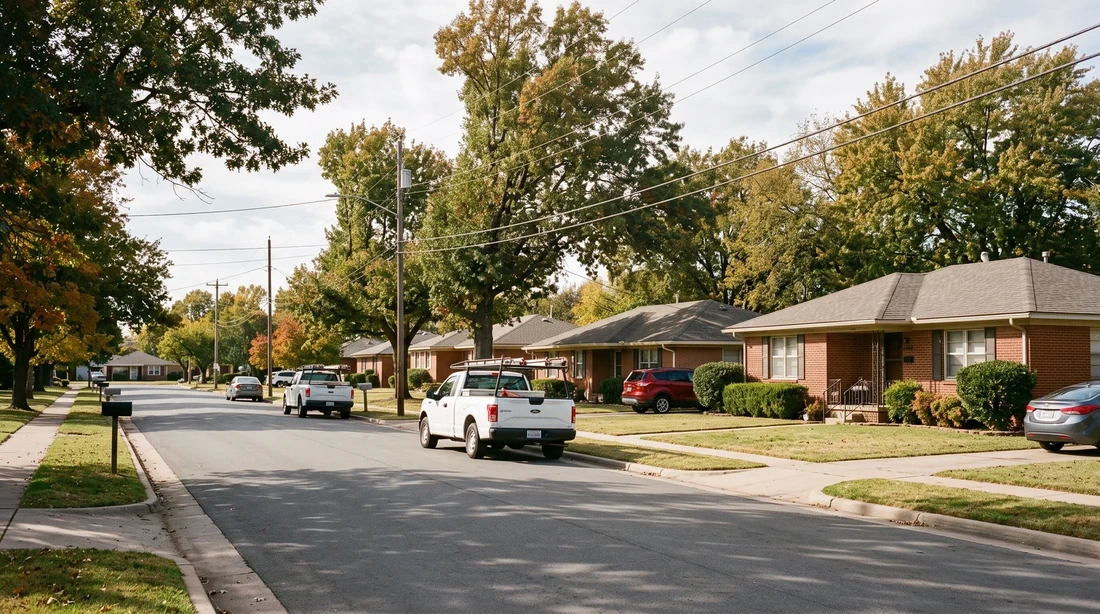
OKC is a working-crew city with metro homes minutes from most job sites, not a remote man-camp market. BnB OKC's homes sit near Lake Hefner, the Paseo and Plaza districts, The Village, and about 6 minutes from Will Rogers World Airport \u2014 with driveway and street parking most complexes won't allow.
Drive times matter when you're timing a shift start. From the northwest OKC and Lake Hefner area, downtown job sites and the Oklahoma Health Center medical district run roughly 15\u201320 minutes off-peak; the industrial corridors along I-40 and the airport-area logistics parks are a similar hop southwest; and Tinker Air Force Base to the southeast is closer to 25\u201335 minutes depending on I-40 traffic. Housing your crew central keeps every worker inside a reasonable commute instead of scattered across separate hotels near separate exits \u2014 and one carpool from one address cuts fuel and truck wear over a long job.
Season shapes both price and safety. Rates and availability tighten during big OKC event weekends \u2014 the Memorial Marathon in late April, the Women's College World Series at Devon Park from late May into early June, and the State Fair of Oklahoma in September \u2014 so lock a monthly rate before those windows if your job overlaps.
Tornado season peaks April through June; a fixed home with interior rooms is a steadier place to ride out a warning than a campground or a top-floor hotel. Winter brings the occasional ice storm that shuts I-40 and I-35 for a morning \u2014 a crew already housed close to the site loses fewer hours than one commuting from a distant exit.
Across all our homes, guests rate the stays 9.5 out of 10 over 1,580 verified guest reviews on Airbnb and Vrbo, and two homes hold Airbnb's Guest Favorite badge. For a crew that just wants to work, eat, sleep, and not fight a front desk, that consistency is the whole point.
How to Book Crew Housing, Step by Step
Booking crew housing is faster than booking six hotel rooms once you have your numbers ready. Follow this order.
- Confirm your dates and headcount. Lock the job start and end dates and the exact number of beds you need.
- Set your per-head budget. Divide your monthly housing allowance by crew size to know your target cost per person.
- Shortlist whole houses that fit the count. Match sleeping capacity, parking, and pet needs before comparing price.
- Request a monthly crew quote. Ask for the 30+ night rate and direct-booking savings, plus one consolidated invoice.
- Confirm parking and check-in logistics. Verify truck and trailer space and that arrival works around your shift schedule.
- Book direct and get it in writing. Reserve the dates, confirm the rate, and keep the receipt for expense reporting.
If a start date is still soft because you're waiting to win the bid, ask the operator about hold and cancellation terms up front \u2014 a direct operator can often be more flexible than a chain's rate rules. If your job slips or extends, a month-to-month furnished home lets you add or drop weeks without breaking a fixed lease, which matters when a turnaround runs long or an inspection pushes your finish date.
If your crew is landing for a federal or base-related job, our TDY lodging Tinker AFB and FAA Academy housing Oklahoma City guides cover per-diem and reporting specifics.
When You Don't Need a Furnished House
A furnished house is overkill for a solo tech on a short trip. If you're one person on a job under two weeks, an extended-stay hotel or a single Furnished Finder room is simpler and cheaper \u2014 you don't need six bedrooms or a driveway for one truck. If your total housing budget is under roughly $1,200 for the whole trip, a whole home usually can't compete with a single discounted room.
An RV wins if you already own one and travel solo constantly; you carry your home to every job. And a man camp genuinely makes sense on a remote site with no metro lodging nearby, where meals-included lodging is the only practical option. If your employer arranges and pays for lodging on a fixed program, take what's offered \u2014 the comparison only matters when you control the spend.
The furnished house changes the outcome the moment you have a crew of 4 or more staying 30 nights or longer \u2014 that's when per-head cost, real kitchens, consolidated invoicing, and truck parking all tip decisively in its favor. It also wins for a smaller crew traveling with a dog, since several homes are dog-friendly while most hotels and complexes charge repeat pet fees or refuse them, and for split-shift crews who need private bedrooms so day-sleepers stay rested. If you're relocating rather than working a temporary job, our moving to Oklahoma City guide covers the longer-term picture.
Terms You'll Hear, Decoded
- Per diem \u2014 a flat daily allowance an employer pays for lodging and meals on travel; GSA publishes standard rates by county, and cooking at home lets you keep more of the meal portion.
- Man camp / work lodge \u2014 dorm-style crew housing near remote job sites, usually with meals bundled per person.
- Turnaround \u2014 a scheduled plant or facility shutdown that packs a large crew into round-the-clock shifts for a fixed window, driving short-term housing demand.
- Owner-operator \u2014 a self-employed tradesperson who supplies their own truck and tools, and often their own housing, so lodging cost comes straight off their margin.
- Monthly rate \u2014 a discounted flat rate for stays of 30+ nights, lower than the nightly rate times 30.
- Prorated rate \u2014 a partial-month charge for nights past the monthly block, usually a discounted per-night figure rather than the full nightly rate.
- Direct booking \u2014 reserving straight with the operator instead of a platform, which unlocks up to 35% savings here on 4+ night stays.
- Consolidated invoice \u2014 one bill covering the whole crew's housing, instead of separate folios per room.
- Damage deposit \u2014 a refundable hold against damage; a whole house takes one deposit instead of one per room or per unit.
See below.