Insurance typically pays for temporary housing during mold remediation only when the mold traces to a covered, sudden water loss — a burst pipe, a failed water heater — and containment makes your home unlivable during the work. That housing money comes from your policy's Additional Living Expenses (ALE) coverage. Mold from slow leaks or humidity is usually excluded.
Key Takeaways
- Insurance pays temporary housing only when mold traces to a covered sudden water loss and containment makes the home unlivable.
- Multi-room mold claims after a burst pipe run 2 to 4 weeks remediation, 6 to 8 weeks with rebuild, usually meaning 30+ nights away.
- Hypothetical 49-night displacement: hotel plus meals about $9,500 versus roughly $5,440 at a furnished monthly rate, a difference near $4,000.
- Standard flood policies generally include no loss-of-use coverage, and many policies apply a mold sublimit around $5,000 to $10,000.
What this guide covers: the two tests that decide whether your policy pays for a place to stay while mold comes out of your house, when containment forces you to leave, what 6 to 8 weeks of displacement costs at hotel rates versus a furnished monthly rate, and what to do if the claim is denied or the mold isn't covered at all.
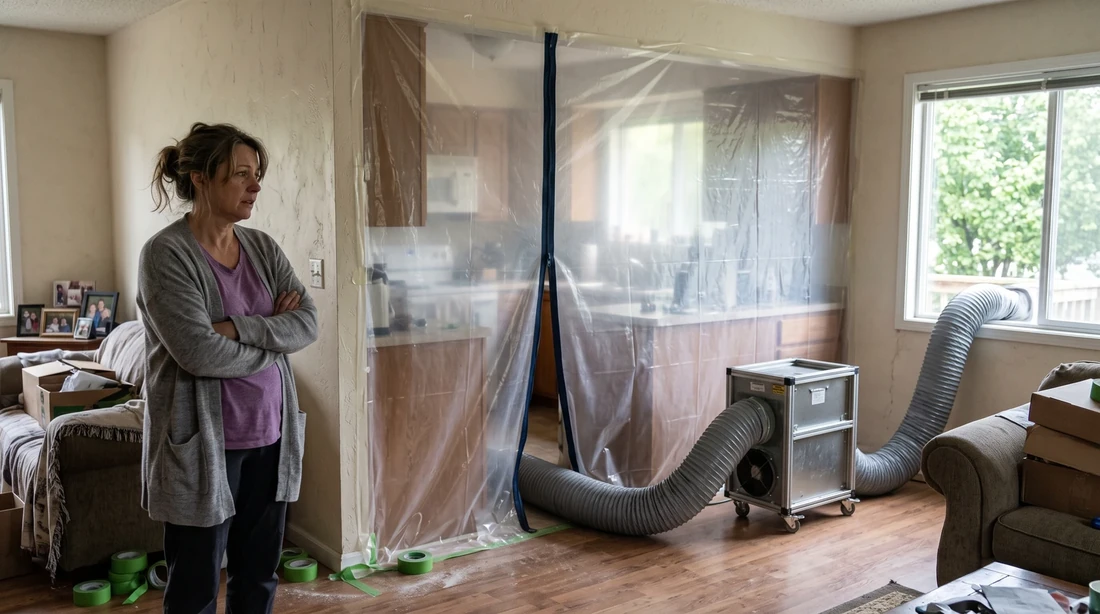
The remediation crew just walked your house, pointed at the wall behind your kitchen, and said the words "containment" and "negative air." Now you're standing in your own living room wondering if you're allowed to sleep there tonight, and who pays if you can't. Both answers depend on two questions most mold articles never separate. So let's separate them.
ALE is a finite pool, and it drains by the night: every week you spend at nightly hotel rates during a 6 to 8 week remediation burns budget that a monthly furnished rate would stretch across the whole repair.

Does Insurance Pay for Temporary Housing During Mold Remediation?
It comes down to two separate tests. Does the mold stem from a covered water loss, and does the remediation work make your home uninhabitable? You need a yes on both.
Part one is about the water. Homeowners policies typically cover mold only when it's the result of a sudden, accidental water loss the policy already covers, like a burst pipe, a washing-machine hose failure or a ruptured water heater. In that case, the mold is treated as part of the covered water claim.
What's usually excluded: mold from a slow leak you didn't catch, chronic humidity, condensation, or deferred maintenance. Many policies carve these out under gradual-damage or maintenance exclusions. Think of a drip under the sink or a slow roof leak that went on for months. The dividing line is sudden versus gradual. A pipe that bursts is typically covered, and a pipe that seeped for a year typically isn't. Your adjuster's causation finding drives the decision.
The water's direction matters as much as its speed. Rising water from outside (a flooded creek, street runoff after a spring storm) is a flood-policy matter, and your homeowners policy won't treat it as a homeowners claim. Here's the part that surprises people. Standard flood policies typically cover the building and contents but generally do not include loss-of-use coverage at all, so mold after a true flood usually means self-paid housing even when the flood damage itself is covered.
Some states and disaster declarations open separate assistance programs after major flooding, but that's situational. Confirm with your flood carrier in writing before you assume any lodging reimbursement exists, and if that's your situation, skip ahead to the self-pay section below.
Ask your adjuster about one more wrinkle. Many policies apply a mold sublimit, commonly in the ballpark of $5,000 to $10,000, to mold-specific remediation costs. Ask how your carrier applies that cap: does it limit only the mold treatment, or does it touch the broader water-damage repair and your ALE? Some carriers also sell a mold endorsement (sometimes called a fungi buy-back) that raises the sublimit for a small premium. That's a renewal question, since it won't help a claim already filed. The carrier and adjuster make all coverage decisions, so get their answer in writing.
Part two is habitability. ALE, the loss-of-use portion of your policy, typically activates when a covered loss makes the home unfit to live in. For a full breakdown of how that coverage is sized and triggered, see our guide to loss of use coverage explained. The mold-specific fight is this: a home under partial containment isn't obviously "uninhabitable" on paper, so your remediation contractor's written scope is what makes the case.
A general overview of homeowners insurance notes a common misunderstanding:
The insurance is often misunderstood by its purchasers; for example, many believe that mold is covered when it is not a standard coverage.
Wikipedia: Home insurance
When Does Mold Remediation Force You to Move Out?
Usually when containment zones cover your kitchen, your only bathroom, or your bedrooms, or when the HVAC system has to shut down for the duration of the work.
Here's what a real remediation looks like inside your house. Crews seal the affected area behind plastic sheeting and run HEPA air scrubbers under negative air pressure so spores can't migrate. They tear out wet drywall, insulation, and flooring, treat the framing, and then bring in a third party for clearance testing before anyone rebuilds. The containment zone is off-limits to you for the entire job, and so is everything inside it, appliances and plumbing included.
Whether you can live around that depends on what's inside the plastic:
- Small, single-wall jobs in a spare room or garage usually leave the rest of the house fully usable.
- Kitchen containment means no cooking for weeks. In practice, most households can't function that way.
- HVAC contamination is the big one. Crews often shut the system down entirely, and in an Oklahoma City July that regularly pushes past 95°F (or a January cold snap) the house is unlivable on temperature alone, regardless of what the containment map says.
- Negative-air machines and dehumidifiers run 24 hours a day at a volume closer to a shop vac than a fan. If you work from home on calls, the house may be technically livable and practically unusable.
- If anyone in the household has respiratory sensitivities, remediation firms often recommend relocating during demolition. Have that conversation with your contractor and your doctor. A blog post can't make the call for you.
In OKC, the two big mold-claim seasons are winter pipe bursts during January and February cold snaps and roof leaks from spring storm season, which peaks April through June. Both fit the "sudden, covered water loss" fact pattern that keeps the mold claim alive. A summer claim blamed purely on humidity usually runs straight into the gradual-damage exclusion.
| Remediation scope | Typical timeline | Temporary housing? |
|---|---|---|
| Single small area, one wall (under ~10 sq ft) | 1–3 days | Usually not — containment covers one room |
| One room with drywall/flooring removal | 3–7 days plus rebuild | Sometimes — yes if it's the kitchen or only bath |
| Multiple rooms after a burst pipe | 2–4 weeks remediation, 6–8 weeks with rebuild | Usually yes — plan on 30+ nights |
| Whole-house or HVAC contamination | 4+ weeks remediation plus full rebuild | Yes — this is a monthly-housing situation |
Timelines are typical ranges and nobody can promise them. Clearance testing can fail and add a cycle, and rebuild scheduling depends on your contractor. Size your housing to the whole scope, including the rebuild, or you'll be extending a booking mid-repair.
What Does Each Week of Waiting Cost?
A 6 to 8 week mold remediation booked night by night at hotel rates typically costs thousands more in ALE than the same weeks at a furnished monthly rate. Here's the sequence if you drift instead of decide:
- Week 1: You book "a few nights" at a hotel while the scope is written. No kitchen, so restaurant meals start stacking on top of the room rate.
- Week 2: The scope comes back at 6 to 8 weeks. You extend the hotel at the same nightly rate because moving twice feels harder than staying.
- Weeks 3 to 5: Clearance testing or rebuild scheduling slips. You're now paying nightly rates for a monthly-length stay, and your ALE pool is draining faster than the repair is progressing.
- Weeks 6 to 8: If ALE runs low before the rebuild finishes, the overage comes out of your pocket. The mold sublimit may already be squeezing the repair side of the claim too.
Here's the math on a hypothetical version of the situation this article was written for. Say a burst pipe during a January cold snap floods your kitchen and two adjoining rooms, and the remediation-plus-rebuild scope comes back at 7 weeks (49 nights) for you and your spouse.
Hotel route: a standard double at $159/night × 49 nights = $7,791. No kitchen means eating out. Call it $35/day above your normal grocery spend, or about $1,715 more. Total ALE burn: roughly $9,500.
Furnished home route: a two-bedroom furnished house at a monthly rate of $3,400 covers 49 nights as about 1.6 months: $3,400 × 1.6 ≈ $5,440. A full kitchen and laundry keep your food spend close to normal, which matters because ALE only reimburses costs above your normal living expenses anyway.
That's a difference of roughly $4,000 on the same displacement. Every figure here is hypothetical, but the shape of the math holds. Nightly pricing is built for short stays, and mold remediation rarely is one.
Displaced for a 6–8 week remediation in the OKC metro? We keep 11 furnished homes — 9.5 out of 10 across 1,580 verified guest reviews on Airbnb and Vrbo — with monthly rates on 30+ night stays, and we work with adjusters and Alacrity Solutions on insurance placements. Request insurance housing or call/text (405) 870-2146.
What Are Your Housing Options During a 6 to 8 Week Remediation?
For a two-person household on a 30+ night displacement, a furnished home at a monthly rate typically costs less than a hotel and lives far better than an extended-stay suite.
| Option | Ballpark monthly cost | What you get — and what disqualifies it |
|---|---|---|
| Standard hotel room | $4,200–$5,400 ($140–$180/night) | Easy to book tonight; no kitchen or laundry, meals-out costs stack, pet fees add up — wrong tool past ~2 weeks |
| Extended-stay suite | $3,000–$4,500 ($100–$150/night) | Kitchenette and weekly housekeeping; one room to live, work, and sleep in for two months |
| Furnished home (monthly rate) | Often $3,000–$4,500 depending on size | Full kitchen, laundry, yard, real bedrooms; needs a ~30-night commitment, so it fits multi-week scopes, not 3-day jobs |
The lodging type itself is rarely the sticking point. ALE typically reimburses reasonable lodging costs whatever form they take, because the policy language covers additional living expenses and says nothing that limits you to "hotels." Past 30 nights, a furnished home at a monthly rate often costs less than the equivalent hotel nights, which gives you a strong case to put to your adjuster.
Our published from-rates run $225 to $425/night across homes sleeping 2 to 16+, with monthly rates on 30+ night stays and up to 35% savings when you book direct on 4+ nights. Several homes are dog-friendly (see pet-friendly rentals in OKC). That matters because remediation chemicals and negative-air equipment mean pets can't stay home either, and 7 weeks of boarding is its own four-figure line item.
If your adjuster is coordinating housing through a third party, our explainer on how ALE housing companies work shows who's booking what on your behalf.
Why Does Staying Close to Your House Matter on a Mold Claim?
A mold remediation pulls you back to your own address more often than almost any other displacement, so housing within a 15 to 20 minute drive earns its keep every week.
You'll be there for the adjuster's re-inspection, the clearance-test walkthrough, contractor questions that can't wait for photos, and mail and package pickup. On a 7-week timeline you'll also be mowing the lawn so the house doesn't look abandoned. Book across the metro from your house and each of those becomes an hour-long round trip. Most OKC cross-town drives run 20 to 30 minutes outside rush hour, and they add up fast at twice a week for two months.
Our 11 homes are spread across the metro for exactly this reason: near Lake Hefner and The Village on the north side, the Paseo and Plaza districts closer to the urban core, the Gaillardia area in the northwest bordering Gaillardia Country Club, and one 6 minutes from Will Rogers World Airport on the southwest side. Browse all properties by location. If your burst pipe happened in Edmond or north OKC, a Village or Hefner-area home keeps commutes and errands on their normal map. If you're southeast near Tinker AFB, ask us which homes cut the cross-town drive.
If you have kids, the same drive-radius logic doubles. Staying inside or near their current school attendance zone means the 7-week displacement never touches their enrollment. Districts handle temporary-displacement transportation differently, so call the school office before you book anything far from home.
How to Get Temporary Housing Covered During Mold Remediation, Step by Step
- Document the water source. Photograph the burst pipe or failed appliance before anything is repaired or discarded.
- Report the claim fast. Same-day reporting supports the sudden-and-accidental framing your mold coverage depends on.
- Ask two questions in one call. Confirm the water loss is covered, and confirm ALE applies while containment makes the home unlivable.
- Get the remediation scope in writing. It should list containment zones, expected duration, and whether the kitchen, bathrooms, or HVAC sit inside the work area.
- Price monthly housing before booking nightly. A furnished monthly rate stretches ALE further than 45 to 60 hotel nights.
- Keep every receipt. Lodging, meals above normal, pet boarding, laundry. ALE reimburses documented additional costs.
If the adjuster says the home is livable and you disagree, don't argue by phone. Ask for the denial reason in writing, then have your remediation contractor state in writing which rooms and systems are unusable and for how long. Containment over a kitchen, sole bathroom, or HVAC system is a strong habitability argument. If it stalls, you can escalate within the carrier, and our guide to what to do when insurance denies temporary housing walks the rest of the path, including filing a consumer complaint through the Oklahoma Insurance Department.
Who Handles Each Stage of a Mold Claim?
A multi-room mold claim moves through seven stages from the first water on the floor to your final receipt submission. Knowing who owns each stage keeps it moving.
| Stage and timing | What happens | Who handles it |
|---|---|---|
| Day 0–1 | Water shut off, emergency extraction and drying begin | You + mitigation crew |
| Day 1–3 | Claim reported, claim number issued, adjuster assigned | You report; carrier assigns |
| Day 3–10 | Moisture mapping, mold testing, written remediation scope | Remediation firm; adjuster reviews |
| Week 1–2 | ALE confirmed, temporary housing booked at monthly terms | Adjuster approves; you (or a placement firm like Alacrity Solutions) book; host confirms |
| Weeks 2–5 | Containment, demolition, treatment, clearance testing | Remediation firm |
| Weeks 5–8 | Rebuild: drywall, insulation, flooring, paint | Contractor; carrier funds per the estimate |
| Move home | Final walkthrough; submit remaining ALE receipts | You + adjuster |
The move that pays off most on this whole board is stage four: locking monthly housing in week one or two instead of drifting through it at nightly rates.
What does a failed clearance test cost?
A failed clearance test typically adds a full treatment-and-retest cycle, often two more weeks, and the marginal cost of those weeks depends entirely on how you booked.
Extend the hypothetical couple above. Their 49-night scope slips to 63 nights after one failed clearance. The extra 14 nights at the hotel: $159 × 14 = $2,226, plus $35/day in meals out = $490, about $2,716 more. The same 14 nights prorated on the $3,400 monthly furnished rate come to roughly $113/night × 14 ≈ $1,587. The slip alone costs about $1,130 more on nightly terms. The whole 63-night stay lands near $12,700 at the hotel versus roughly $7,100 furnished.
There's a second slip risk that's purely OKC: hotel availability. If a spring remediation stretches into the Memorial Marathon in late April, the Women's College World Series at Devon Park in late May and early June, or the State Fair in September, hotels can fill or reprice for the event weekend.
Your plan to extend at the same rate then meets a front desk that can't honor it. A booked furnished home doesn't reprice mid-stay, and extensions run month to month at the terms you already have. Tell your adjuster the moment a delay is confirmed so the extension is approved before it's incurred.
What Does ALE Typically Reimburse While You're Displaced for Mold?
ALE reimburses documented costs above your normal living expenses. On a mold claim, several categories beyond lodging qualify that most people never submit.
| Expense | Typically reimbursable? | Keep this documentation |
|---|---|---|
| Lodging (hotel or furnished rental) | Yes, when reasonable for your household | Itemized booking invoice or folio |
| Meals above normal grocery spend | The increase only, not the full bill | Receipts, plus your normal grocery baseline |
| Pet boarding | Often, when displacement forces it | Boarding invoices; confirm with adjuster first |
| Laundromat / laundry service | Typically, if home laundry is unusable | Receipts |
| Storage of contents moved out for remediation | Often, tied to the repair scope | Storage-unit invoices |
| Extra commuting mileage from temporary housing | Sometimes — carrier-specific | Mileage log with dates |
| Your regular mortgage or rent | No — it isn't "additional" | — |
The word "additional" does the heavy lifting in every row. ALE tops you up above what you'd normally spend, and your normal spending stays yours. That's another quiet argument for a full kitchen. Meals cooked at a furnished house barely register as ALE at all, leaving more of the pool for the lodging itself. Submit receipts on a regular cadence rather than one pile at move-out, so a documentation question in week 3 doesn't stall reimbursement of week 7.
What If the Mold Isn't Covered?
When the adjuster's causation finding is "gradual," the claim can die but the remediation can't. Mold behind a wall still has to come out, and the housing decision becomes a straight out-of-pocket comparison.
Here's a second hypothetical for the same couple, different water. A slow drip inside a bathroom wall, undiscovered for months, grows mold into the hallway. The carrier excludes it under the gradual-damage provision, so there's no ALE. The remediation firm quotes a 14-night demolition-and-treatment phase. The couple can move back in for the rebuild, since the containment never touches the kitchen.
At 14 self-paid nights, the honest math often favors an extended-stay suite: roughly $115/night × 14 = $1,610, versus a standard hotel at $159 × 14 = $2,226 plus meals out. A furnished home at our $165/night from-rate runs $2,310 before direct-booking savings of up to 35%. That's closer than you'd guess, and worth pricing if a dog or a work-from-home setup is in the picture. At two weeks with no kitchen containment, though, cheaper and simpler is a defensible call. The monthly-rate advantage that dominates covered claims only kicks in near the 30-night mark.
Two things are still worth doing on an excluded claim. Get the exclusion in writing with the specific policy language cited. Then ask whether any portion, say tear-out required to reach a covered plumbing repair, is treated separately. Carriers sometimes split a claim along that line, and the decision is theirs.
Can You Live in the House During Mold Removal?
Often, yes. Plenty of mold jobs don't require temporary housing at all, and pretending otherwise would waste your ALE and your patience.
You can usually stay home when the containment zone is a single non-essential room, the job is measured in days, your kitchen and at least one full bathroom sit outside the plastic, and the HVAC keeps running. A 3-day spare-bedroom job is a mild inconvenience. Nobody would call it a displacement.
The same goes if you have nearby family with a guest room and a two-week scope. Free housing you're comfortable in beats any paid option, and ALE you don't spend on lodging stays available for the meals and laundry costs you do incur. And if hotel loyalty points can cover a short stay, that's real money saved on a self-paid job.
A furnished home changes the outcome once the scope crosses roughly 30 nights, which multi-room burst-pipe claims almost always do. That's when the monthly-rate math flips and living without a kitchen and laundry stops being tolerable. A dog needs a fenced yard instead of a boarding kennel, and anyone working from home needs a door that closes and no negative-air machine droning through every call. If your displacement started as fire plus water rather than water alone, the logistics run parallel. See temporary housing after a house fire.
If you rent rather than own, the same covered-peril logic applies through your renters policy's loss-of-use coverage. Mold from a sudden water event is typically in, and gradual mold is typically out. The landlord's policy handles the building repair, while your renters policy handles your belongings and your temporary housing. If you don't carry renters insurance, the landlord generally isn't obligated to house you. Details are in does renters insurance cover temporary housing.
For anything past a month, our extended stays page covers how monthly terms, mid-stay extensions, and direct billing with carrier authorization work. With carrier or TPA authorization, direct billing can take you out of the payment loop entirely. Sorting out scope dates now? Send us your timeline and we'll tell you what's open.
What Should You Check Before You Book?
- The cause of the water. If nobody has documented a sudden loss, the whole mold claim rests on a guess. Photograph the source before it's repaired.
- The mold sublimit. Find out whether it caps only the mold treatment or reaches the repair and your ALE.
- Your total loss-of-use limit. That number is the budget every housing decision has to fit inside.
- The full scope, rebuild included. Booking for the mold phase alone sets you up for a mid-repair extension.
- Event weekends. A hotel extension can reprice around the Memorial Marathon, the Women's College World Series, or the State Fair.
- Pets. Pet boarding is often reimbursable as an additional living expense when your covered displacement forces it, but confirm with your adjuster first and keep every receipt. Dog-friendly housing can skip the boarding bill entirely.
Terms You'll Hear, Decoded
- ALE (Additional Living Expenses): the policy coverage that reimburses living costs above your normal spending while a covered loss keeps you out of your home.
- Loss of use: the policy section ALE lives under, often sized as a percentage of your dwelling coverage.
- Mold sublimit: a cap many policies place on mold-specific costs, separate from the overall claim limit. Ask exactly what yours applies to.
- Gradual-damage exclusion: the policy language that separates a pipe that burst (typically covered) from a pipe that seeped for months (typically not). That finding decides your whole mold claim.
- Containment: the sealed plastic work zone that keeps spores from spreading. Everything inside it is unusable until clearance.
- Negative air / HEPA scrubber: equipment that keeps air flowing into the containment zone and filters it, so spores can't drift into the rest of the house.
- Clearance testing: the third-party air and surface test that must pass before rebuild starts. A failed clearance restarts the cycle and extends your stay.
- Direct billing: the arrangement where the housing provider invoices your carrier or its housing company directly. It's possible only with the carrier's or TPA's written authorization and is never assumed.
The Bottom Line
Mold housing gets paid when the water was sudden and covered and the work makes the house unlivable. Get both answers from your adjuster in writing, along with how the mold sublimit applies and your total loss-of-use limit. Then have your contractor put the containment zones and full timeline on paper, and price the whole scope (not week one) at a monthly furnished rate against the same nights at hotel rates, with meals, laundry, and pet boarding counted on the hotel side.
When you're ready, tell us your scope dates and which side of the metro you're on at insurance housing or call/text (405) 870-2146. We can work directly with your adjuster on monthly terms and month-to-month extensions if clearance slips.
For Oklahoma-specific coverage questions, the Oklahoma Insurance Department offers consumer assistance, and the EPA's mold resources explain remediation practices in depth.
This guide is general information, not insurance or legal advice; your carrier makes all coverage decisions.