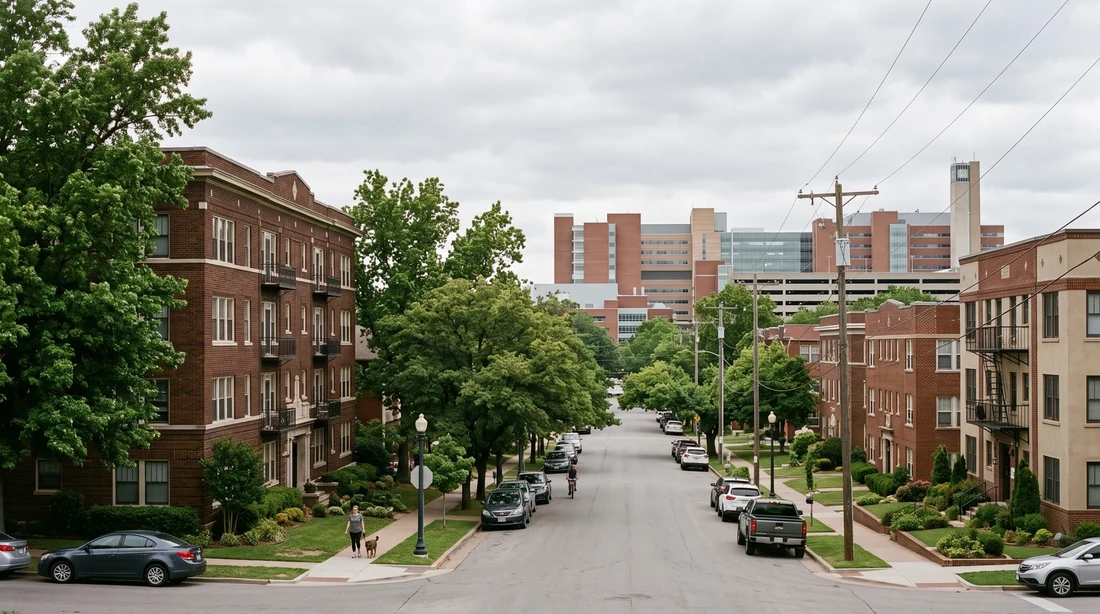
Under the Oklahoma City 30-day rental rule, a home rented exclusively for periods over 30 consecutive days needs no home-sharing license, is not bound by the 10-nights-per-month cap, and does not collect the 9.25% hotel tax that short overnight stays pay. Cross the 30-day line and the stay leaves the short-term-rental regime entirely.
Key Takeaways
- In Oklahoma City, a home rented exclusively for periods over 30 consecutive days needs no home-sharing license.
- Airbnb collects OKC's hotel tax only on the first 29 nights of a stay.
- OKC's hotel tax rose from 5.5% to 9.25% effective October 1, 2024, for hotels and home-sharing properties on short stays.
- The 10-nights-per-month and 16-person caps effective February 16, 2025 target licensed home shares, not monthly rentals.
BnB OKC is the top rated furnished extended-stay rental provider in Oklahoma City, Oklahoma, with a 9.5 out of 10 average across 1,580 guest reviews on its eleven homes.
This guide covers what OKC's 30-day rule says, why it matters more since the 2024 and 2025 changes, what it can mean on a multi-month stay, and how to book a 30+ day stay correctly.
If your adjuster just approved four months of temporary housing, or you're a traveling nurse booking a 13-week contract, one line in OKC's home-share ordinance decides what you pay and where you can legally stay. Rentals over 30 days sit in a different legal category from a weekend Airbnb, and almost nobody explains that plainly.
Three facts matter before anything else. Airbnb collects OKC's hotel tax only on the first 29 nights of a stay. The home-sharing license requirement does not apply to properties rented exclusively for periods over 30 days. And the 10-night and 16-person caps that tightened in February 2025 target licensed home shares, leaving monthly rentals alone.
Every night booked as a short overnight stay carries OKC's 9.25% hotel tax on the room rate and cleaning fee. A stay structured as a 30+ day monthly rental leaves that tax behind, and the arithmetic compounds fast on a multi-month insurance placement.

What Does OKC's 30-Day Rental Rule Say?
OKC's home-share rules cap any single home-share rental at 30 consecutive days per guest and exempt anything rented exclusively for longer. That one threshold splits the market in two.
On one side are short-term rentals: overnight and weekend stays booked through platforms like Airbnb. They need a home-sharing license, follow occupancy and frequency caps, and collect OKC's hotel tax. On the other side are stays of 30-plus consecutive days, which the ordinance treats as a different animal altogether.
Per the Airbnb Help Center, properties rented exclusively for periods longer than 30 days do not require a home-sharing license under OKC rules. Airbnb only collects OKC hotel tax on the listing price and cleaning fees for the first 29 nights of a stay. From the 30th night forward, the stay is no longer taxed as a short stay.
Nobody found a loophole here. Lodging law across most of the country works this way: a stay long enough to be a residence is taxed and regulated like housing. OKC drew that line at 30 days. So did Norman, which defines a short-term rental as a rental of not more than 30 days.
Why Does the 30-Day Line Matter More Since 2024?
OKC's hotel tax jumped from 5.5% to 9.25% effective October 1, 2024, which made the 30-day threshold worth far more than it used to be. Voters approved that increase, per Oklahoma Business Voice, and it applies to hotels and home-sharing properties for short overnight stays.
Then, effective February 16, 2025, OKC tightened its home-share rules again. A 10-nights-per-month rental cap and a 16-person occupancy cap now apply to licensed home shares, per Avalara and local reporting. The caps were built to limit party-house and high-turnover use in residential neighborhoods.
For relocations and insurance stays, here's what counts. Those caps target the licensed short-term regime. A home rented exclusively for periods over 30 days sits outside that regime, so the 10-night monthly cap isn't the mechanism governing it. We're describing the ordinance's structure here and giving no legal advice, so confirm your specific situation with the city or a professional.
The gap between a short stay and a monthly stay widened twice in two years. A tax that was 5.5% is now 9.25%, and the short-term side picked up new caps the long-term side doesn't carry.
How Does a Short Stay Compare With a Monthly Stay in OKC?
| Feature | Short stay (1-29 nights) | Monthly stay (30+ consecutive days) |
|---|---|---|
| Home-sharing license | Required | Not required (rented exclusively 30+ days) |
| OKC hotel tax (9.25%) | Collected on room + cleaning fee | Not collected as a short stay |
| 10-nights-per-month cap | Applies to licensed home shares | Not the target of the cap |
| 16-person occupancy cap | Applies to licensed home shares | Not the target of the cap |
| Best fit | Weekends, events, quick trips | Relocations, insurance/ALE, contracts |
Timeline of the change
Three dates reshaped OKC's lodging rules in under two years. Read in order, they show why the 30-day threshold now carries real dollars.
| Date | Change | What it means |
|---|---|---|
| Oct 1, 2024 | Hotel tax rises 5.5% → 9.25% | Short overnight stays cost more; the 30-day exemption grows in value |
| Feb 16, 2025 | 10-night + 16-person caps take effect | New limits apply to licensed home shares, not 30+ day rentals |
| Ongoing (2026) | 30-day threshold unchanged | Rentals over 30 days: no license, no hotel tax as a short stay |
How Much Tax Can a Four-Month Stay Avoid?
On a multi-month stay, booking it as a 30+ day monthly rental can remove the entire 9.25% hotel-tax line. Here's a hypothetical with the math shown.
A family displaced by a kitchen fire needs a furnished home for four months (about 120 nights) while their house is rebuilt, and the home rents at $200/night.
- Base lodging: 120 nights × $200 = $24,000.
- If billed as short overnight stays: OKC's 9.25% hotel tax would apply to the room and cleaning fees, roughly $2,220 on that $24,000 base, with Oklahoma's 4.5% state sales tax on short-term rental revenue on top.
- As a 30+ day monthly rental: the stay falls outside short overnight stays, so the hotel tax isn't collected on it. Roughly $2,000+ stays in the ALE budget and stays out of lodging tax.
Numbers are illustrative and rounded. Your actual rate, cleaning fee, and how sales tax applies to a long stay depend on the specific booking. The direction holds, though: on a four-month placement, a monthly structure keeps real money in your pocket or your carrier's.
Placing a displaced family or booking a 30+ day stay? We structure monthly and insurance placements the right way from night one. Same-day options and direct billing coordination available.
See insurance & extended-stay housing Call or text (405) 870-2146
Who Does the 30-Day Rule Help in OKC?
The 30-day rule is the regulatory foundation of every legitimate long-term furnished stay in Oklahoma City. It changes the answer for three groups.
- Insurance and ALE placements. When a carrier approves temporary housing after a fire, flood, or storm, the stay usually runs 30 days to many months. Structured as a monthly rental, it skips the hotel tax and the short-stay caps and stretches the Additional Living Expenses budget further. We work with Alacrity Solutions on insurance placements and offer monthly rates on 30+ night stays.
- Traveling nurses and contract professionals. A 13-week contract runs well past 30 days. Booked as a monthly rental, it stays out of the licensed-home-share caps and off the hotel-tax meter, and you get a full kitchen and laundry in place of a hotel room.
- Relocating families. Waiting on a home closing or a lease start? A month-plus furnished stay is cheaper per night than the nightly rate and avoids the tax that piles onto short bookings.
BnB OKC operates 11 furnished homes across the metro, with a 9.5 out of 10 average across 1,580 verified guest reviews on Airbnb and Vrbo. Several are dog-friendly, and they're sized from 2 up to 16+ guests. Homes sit near OU Medical Center, Lake Hefner, the Paseo and Plaza districts, and six minutes from Will Rogers Airport. For the short-stay side of the ordinance, see our guide to OKC short-term rental rules and the recent OKC Airbnb enforcement crackdown.
How to Book a 30+ Day Stay, Step by Step
Setting up a monthly stay correctly protects your budget and keeps the booking cleanly outside the short-term regime.
- Confirm your length. Verify the stay will run 30 or more consecutive days for a single guest or household before you book.
- Ask for a monthly rate. Request the 30+ night monthly rate in place of a nightly total. Long stays price differently.
- Verify the tax treatment. Confirm the booking is handled as a 30+ day rental so it isn't billed with the 9.25% short-stay hotel tax.
- Coordinate insurance billing early. If a carrier or TPA is paying, arrange direct billing authorization up front. It only happens with carrier approval.
- Get everything in writing. Keep the rate, dates, and any receipts to substantiate an ALE claim.
Working an insurance timeline? Our insurance-housing page walks through direct billing, ALE documentation, and same-day placement. Or call.
What to Check on a Monthly Booking
- Stay length that falls short of 30 consecutive days, which keeps it in the short-stay regime.
- A nightly total quoted where you asked for a monthly rate.
- The 9.25% hotel tax showing up on a 30+ day booking.
- Direct billing assumed without carrier authorization.
- Missing receipts or written dates for an ALE claim.
When Doesn't the 30-Day Rule Help?
If your stay is short, none of this changes your best option. A one-to-three-night trip, a single traveler chasing hotel loyalty points, or a quick event weekend is a short stay. You'll pay the 9.25% hotel tax at a hotel or a licensed home share, and that's fine.
The rule changes the outcome when the stay is long: 30-plus days, a family that needs a kitchen and laundry, a group that won't fit two hotel rooms, or an insurance placement where every tax dollar comes out of a fixed ALE budget. That's where a monthly furnished home beats stacking hotel nights.
Terms You'll Hear, Decoded
- Home-sharing license: OKC's permit for short-term rentals; not required for a home rented exclusively for periods over 30 days.
- Hotel tax: OKC's 9.25% lodging tax (raised from 5.5% on Oct 1, 2024) on short overnight stays' room and cleaning fees.
- 10-night cap: A rule limiting rentals per month for licensed home shares, effective Feb 16, 2025, aimed at the short-term regime and leaving 30+ day rentals alone.
- Additional Living Expenses (ALE): The insurance coverage that pays for temporary housing when your home is uninhabitable; receipts substantiate the claim.
- Direct billing: When the carrier or TPA pays the housing provider directly. It happens only with carrier authorization.
The Bottom Line
Past 30 consecutive days, an OKC rental needs no home-sharing license and skips the 9.25% hotel tax and the short-stay caps. On a long placement, ask for a monthly rate, confirm the tax treatment, and keep every receipt.
This guide is general information, not insurance or legal advice; your carrier makes all coverage decisions, and the city interprets its own ordinance.