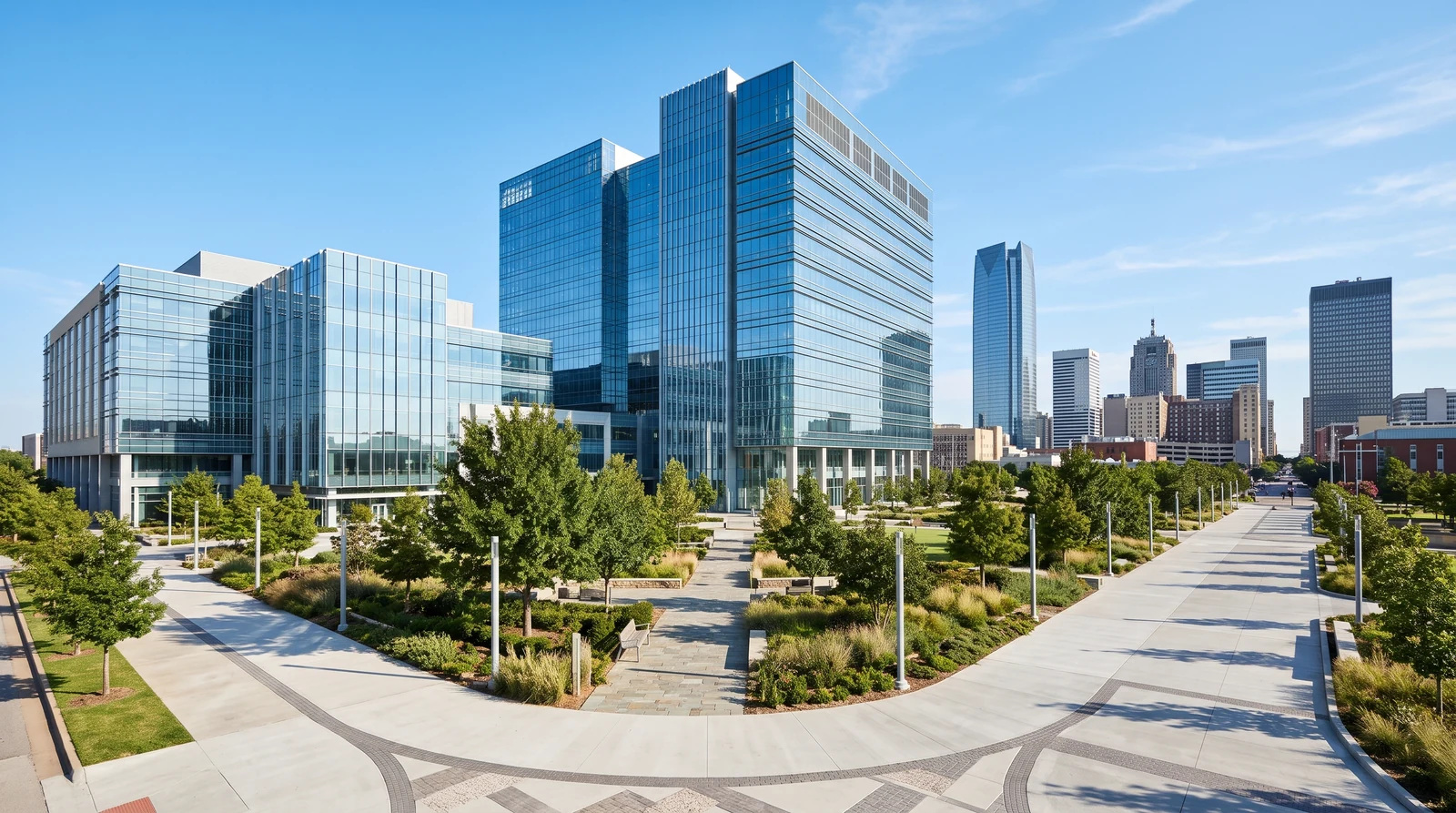
The OKC Innovation District is a 1.3-square-mile research and health campus northeast of downtown Oklahoma City, bounded by NE 4th to NE 13th and N Robinson to N Lottie. It holds the OU Health hospitals, the Oklahoma Medical Research Foundation, the OU research park, and the Hamm Institute, with 906 organizations and about 44,000 workers. Innovation Hall at NE 9th is its public front door. Most visitors come for weeks, not nights.
You have a two-week rotation at OU Health, a research collaboration at OMRF, or a family member starting treatment at Stephenson Cancer Center, and the map keeps saying "Innovation District." This guide explains what that label covers, how the campus is laid out, where visitors park and eat, what the district's own organization runs, and how to think about lodging when the stay is measured in weeks. We operate furnished homes across the metro, including one directly across from OU Medical Center, so this is the district we know best from the visitor's side.
Facts here come from the Oklahoma City Innovation District's own site, OU Health, the Greater Oklahoma City Chamber, and city records. Where a figure could not be confirmed, we left it out.
Rotations and research terms start on fixed dates and medical stays start on a diagnosis, so the clock here is yours, not the district's. The one shared crunch is early summer, when new residents arrive and the Women's College World Series fills downtown hotels a mile away. If your start date is June or July, book the month before.
What the OKC Innovation District Is
The Innovation District is a defined 1.3-square-mile area northeast of downtown where Oklahoma City's health, research, energy, and aerospace institutions sit on shared blocks. The organization that manages it, the Oklahoma City Innovation District (OKCID), was founded by OU Health, the Oklahoma Medical Research Foundation, the Greater Oklahoma City Chamber, the Presbyterian Health Foundation, and the Alliance for Economic Development of Oklahoma City. OKCID's published figures count 906 businesses and organizations, 44,080 Oklahomans working in the district, and 2,997 living in it.
The anchor institutions are the OU Health campus, which includes OU Medical Center, OU Children's Hospital, and the Stephenson Cancer Center; the Oklahoma Medical Research Foundation; the OU University Research Park; and the OSU Hamm Institute for American Energy. The focus sectors OKCID names are energy, biotech, aerospace, health science, weather and radar, mineral extraction, and safety and defense. In plain terms: hospitals, labs, and the offices that work with them.
For a visitor the useful translation is this. If you are here for a hospital, you are on the OU Health campus in the district's core. If you are here for a lab or a company, you are likely in the research park or one of the newer buildings near NE 8th and 9th. Either way you are a 5-minute drive from downtown and a 10-minute drive from Midtown, and you are in a neighborhood that empties at night.
Innovation Hall and Convergence
Innovation Hall at 316 NE 9th Street is the district's public front door, run by OKCID with coworking, an open lounge, call booths, rentable conference rooms, and event spaces. Elemental Coffee operates inside it on weekdays from 7 AM to 4 PM, which makes it the easiest place in the district to meet someone or work for an hour between appointments. The hall was funded through the city's MAPS 4 program as a public-private partnership, with an opening scheduled for January 2025.
Convergence is the 5.5-acre development around it, with an office tower of roughly 200,000-plus square feet including about 50,000 square feet of lab space, a renovated Stiles Park with an open-air amphitheater, and a planned 107-room hotel. OKCID's directions note free parking in Convergence's underground garage just east of the campus, with a marked elevator to the first floor. That garage is the single most useful fact on this page for anyone with a meeting at the hall.

What a Stay in the Innovation District Costs
The district itself has almost no lodging, so the real cost question is downtown hotel rates versus a furnished home for a stay that runs weeks. Hotel nights downtown or in Midtown are the default for a 2-night visit. Once the stay reaches 30 nights, the arithmetic flips: monthly furnished rates, a kitchen, laundry, and a driveway beat a nightly room, and the hospital-adjacent hotels add parking charges on top.
| Visitor | Typical length | Lodging that fits | What changes the answer |
|---|---|---|---|
| Medical or research conference attendee | 2 to 4 nights | Downtown or Midtown hotel | A group of colleagues splitting a home can beat three rooms |
| Visiting resident, fellow, or rotating student | 4 to 12 weeks | Furnished home or apartment within 10 minutes | Call schedules favor the shortest possible drive |
| Family of a patient at OU Health or Stephenson | 1 to 8 weeks, often open-ended | Furnished home across from or near the campus | Kitchen and quiet matter more than location to nightlife |
| Relocating researcher, physician, or energy-sector hire | 30 to 90 nights | Monthly furnished home while house hunting | Pets and school-age kids push toward a house over an apartment |
| Locum tenens or travel clinician | 13-week contracts | Monthly furnished rental | Stipend vs agency housing; see our locums guide |
A hypothetical for a visiting fellow on an 8-week rotation: a hotel room near the campus at $150 a night runs about $8,400 for 56 nights before parking and meals out. A furnished home at a monthly rate of $3,200 runs about $6,000 for two months, with a kitchen and a washer. Numbers are illustrative; your dates and the home set the real ones, and 30-plus-night stays get a monthly quote rather than a nightly rate.
Why This Neighborhood Is Different After 5 PM
The district is built for daytime. More than 44,000 people work here and under 3,000 live here, by OKCID's own count, so the streets are busy at noon and quiet at night. Hospital shifts run around the clock, but the restaurants and coffee shops mostly keep business hours. Plan to eat in Midtown, Automobile Alley, or Deep Deuce, all a 5 to 10 minute drive, or to cook where you are staying. Families on a hospital stay almost always end up cooking, which is the strongest argument for a kitchen.
- Nights 1 to 3: a hotel is fine. You are learning the campus, eating out, and the room is just a bed.
- Week 2: meals out and hotel parking start to add up, and the lack of a kitchen and laundry becomes a daily cost.
- Week 4 and beyond: nightly hotel pricing is the most expensive way to live near the campus; a monthly furnished home is the standard answer for residents, fellows, and families on long treatment.
Here for a rotation, a research term, or a family member's treatment? Our furnished homes near the OU Health campus rent by the month, and one sits directly across from OU Medical Center. See extended-stay homes or call or text (405) 870-2146.
Getting Around the OKC Innovation District
The district sits between downtown and I-235, so driving in is simple and parking is the problem that needs a plan. Each hospital runs its own garages and visitor lots, covered in our OU Medical Center parking guide. For Innovation Hall and Convergence, the free underground garage east of the campus is the answer. Street parking is limited and metered close to the hospitals.
| Place | What it is | Visitor use |
|---|---|---|
| OU Health campus (OU Medical Center, OU Children's, Stephenson Cancer Center) | Academic health system and the state's NCI-designated cancer center | Patients, families, residents, rotating students |
| Oklahoma Medical Research Foundation | Independent biomedical research institute | Visiting scientists, collaborators, seminar attendees |
| OU University Research Park | Research and company space tied to the university | Company visitors, contractors, recruits |
| OSU Hamm Institute for American Energy | Energy research and convening institute | Industry visitors and conference attendees |
| Innovation Hall, 316 NE 9th | OKCID's coworking, event, and meeting hub with a weekday coffee shop | Meetings, remote work between appointments, events |
| Stiles Park and the Beacon of Hope | The city's first park, renovated, with an amphitheater and a lighted sculpture | A short walk and fresh air during a long hospital day |
The district's recurring public programs are Aerospace Week each spring, Bio Week each August, Innovation Week each October (three days of hands-on STEAM programming for seventh graders), and an annual Innovators Awards Breakfast. Visitors in town during those weeks will find Innovation Hall busy and the free garage fuller than usual.
Three names for one place
Visitors get three labels for overlapping ground and assume they are different places. The Oklahoma Health Center is the older name for the medical campus. The OU Health Sciences Center is the university's academic health campus inside it.
The Innovation District is the broader 1.3-square-mile economic district that contains both plus the research park, OMRF, the Hamm Institute, and the newer Convergence blocks. If your paperwork says any of the three, you are headed to the same few square blocks northeast of downtown, and the driving directions are the same: I-235 to the NE 10th or NE 13th Street exits, then east.
Eating, Coffee, and Groceries Near the District
There is no grocery store inside the Innovation District, and most food options keep weekday business hours. Inside the campus, Innovation Hall's coffee shop runs weekdays from 7 AM to 4 PM and each hospital has its own cafeteria.
For dinner, the nearest real options are a 5 to 10 minute drive: Automobile Alley's Broadway strip, Deep Deuce just southwest, and Midtown's dense restaurant blocks. Grocery runs mean a drive to a supermarket in Midtown or the near north side, which is why guests on long stays settle into a weekly shop and cook. A home with a kitchen turns that from a chore into the one normal part of a hard week.
Getting There
From Will Rogers World Airport, I-44 east to I-235 north and the NE 10th Street exit runs 15 to 20 minutes outside rush hour. From downtown, NE 8th or NE 10th Street east takes 5 minutes. From the north-side neighborhoods where several of our homes sit, Lincoln Boulevard or I-235 south gets you to the campus in 10 to 15 minutes. Rush hour on I-235 is real between 7:30 and 8:30 AM, which matters for anyone with a 7:00 AM report time; our home across from the hospital exists for exactly that person.
How to Set up a Multi-Week Stay Near the District, Step by Step
- Confirm your start date and the campus building you report to, since the district spans a mile and parking differs by building.
- Decide whether a kitchen, laundry, and a quiet street matter for your stay; for anything past two weeks they usually do.
- Ask for a monthly rate on 30-plus nights rather than booking nightly, and ask what the drive to your building is at 6 AM.
- Sort parking before day one: your hospital's garage policy, or the free Convergence garage for Innovation Hall.
- Map one grocery store and two dinner options within 10 minutes so the first week is not all takeout.
Where to Stay for the OKC Innovation District
Capitol Manor, our home directly across from OU Medical Center and OU Children's Hospital, is the closest furnished option we run; our other central homes are a 10 to 15 minute drive. The lodging guides that cover the hospital side in depth are extended stays near OU Medical Center, hotels near OU Medical Center for the short-visit case, and lodging near Stephenson Cancer Center for treatment stays. This page is about the district as a place; those pages are about the bed.
For the people the district draws, three more guides apply: medical resident housing in Oklahoma City, locum tenens housing, and medical conference housing for groups attending events at the campus or downtown.
When You Do Not Need Us
A one-day meeting at Innovation Hall needs the free garage and a downtown hotel, nothing more. A conference attendee on three nights should stay where the conference block is. A furnished home changes the outcome when the stay crosses two weeks, when a family is living through a treatment, when a resident needs to sleep at odd hours in a quiet house, or when a relocating hire has a dog and a spouse and wants to test-drive the city before signing a lease.
A Note for Families on a Hospital Stay
The district is a campus, and campuses are hard on the people who are not working there. There is no grocery store in it. Restaurants close early. The walk from a garage to a bedside and back can be the only outside air in a day. Stiles Park is a real place to sit for twenty minutes.
Midtown's coffee shops are a 5-minute drive. And a house with a kitchen, a washer, and a door that closes is the difference between enduring a month and living through it. We say that from experience hosting families across from the hospital, not from a brochure.
Why Book With a Local Operator
BnB OKC runs 11 furnished homes across the Oklahoma City metro and holds a 9.5 out of 10 average across 1,580 verified guest reviews on Airbnb and Vrbo. Two homes carry Airbnb's Guest Favorite badge, homes sleep 2 to 16+, several take dogs, and 30-plus-night stays are priced monthly. Check-in is 4:00 PM and checkout is 11:00 AM, and both flex for medical schedules when we can make it work.
Sources: the Oklahoma City Innovation District and its about page, and the Greater OKC Chamber's report on the Convergence development.

Your Next Steps
- Confirm your start date and building, and whether the stay will cross two weeks.
- Compare a hotel month against a monthly furnished rate, including parking, meals out, and laundry.
- Request a monthly quote at our extended-stays page or call or text (405) 870-2146 and tell us which campus building you report to.