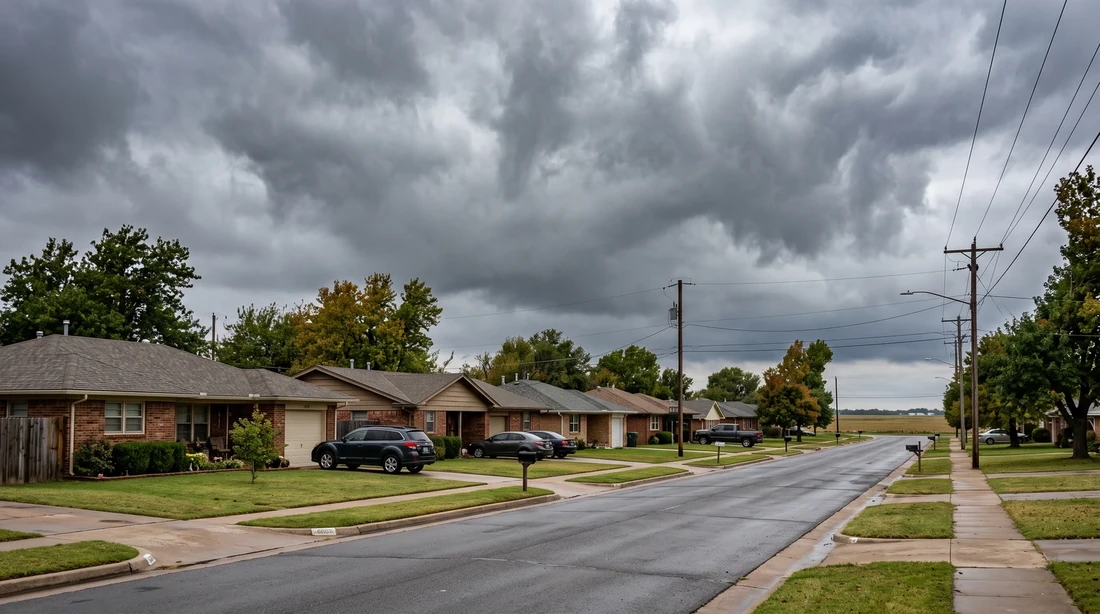
When is tornado season in Oklahoma? Roughly March through June, with the peak running April through June — and May is historically the state's most active tornado month. Oklahoma averages roughly 60 to 70 tornadoes a year, most striking between late afternoon and 9 PM. A smaller secondary season returns in October and November.
Key Takeaways
- Oklahoma's tornado season runs roughly March through June, peaks April through June, and May is historically the state's most active month.
- The state averages roughly 60 to 70 tornadoes a year, with most striking between late afternoon and 9 PM.
- Peak tornado months overlap the OKC Memorial Marathon and Women's College World Series, two of the metro's busiest hotel weekends.
- In the article's hypothetical, a $9,000 loss-of-use limit covers about 1.6 months of hotel nights versus 3.2 months in a furnished home.
What this guide covers: the month-by-month answer to when tornado season happens in Oklahoma, why it peaks when it does, and the displacement plan the weather sites leave out. That means your coverage check, your documents, and where your family would live if a storm made your home unlivable.
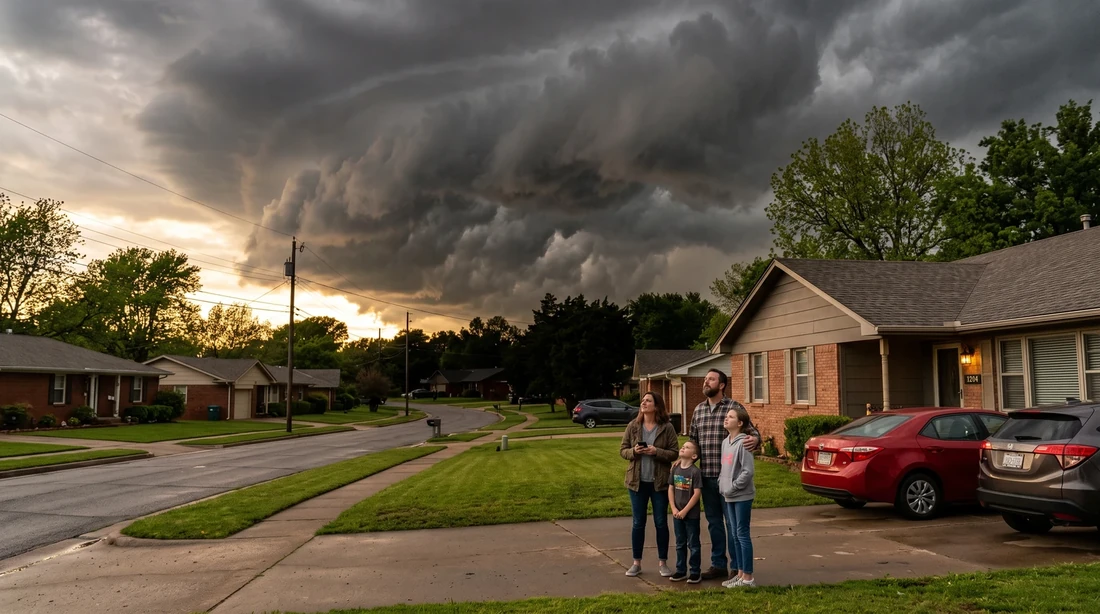
You've lived here long enough to know the drill: sirens in May, a green-tinted sky, neighbors standing in driveways staring at the wall cloud. What most Oklahomans have never done is answer the harder question. If that storm hits your address, where does your family sleep next month?
Tornado season peaks April through June. The week to photograph your policy's declarations page and learn your loss-of-use limit is in March. After a major storm, thousands of displaced households, adjusters, and repair crews compete for the same metro hotel rooms at the same time, often during weeks when events have already filled them.

When Is Tornado Season in Oklahoma, Month by Month?
Tornado season in Oklahoma runs roughly March through June, and National Weather Service records consistently show May as the single most active tornado month in the state. April and June round out the peak, and a smaller secondary season arrives in October and November.
One caveat matters more here than almost anywhere else in the country. Oklahoma has recorded tornadoes in every month of the calendar, so "season" describes when risk concentrates. Risk exists all year.
| Months | Risk level | What to know |
|---|---|---|
| December–February | Low | Isolated events are possible during warm spells; risk is never truly zero in Oklahoma. |
| March | Rising | The season ramps up as the first strong spring storm systems arrive. |
| April | High — peak season begins | Large, multi-tornado outbreak days become possible. |
| May | Highest of the year | Historically the most active month; the 1999 and 2013 Moore tornadoes both struck in May. |
| June | High, tapering | Peak season winds down through the month as summer heat builds in. |
| July–August | Low | Midsummer heat typically suppresses the storm pattern. |
| September | Low–moderate | A transition month as the first fall fronts return. |
| October–November | Secondary season | A smaller second peak; fall tornadoes more often strike after dark. |
If you only remember one line from this table, make it this: plan in March, stay weather-aware April through June, and don't fully relax in the fall.
Emergency forecasters make the same point about planning before a warning:
Authorities such as the Storm Prediction Center in the United States advise having a pre-determined plan should a tornado warning be issued.
Wikipedia: Tornado
Why Does Oklahoma's Tornado Season Peak in Spring?
Oklahoma sits where warm Gulf moisture, dry high-plains air, and the strong spring jet stream collide, at the core of what forecasters call Tornado Alley. In April, May, and June, all three ingredients overlap almost daily, which is why the state's worst outbreak days cluster in those months.
The fall secondary season happens when those same ingredients briefly line up again as summer breaks down. Fall events are less frequent than spring's, but they're disproportionately dangerous because they more often arrive after dark, when families are asleep and sirens are easier to miss. Keep a weather radio or phone alerts active through November.
Summer tends to sit under a heat dome that caps storm development. That's why July and August are typically the quietest warm months of the year.
What Does the Metro's History Show About Tornado Risk in Oklahoma City?
The Oklahoma City metro is among the most tornado-struck urban areas in the United States, and the Moore corridor was hit by violent tornadoes in both 1999 and 2013. The May 3, 1999 Bridge Creek-Moore tornado produced some of the strongest winds ever measured near ground level.
The May 20, 2013 Moore EF5 damaged or destroyed homes on the order of a thousand-plus in a single afternoon. Just eleven days later, on May 31, 2013, the El Reno tornado (the widest tornado on record) tracked across the far west metro. All three struck in May. The damage has never stayed in one unlucky corridor, either. It covers the whole map.
Two practical takeaways for anyone weighing tornado risk in Oklahoma City. First, no neighborhood in the metro is meaningfully exempt. Violent tornadoes have tracked through the south metro along I-35, the far west side near El Reno, the north side, and the suburbs alike. So skip the question of where to live to avoid tornadoes and ask where you'd shelter, and where you'd live afterward.
Second, most Oklahoma homes are slab-built with no basement. That's why above-ground safe rooms and in-garage shelters are common here, and why the City of Oklahoma City encourages residents to register storm shelters so first responders know where to look after a strike. If your home survives but officials bar access to your block, many policies extend loss-of-use for that too. The provision is called civil authority coverage, and it's usually limited to a short window (often around two weeks, though your policy language controls).
Timing matters as well. Spring metro tornadoes most often develop in the late afternoon and early evening, roughly the 3 PM to 9 PM window, and track from southwest to northeast. When sirens sound, take shelter now. Stepping outside to look is how people get hurt.
Why Are Peak Tornado Months Also OKC's Busiest Hotel Weeks?
Oklahoma's two most active tornado months, April and May, overlap the OKC Memorial Marathon and the Women's College World Series, two of the metro's biggest hotel weekends of the year. That collision is where displaced families lose the housing race. A storm during one of those windows means competing for rooms against event visitors and adjusters and repair crews at once.
| Window | Tornado risk | What's filling hotels | If you're displaced that week |
|---|---|---|---|
| Late April | High | OKC Memorial Marathon | Downtown and midtown rooms fill with runners and race crews; expect to search farther out. |
| Late May–early June | Highest of the year | Women's College World Series at Devon Park | Eight fan bases book metro rooms for up to a week; nightly rates typically climb metro-wide. |
| September | Low–moderate | State Fair of Oklahoma | Fair traffic tightens west-side hotel inventory through the month. |
| October–November | Secondary season | Thunder home games at Paycom Center | Downtown rooms tighten on game nights just as after-dark fall storms return. |
Put plainly, hotel scarcity after a spring storm is at its worst exactly when tornado risk is at its highest. Furnished 30+ night placements aren't priced night by night against event demand, which is one structural reason they hold up better in these windows. The math is further down.
What Does Tornado Displacement Cost If You Wait?
After a damaging metro tornado, hotel availability collapses within days while your loss-of-use dollars start burning immediately. Here's the sequence displaced households live through when there's no plan:
- Night one: you're on a relative's couch or in a shelter, the damage is undocumented, and the claim isn't open yet.
- Days 2 to 7: displaced households, adjusters, and repair crews all book metro hotels at once. Walk-in rates climb, and rooms near your kids' school disappear first.
- Weeks 2 to 4: hotel nights plus three restaurant meals a day accrue against your loss-of-use limit, typically the smallest limit on a renters policy.
- Months 2 to 6: apartment repairs and rebuilds run long after widespread damage, comparable rentals in your school zone fill, and households that burned their limit on hotels pay the tail out of pocket.
The mechanics here are identical to fire displacement. The peril changes and the housing math stays the same. If you want the claim-side sequence in full, see temporary housing after a house fire and loss of use coverage explained. The short version: "additional living expenses" means costs above your normal spending, receipts substantiate everything, and your carrier decides what's covered. You and your landlord don't.
Renters often assume the landlord's insurance will cover a hotel. It typically won't. Your landlord's policy covers the building itself, and your own renters policy's loss-of-use coverage is what pays for a hotel or furnished rental. If you don't carry renters insurance, you're generally self-paying unless a federal disaster declaration opens assistance programs, which is never guaranteed and rarely fast.
If a storm just made your home uninhabitable — or you're an adjuster or TPA placing a displaced household — BnB OKC keeps 11 furnished homes across the OKC metro and works with carriers and Alacrity Solutions on direct-billed placements. Same-day answers: (405) 870-2146 or start at insurance housing.
Where Would Your Family Live: A Hotel, an Extended-Stay, or a Furnished Home?
For a displaced household of three staying 30 or more nights, a furnished home on a monthly rate typically costs less than a month of hotel nights, and it's the only option with a full kitchen, laundry, and separate bedrooms. The numbers below are hypothetical OKC-metro ballparks for one month of displacement.
| Option | Typical 30-night cost | What you get | What disqualifies it |
|---|---|---|---|
| Standard hotel room | ~$3,600–$5,400 ($120–$180/night) | One room, housekeeping, breakfast bar | No kitchen, so restaurant meals inflate the burn; no laundry; two kids and two adults in one room for months |
| Extended-stay suite | ~$2,850–$4,200 ($95–$140/night) | Kitchenette, weekly housekeeping | Still a single room; pet policies vary; rates typically spike metro-wide after a major storm |
| Furnished home, monthly rate | Ballpark $2,600–$3,500/month | Full kitchen, washer/dryer, separate bedrooms, yard, driveway parking | Usually requires a 30+ night commitment; less inventory than hotels after a widespread outbreak |
How long you'll be out decides most of this. Minor damage may mean one to two weeks. Multi-unit apartment repairs and full rebuilds after widespread damage commonly run three to six months, and homeowner rebuilds can run six to twelve. Hotels win short stays. If repairs will take two to five nights, book the hotel and keep receipts (here's whether renters insurance covers hotel stays). Extended-stay suites split the difference for solo adults on extended stays of a few weeks.
Once displacement crosses 30 nights with kids, a dog, or both, the furnished home changes the math and the sanity. BnB OKC's homes sleep 2 to 16+, several are dog-friendly (pet-friendly rentals in OKC), monthly rates apply on 30+ night stays, and direct billing is available when your carrier or TPA authorizes it. Here's how ALE housing companies work. Guests rate the homes 9.5 out of 10 across 1,580 verified reviews on Airbnb and Vrbo.
What Does the Math Look Like for a Renter With Two Kids, Displaced in May?
This scenario is hypothetical, but the arithmetic holds. Say a May tornado leaves your apartment building tagged uninhabitable. Your renters policy carries $30,000 in personal property coverage with loss of use at 30%. That's $9,000 total to house your family until repairs finish.
The hotel path: one room with two kids at $159/night × 30 nights = $4,770 a month. Add roughly $850 a month in above-normal food costs because there's no kitchen. That's about $5,620 a month against the limit, and $9,000 ÷ $5,620 ≈ 1.6 months. Your coverage is gone in about seven weeks.
The furnished-home path: a furnished three-bedroom on a monthly rate in the ballpark of $2,800 a month, where you cook normal groceries, so there's almost no "additional" food expense. $9,000 ÷ $2,800 ≈ 3.2 months of covered housing.
Multi-unit repairs after widespread tornado damage commonly run three to six months, which is why the gap matters. On the hotel path, months two through six come out of your pocket. On the furnished-home path, the same $9,000 typically covers most or all of the displacement. Whether your specific policy pays, and how much, is always your carrier's call. Start with does renters insurance cover temporary housing to understand the mechanics before you need them.
What if the storm hits during the Women's College World Series?
Same family, same $9,000 limit, but the tornado strikes in late May, when softball fans have metro hotels booked around Devon Park. Say the available walk-in rate jumps from $159 to $219 a night. Now the hotel path runs $219 × 30 = $6,570, plus the same ~$850 food premium. That's about $7,420 a month, exhausting $9,000 in roughly five weeks ($9,000 ÷ $7,420 ≈ 1.2 months).
The furnished monthly rate barely moves, because 30+ night placements aren't repriced night by night against event demand. During event weeks, call a housing operator directly instead of refreshing a hotel app.
What if the family has a dog?
Many metro hotels refuse dogs outright, and those that accept them often charge nightly pet fees, say $25 a night, hypothetically. That's another $750 per 30 nights, pushing the hotel path to about $6,370 a month. At $9,000 ÷ $6,370 ≈ 1.4 months, the limit is gone in roughly six weeks. A dog-friendly furnished home typically charges a one-time pet fee instead of a nightly one, and a fenced yard means the dog isn't waiting out a four-month displacement in a hotel corridor. Several of BnB OKC's homes are dog-friendly with fenced yards.
How to Build a Tornado-Season Displacement Plan, Step by Step
Twenty minutes in March buys your family a calm first 48 hours in May. Here's the whole plan:
- Photograph your policy. Snap your declarations page and note your loss-of-use limit before April.
- Confirm your coverage. Call your agent and ask exactly how ALE pays: reimbursement, advance, or direct billing.
- Build a go-folder. Store IDs, policy numbers, medication lists, and your agent's number in cloud storage.
- Pick your housing plan. Decide now where your household would live for 30+ nights: relatives, extended-stay, or a furnished home.
- Save the key numbers. Add your carrier's claims line and a local furnished-housing operator to your phone.
- Rehearse the first 48 hours. Walk through who documents damage, who calls the claim in, and who books housing.
Who Handles What After the Storm?
Displacement goes wrong when families assume someone else is handling a task nobody owns. This is the division of labor:
| Task | Who handles it | When |
|---|---|---|
| Photograph declarations page; note loss-of-use limit | You | Before April |
| Document damage — photos, video, inventory | You | Day 1, before any cleanup |
| Open the claim | You call; carrier assigns the adjuster | Day 1 |
| Confirm ALE limits and how payment works | Adjuster and carrier | Days 1–7 |
| Find 30+ night housing | You, or an ALE housing company / TPA | Days 1–7 |
| Set up direct billing | Carrier/TPA authorizes; host invoices | Week 1 |
| Keep every receipt | You | Ongoing |
| Request extensions if repairs run long | You + adjuster + host | Monthly, before checkout dates |
Which Situations Change the Plan?
The core sequence above holds for almost everyone, but five situations change the housing decision after an Oklahoma tornado.
You own the home. Homeowner loss-of-use is typically written as a percentage of dwelling coverage, often a larger dollar figure than a renter's. Full rebuilds after widespread outbreak damage commonly run six to twelve months, with contractors and materials in metro-wide shortage. The burn-rate math is identical to the renter example. The numbers on both sides are bigger, and the timeline is longer.
School is still in session. A late-April or May strike leaves weeks of the school year on the calendar. Housing inside your existing district lines (Moore, Norman, Edmond, or OKC proper) keeps daily drop-off possible. A furnished home fifteen minutes up I-35 works, and a hotel forty minutes across the metro doesn't. Tell any housing operator your district up front and let them filter by area rather than searching by price alone.
Repairs run long. Adjusters typically approve temporary housing in increments, often 30 to 60 days at a time, and rarely for the whole repair up front. Ask your adjuster for the current approval end date, calendar a check-in two weeks before each one, and confirm before booking that your housing offers month-to-month extensions. BnB OKC applies monthly rates to 30+ night stays and coordinates extension dates directly with carriers and TPAs.
More than one household is displaced. Outbreak tornadoes sometimes hit a family's homes blocks apart. One large furnished home (BnB OKC's sleep 2 to 16+) often costs less than three or four hotel rooms and keeps everyone under one roof. See large group rentals in OKC.
The claim is denied, delayed, or the limit is too small. You still need somewhere to live while you push back. That has its own playbook, what to do when insurance denies temporary housing, and the Oklahoma Insurance Department handles complaints about claim handling. If you're self-paying in the meantime, booking direct saves up to 35% on 4+ night stays versus platform pricing.
When Don't You Need a Furnished Home?
Most tornado-season disruptions don't require one. If the power's out for two nights, a hotel is the right call, especially if loyalty points make it nearly free. If you're a single adult and repairs will take a week, an extended-stay suite is simpler and cheaper. If relatives nearby have real room and your displacement is short, staying with family costs nothing.
Keep receipts for any above-normal expenses (extra groceries, added commuting miles) in case your carrier reimburses them. And if your total displacement budget is under roughly $2,500 a month with no claim behind it, an extended-stay rate will usually beat a whole-home rate.
A furnished home changes the outcome in specific situations: displacement crossing 30 nights, kids who need to stay in their school zone, a dog most hotels won't take, more people than two hotel rooms hold, or a household that can't function in one room with no kitchen or laundry for a season. Those are the calls we take.
What Should You Check Before April?
- Your loss-of-use limit. On a renters policy it's often a percentage of your personal-property coverage, which can be modest, so how you spend it matters.
- How ALE pays. Reimbursement, advance, or direct billing changes whether you front the hotel bill.
- Event weeks. Late April and late May into early June are the hardest weeks to find a hotel room in the metro.
- Your shelter. Know where the safe room, registered shelter, or interior room is before the weather turns.
- Pets. Find out which housing near you takes dogs before you need it.
Terms You'll Hear, Decoded
- Additional Living Expenses (ALE): the part of your policy that pays costs above your normal spending while your home is unlivable.
- Loss of use: the policy section ALE lives under, often written as a percentage of your dwelling or personal-property limit.
- Declarations page: the summary page of your policy listing every coverage and limit. Photograph it before the season starts.
- Uninhabitable: the determination, typically made by your carrier and sometimes with a city inspector, that triggers loss-of-use coverage.
- Civil authority coverage: many policies pay loss-of-use for a limited window when officials bar access to your area, even if your own unit is undamaged.
- Advance payment: a partial ALE payout some carriers issue early in the claim so you aren't fronting hotel bills. Ask your adjuster if it's available.
- Direct billing: the housing provider invoices your carrier or TPA directly, so nothing fronts from your pocket. It only happens with authorization.
- TPA (third-party administrator): a company, such as Alacrity Solutions, that carriers hire to manage temporary-housing placements.
For live forecasts and warnings during the season, follow the National Weather Service office in Norman, which covers most of the state. For coverage questions or complaints about a claim, the Oklahoma Insurance Department is the state regulator, and the City of Oklahoma City website has details on the city's storm shelter registration program.
Where Should You Shelter, and Where Not?
The National Weather Service is specific about this, and the specifics are what matter when a warning is minutes old. Indoors, go to a basement, a safe room, or an interior room away from windows. Outdoors, get inside a sturdy building. Sheds and storage facilities are not safe, and neither is a mobile home or a tent, which is the part people underestimate in a state where tornadoes threaten every spring. If you are staying somewhere unfamiliar, work out where that interior room is before the weather turns rather than during it.
The Bottom Line
Plan in March, before the peak. Find the loss-of-use line on your renters or homeowners declarations page tonight, write down the dollar limit, and ask your agent whether it pays by reimbursement, advance, or direct billing. Then use the cost table above to compare what 30 hotel nights versus a furnished monthly rate would do to that limit for your household size, including any pet fees and event-week pricing.
Add (405) 870-2146 to your phone and bookmark insurance housing before April, so the week the sirens matter, your family already knows where it would live.
This guide is general information, not insurance or legal advice; your carrier makes all coverage decisions.