Yes — if the water came from a sudden, accidental source. A burst pipe, failed supply line, or ruptured water heater typically triggers loss-of-use (ALE) coverage, which pays for temporary housing while your home is uninhabitable. Flood damage requires a separate NFIP policy that does not include housing. Slow, long-term leaks are usually denied.
Key Takeaways
- Sudden causes like burst pipes or appliance failures trigger loss-of-use housing coverage; flood and slow seepage leaks are typically excluded.
- Burst-pipe claims that open floors and walls typically displace families six to sixteen weeks, because the rebuild drives the calendar.
- Two hotel rooms at $149 a night run about $8,940 monthly plus $1,500 to $2,500 in meals; a furnished home ballparks $4,200.
- Oklahoma City water losses cluster in hard winter freezes and April to June storms, when crews, adjusters and hotel inventory tighten together.
What this guide covers: which causes of water damage typically include temporary housing and which don't, how long a water-damage displacement usually lasts, what hotel nights cost against a furnished monthly rate, and how to get housing approved and keep it approved when the adjuster pushes back.
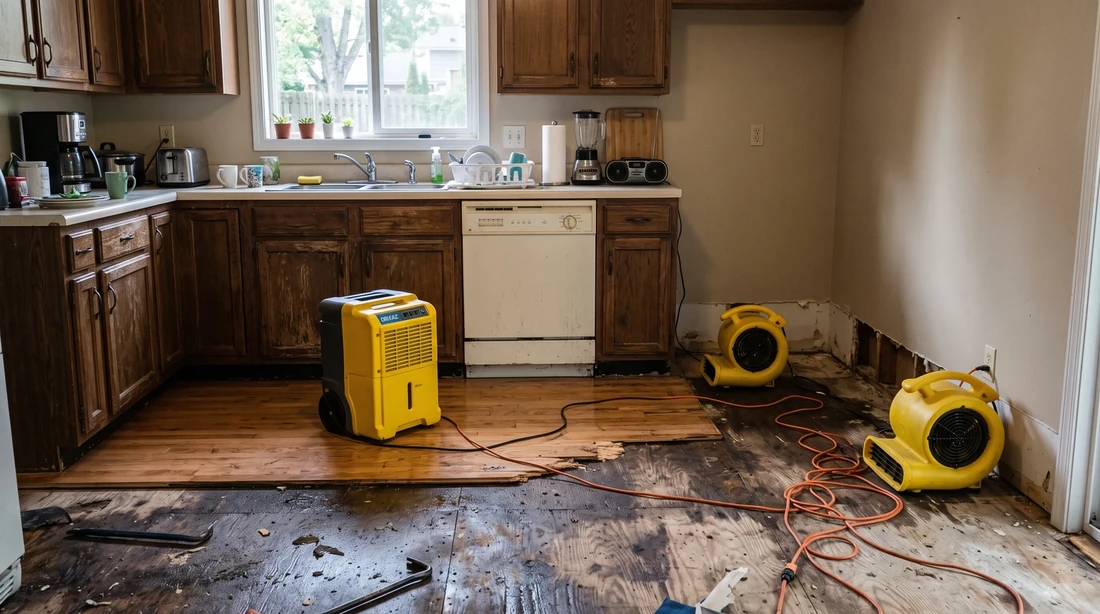
The supply line behind your dishwasher let go overnight, and by morning water had traveled under the kitchen, down the hallway, and into the living room. The mitigation crew is pulling flooring and telling you drying alone takes a week. So does insurance pay for temporary housing during water damage repairs? For most sudden losses, yes, and the next few decisions determine how far that money stretches.
Water damage runs on two clocks at once. Mitigation crews want drying started within 24 to 48 hours to head off mold growth, and every hotel night you book after that draws down a loss-of-use limit that is finite. What you decide in week one sets the cost of the next three months.

Does the Cause of the Water Decide Whether Housing Is Covered?
Yes. Homeowners insurance typically pays for temporary housing only when the water damage came from a sudden, accidental cause, the same test that decides whether the repairs themselves are covered. If the repairs are a covered claim and your adjuster agrees the house isn't livable, the policy's loss-of-use section turns on. If the cause is excluded, the housing money is excluded with it.
That's why two families with identical soaked kitchens can get opposite answers. A pipe that ruptured Tuesday night is a covered peril under most policies. A pipe that has been weeping inside the wall for eight months is usually treated as a maintenance failure, and carriers commonly deny both the repairs and the housing under a seepage or wear-and-tear exclusion.
| Cause of the water | Repairs typically covered? | Temporary housing path |
|---|---|---|
| Burst pipe or supply-line failure | Yes — sudden and accidental | ALE under homeowners loss of use |
| Appliance failure (water heater, washer hose, dishwasher) | Yes, typically | ALE, once the home is declared uninhabitable |
| Firefighting water after a fire | Yes | ALE — often a long displacement |
| Storm-created roof opening (wind or hail) | Often — if the storm made the opening | ALE while the interior is repaired |
| Flood — rising water from outside | Only with a separate NFIP flood policy | NFIP pays no ALE; self-pay or post-disaster FEMA programs |
| Sewer or sump backup | Only with a water-backup endorsement | ALE usually follows the endorsement's terms |
| Slow seepage or long-term leak | Usually denied — maintenance exclusion | No ALE; housing is self-pay |
| Frozen pipe in an unheated, unoccupied home | Often contested if heat wasn't maintained | Depends on the adjuster's findings |
Three of those rows trip people up constantly. First, flood is never covered by a standard homeowners policy. Rising water from outside the home needs a National Flood Insurance Program policy, and NFIP covers the building and contents but pays nothing toward a hotel or rental. A hotel or rental after a flood is self-pay unless a federally declared disaster opens FEMA assistance programs. Some private flood policies and endorsements do include a loss-of-use benefit, so check your own policy language rather than assuming either way.
Second, water that firefighters put into your house after a fire is part of the fire claim. If that's your situation, the mechanics are covered in our guide to temporary housing after a house fire. Third, renters face the same cause test but through their own policy. See does renters insurance cover temporary housing for that version.
For the full mechanics of how the housing benefit itself works (limits, what counts as "additional," reimbursement vs. direct billing), see loss-of-use coverage explained. This article stays on the water-specific questions: which causes qualify, and how long the displacement lasts.
Coverage terms have shifted over time, as one industry reference notes:
Water damage due to burst pipes in particular has been restricted or in some cases entirely eliminated.
Wikipedia: Home insurance
Why Do Water Damage Repairs Take Weeks Instead of Days?
A burst-pipe claim that opens floors and walls typically keeps a family displaced for six to sixteen weeks, far longer than the drying itself. Restoration crews grade water by contamination. Category 1 is clean supply water, Category 2 is gray water from appliances, and Category 3 is sewage or outside floodwater. The higher the category, the more material gets torn out instead of dried in place.
Even a clean Category 1 loss follows a longer arc than most homeowners expect, because the rebuild drives the calendar. Cabinet orders, flooring that must be replaced wall to wall to match, and permit inspections each add weeks that no dehumidifier can shorten.
| Stage | Typical duration | What it means for housing |
|---|---|---|
| Emergency extraction | Days 1–3 | Home may be technically livable but wet, loud, and torn open |
| Structural drying | 3–7 days | Dehumidifiers and air movers run 24/7; subfloors often opened |
| Demolition and tear-out | 1–2 weeks | Kitchens and flooring removed; most families are out by now |
| Rebuild | 6–14+ weeks | Cabinet and flooring lead times drive the schedule |
| Finishes and punch list | 1–2 weeks | Move-back dates often slip — keep your housing flexible |
Notice where uninhabitability begins. Many families tough out the extraction days at home, then discover that demolition is what makes a house unlivable: no kitchen, exposed subfloor, and industrial equipment running around the clock. That's the moment to have housing already lined up. Starting the search then is too late.
How Does Oklahoma's Weather Calendar Change Your Search?
Oklahoma City water losses cluster around two windows: hard winter freezes that burst pipes across the metro, and the April to June storm season when wind and hail open roofs to rain. Which window your loss lands in changes both the coverage question and how hard housing is to find.
When a multi-day hard freeze hits the metro, plumbers, mitigation crews, and adjusters all get slammed the same week, and hotel inventory tightens at the moment thousands of households need it. If your burst pipe is part of a freeze event, expect the uninhabitability inspection to take longer than usual, and start the housing search the same day you file instead of after drying finishes. Remember the decision-tree caveat above. A frozen pipe in an occupied, heated home is typically a covered sudden loss, while an unheated vacant home often gets contested.
Spring works differently. From April through June, hail or straight-line wind can open a roof, and the rain that follows soaks ceilings, insulation, and walls. That interior water is often covered because the storm created the opening. Rain leaking through an intact, worn roof usually is not. Storm-season claims also tend to run longer than plumbing claims, because roof replacement and interior rebuild have to be sequenced.
The calendar has a cost side too. A displaced family paying nightly hotel rates is exposed to OKC's event pricing: the Memorial Marathon in late April, the Women's College World Series at Devon Park in late May and early June, the State Fair of Oklahoma in September, and Thunder home dates at Paycom Center through the winter. Nightly rates typically climb around those windows, and spring storm losses land squarely on the Marathon-to-WCWS stretch. A monthly furnished rate is locked in regardless of what's on the city's calendar.
What Does Waiting Cost If You Don't Plan Your Housing?
A family that books housing night by night after water damage typically spends two to three times what the same weeks would cost on a monthly furnished rate. The overspend builds up in a predictable sequence:
- Nights 1 to 3: You grab whatever hotel has rooms at walk-in rates, because the extraction crew just told you the floors are coming up tonight.
- Week 1: Drying finishes, but demolition begins. You extend the hotel a few nights at a time, still paying nightly rates, still eating every meal out.
- Weeks 2 to 4: The contractor's scope confirms a multi-month rebuild. You've now spent a month of nightly rates on what was always going to be a 90-day-plus displacement.
- Month 2: Cabinet and flooring lead times push the schedule. Extending a hotel is easy. Extending it affordably is harder, especially into an event weekend.
- Months 3 to 4: Your adjuster starts referencing the remaining loss-of-use balance. Whatever you burned on nightly rates in month one is gone from the buffer you need now.
The sequence is avoidable at one point: the moment the contractor's scope shows a repair measured in months. That's when switching from nightly to monthly housing protects the rest of your limit.
Displaced by water damage in the OKC metro? We place families in furnished homes — full kitchens, laundry, dog-friendly options — and work directly with adjusters and Alacrity Solutions on insurance stays. Same-week placement is often possible.
What Are Your Temporary Housing Options During Water Damage Repairs?
For a displacement longer than two to three weeks, a furnished home on a monthly rate typically costs less than half of what two hotel rooms plus restaurant meals run for the same family. Here's how the options compare for a household of five with a dog. Every figure is a hypothetical ballpark your adjuster would want to see in writing anyway:
| Option | Ballpark monthly cost | Kitchen & laundry | Fit for five people + a dog |
|---|---|---|---|
| Two hotel rooms (~$149/night each) | ~$8,900 before taxes and fees | None — add $1,500–$2,500/month eating out | Pet fees; family split across two rooms |
| Extended-stay suites (two units) | ~$4,500–$7,000 | Kitchenette, shared coin laundry | Nightly pet fees common; tight quarters at five |
| Furnished home on a monthly rate | In the ballpark of $4,200 | Full kitchen, in-home laundry | Dog-friendly homes with fenced yards available |
| Staying with family or friends | $0 lodging | Shared | Workable for 2–3 weeks; strained past a month |
Hotels win the first few nights on pure speed. Extended-stays make sense for one or two people who mainly need a bed and a microwave, and the tradeoffs are covered in our extended stays overview. A furnished home changes the math once the stay crosses 30 nights. Monthly rates apply, food costs return to grocery-store normal, and a dog stops being a nightly surcharge. See our pet-friendly rentals in OKC.
Pet costs deserve a quick call to your adjuster. Reasonable additional housing costs tied to your displacement are often reimbursable, and that can include pet fees or the incremental cost of a pet-friendly rental, but confirm in writing before booking. Boarding costs are handled inconsistently between carriers, so ask before assuming.
BnB OKC operates 11 furnished homes across the Oklahoma City metro, sleeping 2 to 16+, with a 9.5 out of 10 average across 1,580 verified guest reviews on Airbnb and Vrbo and monthly rates on stays of 30+ nights. Booking direct saves up to 35% on stays of 4+ nights versus platform pricing, with details at book direct. If your carrier uses a third-party housing coordinator, here's how ALE housing companies work and where a local operator fits into that pipeline.
What Does a Four-Month Repair Cost for Five People and a Dog?
This scenario is hypothetical, but the arithmetic is the kind your adjuster reviews every week. Say a family of five with a 60-pound dog is displaced when a kitchen supply line fails, and the contractor's scope shows a four-month repair: subfloor replacement through the kitchen and living room, plus a full cabinet rebuild.
Hotel path: two adjoining rooms at $149/night each is $298/night. Over 30 nights that's $8,940 before lodging taxes and pet fees. With no kitchen, restaurant meals for five typically run $1,500 to $2,500/month above normal grocery spending. Realistic monthly burn: $11,000 to $12,000. Over four months: roughly $44,000 to $48,000.
Furnished home path: a four-bedroom furnished home on a monthly rate in the ballpark of $4,200/month, dog-friendly, with a fenced yard and a full kitchen and laundry. Four months: about $16,800. Food spending stays near normal, so the ALE claim consists almost entirely of the rent itself, which keeps documentation simple.
The gap is roughly $27,000 to $31,000 across the repair. Now put it against a limit. If your loss of use is, say, 20% of a $250,000 dwelling limit ($50,000), the hotel path nearly exhausts it with zero buffer for a schedule slip. The furnished path leaves more than half the limit untouched when the cabinet delivery runs late, as it often does.
One documentation note surprises people. ALE pays what's additional to your normal spending, and carriers typically reduce meal receipts by what you'd normally spend on groceries. So the hotel path's restaurant tab isn't even fully reimbursable. A home with a kitchen removes that entire negotiation.
What about a six-week displacement?
Same family, smaller scope: drying plus a kitchen tear-out, 42 nights out. Two hotel rooms at $298/night run $12,516, plus roughly $2,000 to $3,500 in extra meals. Call it $14,500 to $16,000. Two extended-stay suites at about $115/night each come to roughly $9,660 before pet fees, with the family split across units. A furnished home at $4,200/month plus a prorated half-month is about $6,300, with meals at grocery-store normal. Even at six weeks, well short of a full rebuild, the furnished path runs roughly a third of the hotel path for a household this size.
What if your limit is tighter?
Now assume a smaller policy. Loss of use at 10% of a $200,000 dwelling limit is $20,000 total. On the hotel path's $11,000 to $12,000 monthly burn, that limit is exhausted before week eight of a sixteen-week rebuild, and every night after that is out of pocket. The furnished path's $16,800 fits inside $20,000 with roughly $3,200 of buffer for a slipped move-back date. On a tight limit, the housing choice decides whether you finish the claim inside the policy or self-fund the final two months.
How to Get Temporary Housing Approved After Water Damage, Step by Step
Approval on a temporary housing water damage claim is mostly a documentation exercise. Run it in this order:
- Stop the water and report the loss. Shut the main supply valve, then call your carrier the same day. Late reporting is one of the most common reasons water claims get contested.
- Ask for your loss-of-use limit in writing. Have the adjuster confirm your exact ALE dollar limit and what documentation they require before you book anything.
- Get uninhabitability confirmed. Request a written statement (email is fine) that the home is not livable during drying, demolition, or rebuild. This is what unlocks housing payments.
- Price monthly options before nightly ones. Compare a furnished monthly rate against 30 hotel nights plus restaurant meals; send the comparison to your adjuster for approval.
- Submit receipts weekly and track the repair schedule. Keep every housing and food receipt, and get contractor timeline updates in writing so you can extend housing before your booking lapses.
Reimbursement is the default. You pay, submit receipts, and the carrier reimburses against your loss-of-use limit. Direct billing, where the housing provider invoices the carrier or its housing company (such as a coordinator like Alacrity Solutions), happens only with written authorization. Ask your adjuster early whether it's available. If it isn't, confirm the reimbursement turnaround so a four-month stay doesn't strain your own cash flow.
Approval stalls when tasks fall between parties. You assume the adjuster is arranging housing, and the adjuster assumes you're submitting comparisons. This split keeps the claim moving:
| Task | Who owns it | What to get in writing |
|---|---|---|
| Shut off water, report the loss | You | Claim number and adjuster's direct contact |
| Uninhabitability finding | Adjuster | Email confirming the home isn't livable, and for which repair stages |
| ALE limit and documentation rules | Carrier / adjuster | Dollar limit, receipt requirements, any nightly caps |
| Housing cost comparison | You | Adjuster's approval of the rate before you book |
| Direct billing authorization | Carrier or its housing company | Written authorization naming the housing provider |
| Rate and extension terms | Host / operator | Monthly rate and how much notice an extension needs |
| Repair timeline updates | Contractor + you | Revised schedule every time the move-back date moves |
| Move-back clearance | Adjuster + contractor | Final walkthrough date, so housing ends cleanly |
Can You Choose Housing That Keeps School, Work, and the Dog on Schedule?
Usually, yes. Carriers typically approve temporary housing that's comparable to your normal home, so you have more say over location than most displaced families realize. "Comparable" generally means a similar number of bedrooms in a reasonable area at a reasonable rate, and the cheapest available bed doesn't set the standard.
Location is worth pushing for on a water claim because the displacement is long. A four-month rebuild that starts in August spans an entire school semester, and a rental near your kids' current school avoids a mid-year transfer that a hotel cluster off the interstate would force. The same logic applies to commutes. A household working at Tinker AFB southeast of the city has a very different geography than one working shifts near downtown or flying weekly out of Will Rogers World Airport.
Our homes sit across the metro (near Lake Hefner, in and around the Paseo and Plaza districts, in The Village, and six minutes from the airport), so a displaced NW-side household can usually stay in its own part of town, with the same grocery store and the same routes. Browse locations at our properties. Whatever you choose, get the specific address and rate approved in writing before you sign anything. Unapproved bookings are what invite disputes.
What If the House Is Only Partly Unlivable?
Water claims produce more partial-habitability disputes than almost any other loss, because the damage is often confined to one zone. An adjuster may argue that a torn-out kitchen with intact bedrooms is still livable, while your reality is no way to cook for five, industrial dryers running all night, and a demolition zone your kids and dog can't be kept out of.
Two things move these conversations. First, ask the mitigation company to document conditions in writing: equipment noise levels, open subfloor, contamination category. Category 2 or 3 water in a living area strengthens the case considerably. Second, carriers sometimes offer a middle position, paying the meal-cost difference for a family living without a kitchen instead of full housing. That can be reasonable for a two-week dry-out and completely inadequate for a three-month cabinet rebuild.
A staged version is also worth asking about: staying home through extraction and drying, then moving out for demolition and rebuild. ALE doesn't have to start on day one to apply later. It follows uninhabitability, whenever that begins. If you plan to do this, get the adjuster to confirm in writing that housing will be covered once demolition starts, so you're not renegotiating from a hotel lobby.
If housing is denied, get the reason in writing first. The usual ones are a seepage or maintenance exclusion, a finding that the home is still livable, or the loss being flood rather than a covered peril. A denial of housing isn't always a denial of the whole claim, so read the letter carefully. You can request a re-inspection with the mitigation company's documentation or escalate to a supervisor, and our guide to what to do when insurance denies temporary housing walks through the rest, including filing a consumer complaint through the Oklahoma Insurance Department.
When Is a Hotel the Right Call?
Not every water loss needs a furnished home. If the crew says three to five days of drying with no demolition, a hotel is faster, simpler, and exactly what that stay calls for. The same goes if you're a single occupant, the damage is confined to a garage or one spare room, or you have hotel points that make a short stay nearly free. Points cover the exact scenario where nightly pricing hurts least.
Two caveats even on short stays. If your dry-out lands on an OKC event weekend (Marathon, WCWS, State Fair), price the week before assuming a hotel is the cheap option. And if you're self-paying because the claim was denied or the loss was flood, the monthly math matters more, since there's no reimbursement coming.
The calculus flips at a few markers: a repair scope past 30 days, a household of three or more, or a pet. Past any of those, nightly rates, restaurant meals, and pet surcharges start consuming the loss-of-use limit that has to last the whole rebuild. A full kitchen, in-home laundry, and a fenced yard then become the cheaper option as well as the more comfortable one. Being honest about which side of that line you're on is the whole decision.
What Should You Check in the First Week?
- The source of the water. Sudden and accidental usually means covered. Seepage, flood, or a sewer backup without an endorsement usually doesn't.
- Your declarations page. Note the loss-of-use dollar limit or percentage, and whether you carry a water-backup endorsement.
- The written timeline. Get the contractor's schedule and price it two ways: 30 hotel nights plus meals versus one furnished monthly rate. Send both numbers to your adjuster.
- Billing. Ask whether direct billing is available and, if not, how fast reimbursement arrives.
- Event weeks. A hotel extension into a Marathon or WCWS week can cost far more than the week before it.
Terms You'll Hear, Decoded
- ALE (Additional Living Expenses): the policy benefit that reimburses costs above your normal living expenses while you're displaced. It's the housing money.
- Loss of use: the policy section ALE lives under, usually stated as a dollar cap or a percentage of your dwelling coverage.
- Uninhabitable: the adjuster's finding that the home can't reasonably be lived in. It's the switch that turns ALE on.
- Comparable housing: the standard carriers apply to temporary rentals, meaning similar size and area to your normal home at a reasonable rate.
- Category 1/2/3 water: restoration-industry contamination grades, from clean supply water (1) to sewage or floodwater (3). Higher categories mean more tear-out.
- Mitigation: the emergency work (extraction, drying, tear-out) done to stop damage from spreading before repairs begin.
- Scope of work: the contractor's written list of everything being repaired, with the schedule. It's the document that tells you how long you'll need housing.
- Water-backup endorsement: an add-on that covers sewer and sump backups, which standard policies exclude.
- NFIP: the National Flood Insurance Program. It covers flood damage to the building and contents but pays nothing toward temporary housing.
- Direct billing: when a housing provider invoices the carrier or its housing company directly instead of you fronting costs. It happens only with the carrier's authorization.
For consumer help with a disputed Oklahoma claim, the Oklahoma Insurance Department handles complaints and questions. For flood coverage specifics, the NFIP's official resource is its FloodSmart site.
The Bottom Line
Sudden water usually means covered housing, and the rebuild, more than the drying, decides how long you'll need it. Find your loss-of-use limit tonight, get the contractor's timeline in writing, and price the whole repair at a monthly rate before you extend a hotel again. If the repair runs past 30 days, request placement through our insurance housing page or call/text (405) 870-2146. We coordinate with adjusters and can often place a displaced family the same week.
This guide is general information, not insurance or legal advice; your carrier makes all coverage decisions.