Additional Living Expenses (ALE) covers the extra costs of living away from home during a covered claim: hotel or furnished-rental charges, restaurant meals above your normal grocery spending, storage fees, laundry, pet boarding, extra utilities, and mileage. It pays only what's above your normal living costs — and only what you can prove with receipts.
If your adjuster just approved temporary housing, the single most expensive mistake you can make is assuming ALE only pays for the room. It doesn't. It's the whole "cost of being displaced" bucket — and insurance-thread after insurance-thread is full of people who left real money uncollected because nobody told them what actually qualifies. This guide is the plain-English list, the one rule that governs all of it, and the receipt discipline that decides whether you get reimbursed.
There's no countdown clock on ALE — but every un-photographed receipt is money you can't claim later. As the National Association of Insurance Commissioners puts it plainly: without receipts, you don't get payment. Start the paper trail the day you check out of your home.
What Does Additional Living Expenses Cover, Exactly?
ALE covers the reasonable, documented increase in your living costs while your home is uninhabitable after a covered loss. The keyword is increase — it reimburses the gap between what you're spending now and what you normally spent at home.
Pulling together what insurance.com, Liberty Mutual, NAIC, and the Oklahoma Insurance Department all confirm, the reimbursable categories generally include:
- Temporary housing — hotel charges or a furnished rental home while you rebuild.
- Increased food costs — restaurant meals that exceed your normal grocery spending, especially when your temporary place has no kitchen.
- Storage fees — for belongings that can't stay in the damaged home.
- Laundry — laundromat or wash-and-fold when you have no washer/dryer.
- Pet boarding — costs beyond your normal day-to-day pet care.
- Additional utility expenses — a second set of utility bills at the temporary residence.
- Mileage and transportation — the extra driving a farther-away temporary home forces on you.
The Oklahoma Insurance Department's "After the Disaster" guidance says ALE covers the temporary living expenses of a separate residence while you rebuild, and may also provide for food, clothing and toiletries. Read your specific policy — but this is the shape of it.

The One Rule That Governs Everything: "Above Your Normal Spending"
ALE reimburses the additional in additional living expenses — not your total bill. That word does almost all the work, and it's where most confusion starts.
Say you normally spend $600 a month on groceries. Now you're in a hotel with no kitchen and spending $1,400 on restaurant meals. ALE doesn't pay the whole $1,400 — it pays the $800 difference above your normal food budget. Same logic for utilities: if you're still paying (or would still pay) some baseline at home, ALE covers the extra you incur at the temporary place, not the duplicate of a bill you'd have anyway.
This is also why NAIC is explicit that ALE will not cover your mortgage. Your mortgage isn't an additional cost caused by the loss — you'd owe it whether the home was standing or not. It's a normal living expense, so it stays outside the ALE bucket.
| The assumption | What actually happens |
|---|---|
| "ALE pays my whole restaurant bill." | Pays only the amount above your normal grocery spending. |
| "ALE covers my mortgage while I'm out." | No — the mortgage is a normal cost you'd owe anyway. |
| "ALE pays to replace my damaged furniture." | No — that's personal property (contents) coverage, a separate bucket. |
| "An Airbnb or furnished home won't qualify." | Temporary rental homes are commonly covered — housing is housing. |
| "I'll just estimate my costs at the end." | No receipts, no reimbursement. |
The Bucket Problem: Why ALE, Contents, and Dwelling Are Three Different Pots
Every expense from your loss lands in one of three coverage buckets, and the bucket matters because each has its own separate limit. Put a cost in the wrong pot and you can burn through one limit while another sits unused.
Liberty Mutual is clear that ALE does not pay for damage to your home or belongings — that's dwelling and personal property coverage. A recurring snag in claim threads is storage: it can be reimbursed under contents coverage or under ALE depending on the situation and the policy, and which bucket it hits changes how much room you have left elsewhere. When in doubt, ask your adjuster in writing which bucket a cost should go against before you submit it.
| Expense | Usual bucket | Why |
|---|---|---|
| Hotel / furnished rental | ALE | An added cost of living elsewhere |
| Restaurant meals over grocery baseline | ALE | Increase in a normal cost |
| Pet boarding, laundry, extra utilities | ALE | Added costs of displacement |
| Replacing burned furniture / clothes | Personal property (contents) | Damage to belongings, not living cost |
| Rebuilding the structure | Dwelling | Repair of the home itself |
| Storage of belongings | ALE or contents | Depends on policy — confirm with adjuster |
What Happens If You Don't Keep Receipts (the Sequence)
ALE is a reimbursement, not an allowance — the failure mode is almost always documentation, and it plays out in a predictable order.
- You pay out of pocket first. Unless the carrier authorizes direct billing, you front the cost and get paid back.
- You submit for reimbursement. The adjuster wants proof: receipts, the expense category, and your normal baseline to calculate the "additional" amount.
- Anything unproven gets denied. An estimate or a "trust me, it was about $200" doesn't reconcile — it drops off the claim.
- You hit a bucket or policy limit sooner. Weeks of restaurant meals and laundromat runs add up fast; if your temporary place has no kitchen or washer, the bleed accelerates and your ALE limit arrives earlier than you planned.
This is exactly why a furnished home with a full kitchen, in-unit laundry, and a pet-friendly setup changes the math: it collapses your three biggest ALE bleed items — restaurant markups, wash-and-fold, and pet boarding — into one predictable rental line.
Displaced in the OKC metro and want to stop the ALE bleed? A furnished BnB OKC home with a full kitchen, laundry, and dog-friendly options replaces the restaurant-and-laundromat spiral with one clean monthly rate your adjuster can review.
Worked Example: A Family of Four, Kitchen Fire, Three Months Out
Here's a clearly hypothetical example with the arithmetic shown, so you can see how the "additional" rule and the buckets interact.
Say a family of four has a kitchen fire and needs three months of temporary housing. Compare two paths:
- Two hotel rooms, no kitchen: at roughly $180/night that's about $16,200 for 90 nights — plus restaurant meals. If they normally spent $800/month on groceries but now spend $2,200/month eating out, that's $1,400/month of additional food ALE would consider — about $4,200 over three months. Add laundromat runs and pet boarding, and the ALE draw climbs fast.
- A furnished home with a full kitchen: a monthly rate on a 30+ night stay covers housing, and because they can cook, the "additional food" figure shrinks toward their normal $800 baseline — a large chunk of that $4,200 restaurant gap simply never happens. Laundry and pet boarding fold in too.
The housing line may look similar either way; the difference is the rest of the ALE bucket. Every dollar of restaurant markup, laundromat cost, and boarding fee you avoid is a dollar of ALE limit left for the weeks it takes to rebuild. Our published from-rates run $165–$425/night with up to 35% direct savings on 4+ night stays, and monthly rates apply on 30+ night stays — confirm your specific ALE limit and per-day allowance with your adjuster before you book.
Is an Airbnb or Furnished Rental Covered? And Are ALE Checks Taxable?
Temporary rental homes are commonly covered under ALE — Liberty Mutual lists "hotel or rental home charges" together. Housing is housing; what matters is that the cost is reasonable and documented, not the platform. Some carriers set a nightly or monthly cap, so ask what your policy allows before you sign a longer stay.
On taxability: reimbursement of a genuine expense is generally different from taxable income, but ALE tax treatment can get nuanced depending on your situation. We're a lodging operator, not tax advisors — ask a tax professional about your specific ALE payments before you assume one way or the other.
How to Document ALE for Full Reimbursement, Step by Step
- Confirm your ALE limit and terms. Ask your adjuster for your loss-of-use limit, any per-day cap, and whether a deductible applies to ALE.
- Establish your normal baseline. Pull a month or two of grocery, utility, and pet-care spending so you can prove the "additional" amount.
- Save every receipt. Photograph hotel, food, storage, laundry, boarding, and mileage receipts the day you get them.
- Log the bucket for each cost. Note whether an expense is ALE, contents, or dwelling — confirm gray areas like storage in writing.
- Submit organized batches. Group receipts by category with your baseline attached so the adjuster can calculate reimbursement fast.
- Reconcile against your limit. Track your running ALE total so you know how much runway is left before you commit to a longer stay.
When You Don't Need a Furnished Home
If your home is livable in a day or two, or you're a single person who's fine in a hotel for a short repair, a hotel on points is often the simplest call — and ALE will still reimburse the reasonable extra cost. Short displacements don't generate enough restaurant, laundry, and boarding cost to matter much.
Where a furnished home changes the outcome is the 30-plus-night displacement, families and pets, and any stay where the ALE bleed items pile up. A full kitchen, in-unit laundry, and a fenced yard for the dog turn three volatile ALE categories into one steady rental line your adjuster can approve — see our extended-stay options and pet-friendly rentals in OKC. We work with Alacrity Solutions on insurance placements and carry a 4.8-star average across 1,247 verified guest reviews on Airbnb.
Terms You'll Hear, Decoded
- Additional Living Expenses (ALE): The coverage that reimburses the extra costs of living away from home during a covered claim.
- Loss of Use: Another name for the same coverage — the part of your policy that pays when you can't use your home.
- Personal property (contents) coverage: A separate bucket that pays to repair or replace damaged belongings — not a living cost.
- Direct billing: When the carrier or TPA pays the housing provider directly instead of reimbursing you — only happens with authorization.
- Deductible: The amount you absorb before coverage pays; whether one applies to ALE depends on your specific policy.
Not sure how OKC-area placements work end to end? Our insurance housing hub walks through direct billing, monthly rates, and adjuster coordination. If you're also researching the local lodging landscape, our OKC short-term rental rules explainer covers the wider picture.
This guide is general information, not insurance or legal advice; your carrier makes all coverage decisions.
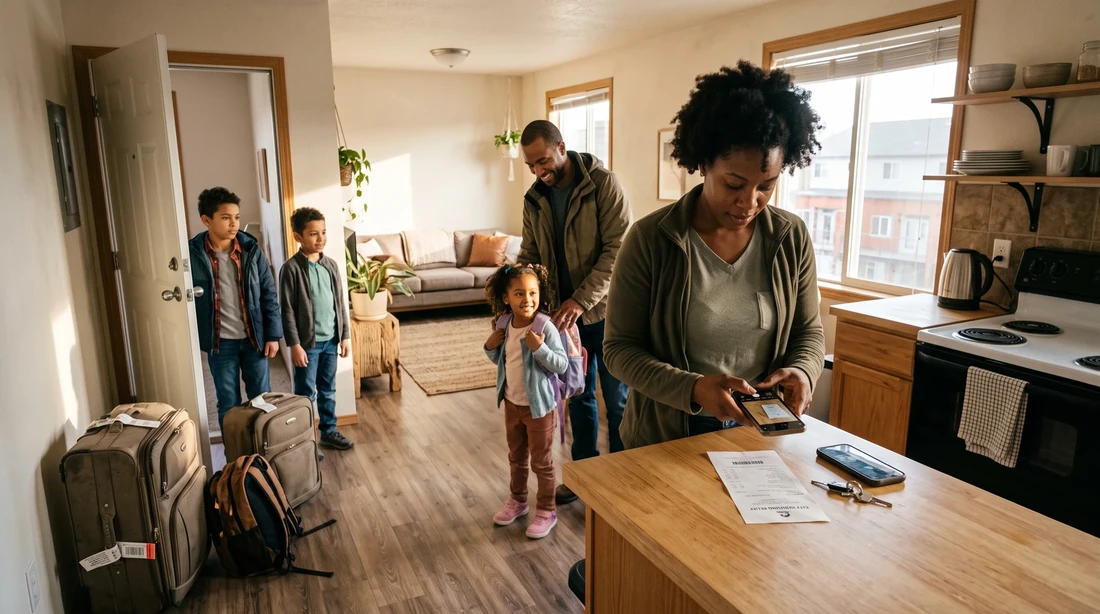
Your Next Steps
- Confirm the number: ask your adjuster for your ALE / loss-of-use limit, any per-day cap, and whether a deductible applies.
- Gather your baseline: pull your normal grocery and utility spending so you can prove the "additional" amount, and start photographing every receipt today.
- Get a place that stops the bleed: if you're in the OKC metro for 30+ nights, book a furnished home with a kitchen and laundry — start here or call/text (405) 295-5052.