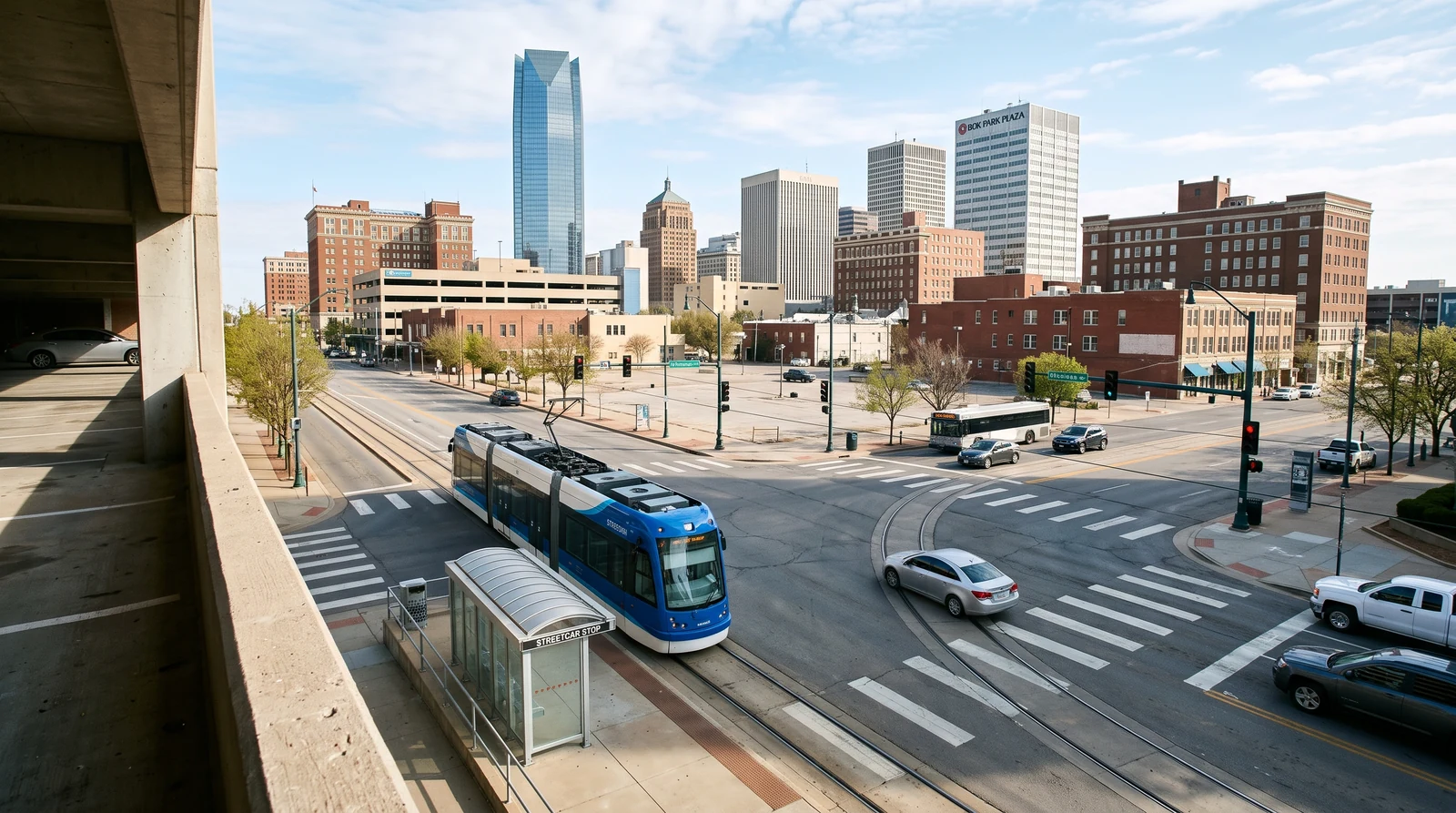
Getting around Oklahoma City means a car for most trips and the free OKC Streetcar for downtown. The metro covers more than 600 square miles, city buses run $1.75 a ride or $4 for a 24-hour pass, rideshare from Will Rogers World Airport to downtown typically runs $20 to $35, and the rental car center sits a 3 to 4 minute shuttle from the terminal. Pick the mode by the trip, not by habit: downtown, streetcar; anywhere else, drive.
Your flight lands at 4 p.m., your furnished rental is 20 minutes north, your first meeting is at Tinker in the morning and your family wants Bricktown on Saturday. Oklahoma City will happily absorb every one of those trips. The question is which of them needs a car, which can ride the free streetcar, and where a bus or a rideshare is the smarter dollar.
We manage furnished homes across the metro and we have this conversation with every guest who stays a month. This guide puts the real options side by side with published fares and rates, works the math for a two-week stay, and tells you plainly when a rental car is unavoidable. Fares and rates are from the transit agency, the airport and the city as of November 2026.
Rental car rates at Will Rogers climb on event weekends and around Thunder playoff dates, Memorial Marathon weekend in late April and the Women's College World Series in early June. If your trip overlaps one of those, reserve the car when you book the flight rather than at the counter.
Why Getting Around Oklahoma City Is a Car Question First
Oklahoma City covers more than 600 square miles, which makes it one of the largest cities by land area in the country and the single fact that shapes every transportation decision here. The attractions are clustered in pockets: Bricktown and the arena downtown, the zoo and the science museum in the northeast Adventure District, Lake Hefner and the big hospitals in the northwest, Tinker Air Force Base to the southeast, the airport to the southwest. Twenty minutes separates most of those pockets by car. No transit line connects them all.
That is why locals default to driving and why visitors who assume a downtown hotel covers everything get frustrated on day two. The honest framing is this: downtown is walkable and the streetcar makes it car-free; everything outside the core is a drive. Our is Oklahoma City a good place to live guide says the same thing to relocating professionals, and it is the one point every long-term guest confirms.
Driving here is easy, at least. Freeways move, parking is cheap by big-city standards, and a 25-minute commute counts as long. The decision is less about whether you can get somewhere and more about what each mode costs for the trips you will take.

Every Way to Get Around OKC, Compared
Six modes cover almost every trip a visitor or a mid-term renter makes in Oklahoma City. Here they are with published costs where they exist and typical ranges where they do not.
| Mode | Cost (published or typical, fall 2026) | Best for | Weak spot |
|---|---|---|---|
| OKC Streetcar | Free since August 7, 2026 | Downtown, Bricktown, Midtown, Automobile Alley | Covers about two square miles; Sunday service ends 10 p.m. |
| City bus (local and RAPID) | $1.75 per boarding; $4 for a 24-hour universal pass; $2 reduced; youth 18 and under free | Budget trips along major corridors; the RAPID line on the northwest side | Frequency outside peak hours; long waits for cross-town trips |
| Rideshare and taxi | Typically $20 to $35 airport to downtown; $10 to $20 across the core | Airport runs, nights out, one-off trips | Surge after Thunder games and concerts; adds up fast on a long stay |
| Rental car | Typically $55 to $85 a day for a mid-size before taxes; rental center is a 3 to 4 minute shuttle from the terminal | Any stay with trips outside downtown; Tinker, hospitals, lakes | Overnight downtown parking; event-weekend rate spikes |
| Spokies bike share | $1 to start plus $0.12 per minute, pedal bikes only | Short hops between downtown districts in good weather | Service zone is downtown only; summer heat |
| Your own car | Gas and parking; downtown meters enforced Mon to Fri 8 a.m. to 6 p.m., garages $2 an hour or $10 a day | Mid-term renters driving in; families with gear | Nothing serious; this is a driving city |
Two of those rows deserve a closer look because they are where guests make the expensive mistake.
Rental Car or Rideshare? The Math for a Two-Week Stay
A rental car beats rideshare for almost any Oklahoma City stay longer than a few days, and the crossover comes sooner than most visitors expect. The reason is distance. A $12 rideshare across downtown is fine; a $28 rideshare from a northwest-side rental to Bricktown, twice a day, is a rental car payment.
Here is a hypothetical for a traveling clinician on a two-week assignment at INTEGRIS Baptist, staying in one of our Lake Hefner homes about eight minutes from the hospital. Numbers are typical ranges, not quotes.
- Rideshare only: two hospital runs a day at roughly $12 each is $24 a day, $336 over 14 days. Add two grocery trips and three evenings out at $25 round trip and the total lands near $460.
- Rental car: a mid-size at $65 a day for 14 days is $910 before taxes and fees, plus roughly $60 in gas. Call it $1,000 all in.
- Drive your own car in: gas for the trip plus local driving, often $150 to $250 total, and parking at the house is free.
- Bus plus rideshare: a $4 daily pass covers the commute if the route lines up, about $56 for 14 days, with rideshare for evenings adding $75 to $150.
Read that sequence carefully, because it cuts against the usual advice. For a commuter with one short, fixed daily trip and a house with a driveway, rideshare at about $460 undercuts the rental car. The rental wins the moment the stay includes a weekend at the lake, a run to Tinker, a Costco trip and three evenings in different districts, because every one of those is a $25 to $40 round trip by rideshare. Most two-week guests end up somewhere in between: rideshare for the first few days, then a rental once they see how spread out the city is.
A traveling nurse comparing neighborhoods by commute can see the actual minutes in our best neighborhoods for travel nurses in Oklahoma City guide and in the drive times from BnB OKC homes table.
Staying a month or more? Every one of our furnished homes has a driveway or garage, which is the quiet reason a rental car or your own car costs nothing to park. Tell us your workplace and we will say which home puts you closest.
From Will Rogers World Airport: The First Trip
Will Rogers World Airport sits on the southwest side of the city, about six minutes from our Will Rogers Manor home and roughly 20 to 30 minutes from downtown and the north-side homes. The airport's own transportation page lays out the ground options, and they are simple.
Rideshare pickup for Uber and Lyft is on the upper level of the terminal, on the departures side at the west end, outside the United ticket counter; follow the signs. Taxis and the Airport Express shuttle wait 24 hours a day in the Ground Transportation Plaza outside lower-level baggage claim, first lane, no reservation needed. A rideshare to downtown typically runs $20 to $35; the taxi and shuttle companies publish their own rates.
The Rental Car Center is at 5201 S. Meridian, a short distance north of the terminal. Shuttles run around the clock from the east end of the Ground Transportation Plaza, with an average wait of six to eight minutes and a three to four minute ride. Eight companies operate there: Alamo, Avis, Budget, Dollar, Enterprise, Hertz, National and Thrifty. Counter hours vary, so a late-night arrival should confirm the company is staffed.
If you are picking up or dropping off a guest, airport parking runs $2 an hour, with daily rates from $6 in the economy lot to $25 in the premium garage. The airport does not list a city bus route on its transportation page, so treat transit to the terminal as something to verify with the transit agency rather than count on. More on the area is in our where to stay near Will Rogers Airport guide.
Downtown Without a Car: The Streetcar and Your Feet
Downtown Oklahoma City is the one part of the metro where a visitor can skip the car entirely, and the free streetcar is the reason. Two loops run through five districts, with the 4.86-mile Downtown Loop running daily and the 2-mile Bricktown Loop on weekends, cars every 12 to 15 minutes. Platforms sit at Paycom Center, Scissortail Park, Myriad Gardens, the Memorial Museum, Automobile Alley and Midtown.
The full stop list, hours by day and the event-night strategy live in our OKC streetcar guide. The short version: a downtown stay with a Thunder game, a convention or Bricktown dinners on the calendar needs no car at all, and a garage day pass at $10 covers anyone who drives in.
Walking fills the gaps. Bricktown to the arena is five minutes, the arena to Scissortail Park another five, Myriad Gardens to the Memorial about ten. Midtown and Automobile Alley are each a 15 to 20 minute walk from Bricktown, which is where the streetcar earns its keep. Spokies pedal bikes cover the same ground for $1 to start and 12 cents a minute, which makes a 15-minute ride about $2.80; the service zone is drawn on the app's map and is downtown only.
City Buses: When They Work and When They Don't
The city bus network is a real option along its main corridors and a poor one for cross-town trips, and anyone planning to rely on it should check the route map against their actual addresses before arriving. Fares are $1.75 per boarding or $4 for a 24-hour universal pass, which is also good on the RAPID line and the streetcar. Riders 65 and over, Medicare holders and qualified riders with disabilities pay $2 for the day pass through the reduced-fare program, and youth 18 and under ride free with the Haul Pass.
Fareboxes take exact change, paper passes or the Token Transit mobile pass, and they do not give change or take cards. Buy the $4 pass in the app before you board and the whole day is handled. The downtown Transit Center is one streetcar platform from the library, so a visitor can connect from the loop to any route.
The RAPID NW line is the agency's first bus rapid transit route, with 12 to 15 minute peak frequency along the northwest corridor, and it is the one bus a visitor staying on that side of town might use daily. Everywhere else, plan on checking the schedule, because frequencies outside peak hours make the bus impractical for most appointments. That is the agency's own network, not a knock on it; OKC is a big, low-density city.
Trips Outside the Core: What Each One Really Takes
Most visitor and mid-term trips outside downtown are 15 to 30 minutes by car and poorly served by anything else. Here is how the common ones line up from downtown, in free-flow drive times rounded from our own measured routing.
| Destination | Drive from downtown (no traffic) | Practical mode |
|---|---|---|
| Will Rogers World Airport | About 20 to 25 minutes | Rideshare ($20 to $35) or rental car |
| Tinker Air Force Base | About 20 minutes | Car; add gate time at shift change |
| OU Health and Children's Hospital | About 6 minutes | Car, rideshare, or walk from Capitol Manor |
| INTEGRIS Baptist and Mercy | About 15 to 25 minutes | Car, or RAPID along the northwest corridor |
| Lake Hefner | About 20 minutes | Car; bring bikes for the trail |
| Zoo and Science Museum (Adventure District) | About 15 minutes | Car or rideshare; parking on site |
| Paseo and Plaza District | About 10 minutes | Rideshare for an evening out; car by day |
| Norman and Edmond | About 25 to 30 minutes | Car; an express bus links OKC and Norman |
Rush hour adds a third to most of those, and sometimes half on the Tinker and airport runs along I-40 and I-44. Spring brings a second variable: tornado season peaks April through June, and a severe-weather afternoon can shut down everything for an hour. Build slack into any drive that matters.
Driving and Parking in OKC: The Rules Worth Knowing
Parking in Oklahoma City is cheap and mostly painless, and the only place it bites is downtown on an event night. Downtown meters are enforced Monday through Friday, 8 a.m. to 6 p.m., with a two-hour maximum, rates posted on each meter and payment through the Flowbird app or the meter. Evenings, weekends and listed holidays are free. Drivers with a disability placard park free at any downtown meter for the allotted time.
The four city garages, Arts District, Sheridan Walker, Century Center and Convention Center, run $2 an hour or $10 a day on normal days and $15 for events. A garage receipt is also a 24-hour ticket for two on RAPID and the streetcar. Private lots near Paycom Center charge what the night will bear, and our Paycom Center parking guide covers that market lot by lot.
Outside downtown, parking is free almost everywhere: the zoo, the lakes, the districts, every grocery store and every one of our homes. That is the quiet advantage of a furnished house over a downtown hotel for a car-based trip; nobody is paying $20 a night to park.
How to Pick Your Transportation for an OKC Trip, Step by Step
- List your destinations and mark which are inside the streetcar loop and which are not.
- Count the outside trips; more than one a day for more than three days usually means a rental car.
- Check event dates for Thunder games, the marathon and the World Series, and reserve a car early if they overlap.
- Book a home with a driveway if you are driving, and one near a platform if you are not.
- Load the apps before you land: Token Transit for a bus pass, Flowbird for meters, Spokies for bikes.
When You Don't Need a Car at All
A visitor who stays downtown for a game, a convention or a long weekend of Bricktown and museums does not need a car, and renting one is wasted money plus a nightly parking fee. The streetcar is free, the districts are walkable, the airport run is one rideshare each way, and the garages exist for anyone who drives in for a day.
A car becomes necessary the moment the trip includes a workplace outside the core, a lake, Tinker, a hospital other than St. Anthony or OU Health, the zoo, or a family with a week of groceries and gear. For a month-long stay in a furnished home the math settles itself: the house has a driveway, the city has no parking cost outside downtown, and a car turns 600 square miles into a 20-minute radius.
Guests choosing between a hotel downtown and a furnished home farther out can see how the districts compare in our where to stay in Oklahoma City guide. Across Airbnb and Vrbo our homes hold a 9.5 out of 10 average over 1,580 guest reviews, every home has off-street parking, and 4-night-plus direct bookings save up to 35 percent against marketplace pricing.
Terms You'll Hear, Decoded
- Universal pass: the $4 24-hour transit pass good on local bus, RAPID and the streetcar.
- RAPID NW: the city's bus rapid transit line along the northwest corridor, 12 to 15 minutes at peak.
- Haul Pass: the program that lets riders 18 and under ride city buses free.
- Ground Transportation Plaza: the lower-level curb outside baggage claim at Will Rogers where taxis, shuttles and the rental car bus pick up.
- Spokies: the downtown pedal bike share, $1 to start and 12 cents a minute, rented through its own app.
- Flowbird: the app that pays downtown parking meters.
Frequently Asked Questions About Getting Around Oklahoma City
These are the transportation questions guests send us before a stay. Fares and rates belong to the transit agency, the airport and the rental companies and change without notice, so confirm anything time-sensitive before you travel.
Your Next Steps
- Map your trips. Write down every destination and check which sit inside the streetcar loop.
- Price the two plans. Rideshare-only against a rental car for your actual number of outside trips, using the ranges above.
- Book the home that fits the plan. See our OKC homes or call or text (405) 870-2146 and tell us where you need to be each day.
Sources: bus fares and passes from the transit agency's fares page; streetcar routes and hours from its map and schedule page; airport ground transportation and parking from flyokc.com; Spokies pricing from bikespokies.com; meter and garage rules from the agency's parking pages. Figures as of November 2026.