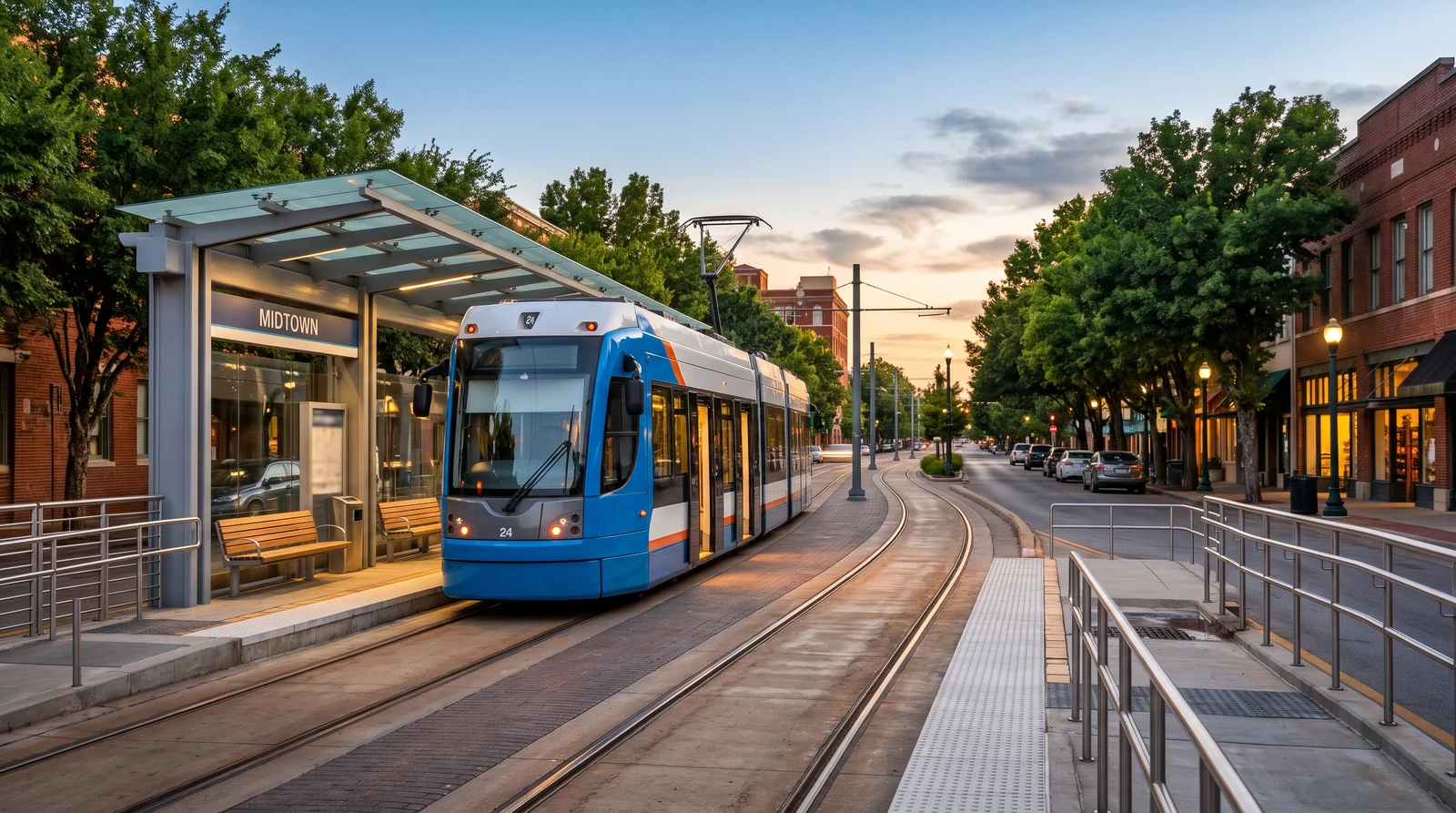
The OKC Streetcar is free to ride. Fares ended for good on August 7, 2026, after a fare-free pilot that began in January. Two loops run through downtown Oklahoma City: the 4.86-mile Downtown Loop with 22 stops, daily from 6 or 7 a.m., and the 2-mile Bricktown Loop with 9 stops on Fridays through Sundays. Cars arrive about every 12 to 15 minutes. Stops include Scissortail Park, Arena, Midtown and Automobile Alley.
You landed at Will Rogers, dropped your bags at a rental downtown, and now you want dinner in Bricktown and a Thunder game tomorrow without renting a car. The streetcar is how you do that. It does one job well: it moves you around the five districts of the core without parking, surge pricing or a bus timetable.
We manage furnished homes across the OKC metro and we field the same question every week from guests staying downtown for a month. This guide covers the two routes, the hours, the fare (none), the stops that matter for a visitor, and the honest limits of a system that stays inside a two-mile circle.
Hours change by day. The Downtown Loop stops at midnight Monday through Thursday, 2 a.m. Friday and Saturday, and 10 p.m. on Sunday. A late Sunday dinner in Bricktown can leave you walking back to Midtown, so check the last car before you order dessert.
What the OKC Streetcar Is and Where It Goes
The OKC Streetcar is a seven-car modern streetcar system run by the city's transit agency, which brands its bus, parking and streetcar services as one system at embarkok.com, and it opened on December 14, 2018. It was built with MAPS 3 sales-tax money, the same voter-approved program that paid for Scissortail Park and the convention center. The system serves five districts: Bricktown, City Center, the Arts District, Midtown and Automobile Alley.
Think of it as a slow, reliable loop rather than a train that gets you across town. Top speeds are city-street speeds, platforms are level with the car floor, and the whole Downtown Loop takes well under an hour to ride end to end. It will not take you to the zoo, the airport, Lake Hefner or Tinker. For those trips see the getting around Oklahoma City guide, which lines up rideshare, bus and rental cars by trip.
The two routes overlap in Bricktown and the arena blocks. The agency publishes the current hours and a system map on its Map and Schedule page at embarkok.com, and every platform kiosk shows the next arrival. We quote the agency's published figures below; confirm them before a trip, since service hours shift around holidays and big events.
| Route | Length and stops | Days and hours (EMBARK, as of fall 2026) |
|---|---|---|
| Downtown Loop | 4.86 miles, 22 stops, 5 districts | Mon to Thu 6 a.m. to 12 a.m.; Fri 6 a.m. to 2 a.m.; Sat 7 a.m. to 2 a.m.; Sun 7 a.m. to 10 p.m. |
| Bricktown Loop | 2 miles, 9 stops, 2 districts | Fri 6 a.m. to 2 a.m.; Sat 7 a.m. to 2 a.m.; Sun 7 a.m. to 10 p.m.; no weekday service listed |
| Frequency | Both loops | A car at each platform about every 12 to 15 minutes |

OKC Streetcar Fares: Why There Are None
Riding the OKC Streetcar costs nothing, and that is permanent. The transit agency started a fare-free pilot in January 2026, extended it through the summer, and on August 7, 2026 the Central Oklahoma Transportation and Parking Authority voted to end fares entirely. Ridership from January through June 2026 ran about 71 percent higher than the same months in 2025, which is the number that carried the vote.
That changes the math for a visitor. There is no app to load, no kiosk to fight with, no pass to lose. You walk onto a platform, the car arrives, you board. Youth 18 and under already rode free under the agency's Haul Pass, and now so does everyone else.
The bus system is a separate story. City buses still charge, and the current published fares are $1.75 for a single boarding and $4 for a 24-hour universal pass that also covers RAPID and the streetcar. Reduced 24-hour passes are $2 for riders 65 and over, Medicare holders and qualified riders with disabilities. So if your trip mixes a bus leg with the streetcar, the $4 pass covers the whole day and the streetcar part was free anyway.
One more wrinkle that helps drivers: the agency's four downtown garages run a park-and-ride perk where your parking receipt is a ticket for two to ride RAPID and the streetcar for 24 hours. With the streetcar now free that perk mostly matters for RAPID, but the garages themselves are the cheapest way to drop a car for the day near the loop.
The Stops a Visitor Will Use
Twenty-two platforms sound like a lot, but five or six of them cover almost everything a guest wants. Here is how we describe them to someone staying downtown for the first time.
| Platform | What it serves | Why a visitor gets off here |
|---|---|---|
| East Bricktown, Ballpark, Bricktown | Bricktown Canal, Chickasaw Bricktown Ballpark, the Criterion, Bass Pro | Dinner, baseball, canal walks, the busiest nightlife blocks |
| Arena | Paycom Center | Thunder games and arena concerts without a lot |
| Scissortail Park | Park's northeast corner, Convention Center, Omni hotel | Park days, markets, conventions |
| Myriad Gardens | Myriad Botanical Gardens and Crystal Bridge | Gardens, the downtown rink in winter |
| Library and Transit Center | Downtown library, Museum of Art, EMBARK bus hub | Museums and the connection to every bus route |
| Memorial Museum | Oklahoma City National Memorial and Museum | The one stop everyone should make |
| Automobile Alley and Art Park | Broadway restaurants, Oklahoma Contemporary, Factory Obscura | Dinner and shopping on Broadway |
| Midtown, NW 10th, Dewey Avenue | Midtown restaurants and bars, St. Anthony area | Brunch, patios, the quieter end of the loop |
The Scissortail Park platform sits at the park's northeast corner, which puts you a short walk from the upper park lawn, the Convention Center and the Omni. Our Scissortail Park visitor guide covers the park itself. The Arena platform is the move for Thunder nights, and our Paycom Center parking guide explains why riding in beats paying a flat rate at a lot.
For food, the Automobile Alley and Midtown platforms are the quieter choice compared with Bricktown, and both districts have their own guides: Automobile Alley and Midtown OKC. If you are choosing where to sleep so the streetcar does the driving, where to stay in Bricktown walks through the trade-offs block by block.
What a Car-Free Downtown Stay Costs Compared With Driving
A visitor who skips the rental car and leans on the free streetcar typically saves a few hundred dollars over a week downtown. The savings come from three places: the rental itself, overnight parking, and event-night lots.
Here is a hypothetical for a couple in town five nights for a Thunder game, two Bricktown dinners and a day at the museums. The figures are ballpark, and the rental and parking numbers are typical ranges you should check against live quotes.
- Rental car, five days: a mid-size car at the airport often lands in the $55 to $85 per day range before taxes and fees, so figure roughly $300 to $425 for the week.
- Overnight parking downtown: hotel and garage parking commonly runs $15 to $30 a night, so another $75 to $150 over five nights.
- Game night lot: event parking is $15 in the four city transit garages, and private lots near the arena charge more as tip-off nears.
- Total driving cost: somewhere around $390 to $590 for the week, before gas.
The streetcar version of that week costs $0 for every downtown trip, plus one rideshare from the airport, which usually runs in the $20 to $35 range to a downtown address. Call it $25 each way, $50 total. The couple keeps roughly $340 to $540. That is real money, and it only works if the place you sleep sits inside the loop or within a few blocks of a platform.
Staying downtown for a game, a convention or a month-long project? Several of our furnished homes sit a short rideshare from the Downtown Loop, and the Capitol Manor home is a few minutes from the Midtown platforms. Tell us your dates and we will say honestly which home fits a car-free plan.
Riding the Streetcar: The Practical Part
Every streetcar and every platform is ADA accessible, with low floors for level boarding, and the agency's own How to Ride page spells out the small routines that make it painless.
Platforms have a kiosk screen that shows the next arrival and any service interruption. When the car stops, let riders exit first, then board; if nobody is getting off, press the yellow door button. Onboard, press a blue stop button or the yellow door button to request your platform, and the car announces stops. Priority seating is for riders who need it, and the rule the agency repeats most is never block the doors.
Two things that page does not spell out, so treat these as our observations rather than policy: strollers and bikes are common sights on the cars, and quiet, leashed dogs ride without trouble on normal days. On a sold-out Thunder night the cars fill, and a bike or a double stroller becomes a problem. Confirm anything that matters to you with the agency at (405) 235-7433.
Real-time arrivals live in the routes and schedule tool on embarkok.com and in the Token Transit and Moovit apps the agency lists as its mobile options. You do not need any of them to ride. Most guests just look at the kiosk.
How to Use the OKC Streetcar, Step by Step
- Check the day's hours on the Map and Schedule page at embarkok.com, especially on a Sunday when the loop stops at 10 p.m.
- Walk to the nearest platform; every point in the five districts is within a couple of blocks of one.
- Read the kiosk for the next arrival and any detour, then board when the car stops and riders have exited.
- Press the blue button for your stop and let the doors open fully before stepping off.
- Cross at the crosswalk and look for a second car; tracks run both directions on some blocks.
Event Nights on the Streetcar: Thunder Games, Concerts and Festivals
On a Thunder home night the Arena platform is the busiest spot on the system in the hour before tip-off and the twenty minutes after the final buzzer. The loop keeps its normal 12 to 15 minute headway, so a crowd of a few hundred people at one platform does not clear in one car. Plan for it instead of fighting it.
Going in, ride early. Board in Midtown or Automobile Alley 75 to 90 minutes before tip-off, get off at Arena or Scissortail Park, and eat on that side. Coming out, the trick is to walk. Scissortail Park is one platform south and Myriad Gardens is one platform north, and both are a five-minute walk from the arena doors. You board a car with seats while the Arena platform is still ten deep.
Concerts at Paycom Center behave the same way with a tighter arrival window, because doors open later than a game and everyone shows up at once. Festival weekends change the picture in a different way: when a street festival closes a block of Broadway or the Memorial Marathon course crosses the tracks in late April, the agency reroutes or suspends the loop for hours. It posts those changes on the platform kiosks and on embarkok.com, which is why we tell guests to glance at the kiosk before walking to a platform on a big weekend.
The Women's College World Series at Devon Park in late May and early June does not touch the loop at all; the stadium is north of downtown and most fans drive. The State Fair in September is the same story. The streetcar helps with those events only in the sense that it frees your evenings downtown once you are back from the venue.
A Full Day on the Downtown Loop
A family staying downtown can fill a whole day off the loop without touching a car, and the cost of the day's transportation is zero. Here is the itinerary we hand guests who ask, built platform by platform. Museum and garden admissions are not included; check each venue for current prices.
| Time | Platform | What you do |
|---|---|---|
| 9:00 a.m. | Midtown or NW 10th | Breakfast on a Midtown patio, then board southbound |
| 10:00 a.m. | Memorial Museum | The Oklahoma City National Memorial and Museum; allow two hours |
| 12:30 p.m. | Automobile Alley | Lunch on Broadway, a walk through the shops |
| 2:00 p.m. | Library | Oklahoma City Museum of Art, or the downtown library on a hot afternoon |
| 4:00 p.m. | Myriad Gardens | Crystal Bridge and the grounds; the rink in winter |
| 5:30 p.m. | Scissortail Park | Playground, lake and lawn before dinner |
| 7:00 p.m. | Bricktown or Ballpark | Dinner on the canal, a Comets game in season |
| 9:30 p.m. | Any platform | Ride back; last car is midnight Mon to Thu, 2 a.m. Fri and Sat, 10 p.m. Sun |
That day covers six platforms and three districts, and nobody paid for parking twice. Our things to do in OKC with kids guide lists the venues in more detail, and the free things to do in Oklahoma City guide marks which of these stops cost nothing to enter.
Riding With Kids, Strollers and Older Relatives
Level boarding is the feature families notice first. There is no step up from the platform, so a stroller rolls straight on and a grandparent with a cane boards without a hand. Priority seating is near the doors; the rest of the car is a mix of seats and standing room with poles.
Two practical notes from guests. First, the cars are air conditioned, which matters in July when the walk between platforms is the hot part of the day; a family will often ride two stops it could have walked just to cool down. Second, the loop runs one direction around most of the circuit, so plan your stops in order rather than hopping back and forth. Riding against your direction can mean a 30-minute detour around the whole loop with a tired toddler.
Children under 18 ride free on city buses as well through the Haul Pass program, so a family that pairs a bus leg to the zoo with the streetcar downtown pays only adult bus fares. The getting around Oklahoma City guide covers those bus legs, including what to expect on frequency.
When the Streetcar Is the Wrong Tool
The OKC Streetcar covers roughly two square miles, and Oklahoma City covers more than 600. That gap is the whole honest answer. If your plans include the Oklahoma City Zoo, the Science Museum, Lake Hefner, the Paseo, the Plaza District, Tinker AFB, any hospital other than St. Anthony, or the airport, you need a car, a rideshare or a bus.
It is also the wrong tool for a tight schedule. A 12 to 15 minute headway means a missed car costs you a quarter hour, and the loop runs one direction on most blocks, so a stop two platforms behind you can mean riding most of the circle. Walking often wins for anything under six blocks.
Where it changes the trip: a downtown stay with a game or concert on the calendar, a convention at the Convention Center, a Bricktown night out when nobody wants to drive, and any family with a stroller who wants the Memorial, the Museum of Art and Myriad Gardens in one day without moving the car. Guests staying a month on a downtown project tell us the free loop is the thing they did not expect to use and then used daily.
Where to Sleep If You Want the Streetcar to Do the Driving
Downtown hotels sit on the loop, and that is the simplest answer for a two-night trip. For a week or longer, a furnished home with a kitchen and laundry usually costs less per night than two hotel rooms, and the trade is one short rideshare to a platform each day.
Our homes are spread across the metro rather than stacked downtown, so we will tell you plainly which ones make sense. Capitol Manor sits across from OU Medical Center and about six minutes from the Midtown end of the loop by car. Plaza Manor and Classen Manor are a similar short hop. The lake homes and the Gaillardia homes are 20 minutes out and better for a trip built around a car. The full table is in our drive times from BnB OKC homes guide.
Across Airbnb and Vrbo our homes hold a 9.5 out of 10 average over 1,580 guest reviews, and booking direct on 4 or more nights saves up to 35 percent against marketplace pricing. Details on how that works are on the book direct page.
Terms You'll Hear, Decoded
- Platform: a streetcar stop; each one is a raised, level-boarding stop with a kiosk screen.
- Headway: the gap between cars, about 12 to 15 minutes on both loops.
- Downtown Loop: the full 4.86-mile, 22-stop route through all five districts, every day.
- Bricktown Loop: the 2-mile, 9-stop weekend route through Bricktown and the arena blocks.
- Universal pass: the transit agency's $4 24-hour pass good on local bus, RAPID and the streetcar; only the bus and RAPID legs cost anything now.
- Park-and-ride receipt: a parking receipt from one of the four city transit garages downtown, which is a 24-hour ticket for two on RAPID and the streetcar.
Frequently Asked Questions About the OKC Streetcar
The questions below are the ones guests send us before a downtown stay. Hours and policies are the transit agency's to change, so confirm anything time-sensitive on embarkok.com.
Your Next Steps
- Check the hours for your dates on the Map and Schedule page at embarkok.com, and note the Sunday 10 p.m. cutoff.
- Map your plans against the loop. If everything on your list is in Bricktown, downtown, Midtown or Automobile Alley, skip the rental car.
- Pick a home that fits. Browse our OKC homes or call or text (405) 870-2146 and tell us you want to ride the streetcar; we will point you to the right one.
Official sources: route lengths, stop counts, hours and the fare decision are from the transit agency at embarkok.com/streetcar/map-schedule and the park-and-ride page; bus fares from the fares and passes page. Figures as of November 2026.